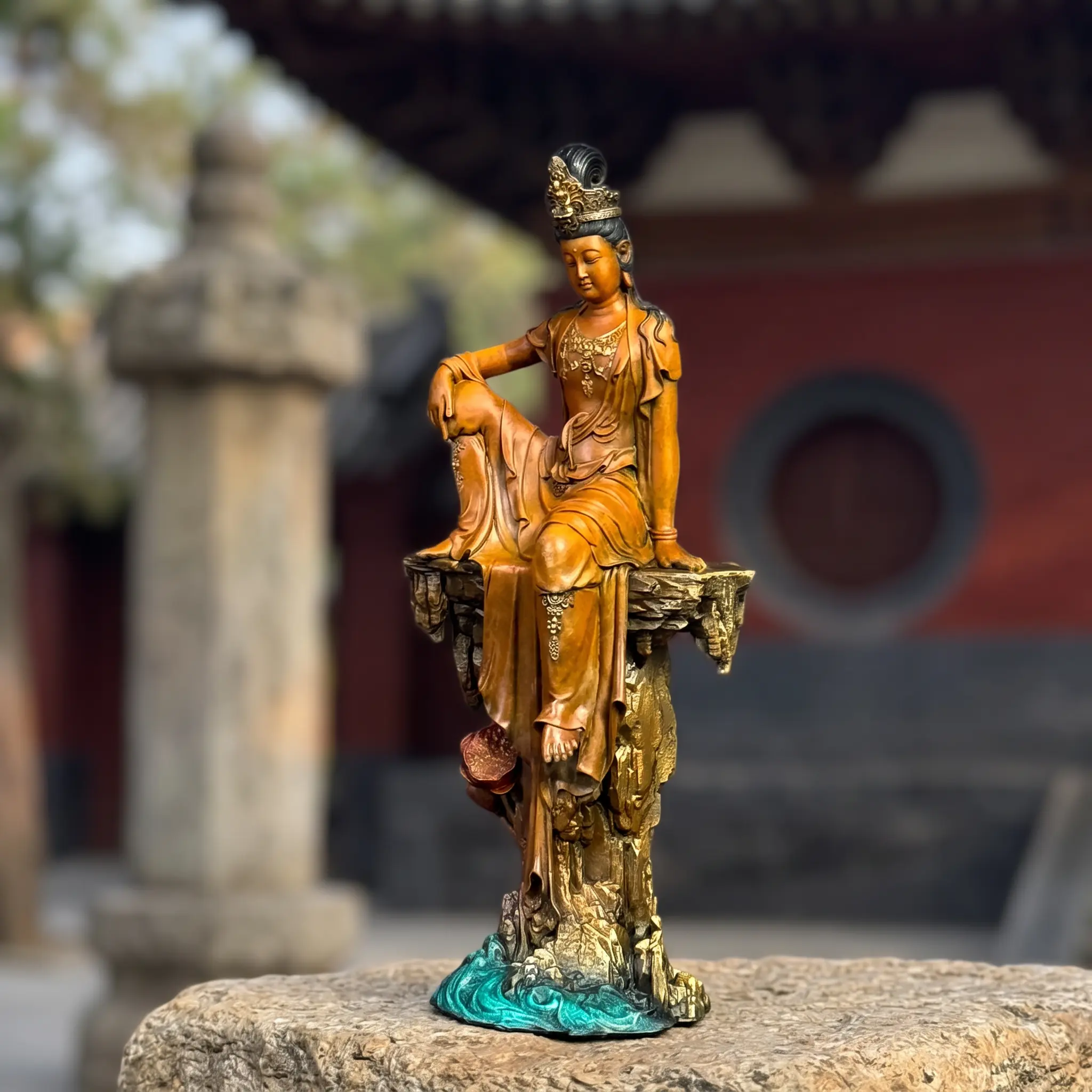
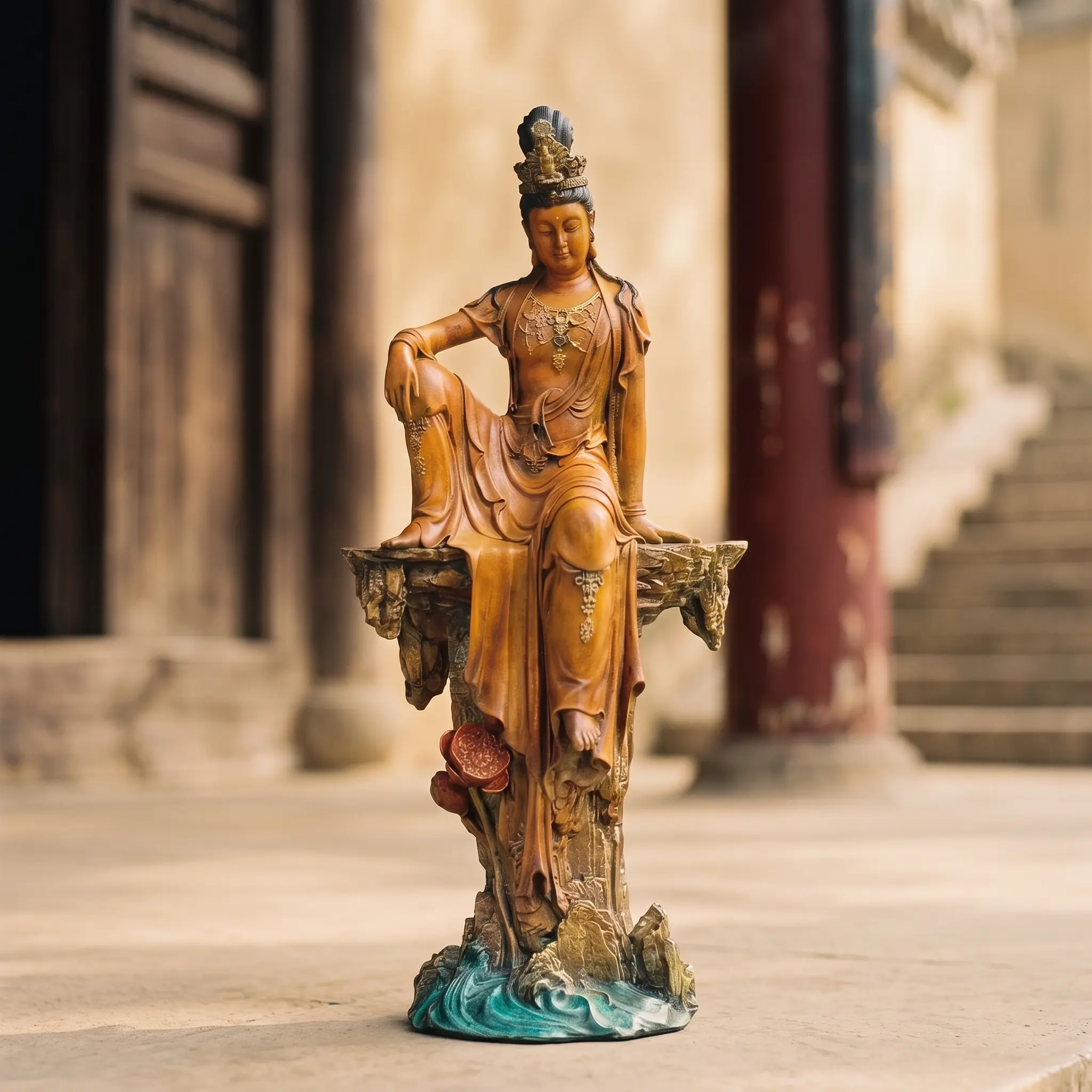
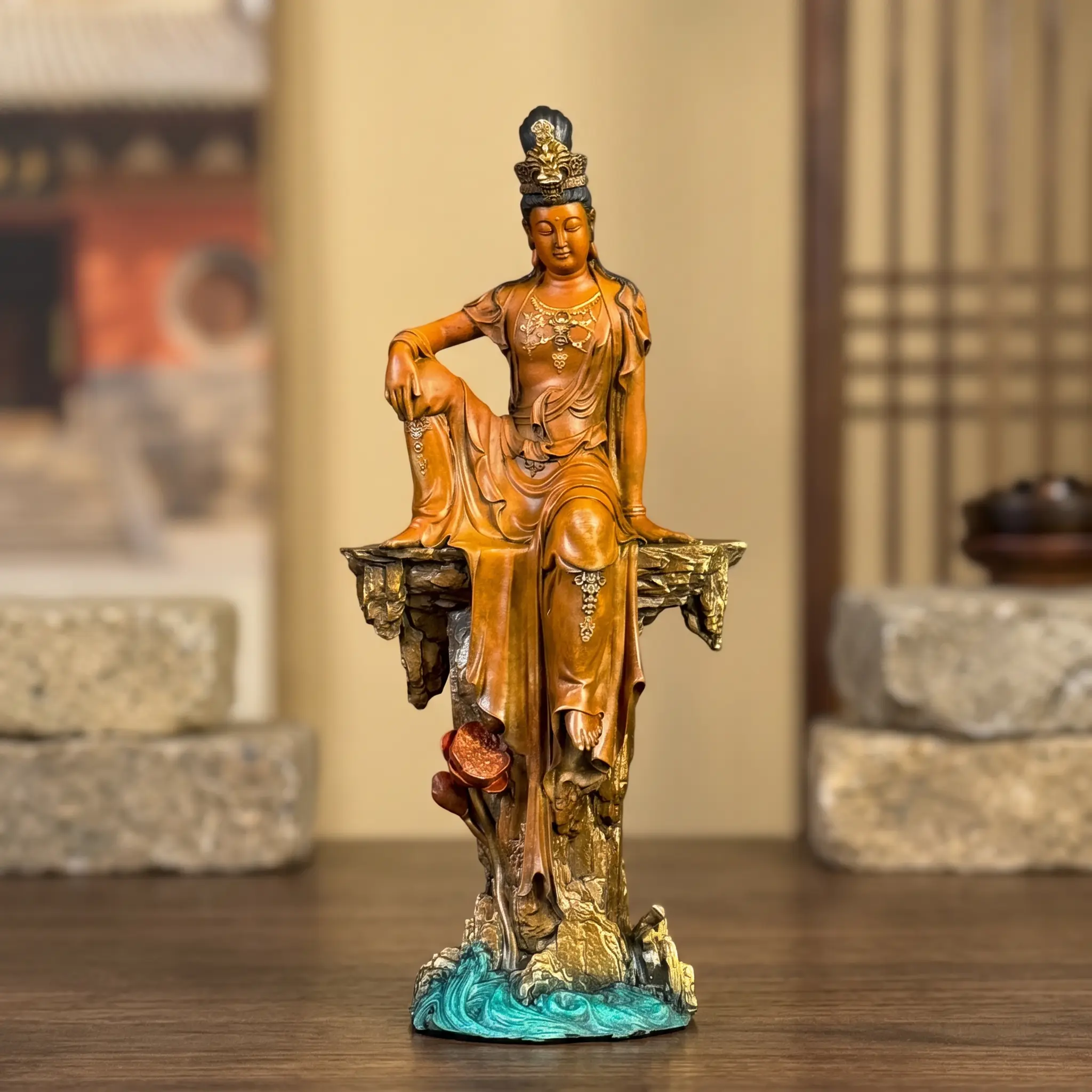
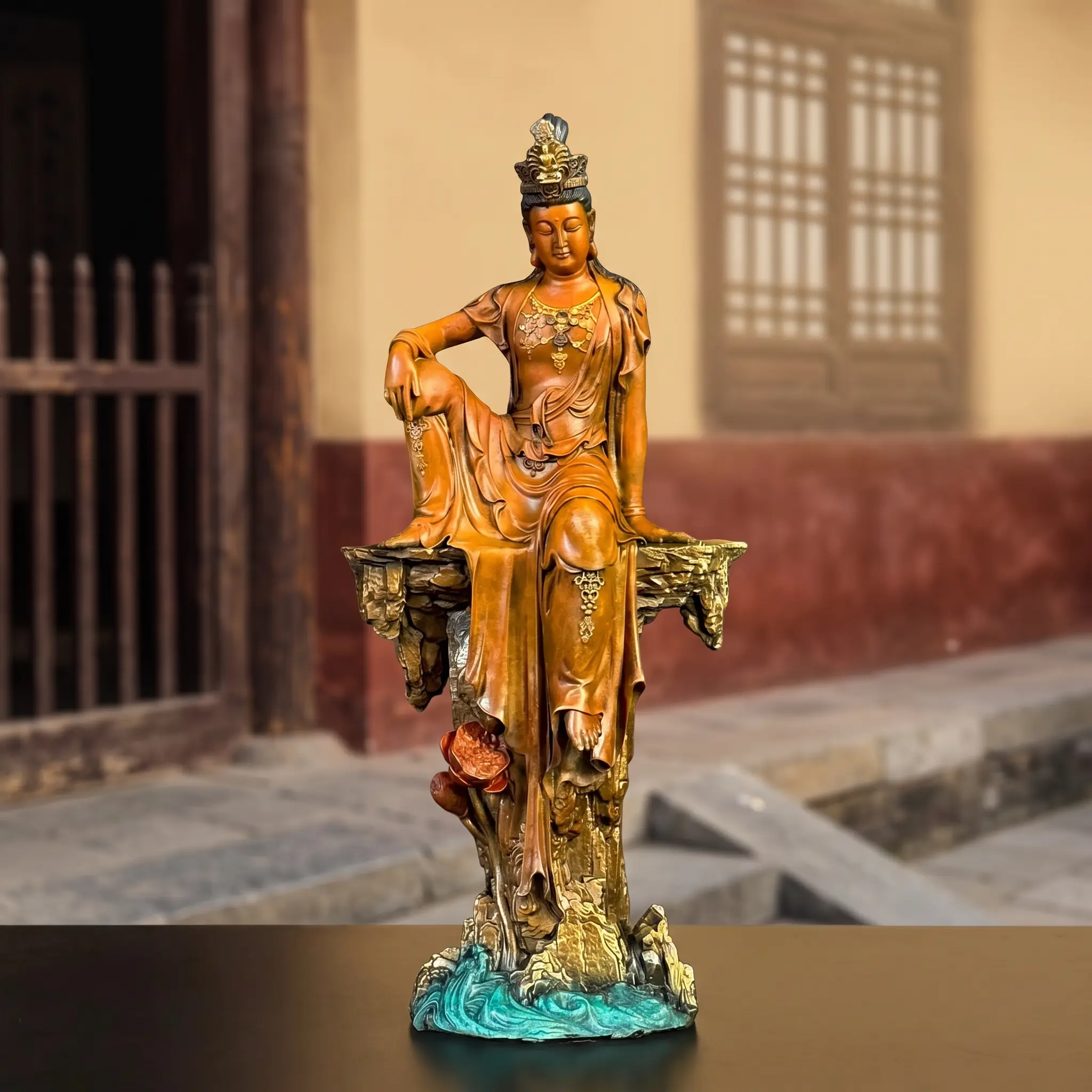
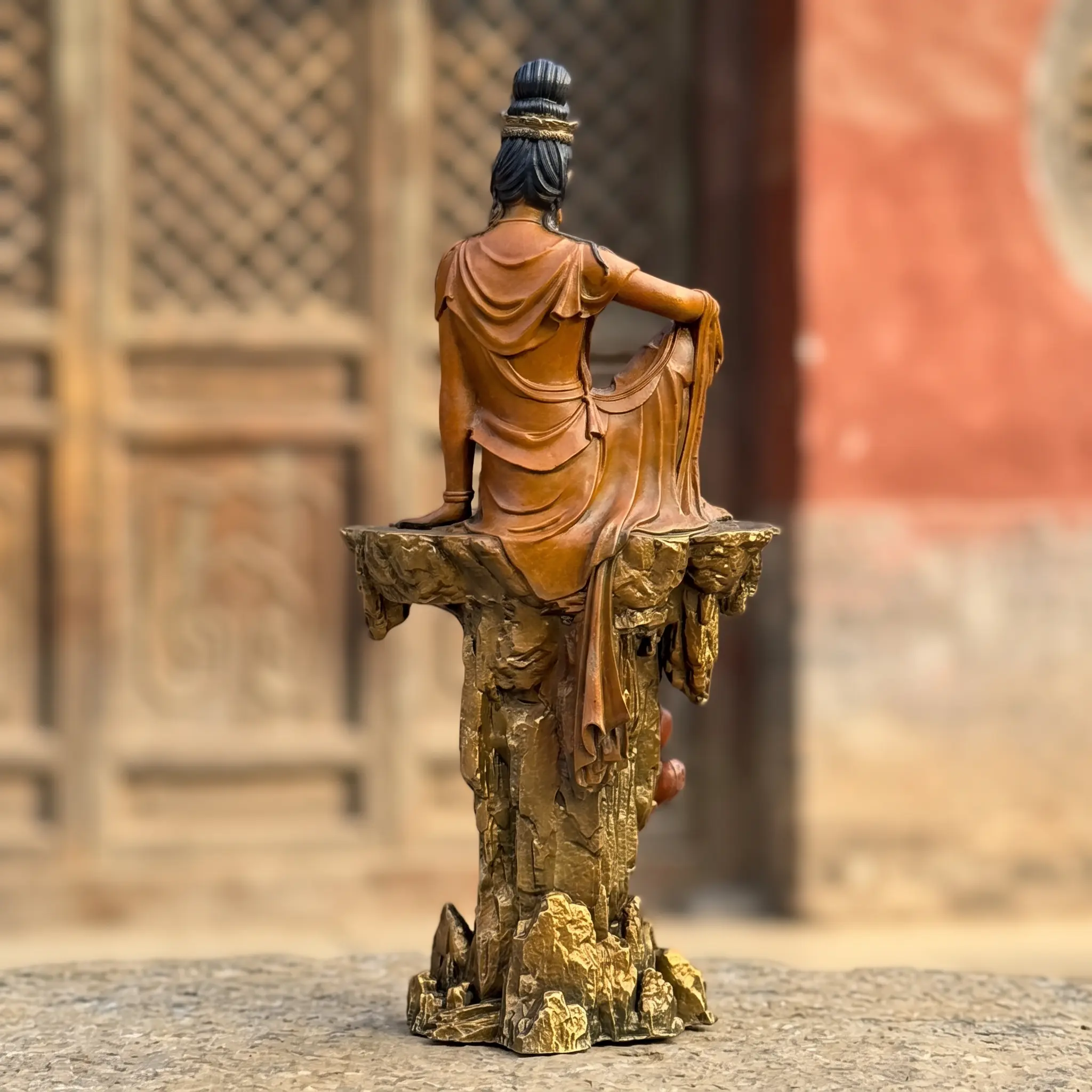
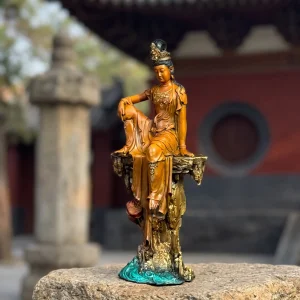
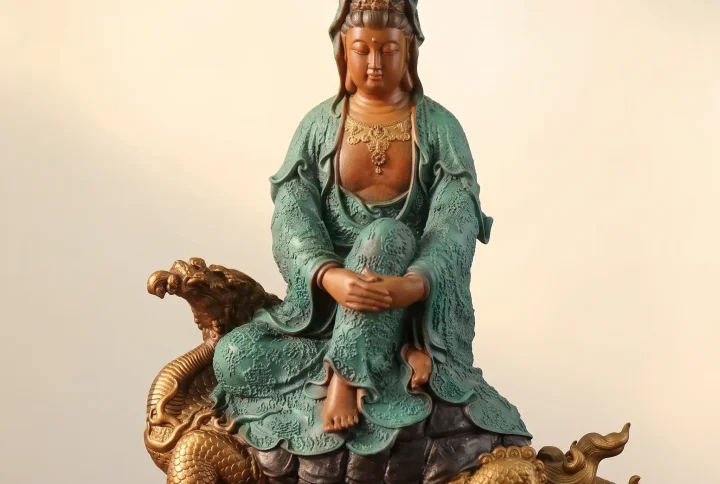
Some rooms feel busy even when they are tidy. This Royal Ease Guanyin statue gives yours a quiet center. Guanyin (Kuan Yin), the bodhisattva of compassion, rests on a rocky ledge above teal waves and a lotus. One arm lies easy on a raised knee. The eyes are lowered, the face calm.
It is handcrafted in solid copper, finished with gilded crown and jewelry details, and blessed by Shaolin monks. At 8.9 in (22.6 cm) tall, it fits a desk, shelf, or altar.
- Premium solid copper: real metal, made for lasting quality, weight, and character.
- Museum-level detail: smooth lines, fine textures, and a warm finish that matures beautifully.
- Grounding presence: the Royal Ease pose brings calm, clarity, and balance to a room.
- Versatile statement piece: sits well in modern interiors with quiet elegance.
- Thoughtful gift: for mindful living, celebrations, and housewarmings.
What the Royal Ease Pose Means
The pose looks relaxed, and it is. But it is not lazy. In Buddhist art this seat is called royal ease (rajalilasana). One knee is raised, one arm rests on it, and the body stays loose. Guanyin is at rest, and still ready to rise the moment someone calls.
Rest is not retreat. It is how compassion stays steady.
Ease with readiness
That is the lesson of the pose, and it is why people keep it near where they work. You can be calm and useful at the same time. The Princeton University Art Museum notes that this pose became linked with Guanyin in the late ninth century, so you are looking at a form with more than a thousand years of history behind it.
The Water-Moon Guanyin: rock, waves, and lotus
The ledge and waves are not just scenery. Museum collections, including the Asian Art Museum in San Francisco and The Metropolitan Museum of Art, describe a Water-Moon Guanyin: a bodhisattva seated in royal ease on a rock at Mount Potalaka, watching the moon’s reflection in water. The reflection points to a core Buddhist idea. What we cling to is as fleeting as a moon on a ripple. This statue draws on that tradition.
- Rock: steadiness when things shift around you.
- Waves: change that never stops, and need not shake you.
- Lotus: clarity that grows out of mud.
Guanyin, Kuan Yin, Avalokiteshvara: one figure, many names
Guanyin is the Chinese form of the Indian bodhisattva Avalokiteshvara. You will also see Kuan Yin, Kwan Yin, and Quan Yin. Across Asia the figure appears in both male and female forms, and Royal Ease sculptures can be read either way. The ornate crown and jewelry echo the princely dress of early Royal Ease figures.
Size and Specifications
- MaterialPremium solid copper with lustrous finish
- CraftFully handcrafted with intricate detailing
- Dimensions11 × 6.8 × 22.6 cm (4.3 × 2.7 × 8.9 in)
- Weight980 g (2.16 lb)
- StyleElegant, versatile design for contemporary interiors
For scale, it stands about as tall as a hardcover novel. That makes it a shelf-and-desk size: present, but never crowding.
Where to Place Your Royal Ease Guanyin
Placement is simple. A little care shows respect and helps the piece do its job as a visual pause.
- Go high. Eye level or above works best. Many traditions suggest about 3 ft (90 cm) off the floor at minimum.
- Face the room. Let Guanyin look into the space where you live or work.
- Pick a clean, quiet spot. A desk, shelf, console, or altar is ideal.
- Avoid the floor, bathrooms, and kitchens.
Styling in modern interiors
Warm copper loves natural wood, stone, linen, and soft light. Leave some empty space around it. A single figure on a clear surface speaks louder than a crowded shelf.
Is it respectful to display if I’m not Buddhist?
Yes, when you choose it and display it with care, not as a novelty. Many people keep Guanyin simply as a reminder of compassion and calm.
Caring for Copper
Copper is easy to live with. Treat it gently, and let the color deepen naturally.
- Dust with a soft, dry cloth.
- For fingerprints, use a barely damp cloth with mild soap, then dry right away.
- Skip abrasive pads and metal polish. They can strip the warm finish and the painted accents.
- Display indoors and away from damp spots.
A Meaningful Gift for Mindful Living
Guanyin is a gift of comfort, not luck. Choose it for someone who needs a reason to slow down. It suits:
- A housewarming or a new home
- A friend starting a new chapter
- A meditation corner or home office
- Anyone you want to tell, “Take it easy. I’m with you.”
Frequently Asked Questions
What does the Royal Ease pose symbolize?
Calm that stays ready. One knee is raised and one arm rests on it, so the body is relaxed, yet Guanyin can rise at once to help anyone who calls.
Is this statue Guanyin, Kuan Yin or Avalokiteshvara?
They are names for the same bodhisattva of compassion. Avalokiteshvara is the Indian name, Guanyin is the Chinese name, and Kuan Yin, Kwan Yin and Quan Yin are common spellings.
Is it really solid copper, not resin?
Yes. This statue is made of premium solid copper with a lustrous finish. It is metal, not cold-cast resin mixed with metal powder.
Will the copper change color over time?
Copper naturally deepens in tone with time and handling. Dust it with a soft cloth and avoid abrasive polish to keep the finish looking its best.
Where should I place a Guanyin statue?
Place it at eye level or higher, on a clean and quiet surface, facing into the room. Avoid the floor, bathrooms and kitchens.
Is it respectful to display Guanyin if I am not Buddhist?
Yes, when you display it with care and not as a novelty. Many people keep Guanyin as a reminder of compassion and calm.
What does “blessed by Shaolin monks” mean?
Shaolin monks bless each statue with the intention that it brings steadiness and compassion to your space.
SEO settings (not part of the product description)


Reviews
There are no reviews yet.