
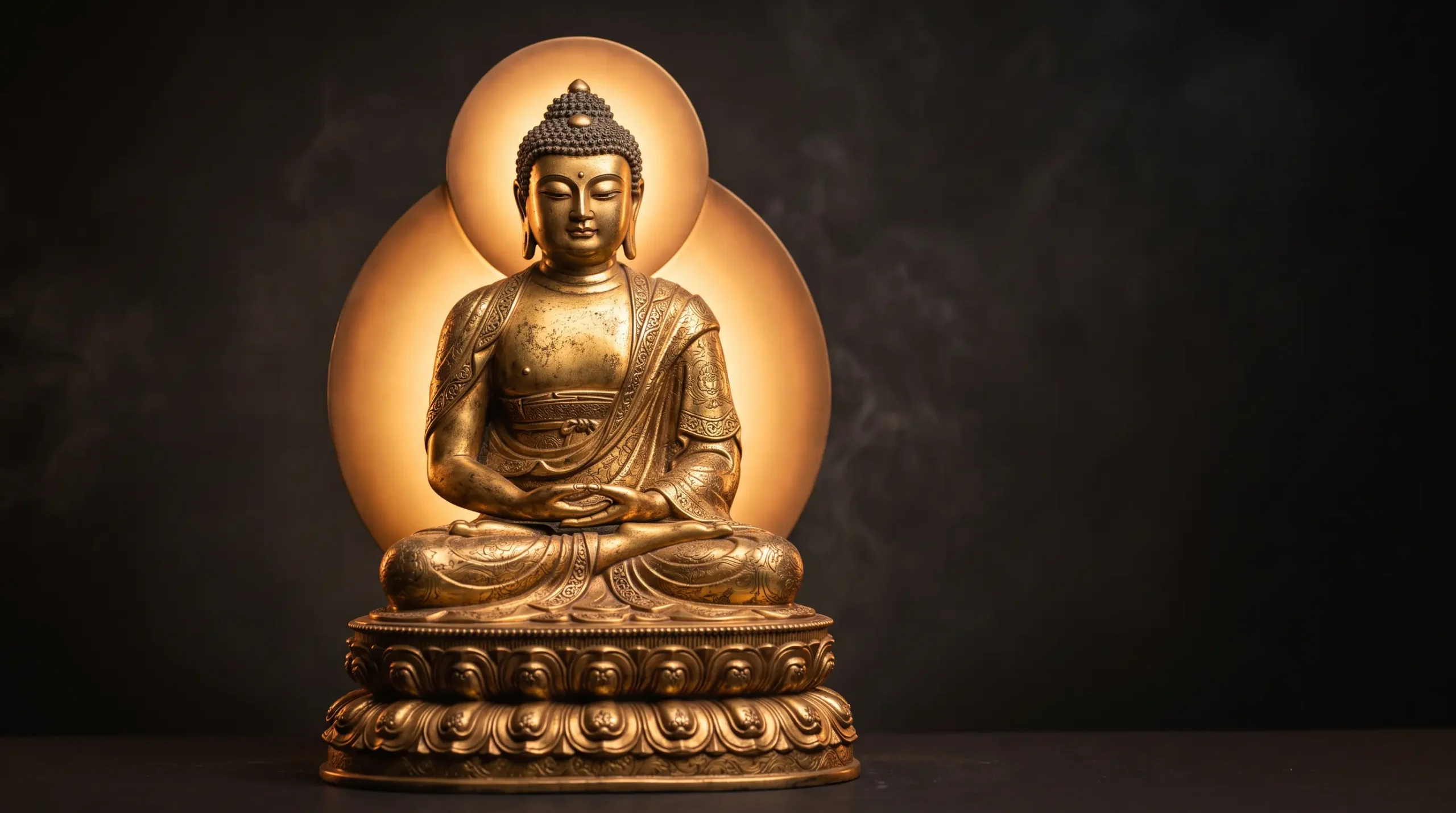
Amitabha Buddha is the Buddha of Infinite Light and the central figure of Pure Land Buddhism, a Mahayana tradition. Statues usually show him seated on a lotus throne with his hands in the dhyana mudra, the meditation gesture.
That is the short answer. The rest of this guide covers what sits behind it: a vow, a Pure Land called Sukhavati, and a handful of visual clues you can learn to read. If you have heard a Shaolin monk say “Amituofo,” or paused before a glowing golden Buddha in a museum, you have met the same figure.
At ShaoLin Store, we write about Buddhist statuary from a Shaolin Chan perspective, and we check every identification claim against museum and encyclopedia records first. That care matters because statues of different Buddhas often share the same pose.
What Does Amitabha Buddha Mean?
Amitabha Buddha is the Buddha of Infinite Light and the central Buddha of Pure Land Buddhism. His Sanskrit name joins amita, “infinite,” and abha, “light.” He is also called Amitayus, “Infinite Life.” Chinese Buddhists say Amituofo, Japanese Buddhists say Amida, and he is traditionally believed to preside over Sukhavati, the Western Pure Land.
He is a Buddha, meaning an awakened being, not a bodhisattva. You may have first heard his name in a martial arts film, long before meeting the sutras behind it. Britannica records these name forms in its entry on Pure Land Buddhism.
What does the name Amitabha mean in Sanskrit, Chinese, and Japanese?
In Sanskrit, Amitabha means “Infinite Light”; Chinese Buddhists say Amituofo and Japanese Buddhists say Amida. The table lists each form.
| Language | Name | Meaning |
|---|---|---|
| Sanskrit | Amitabha | Infinite Light |
| Sanskrit | Amitayus | Infinite Life |
| Chinese | Amituofo | Chinese form of the name, “Buddha Amitabha” |
| Japanese | Amida Butsu | Japanese form of the name, “Buddha Amida” |
| Tibetan | Öpakmé | Boundless Light |
Amitayus names the same Buddha through the promise of long life, a link that shapes his Tibetan images.
Who was Dharmakara, and what are the 48 vows?
According to the Larger Sutra of Immeasurable Life, Amitabha was once a monk named Dharmakara who made 48 vows.
Dharmakara spoke these vows before an earlier Buddha, Lokesvararaja, and described the Pure Land he hoped to build. After fulfilling them, the sutra says, he became Amitabha. The 18th and 19th vows matter most to devotees, so they get their own section below.
What Is the Pure Land, and How Do People Practice Devotion to Amituofo?
Sukhavati, the “Land of Bliss,” is the Western Pure Land that Amitabha is traditionally believed to have created through his vows, and devotion centers on calling his name. Britannica describes the core belief as rebirth in this Western Paradise for anyone who invokes Amitabha with sincere devotion. Pure Land schools in East Asia grew from that idea, and the Japanese teachers Honen and Shinran made name recitation central.
Practitioners call this recitation nianfo in Chinese, “mindfulness of the Buddha,” and nembutsu in Japanese, where the phrase is “Namu Amida Butsu.” Many count recitations on a 108-bead mala. A handmade Tibetan bodhi seed bracelet is a shorter, wearable cousin, better as a reminder than a counting tool.
What did the 18th vow promise?
The 18th vow is taught to promise rebirth in the Pure Land to anyone who sincerely calls Amitabha’s name, even ten times.
Lion’s Roar adds that the 19th vow promises he will appear to those who invoke him at the moment of death. This reliance on his promise is called Other-Power: trust in Amitabha’s vow rather than in one’s own effort alone. Traditions weigh these ideas differently, so read this as a summary of what the texts say, not guidance on practice.
How is “Amituofo” used as a greeting at Shaolin Temple?
Shaolin monks and lay students use “Amituofo” as a greeting, a thank-you, and an apology, all in one phrase.
The USA Shaolin Temple explains that it can serve as a salutation, a blessing, “please,” or “I’m sorry.” The pronunciation is roughly “ah-mee-twoh-foh.” In class settings the phrase is said three times, once to honor the Buddha, once the dharma, and once the sangha. Its thank-you sense may feel familiar at Thanksgiving, when gratitude is spoken aloud.
How Is the Buddha of Infinite Light Depicted in Art?
Amitabha is most often shown seated on a lotus throne with his hands in the dhyana mudra, wearing a plain monastic robe and surrounded by a halo of light. Hand gesture and body color tell you the most, and the sections below cover both.
Which mudras identify Amitabha?
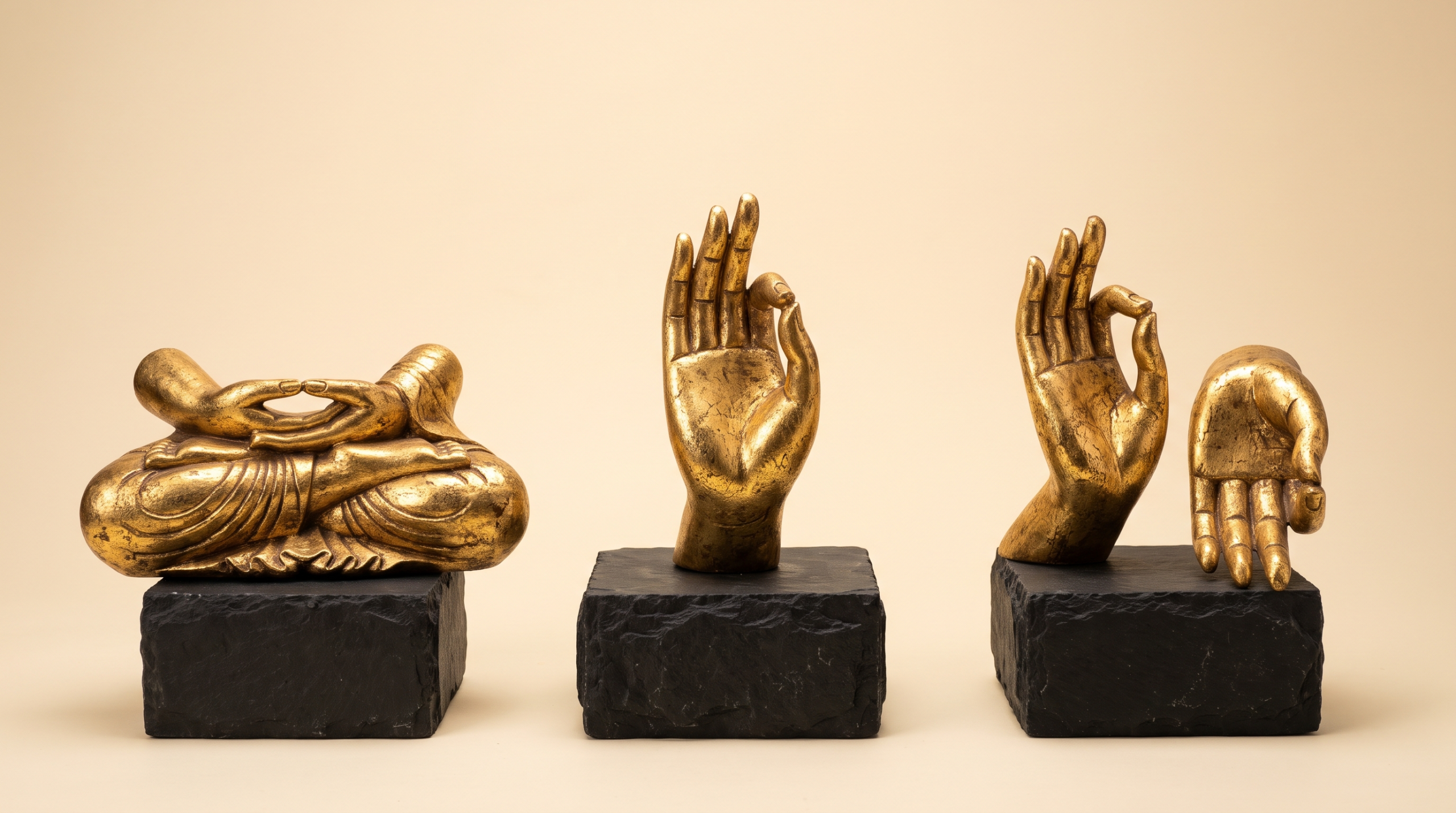
The dhyana mudra, with the right hand resting on the left, palms up and thumbs touching, is the gesture most closely tied to Amitabha.
| Mudra | Hand position | Where you see it | What it signals |
|---|---|---|---|
| Dhyana | Both hands in the lap, palms up, thumbs touching | Tibetan and Chinese images, Japanese great Buddhas | Meditation and concentration |
| Vitarka | One hand raised, thumb and fingertip touching | Korean and Japanese images, such as the central Buddha in the Met’s Goryeo triad | Teaching the dharma |
| Raigo-in | One hand raised and one lowered, fingers forming circles | Japanese Amida statues and paintings | Welcoming the dying to the Pure Land |
Smarthistory’s guide to mudras links dhyana most closely with Amitabha among the five Dhyani Buddhas. Two landmarks show the pose at monument scale. The Great Buddha of Kamakura (Kamakura Daibutsu) rises 43.8 feet (13.35 m) and was cast around 1252, in the open air. Byodo-in’s Phoenix Hall in Uji enshrines an Amida statue by the sculptor Jocho, completed in 1053.
While checking numbers for this guide, we hit a small puzzle. The Wikipedia entry for Kotoku-in gives about 93 tonnes in its text and 121 tonnes in its infobox, and ANA’s Japan Travel Planner says about 121 tons. We list both: 93 tonnes (roughly 205,000 lb) and 121 tonnes (roughly 267,000 lb). Sources disagree, so treat any single figure with care.
What are the nine raigo mudras in Japanese Amida statues?
Japanese Amida statues may show one of nine welcoming gestures, raigo-in, matching the nine grades of rebirth described in the Contemplation Sutra.
Three main grades, each split into three levels, give the nine. In Japanese art, each pairs with its own hand position. The Spencer Museum of Art at the University of Kansas describes raigo-in as the gesture that welcomes the dead into paradise. The Kyoto National Museum holds a seated Amida with raigo mudra from the 11th century, carved in lacquered and gilded cypress and about 55 inches (140.2 cm) tall. Jōruri-ji near Kyoto preserves nine Amida statues in a row, a famous visual version of the nine grades.
Why is Amitabha red in Tibet but golden in East Asia?
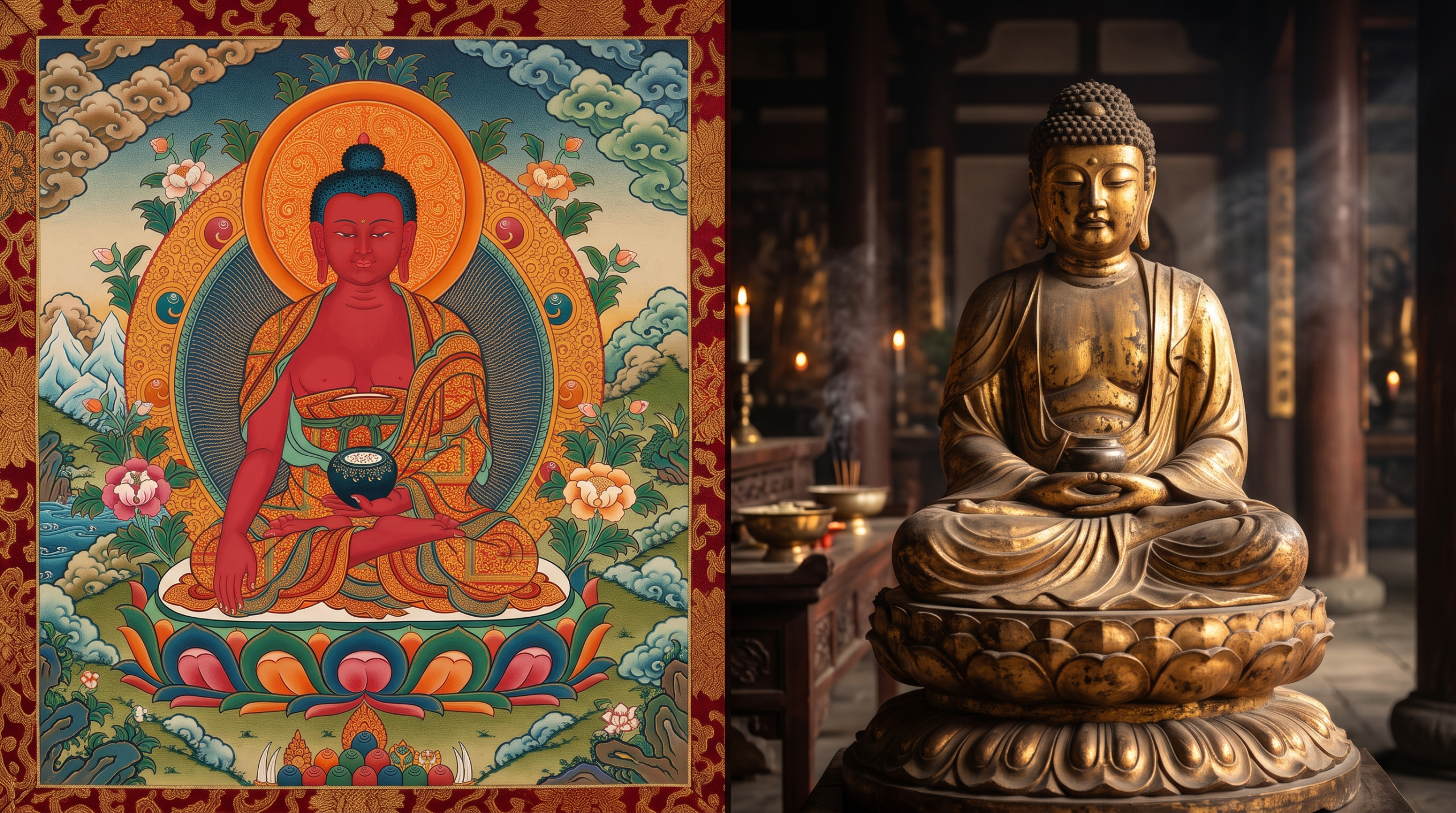
In Tibetan art Amitabha is red, linked to the west and the setting sun, while Chinese and Japanese images usually show him in gold.
| Region | Typical color | Common medium |
|---|---|---|
| Tibet and the Himalayas | Red body | Thangka paintings and cast metal |
| China, Korea, and Japan | Gold or gilded surface | Gold leaf on wood, gilt bronze, and painted scrolls |
In Tibetan tradition he is also one of the five Dhyani Buddhas, heading the Lotus (Padma) family. Color follows artistic convention, so a red or gold surface says nothing about a statue’s power.
How Can You Tell Amitabha Apart From Shakyamuni, Amitayus, and Guanyin?
Look at the hands, the head, and the companions: Shakyamuni often touches the earth, Amitayus wears a crown and holds a vase, and Guanyin carries a tiny Amitabha in her crown.
| Figure | Head and dress | Hands | Extra clue |
|---|---|---|---|
| Amitabha | Bare head with an ushnisha, plain monastic robe | Dhyana, raigo, or teaching gesture | Often flanked by two bodhisattvas in a triad |
| Shakyamuni | Bare head with an ushnisha, monastic robe | Earth-touching is common; dhyana also appears | The historical Buddha of our world |
| Amitayus | Crown and jewelry in Tibetan art | Both hands in the lap holding a long-life vase | Red body in Tibetan art |
| Medicine Buddha | Bare head, monastic robe | Holds a medicine bowl | Blue body in Tibetan art |
| Avalokiteshvara (Guanyin) | Crowned bodhisattva | Varies by tradition | Tiny Amitabha in the crown |
One limit is worth stating plainly: the hands alone do not settle it. Our own copper meditating Buddha in the dhyana mudra sits in the same pose as many Amitabha images, yet our listing identifies it as Shakyamuni. Mislabeling like this is common, and feeling unsure about it is normal. The aged copper piece ($298.95 as of 11/05/2026) works well as a hands-on reference for the pose, as long as you read it as Shakyamuni.
What is the difference between Amitabha and Shakyamuni Buddha?
Shakyamuni is the historical Buddha of our world, while Amitabha is a celestial Buddha who presides over a Pure Land.
The Pure Land sutras are traditionally presented as teachings of Shakyamuni, so the two Buddhas are linked in the texts even though their images differ.
What is the difference between Amitabha and Amitayus?
Amitayus is the “Infinite Life” aspect of the same Buddha, usually crowned and holding a long-life vase in Tibetan art.
Amitabha, by contrast, appears with a bare head and plain robe, which is why the crown is your quickest visual separator.
How do you identify Guanyin and Mahasthamaprapta in an Amitabha triad?
In an Amitabha triad, Avalokiteshvara wears a miniature Amitabha in the crown, while Mahasthamaprapta wears a small water vase, called a kundika.
The Metropolitan Museum of Art in New York holds a Goryeo-period triad, painted on a hanging scroll around the 13th century and measuring 45 1/4 by 23 1/4 inches. Its museum notes name both crown details. Note that it is a painting, and the central Buddha’s hand there signals teaching rather than meditation.
The Philadelphia Museum of Art holds a 7th to 8th century Avalokiteshvara, and Harvard Art Museums list a standing Mahasthamaprapta. One Dunhuang cave description mentions a small pagoda instead of a vase, so treat the crown object as a strong clue, not absolute proof.
If you want to study the form of a seated bodhisattva in three dimensions, the Royal Ease Guanyin statue in solid copper measures 8.9 inches tall and weighs 2.16 lb ($388.95 as of 11/05/2026). It is a Guanyin statue, not an Amitabha triad, so use it as a study of the bodhisattva’s pose.
How Do You Choose and Display an Amida Statue With Respect?
Check five clues before you buy, then display the statue at eye level or higher in a clean, quiet spot:
- Mudra: A dhyana, raigo, or teaching gesture fits Amitabha; an earth-touching hand suggests Shakyamuni.
- Robe and head: A plain monastic robe and bare head with an ushnisha point to a Buddha; a crown points elsewhere.
- Object in the hands: An alms bowl fits Amitabha; a long-life vase signals Amitayus.
- Body color: Red fits Tibetan Amitabha; gold fits Chinese and Japanese images.
- Attendants: Two bodhisattvas beside a central Buddha suggest an Amitabha triad.
Five clues for identifying an Amitabha statue12345MudraDhyana, raigo, or teaching gesture fits Amitabha. Earth-touching suggests Shakyamuni.Robe and headPlain monastic robe and a bare head with an ushnisha. A crown points elsewhere.Objects in the handsEmpty hands or an alms bowl. A long-life vase suggests Amitayus.Body colorRed in Tibetan art. Gold or gilt in Chinese and Japanese images.AttendantsTwo bodhisattvas beside a central Buddha suggest an Amitabha triad.Figure 3. A quick checklist for reading any listing or museum label.
What should you check on a product listing before buying?
Read the mudra first, then the head: a bare head with an ushnisha suggests a Buddha, while a crown suggests Amitayus or a bodhisattva.
Next, ask the seller which tradition the piece follows and who made it. A listing that names the Buddha but shows only a seated pose deserves a second look.
We do not currently carry a dedicated Amitabha statue, so use this checklist on any listing, including ours. You can compare mudras and crowns side by side across our handmade Buddha and bodhisattva statues, which lets you test the checklist on real pieces before you decide.
Is it respectful to display Amitabha if you are not Buddhist?
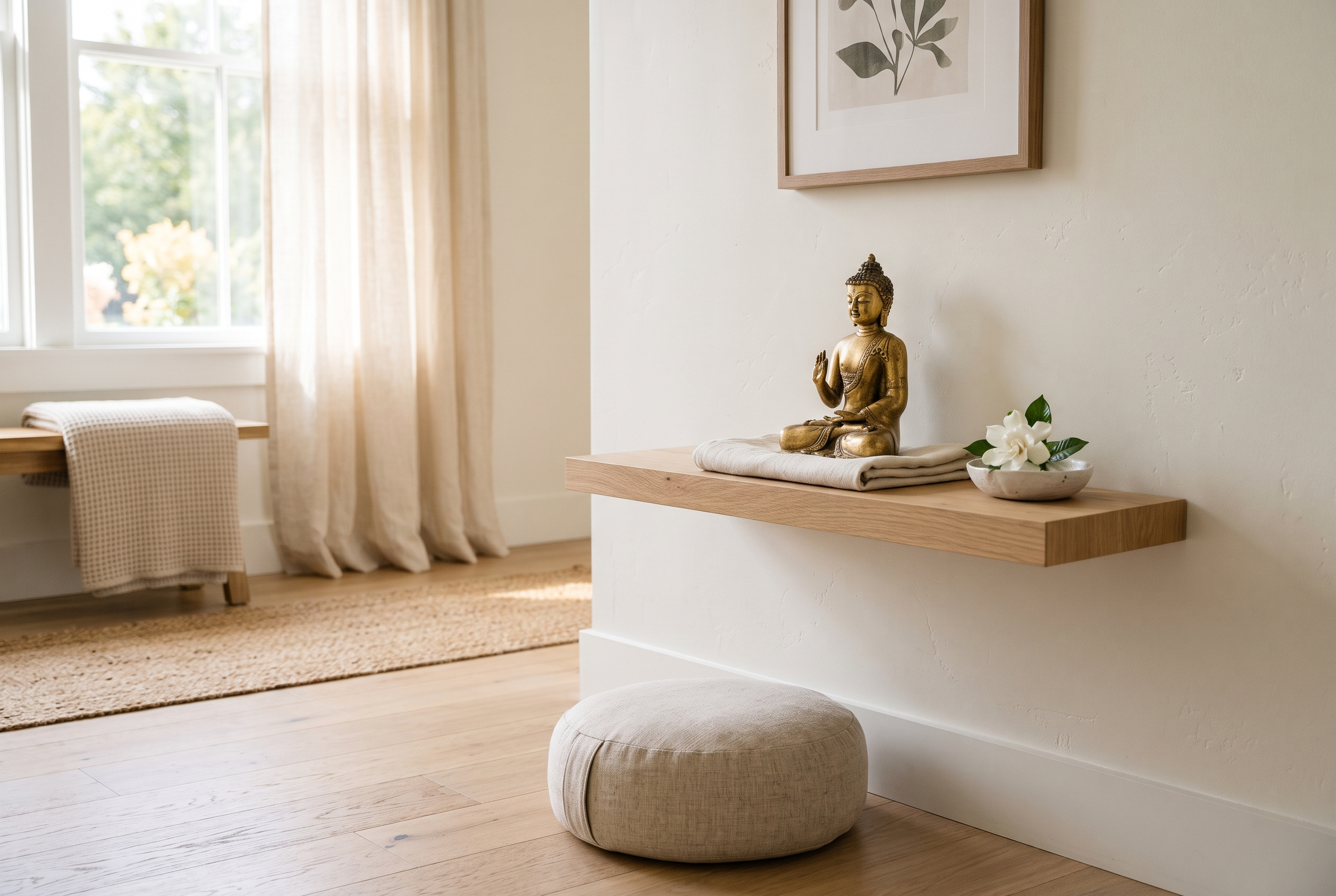
Yes, display is generally regarded as respectful when you treat the image with care rather than as a novelty.
Place it at eye level or higher on an altar, shelf, or meditation space, keep it clean, and avoid floors, bathrooms, and kitchens. Do not use it as a doorstop or garden ornament. If you are not Buddhist and feel unsure, that is a common and thoughtful worry. Teachers differ on details, so a local temple is the best place to ask.
Amitabha Buddha FAQ
Buddhist traditions describe Amitabha as a Buddha, an awakened being, not a creator god. Devotion to him is traditionally understood as trust in his vows rather than worship of a deity who controls the world.
In Tibetan practice the mantra is commonly given as “Om Ami Dewa Hrih,” while Chinese and Japanese Pure Land Buddhists recite “Namo Amituofo” or “Namu Amida Butsu.” Pronunciation and practice details are best learned from a teacher.
Amitabha is associated with the west, which is why Sukhavati is called the Western Pure Land. In Tibetan art this link to the setting sun also explains his red color.
The Metropolitan Museum of Art in New York holds a Goryeo-period Amitabha triad, and the Smithsonian’s National Museum of Asian Art in Washington, DC, holds a 6th-century Western Paradise relief. Displays rotate, so check gallery availability first. To study the forms at home, browse our handmade Buddha and bodhisattva statues and compare their mudras with this guide.
In summary, Amitabha Buddha is the Buddha of Infinite Light, known as Amituofo in China and Amida in Japan, and recognizable by his mudra, his body color, and his attendants. The key takeaway is that no single clue settles identification, so read them together. For more guides, see the Buddhist art and meaning guides on our blog.
Compare the Clues in Person
ShaoLin Store offers handmade Buddha and bodhisattva statues. Use the five clues above to compare mudras, crowns, and finishes before you choose.Browse Handmade Statues
⚠️ Important Note: This article explains Buddhist tradition and art history for general education. It is not religious instruction. Statements about devotion and rebirth describe what traditions teach, not proven outcomes. For practice guidance, consult a qualified teacher or temple.
📚 References
- Amitabha triad, Goryeo dynasty: Museum record of a 13th-century hanging scroll with notes on the attendants’ crown details. The Metropolitan Museum of Art
- Seated Amida with Raigo Mudra: Collection entry for an 11th-century Japanese Amida statue with the welcoming gesture. Kyoto National Museum
- Western Paradise of the Buddha Amitabha: Educator resource on a Northern Qi relief showing rebirth in the Pure Land. Smithsonian National Museum of Asian Art
- Pure Land Buddhism: Encyclopedia overview of Amitabha, Sukhavati, and the Pure Land schools of East Asia. Encyclopaedia Britannica