
An Om Mani Padme Hum ring carries the six-syllable mantra of Avalokiteshvara, the Buddhist bodhisattva of compassion. You can wear one respectfully even if you are not Buddhist. Tradition reads the mantra as compassion joined with wisdom, and a ring turns that idea into a small daily reminder. It is not a lucky charm.
ShaoLin Store works from the Chan (Zen) Buddhist tradition, so we checked this guide against Tibetan, Chinese and scholarly sources. We say plainly where they disagree.
Below you will find what the six syllables mean, how the mantra lives in Chinese Buddhism, and how to tell which script your ring shows. You will also get seven etiquette habits and a guide to silver and size. If you are already shopping, browse our sterling silver mantra and spiritual rings, which list the metal and US sizes.
Important note: This guide shares traditional Buddhist interpretations for general education. It is not religious instruction, and it makes no claims about luck, health, wealth or protection. For questions about practice, ask a qualified teacher at a local dharma center.
What Does Om Mani Padme Hum Mean on a Ring?
Om Mani Padme Hum is the six-syllable mantra of Chenrezig (Avalokiteshvara), the bodhisattva of compassion. Mani means “jewel” and padme means “lotus.” In the Dalai Lama’s reading, the jewel stands for compassionate method and the lotus for wisdom. The final Hum joins them, so a ring carrying it is a reminder, not a charm.
In the Tibetan Buddhist world, the mantra is carved on mani stones and written on prayer flags and prayer wheels. Engraved on a ring, it travels with you. Each time you notice it, you can pause and recall what it stands for.
The Six Syllables, One by One
The Dalai Lama’s explanation, reprinted by the Tibetan Nuns Project, maps the syllables like this:
- Om: your body, speech and mind as they are now, and the pure body, speech and mind of a Buddha.
- Ma and Ni (mani): the jewel, which stands for the wish to awaken for others, compassion and love.
- Pad and Me (padme): the lotus, which stands for wisdom.
- Hum: the indivisible union of method and wisdom.
Some Chenrezig practice texts also pair the syllables with six colors and the six perfections. Treat those as extra layers, not requirements for wearing the ring.
Who Is Chenrezig (Avalokiteshvara)?
Chenrezig is the Tibetan name for Avalokiteshvara, the bodhisattva who embodies compassion. Tibetan Buddhists regard the Dalai Lamas as manifestations of this figure. Chinese Buddhists know the same bodhisattva as Guanyin, which the next section covers.
Why Scholars Still Debate the Translation
Mani is “jewel” and padme is “lotus,” but scholars disagree on the grammar. Alexander Studholme reads manipadme as “in the jewel-lotus,” a phrase tied to rebirth in a pure land. Donald Lopez cites Tibetan grammatical sources to argue that it is more likely a form of address. In that reading, the words call out to a bodhisattva named “jewel-lotus.” Most Tibetan commentaries treat translation as secondary to the correspondences of the six syllables. The key takeaway: the practice behind the words matters more than any single English phrase.
Guanyin’s Six-Character Mantra: The Chinese Buddhist Side of the Story
In Chinese Buddhism, the same mantra is written 唵嘛呢叭咪吽 and belongs to Guanyin, the East Asian form of Avalokiteshvara. Many English guides to mantra jewelry cover only the Tibetan side, which leaves out a living Chinese tradition.
That tradition is active today. The Chinese transliteration is painted on walls and entrances in Chinese Buddhist temples. The mantra is also built into one of the Ten Small Mantras, which most modern Chinese temples still recite every morning. We work from the Chan (Zen) side of this story: Shaolin Temple stands on Mount Song in Henan, China, and tradition dates its founding to 495 CE.
One Bodhisattva, Three Names
Sanskrit texts say Avalokiteshvara, Tibetan Buddhists say Chenrezig, and Chinese Buddhists say Guanyin (观音). It is the same bodhisattva of compassion and the same six syllables. Only the language and the art change.
Where the Mantra First Appears: The Kāraṇḍavyūha Sūtra
The earliest known description of the mantra is in the Kāraṇḍavyūha Sūtra, composed around the 4th to 5th centuries CE. The sutra calls it the “innermost heart” of Avalokiteshvara. It reached China in 983 CE, when the monk Tianxizai translated it into Chinese during the Song dynasty. Chinese and Tibetan Buddhists therefore share one scriptural source for the same six syllables.
Which Script Is on Your Ring? Reading Tibetan, Lantsa and Chinese Versions
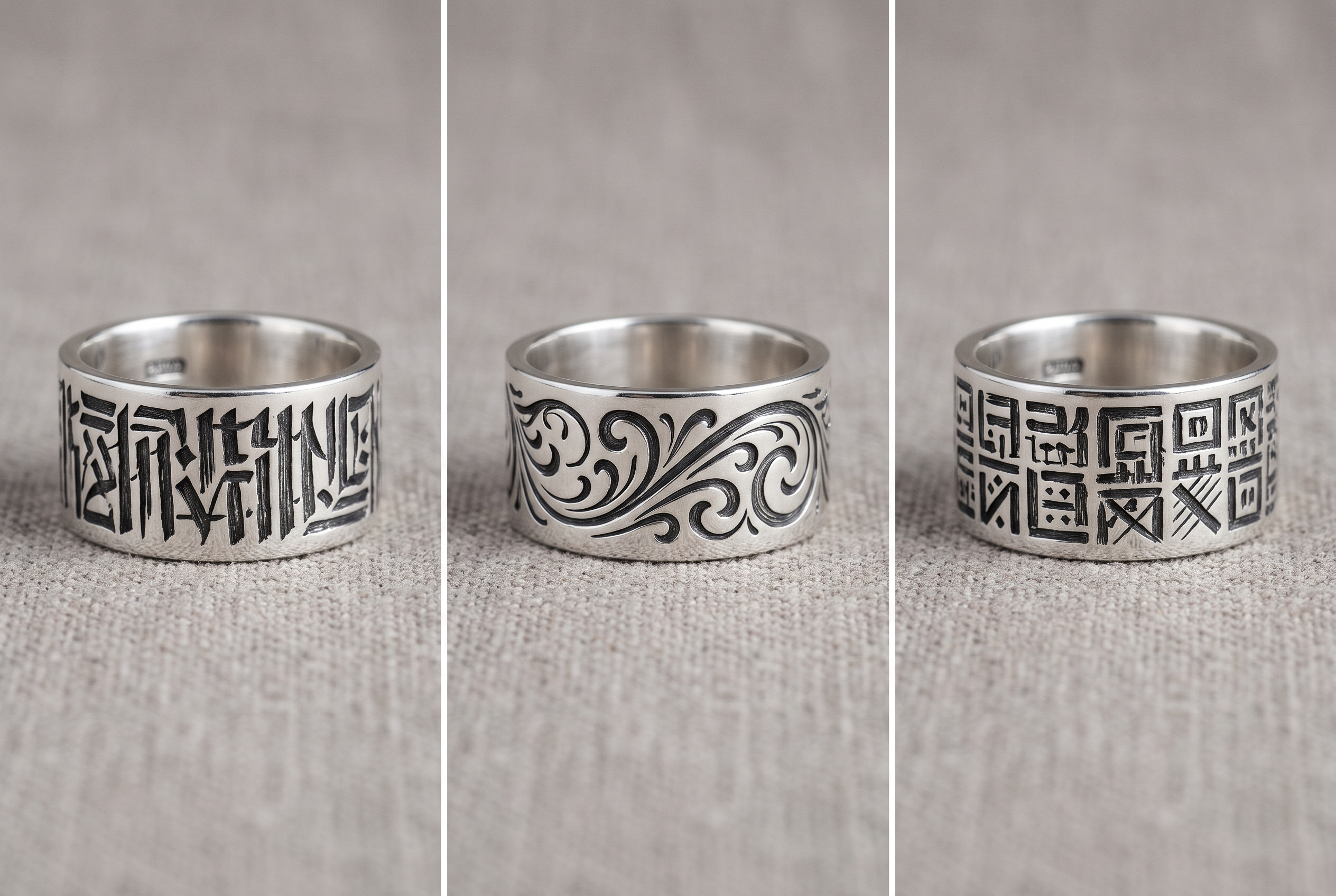
Most Om Mani Padme Hum rings use one of three scripts: Tibetan Uchen, the ornamental Lantsa (Ranjana) script, or Chinese characters. You can usually tell which in under a minute.
| Script | Example | How to recognize it |
|---|---|---|
| Tibetan (Uchen) | ཨོཾ་མ་ཎི་པདྨེ་ཧཱུྃ | Upright letters divided by small dots. Common on mani stones and prayer wheels. |
| Chinese | 唵嘛呢叭咪吽 | Six square characters. Typical on walls and entrances in Chinese Buddhist temples. |
| Lantsa (Ranjana) | Ornamental Sanskrit letters | Curving, decorative letterforms used to write Sanskrit mantras on mani stones and ritual art. |
A 60-Second Check: Count the Blocks
Run this check on any listing photo before you buy:
- Chinese: look for six square characters, 唵 嘛 呢 叭 咪 吽.
- Tibetan: look for five or six units divided by small dots. Many writers join padme into one unit, and others split it into pad and me, so both counts are correct.
- Lantsa: look for ornamental Sanskrit letterforms, common on mani stones.
- None of the above: if the shapes read as decoration, the ring most likely uses mantra-inspired script.
What “Mantra-Inspired Script” Means on a Product Page
“Inspired script” means the lettering imitates the look of the mantra without promising a letter-perfect transcription. Our own six-syllable ring is listed as “Om Mani Padme Hum-inspired script.” Ask any seller, including us, for a close-up photo and a plain answer about what is engraved before you buy.
If you discover your ring uses decorative lettering, you have not done anything wrong. Knowing what is engraved simply lets you treat it with the right care.
One Stone, Six Scripts: The Stele of Sulaiman
The Stele of Sulaiman, erected in 1348 under the Yuan dynasty, shows how many scripts one mantra can wear. It was set up at the Mogao Caves near Dunhuang and is now held by the Dunhuang Academy. The mantra is carved around a four-armed Avalokiteshvara in six scripts: Lantsa for Sanskrit, Tibetan, ’Phags-pa, Uyghur, Tangut and Chinese. Your ring’s script is one more way of writing the same sounds.
Is It Disrespectful to Wear Om Mani Padme Hum Jewelry?
No. Wearing Om Mani Padme Hum jewelry is not disrespectful in itself; what matters is that you know what the words say and treat them with care. If you have hesitated before putting one on, that instinct is a good sign. It shows you treat the words as words, not decoration.
Can You Wear It If You’re Not Buddhist?
Yes. The Tibetan Nuns Project says plainly, “You don’t have to be a Buddhist to wear or use a mala.” That guidance is about malas, but its spirit applies here: respect and understanding matter more than membership.
You are in large company. Pew Research Center found that 22% of US adults describe themselves as spiritual but not religious (a survey of 11,201 adults, published 12/07/2023). Many people reach symbols like this one from outside any tradition. Respect and intention matter most. For questions about formal practice, such as reciting the mantra as a daily commitment, ask a qualified teacher.
Appreciation vs. Appropriation: A 3-Question Check
Ask yourself these three questions before you wear it:
- Do I know what it says? After the first section of this guide, you do.
- Would I treat it the same way if a practitioner were watching? If the answer is yes, your habits are already respectful.
- Am I claiming powers or an identity I do not hold? Calling it a protective charm, or posing as a monastic, moves from appreciation toward cultural appropriation.
7 Etiquette Rules for Everyday Wear
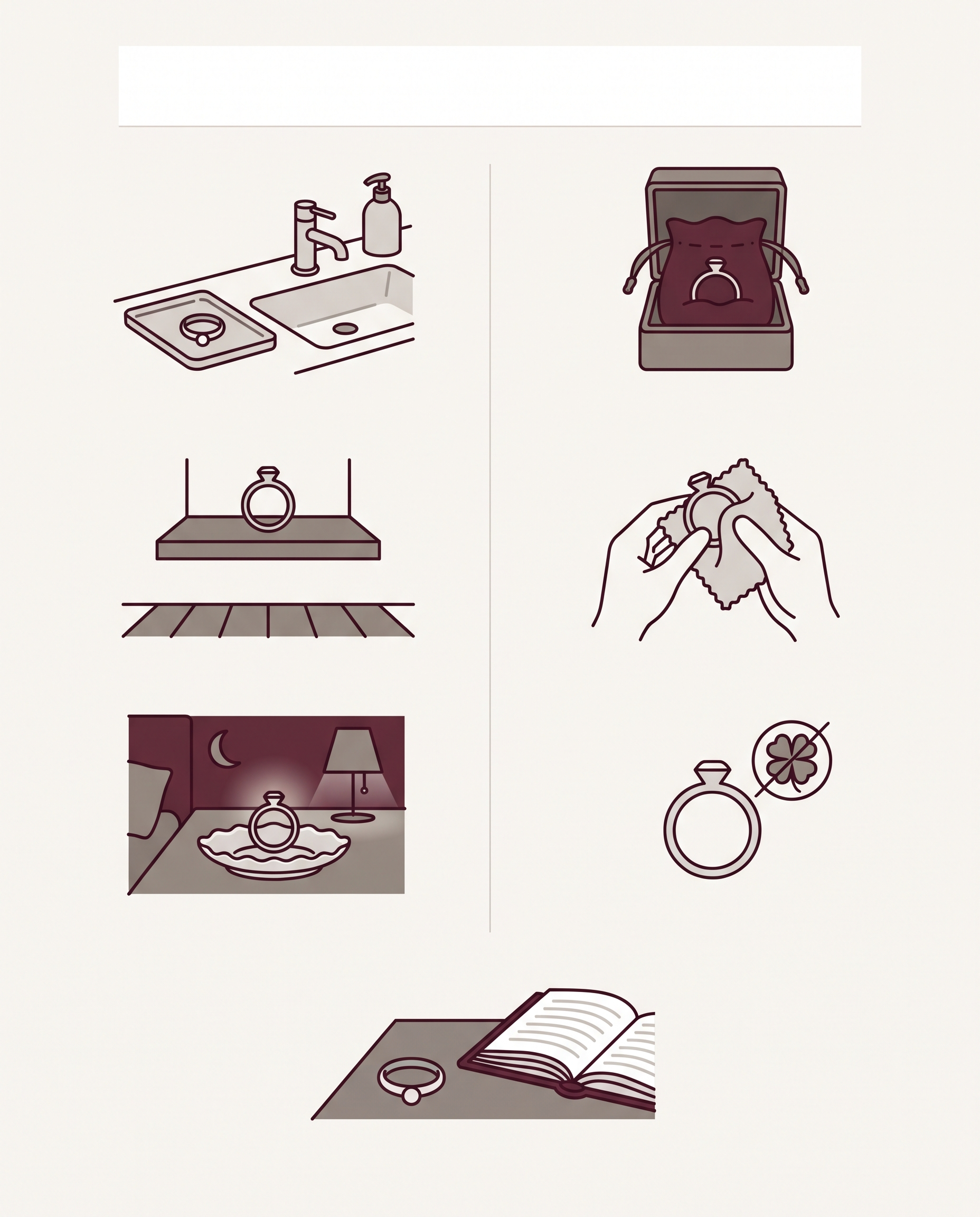
These habits are widely shared courtesies among practitioners:
- Remove it before using the bathroom. Set it somewhere clean first.
- Keep it off the floor. Use a tray, a pouch or a shelf.
- Do not sleep on it. Many practitioners take sacred jewelry off at night and rest it on a clean surface.
- Store it high and clean. A soft pouch or closed box keeps silver dry and the script protected.
- Keep it clean. Wipe it with a soft cloth, and do not scrub oxidized lettering.
- Do not treat it as a lucky charm. It is a reminder of compassion, not a promise of luck.
- Learn what it says. Recall its meaning whenever you put the ring on.
These are courtesies, not one official rulebook. If a teacher you trust says otherwise, follow your teacher.
Which Hand or Finger? Buddhism Doesn’t Say
Buddhism sets no rule for which hand or finger carries a mantra ring. The finger rules you may have read online usually come from feng shui, a separate tradition with its own symbols. If feng shui is part of why you are shopping, try the 990 silver Pixiu mantra ring. It pairs a Pixiu figure with a mantra inside the band and adjusts to US sizes 8 to 13. Otherwise, wear any ring on the finger where it fits and feels comfortable.
Choosing a Six-Syllable Ring: Silver, Width and US Sizing
Choose a mantra ring the way a jeweler would: metal purity first, band width second, and a US size measured for the finger you will wear it on. Then match the format to how you live. A wide band is a statement you will notice all day. If you type for hours or want something you forget you are wearing, a cord bracelet suits you better.
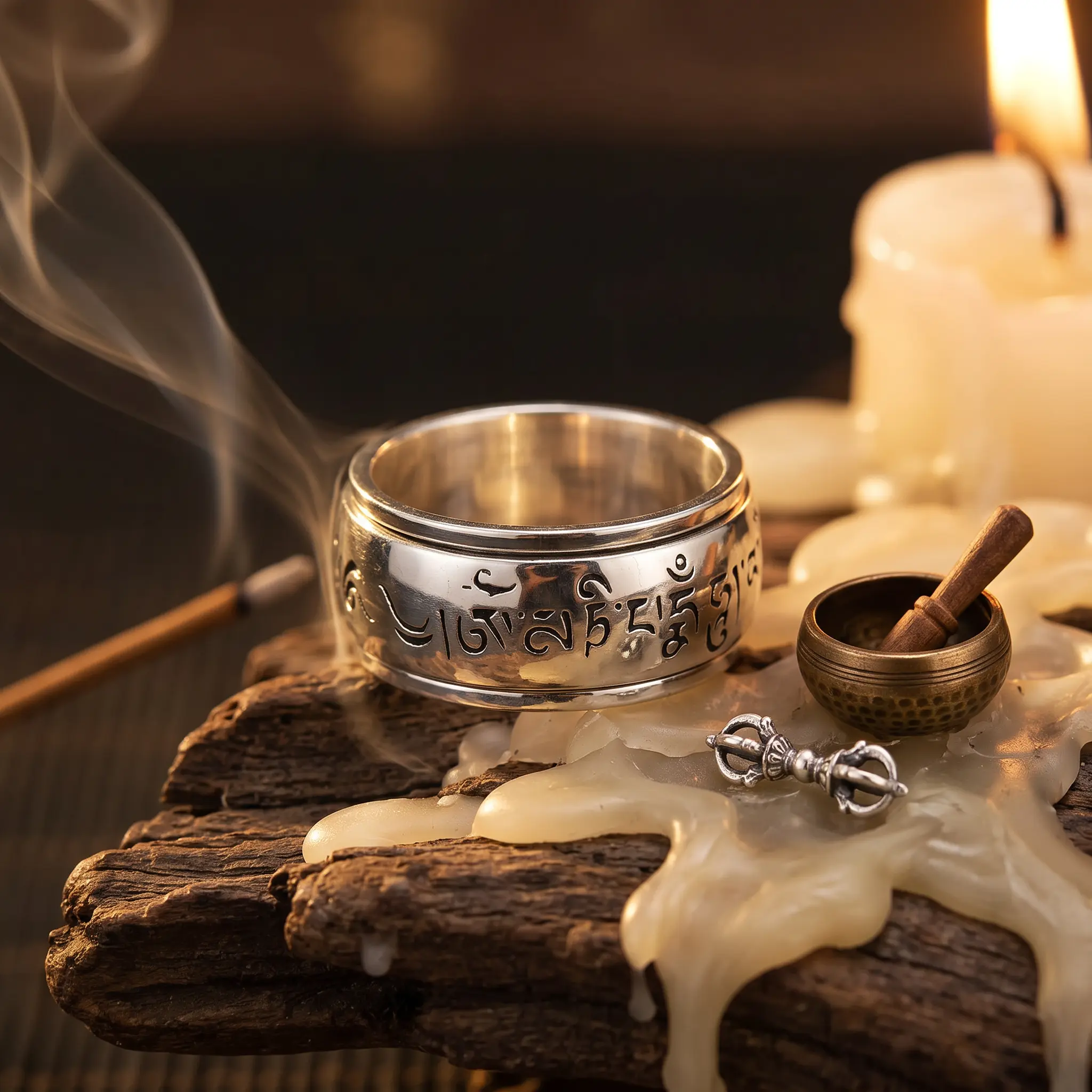
Mantra Ring, Pixiu Ring or Cord Bracelet: A Quick Comparison
Here is how three ShaoLin Store formats compare, with prices checked on 11/05/2026:
| Format | Example | Metal | Fit | Price (USD) | Best for |
|---|---|---|---|---|---|
| Wide mantra ring | Six-Syllable Mantra Ring, 10 mm band | S925 sterling silver | Sold by US size, 8 to 13 | $236.95 | A bold, readable daily reminder |
| Pixiu mantra ring | Feng Shui Pixiu Ring | 990 silver | Adjustable, US 8 to 13 | $46.95 | Feng shui interest, or an unknown size |
| Cord bracelet | Handwoven S999 silver Om Mani Padme Hum cord bracelet | S999 fine silver bar, woven cord | Woven cord band | $89.95 | Quieter wear when a ring is impractical |
Silver Purity: S925, S999 and 990 Explained
S925 means 92.5% pure silver, the standard sterling alloy. In the US, the FTC’s Jewelry Guides allow the word “sterling” only for metal that is at least 92.5% pure. The three grades you will meet on mantra jewelry behave differently:
- S925 sterling (92.5% silver): harder than fine silver, so it suits a daily-wear ring. It does tarnish, and a soft silver cloth restores the shine. The Six-Syllable Mantra Ring pairs S925 with black-oxidized script, so polish the band and leave the lettering alone.
- 990 silver (99% silver): purer than sterling, used on the adjustable Pixiu ring.
- S999 fine silver (99.9% silver): the purest grade, used for the engraved bar on the cord bracelet. Fine silver is softer than sterling.
Sizing a 10 mm Wide Band
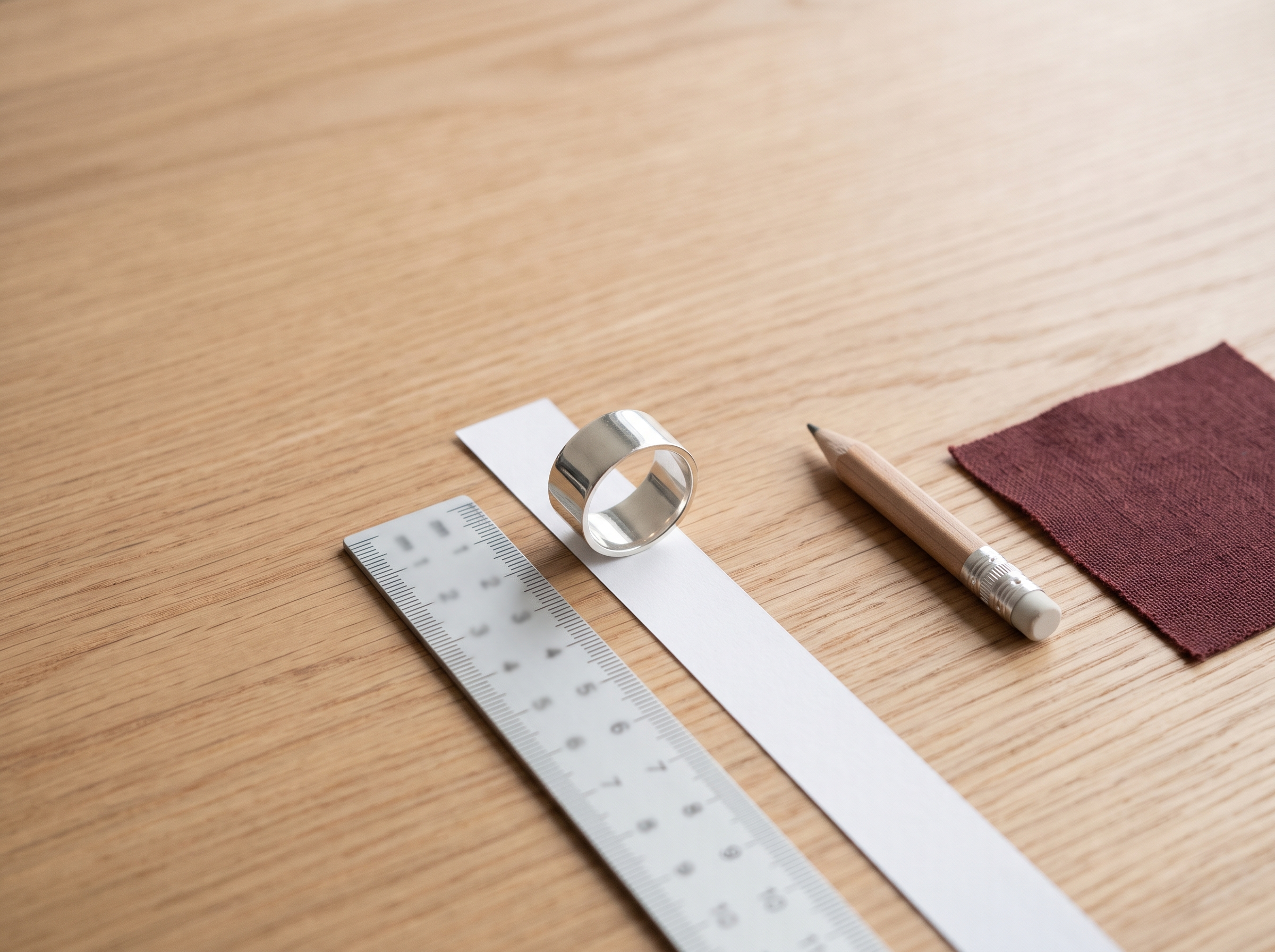
For a 10 mm band, many jewelers suggest going up about half a size, and choosing the larger size if you fall between two. Wide bands cover more of your finger, so they fit snugger than thin ones. To check your size at home:
- Cut a paper strip about 0.39 in (10 mm) wide, the same width as the band.
- Wrap it around the base of your finger and mark where it overlaps.
- Measure the strip in millimeters and match it to the chart below.
At 0.39 in (10 mm), the script stays readable at a glance, which is what lets the ring work as a reminder. The trade-off is weight: the ring runs 13 to 16 g (0.46 to 0.56 oz), depending on size.
| US size | Inner circumference | Approx. weight |
|---|---|---|
| US 8 | 2.20 in (56 mm) | 0.46 oz (13 g) |
| US 9 | 2.32 in (59 mm) | 0.49 oz (14 g) |
| US 10 | 2.40 in (61 mm) | 0.53 oz (15 g) |
| US 11 | 2.48 in (63 mm) | 0.53 oz (15 g) |
| US 12 | 2.56 in (65 mm) | 0.56 oz (16 g) |
| US 13 | 2.64 in (67 mm) | 0.56 oz (16 g) |
See the full spec sheet
The Six-Syllable Mantra Ring in S925 silver comes in US sizes 8 to 13, ships free, and can be returned within 60 days if the fit is off.
Cord Bracelets, Malas and Gifts: Carrying the Mantra in Other Forms
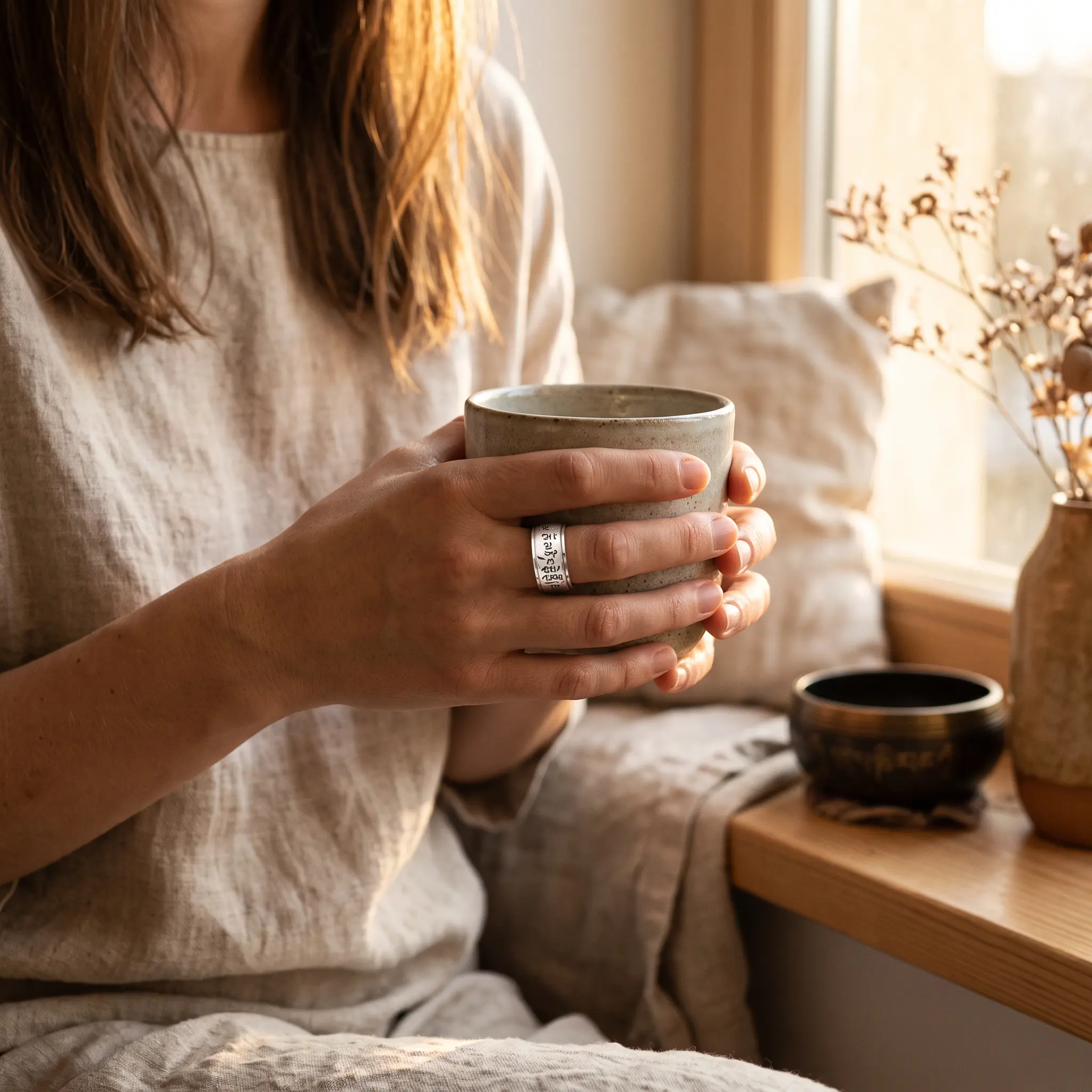
If a ring feels like too much, a mantra cord bracelet or a 108-bead mala carries the same words in a quieter form. The two do different jobs, and the difference matters if you plan to practice.
Cord Bracelets vs. Malas
A cord bracelet carries the script as jewelry. A mala is a counting tool. The Tibetan Nuns Project explains that Tibetan malas usually have 108 counting beads plus a guru bead. The number reflects the 108 volumes of the Buddha’s words, known as the Kangyur. Practitioners use malas to focus awareness during practice. If you want one for practice, learn how it is used first. The Tibetan Nuns Project’s guide to using and choosing a Tibetan mala is a good start.
A Three-Line Gift Card Template
A short card turns mantra jewelry into a gift that arrives with its meaning attached. Gifting season starts soon, with Thanksgiving on 11/26/2026 and Black Friday on 11/27/2026. If you do not know the recipient’s size, choose an adjustable piece or a cord bracelet.
This carries the six-syllable mantra of compassion, Om Mani Padme Hum.
It is a quiet reminder to pause and be kind.
Please keep it clean, and take it off before the bathroom.
Frequently Asked Questions About Mantra Rings
Water alone will not harm sterling silver, but our care notes say to remove the ring before swimming, cleaning, and using lotion or perfume. Many practitioners also take mantra jewelry off before the bathroom, so the shower is a natural moment to remove it.
In Sanskrit it sounds roughly like “ohm MAH-nee PAHD-may hoom.” In modern Lhasa Tibetan it is pronounced “om mani peme hung.” Either is fine, because attention matters more than accent.
Some spinner rings borrow the idea of the prayer wheel, a device filled with mantra scrolls that practitioners turn clockwise. A ring’s spin works as a cue to pause. It does not replace reciting the mantra or practicing under a teacher.
Look for listings that state the silver purity, band width and US size range, and that explain the script honestly. You can start with our mantra and spiritual rings, then compare each ring’s metal, size range and price before you decide.
The bottom line: An Om Mani Padme Hum ring is a reminder of compassion joined with wisdom. Wear it knowing what the six syllables say, keep it clean, and take it off before the bathroom. The Tibetan Nuns Project’s own guidance is that you do not have to be Buddhist to wear a mala, and the same respectful spirit applies to a mantra ring.
Carry the mantra with care
Browse rings, bracelets and necklaces, with free shipping on all orders and a 60-day return window.Browse ShaoLin Store’s spiritual jewelry collection
Editorial note: We wrote this guide from the sources below, checked product details and prices on 11/05/2026, and will update it when listings change.
📚 References
- The meaning of the six syllables: The Dalai Lama’s explanation of Om Mani Padme Hum, reprinted by arrangement with Shambhala Publications. Tibetan Nuns Project
- Malas, 108 beads and who may wear them: A practical guide to Tibetan prayer beads from nuns who make and bless them. Tibetan Nuns Project
- Spiritual but not religious Americans: Survey of 11,201 US adults, conducted 07/31/2023 to 08/06/2023 and published 12/07/2023. Pew Research Center
- Scholarly debate, Chinese liturgy and the six-script stele: Overview of the mantra’s origins and translations, plus the 1348 inscription at Mogao. Wikipedia: Om mani padme hum and Wikipedia: Stele of Sulaiman