
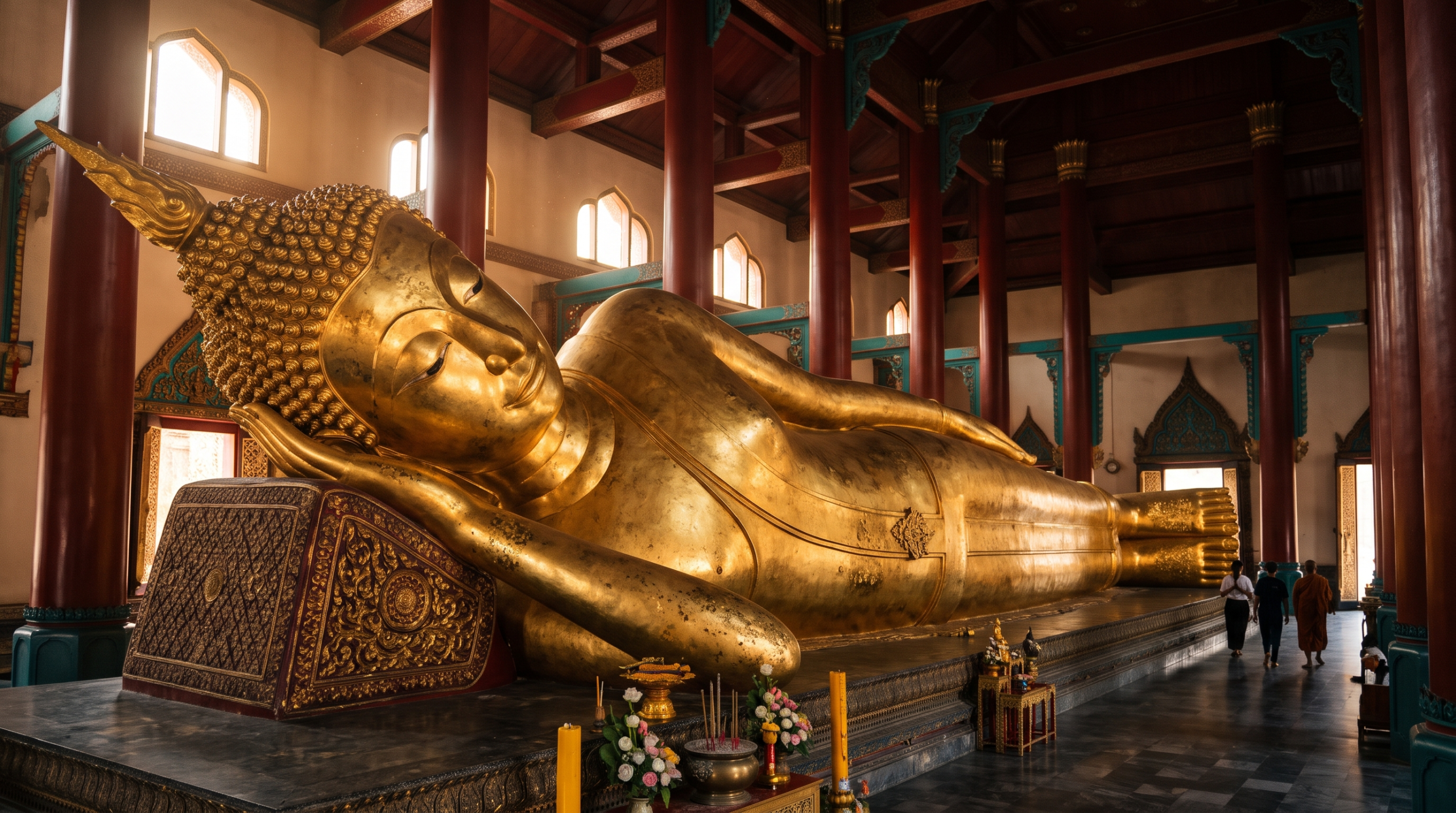
Most visitors to Bangkok’s Wat Pho see a 151-foot (46 m) golden figure and assume the Buddha is napping. He is not. A reclining Buddha shows him at his parinirvana, the final passing of an awakened teacher, lying on his right side in the lion’s posture.
This guide follows that image from the Pali Canon’s account at Kushinagar to temples in Sri Lanka, Myanmar, and Japan. You will learn what the earliest text says, how Theravada and Mahayana readers differ, and which sleeping Buddha statues are the oldest and largest.
At ShaoLin Store, we sell handmade Buddha statues, so we built this guide on primary texts and museum records, not caption lore. One line in the Pali Canon’s account of his death shows why “sleeping Buddha” is the wrong name.
This guide explains cultural and textual meaning, not religious instruction. Jump to the posture comparison.
What Does the Reclining Buddha Mean?
A reclining Buddha statue shows Shakyamuni Buddha lying on his right side as he passes into parinirvana, the final liberation from rebirth, at age 80. According to the Pali Canon, this happened between twin sal trees near Kushinagar. The figure is not sleeping. It depicts complete peace.
Buddhists traditionally read the reclining Buddha as a teaching on impermanence (anicca), the idea that all conditioned things change. Even an awakened teacher’s body ages, rests, and ends. Temples use the figure as a teaching image for contemplating that fact.
The calm face signals release from samsara, the cycle of birth, death, and rebirth, rather than loss. If a “death statue” feels unsettling, that reaction is common. Tradition reads this image as peace, not grief.
Our team first read it as simple rest, too. That changed when we read the sutta line by line, as the next section shows.
Is the Reclining Buddha Sleeping?
No. Many people say “sleeping Buddha,” but the reclining posture traditionally depicts the Buddha’s final passing, not ordinary rest. The Thai name, Phra Buddhasaiyas, simply means the Buddha lying down. “Reclining Buddha” or “Buddha in parinirvana” is the more accurate label.
What Is Parinirvana, and How Is It Different From Nirvana?
Nirvana is the awakening a Buddha reaches while alive. Parinirvana is the final nirvana entered at death, after which no rebirth follows. Scholar Rupert Gethin notes that modern usage reserves “parinirvana” for the death of someone already awakened.
Tradition holds that the Buddha awakened at 35, taught for about 45 more years, and entered parinirvana at 80.
What Happened at Kushinagar? The Buddha’s Final Night in the Pali Canon
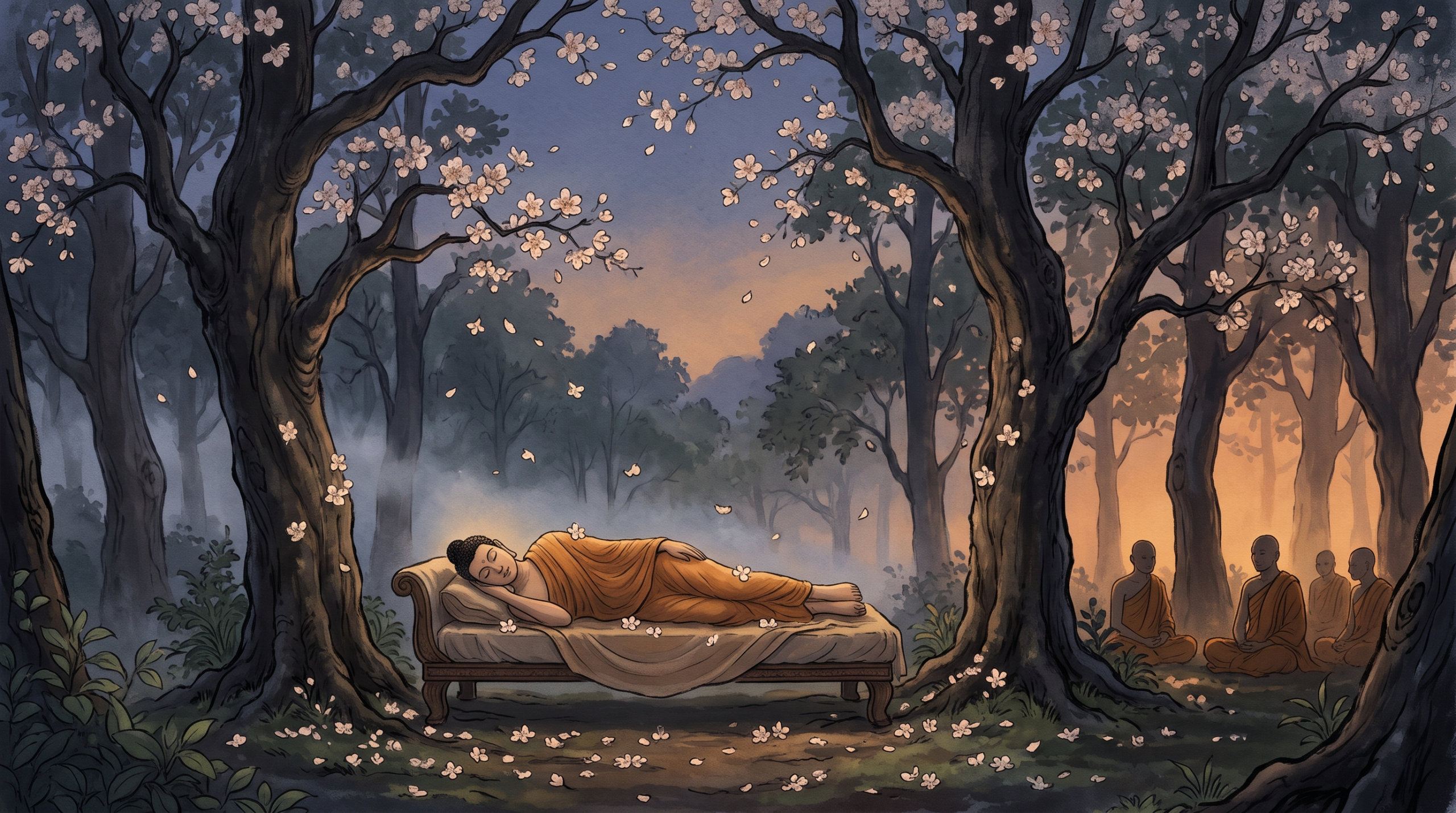
The Buddha passed into parinirvana at Kushinagar (Pali: Kusinārā), lying between twin sal trees in the Mallas’ grove at Upavattana. According to the Mahāparinibbāna Sutta (DN 16), he was 80, and he had asked Ānanda to prepare a bed with its head to the north.
The sutta says the sal trees burst into bloom out of season and scattered flowers over him. His last words, as the text records them, urged the monks to keep striving with diligence because all conditioned things decay.
The date is disputed. Theravada tradition gives 543 BCE, while scholars propose alternatives such as 487 BCE, 483 BCE, and dates closer to 400 BCE.
Today the site draws pilgrims. Archaeologist Alexander Cunningham identified the ruins as the parinirvana site in 1861 and 1862. In 1876, Archibald Carlleyle uncovered a 20-foot (6.1 m) red sandstone reclining Buddha there, restored in 1877 and now housed in the Mahaparinirvana Temple. It lies on its right side with its head to the north.
Why Twin Sal Trees and a Bed With Its Head to the North?
The sutta records both details without saying why. Later commentators offered symbolic readings, but the earliest text gives no reason, so we treat those readings as interpretation, not doctrine. The head-to-the-north detail is the one you can still check in the Kushinagar statue, which follows it.
The Detail Most Guides Miss: No Intention to Rise
Earlier in DN 16, when the Buddha lies down to rest, the text says he keeps in mind the time to rise. On his final night, that phrase is missing. Translator Thanissaro Bhikkhu renders the earlier phrase as a “mental note to get up,” and it does not appear in the last scene.
We read past this line the first time through. Once you see it, the “sleeping” label is hard to keep. A resting figure keeps the thought of rising. The figure in parinirvana does not. This is our reading of the text, not a doctrinal claim.
Why Does the Sleeping Buddha Lie on His Right Side?
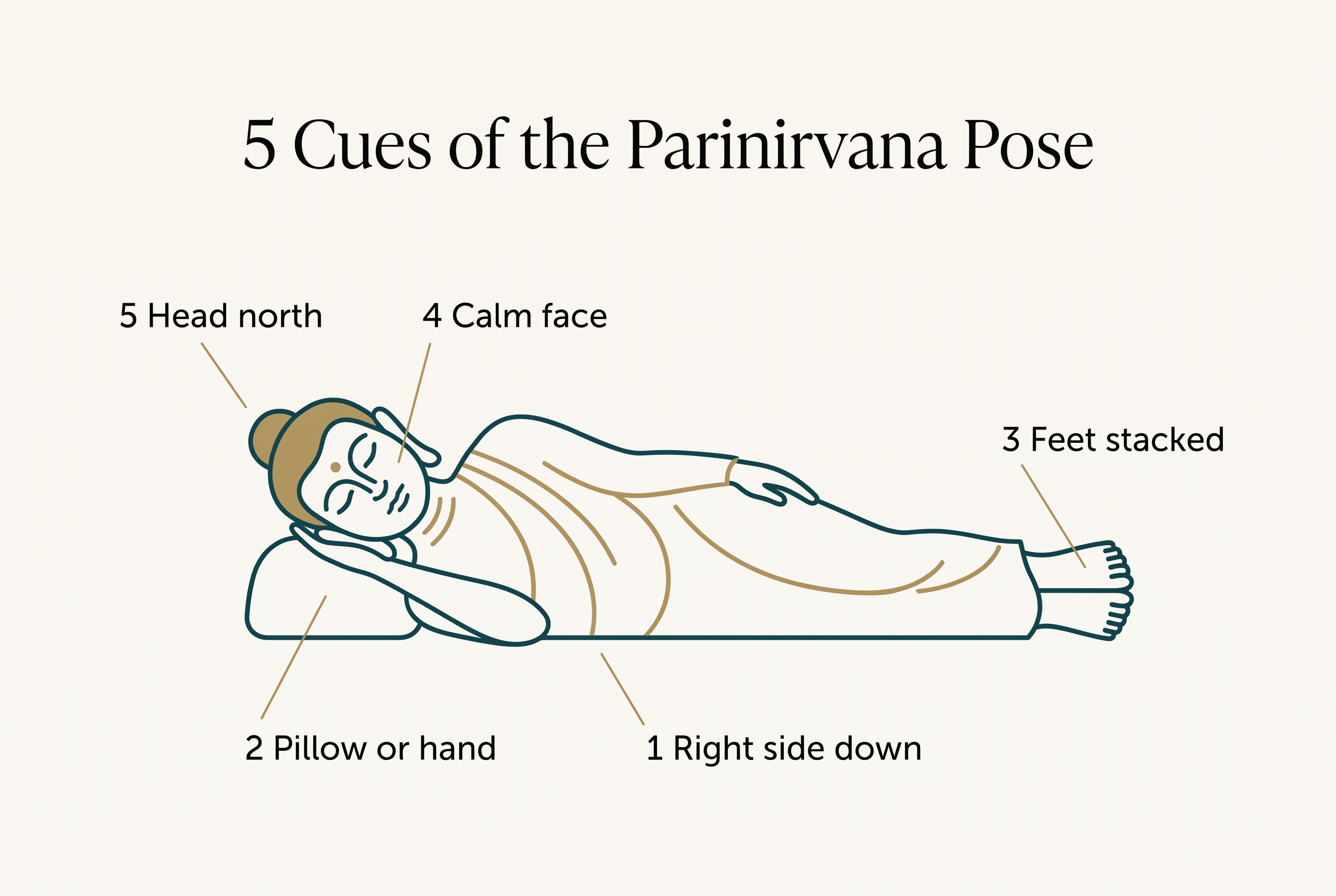
He lies right side down because the Pali Canon describes the lion’s posture at his parinirvana.
- Right side down: the Pali Canon calls this the lion’s posture (sīhaseyyā).
- Head support: a pillow, or the right hand and elbow, holds the head.
- Legs extended: one foot rests on top of the other, as the sutta describes.
- Serene expression: the eyes are lowered or half closed, and the face is calm.
- Head to the north: the sutta orients the bed this way, and the Kushinagar image follows it.
The sutta names the posture but gives no doctrinal reason for it. Later teachers offered explanations, yet we cannot trace one to the earliest text. For identifying a statue, the posture itself is what matters.
How to Read the Five Cues on a Real Statue
Check the side first, then the head support, then the feet. Wat Pho’s gilded figure follows the first four cues. At Gal Vihara in Sri Lanka, the whole figure is carved from one granite rock face.
In our experience, the side is the fastest check. If a statue lies on its right side with its legs extended, you are almost certainly looking at the parinirvana.
The Exceptions: Left-Side Figures Like Phnom Kulen
A few statues lie on the left side. Wikipedia’s Reclining Buddha entry notes a left-side example at Phnom Kulen in Cambodia. Such cases are rare, and we know of no text that explains them, so treat them as regional variation rather than a different event.
How Theravada and Mahayana Traditions Read the Buddha in Parinirvana
Theravada Buddhists read the reclining image as the Buddha’s complete and final release, while many Mahayana schools, drawing on the Mahāparinirvāṇa Sūtra, teach that his passing was a skillful display and that the Buddha is, in a deeper sense, eternal.
| Tradition | Core text | What parinirvana means | Typical art |
|---|---|---|---|
| Theravada | Pali Canon (DN 16) | Final release with no rebirth; the teaching remains as the guide | Large reclining statues in Sri Lanka, Thailand, and Myanmar |
| Mahayana | Mahāyāna Mahāparinirvāṇa Sūtra | A skillful display; the Buddha’s true nature is described as permanent | East Asian nehan-zu paintings with many mourners |
| Vajrayana and other lineages | Their own commentaries | Differs by lineage and teacher | Ask a teacher in your tradition |
Theravada: The Final “Unbinding”
Theravada readers take the reclining image as the Buddha’s complete and final release. Thanissaro Bhikkhu’s translation of DN 16 carries the title “The Great Discourse on the Total Unbinding.” Across Sri Lanka, Thailand, and Myanmar, large reclining statues serve as a focus of veneration and pilgrimage.
Mahayana: The Eternal Buddha of the Mahāparinirvāṇa Sūtra
A Mahayana scripture of the same name presents the Buddha’s death as a skillful display (upāya) meant to teach impermanence. Many Mahayana schools read it as saying the Buddha’s true nature does not end. Many readers therefore hold both ideas together: an ending in form and a continuing presence.
Japanese Nehan-zu Paintings: When Mourners Take Center Stage
Nehan-zu are Japanese paintings of the parinirvana that crowd the scene with mourning monks, laypeople, and animals. Art historians describe an earlier type centered on the reclining Buddha and a later type that gives mourners more room.
The mourners are not a Japanese invention. A Gandhara schist relief at The Metropolitan Museum of Art, dated to about the 3rd century CE, already shows the Buddha on his right side among grieving figures. The wandering ascetic Subhadra, the Buddha’s last convert, sits calmly nearby. Same scene, different emphasis.
Reclining Buddha vs. Seated and Standing Buddhas: How the Postures Compare
Buddhist art shows four main postures, and each marks a different moment in the Buddha’s life.
| Posture | Moment or meaning | Common details | Where you see it |
|---|---|---|---|
| Seated | Meditation, awakening, and teaching | Hands in the lap (dhyana mudra) or touching the earth | Altars, meditation halls, home shelves |
| Standing | Teaching, giving, and protection | Raised hand in a fearlessness gesture (abhaya mudra) | Temple halls and cave walls |
| Walking | Movement of the teaching into the world | One foot forward; best known in Thai Sukhothai-style art | Temple courtyards in Thailand |
| Reclining | The final passing, parinirvana | Right side down, head on a pillow or hand, calm face | Large temple halls, rock-cut sites, sutra paintings |
Thailand’s Wat Phra Si Iriyabot in Kamphaeng Phet takes its name from these postures.
Which Posture Suits a Home Meditation Corner?
A seated figure usually fits a meditation corner best. It faces you, reads from the front, and needs only a shelf at eye level. A reclining figure needs a long, clear surface and reads from the side.
ShaoLin Store’s aged copper meditating Buddha statue in dhyana mudra pairs a mud-gold finish with hands resting in the lap. That gesture is the one most associated with meditation, which gives you a steady point of focus for daily sitting. To compare more styles, browse our handmade Buddha statues collection.
Rest With Readiness vs. Final Rest: A Useful Contrast
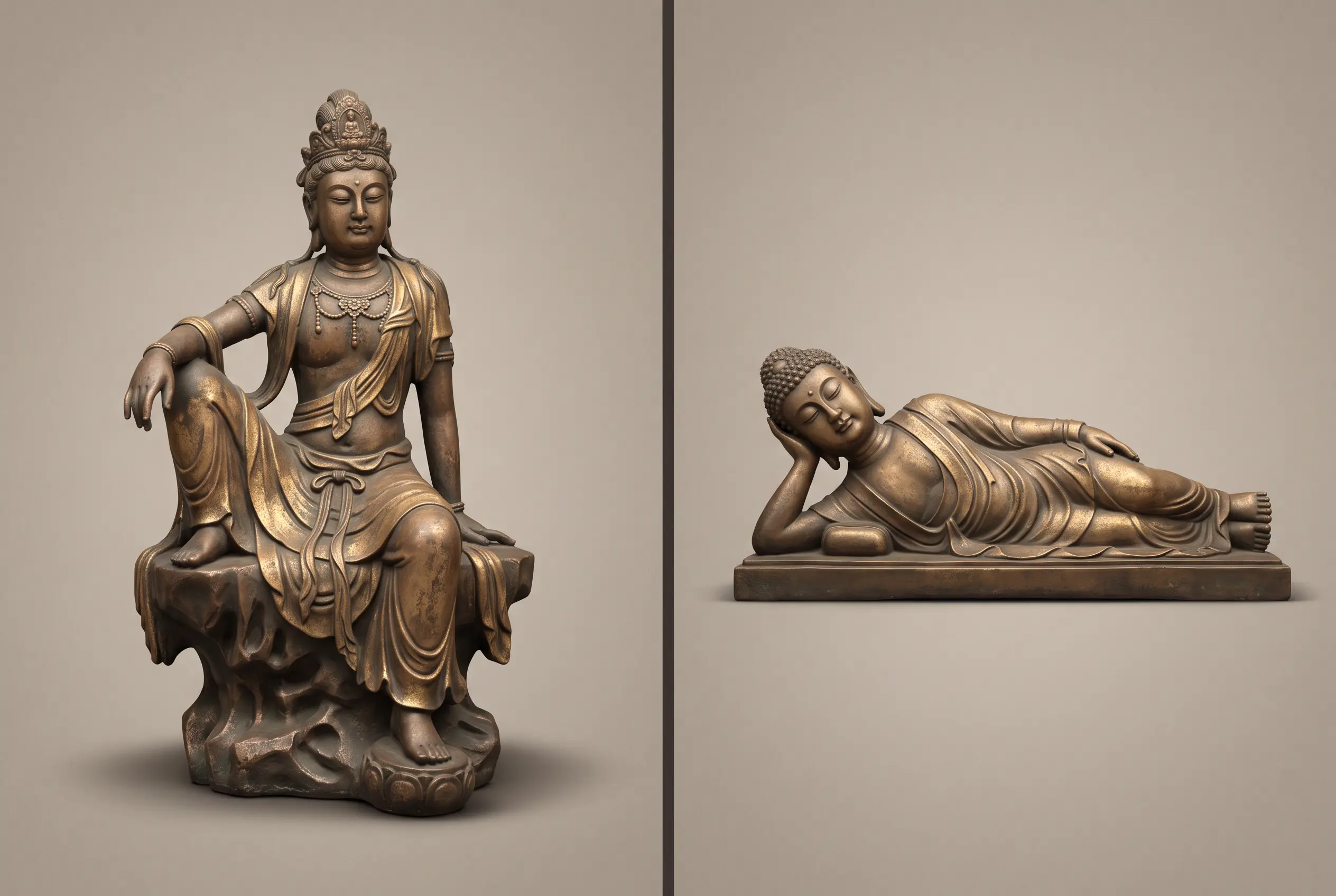
The “royal ease” pose (rajalilasana) of Guanyin, the bodhisattva of compassion, shows a relaxed figure with one knee raised and one arm resting on it, ready to rise at any moment. The parinirvana figure shows rest after a life’s work, with no intention to rise. Seeing the two side by side makes each posture clearer.
ShaoLin Store’s Royal Ease Guanyin statue in solid copper stands 8.9 inches (22.6 cm) tall and weighs 2.16 lb (980 g). That is small enough for a desk or shelf, so you can study the pose up close.
A Timeline of Parinirvana Statues: From Gandhara Stone to Wat Pho Gold
The oldest known reclining Buddha, at Pakistan’s Bhamala Stupa, is described as roughly 1,700 to 1,800 years old, while the largest, Myanmar’s Win Sein Tawya, stretches about 590 feet (180 m) and was begun in 1992.
- About 1,700 to 1,800 years ago, Bhamala Stupa, Gandhara region, Pakistan: a 46-foot (14 m) figure described as the oldest known.
- Late 5th century, Ajanta Cave 26, India: a 23-foot (7 m) rock-cut figure with mourning monks below.
- 5th to 8th century (sources vary), Ajina Tepe, Tajikistan: a monumental clay figure.
- Mid-Tang dynasty, Mogao Cave 158, Dunhuang, China: about 51 feet (15.6 m) long.
- 12th century, Gal Vihara, Sri Lanka: 46 feet (14 m), carved under King Parakramabahu I (1153-1186).
- Date uncertain, Shwethalyaung, Bago, Myanmar: 181 feet (55 m) long.
- 1832, Wat Pho, Bangkok: 151 feet (46 m) long and 49 feet (15 m) high, built under King Rama III.
- 1992, Win Sein Tawya, Mudon, Myanmar: about 590 feet (180 m); construction began 02/29/1992.
- 1995, Nanzoin, Japan: a 135-foot (41 m) bronze figure weighing about 300 tons.
South Asia: Where the Image Began
The earliest known reclining images come from Gandhara art and the cave temples of India. Both are tied to monasteries: Bhamala’s figure sat in a stupa complex, and Ajanta’s was carved into a cave temple. At Kushinagar, the red sandstone image sits at the traditional place of the parinirvana, which is why pilgrims still visit it.
Sri Lanka and Southeast Asia: Rock-Cut and Gilded Giants
Royal and monastic patrons across Sri Lanka and Southeast Asia built the image on a monumental scale. Gal Vihara was cut from a single granite face in the Polonnaruwa period. Wat Pho’s brick-and-plaster figure was gilded in the Rattanakosin period, and Myanmar’s Shwethalyaung and Win Sein Tawya continue that scale.
China, Central Asia, and Japan: Caves, Clay, and Bronze
The image traveled east along the Silk Road. Mogao Cave 158 at Dunhuang holds a painted clay figure inside a cave. Ajina Tepe’s clay figure was found in the ruins of a monastery in Tajikistan, and Japan’s Nanzoin, completed in 1995, is a modern bronze that shows the tradition is still alive.
Why sources disagree. Win Sein Tawya appears as about 590 feet (180 m) in some sources and “600 feet” in others. Mogao Cave 158 is listed at both 15.6 m and 15.8 m. Bhamala is dated to about 1,800 years in one source and called 1,700 years old in another. Shwethalyaung is traditionally dated to 994, but Wikipedia says the actual date is unknown. We give the most widely cited figure and flag the range.
Common Questions About Parinirvana Statues
At Wat Pho, the soles of the reclining Buddha are inlaid with mother-of-pearl in 108 panels showing the auspicious marks traditionally associated with the Buddha. The number 108 is significant across Buddhist practice. It is also why the hall holds 108 bronze bowls for offerings.
According to the Mahāparinibbāna Sutta, the Buddha was 80 when he passed into parinirvana near Kushinagar. The year is debated. Theravada tradition gives 543 BCE, and scholars propose several alternatives, including 487 BCE, 483 BCE, and dates closer to 400 BCE.
No. The reclining Buddha is the historical Shakyamuni at his final passing. The “Laughing Buddha” is Budai, a later Chinese folk figure associated with joy and abundance. Some decor pieces show a reclining Budai, which is a different subject.
Yes, if you display it with care. Common guidance is to keep it off the floor, on a clean surface at eye level or higher, and away from bathrooms and shoe areas. Practices vary by tradition, so ask a teacher if you want specifics. If you are building a quiet space for reflection, start with the posture comparison above.
In summary, a reclining Buddha statue shows the Buddha’s parinirvana at age 80 near Kushinagar, not a nap. The right side, the lion’s posture, and the calm face all trace back to the Pali Canon, and different traditions read the same scene with different emphasis.
The key takeaway is that the image is a quiet reminder of impermanence. It pictures peace after the work is done.
Building a quiet corner for practice? Browse ShaoLin Store’s meditation cushions and singing bowls to set up a space for daily sitting.
⚠️ Important Note: This guide is for cultural and educational purposes. Interpretations differ by tradition and teacher, and it is not religious instruction. For guidance on practice, consult a qualified teacher in your tradition. Dates and measurements for ancient statues vary between sources.
📚 References
- The Death of the Buddha (Parinirvana), Gandhara, Kushan period: Museum record for the schist relief showing the Buddha’s final passing with mourners. The Metropolitan Museum of Art
- Maha-parinibbana Sutta (DN 16), translated by Thanissaro Bhikkhu: The Pali Canon account of the Buddha’s final days, the lion’s posture, and the twin sal trees. Access to Insight
- Parinirvana: Overview of the term, its use in different traditions, and Rupert Gethin’s distinction from nirvana. Wikipedia
- Reclining Buddha: Survey of notable reclining Buddha statues, including Bhamala, Gal Vihara, Wat Pho, and Phnom Kulen. Wikipedia