A Guanyin statue represents compassion that listens and responds. It portrays Guanyin (also spelled Kuan Yin), the Chinese form of Avalokiteshvara, the bodhisattva of compassion in Mahayana Buddhism.
Every detail on the figure works like a sentence, and you can read most of them in under a minute. Seven symbols carry most of the meaning: the Amitabha crown, the hand gesture, the vase, the willow branch, the lotus throne, the many arms, and the royal-ease seat. This guide explains each one, then shows you how to choose a form and place it in your home.
We built this guide from museum records, including the Princeton University Art Museum and the Asian Art Museum in San Francisco, instead of online folklore. ShaoLin Store also carries a solid copper Royal Ease Guanyin, which we use as one worked example later on.
⚠️ Important Note: This guide describes traditional Buddhist symbolism and cultural history. A Guanyin statue is believed to serve as a reminder of compassion. It does not guarantee protection, healing, fertility, or luck, and it does not replace medical or mental health care.
What Does a Guanyin Statue Symbolize?
Guanyin statue symbolism rests on one idea: compassion that notices suffering and acts on it. Guanyin’s name, short for Guanshiyin, means the one who perceives the sounds of the world. Every symbol on the figure, from the vase to the lotus, expresses part of that promise.
A bodhisattva is an enlightened being who chooses to stay in the world to ease the suffering of others. The Princeton University Art Museum notes that bodhisattvas remain in the mortal world even though they are ready to attain nirvana. So the statue shows a helper, not a ruler or a judge.
The One Who Perceives the Sounds of the World
Guanyin is short for Guanshiyin, which means the one who perceives the sounds of the world. Princeton’s museum label reads the name as a figure who hears the world’s sorrows. In chapter 25 of the Lotus Sutra, the bodhisattva vows to save people in danger, from shipwreck to violence. That vow is why the figure is traditionally shown attentive and calm.
Is Guanyin a Buddha or a Bodhisattva?
Guanyin is a bodhisattva, not a Buddha. A Buddha has completed the path to awakening. A bodhisattva postpones final release to help others, and that choice is the heart of the Mahayana ideal.
On a statue, a crown and jewelry usually mark a bodhisattva. For a Buddha figure to compare, see the Shaolin Quiet Sakyamuni Buddha statue, a bust of the historical Buddha with a silence gesture.
Kuan Yin, Kwan Yin, Avalokiteshvara, Chenrezig: One Bodhisattva, Many Names
Guanyin, Kuan Yin, Kwan Yin, and Quan Yin are spellings of one Chinese name for Avalokiteshvara, the Indian bodhisattva of compassion, known as Kannon in Japan and Chenrezig in Tibet.
| Name | Where it is used | Note |
|---|---|---|
| Avalokiteshvara | India (Sanskrit) | The original name, shown as a masculine figure in early art |
| Guanyin (Kuan Yin, Kwan Yin, Quan Yin) | China | Spellings vary by romanization; all name the same figure |
| Kannon | Japan | The Japanese name for the same bodhisattva |
| Chenrezig | Tibet | The Tibetan name for the same bodhisattva |
| Quan Âm | Vietnam | The Vietnamese name for the same bodhisattva |
Goddess of Mercy is a popular English label, not a Buddhist title. Princeton’s handbook traces the phrase to early Jesuit interpretations of the deity’s role. We use “bodhisattva of compassion” as the more accurate term.
Guanyin’s Timeline: From the 1st Century to the Yuan Dynasty
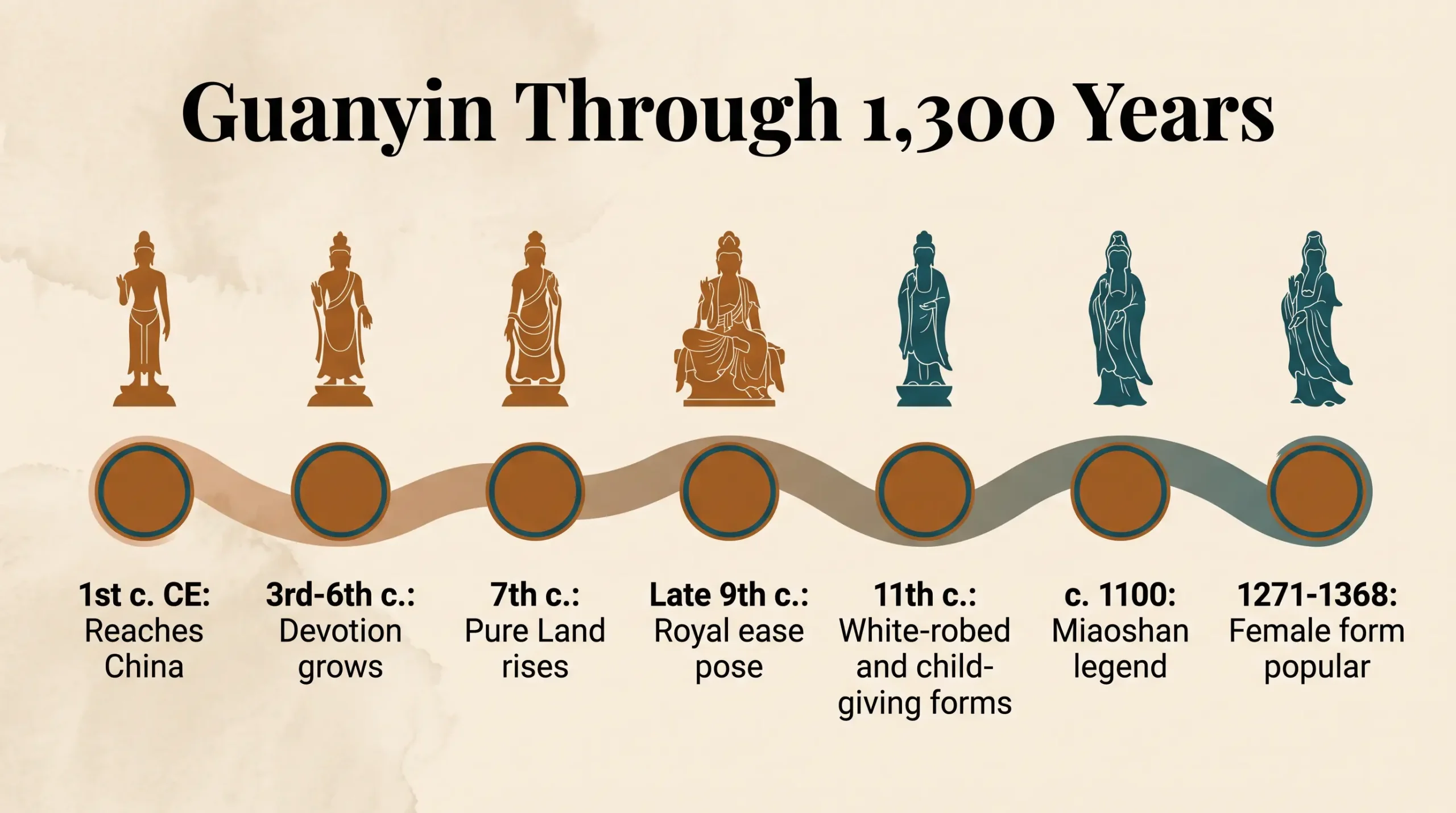
Guanyin’s image changed over roughly 1,300 years, and museum records let you date each step.
- 1st century CE: Guanyin’s veneration reaches China along with Buddhism, according to the University of Michigan Museum of Art.
- 3rd to 6th century: A cult devoted to the bodhisattva emerges in China, per Princeton.
- 7th century: The rise of the Pure Land school makes Guanyin a prominent figure.
- Late 9th century: The relaxed royal-ease pose becomes associated with Guanyin in China.
- 11th century: An apocryphal sutra describes the white-robed and child-giving forms.
- Around 1100: The tale of the princess Miaoshan attaches to Guanyin, linking her to the thousand-armed figure.
- 1271 to 1368 (Yuan dynasty): The female form becomes popular, as the Asian Art Museum records.
Is Guanyin Male or Female?
Guanyin is neither strictly male nor female: early Chinese images look masculine, and later images look increasingly feminine. Avalokiteshvara is male in the Lotus Sutra, and Princeton’s handbook says early bodhisattva figures are generally shown as androgynous, handsome males.
The Asian Art Museum dates the shift to the ninth century, when carvers began softening the face and torso. Princeton points to the 11th and 12th centuries. Museums date the change differently, so a statue that reads as either gender is traditional, not a flaw. The Lotus Sutra also describes more than thirty manifestations, each reaching a different kind of person.
Guanyin vs. Tara: How Are They Different?
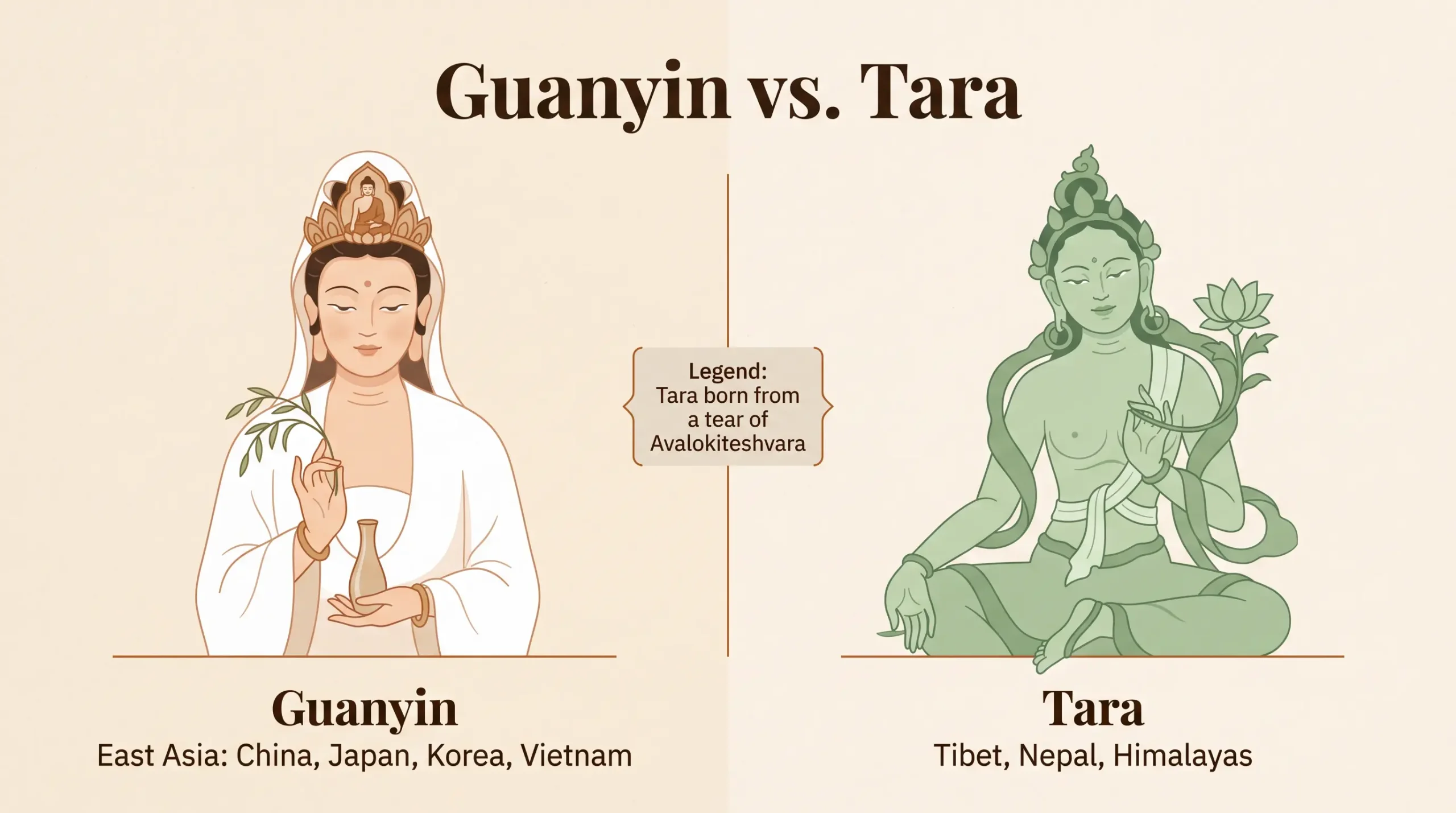
Guanyin and Tara are different figures: Guanyin is a bodhisattva of compassion honored mainly in East Asia, while Tara is a female bodhisattva honored mainly in Tibetan Buddhism. A Tibetan legend says Tara was born from a tear of Avalokiteshvara, which is why the two are often linked.
| Feature | Guanyin | Tara |
|---|---|---|
| Main region | China, Japan, Korea, Vietnam | Tibet, Nepal, and Himalayan regions |
| Common look | White robe, vase, willow branch, Amitabha figure in the crown | Often seated with one leg extended and a lotus in hand |
| Best-known link | Bodhisattva of compassion; Lotus Sutra chapter 25 | Tibetan legend of birth from Avalokiteshvara’s tear |
Decode the Symbols in 10 Seconds: Vase, Willow, Lotus, and Hands
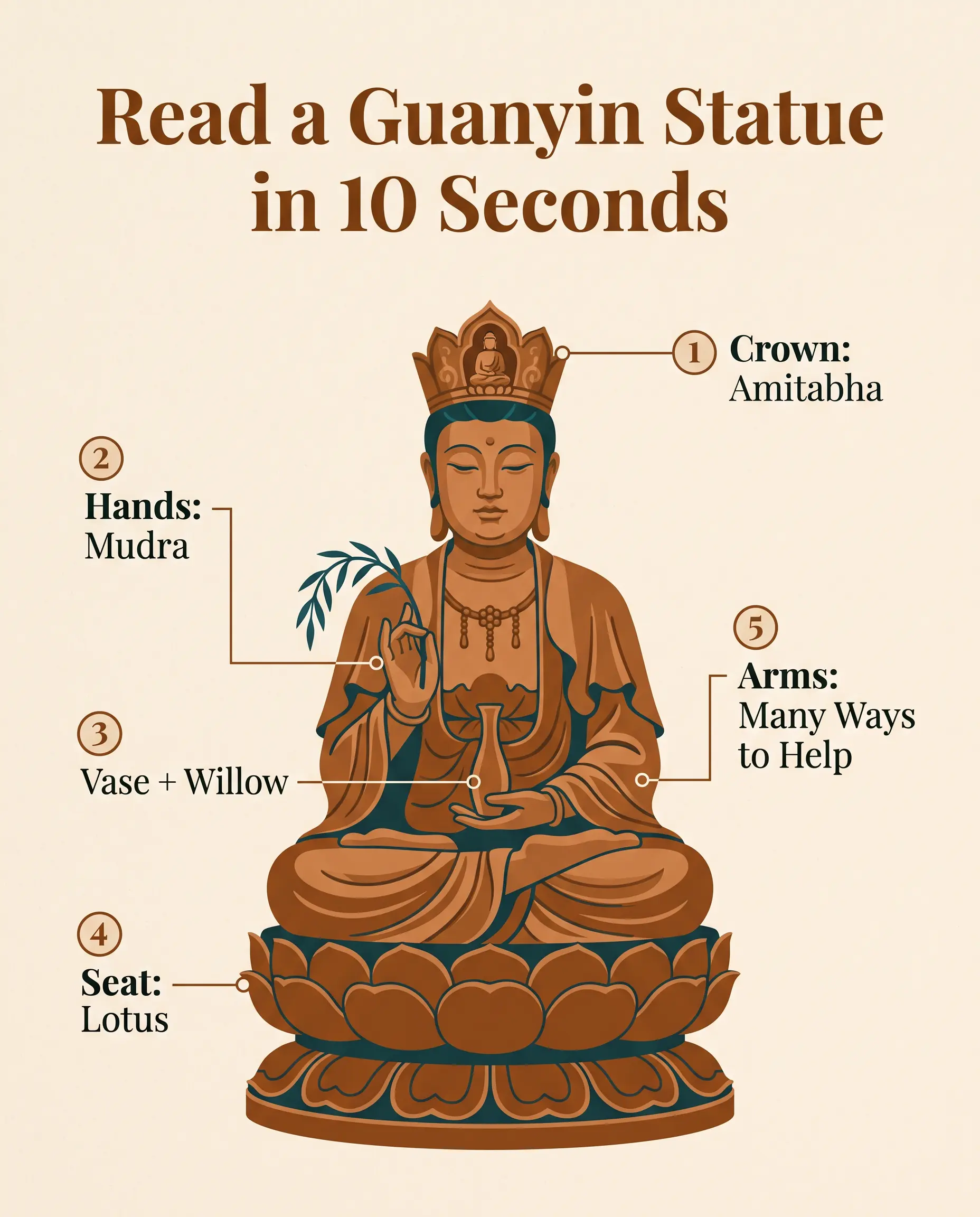
To read a Guanyin statue, check these five things in order:
- Crown: Look for a tiny seated Buddha. That is Amitabha, and it usually identifies the figure as Guanyin.
- Hands: A raised open palm traditionally signals reassurance. A lowered open palm signals giving.
- Held objects: A vase holds pure water, and a willow branch stands for flexible compassion.
- Seat: A lotus throne means purity that rises from mud. A rock above waves points to the Water-Moon form.
- Arms: Two arms is the common form. A thousand arms signals many ways of helping.
You will probably notice the lowered eyes before you notice the vase. The downcast gaze is traditionally read as attention turned toward the people below.
What Does the Vase on a Guanyin Statue Mean?
The vase on a Guanyin statue holds pure water, sometimes described as compassionate nectar, and it traditionally symbolizes purification and relief from suffering. The willow branch, usually held in her other hand, is read as compassion that bends without breaking. Together, the vase and willow branch show how mercy is given: gently and without force.
Lotus Throne, Mudras, and the Small Buddha in the Crown
The lotus throne symbolizes purity because the flower rises clean from muddy water. A mudra is a symbolic hand gesture, and on Guanyin it usually signals reassurance or generosity.
The small Amitabha figure in the crown is the most reliable identifier. Princeton’s handbook uses it to confirm that a sculpture is Guanyin. We check the crown first, because it settles identity faster than any other detail. A few statues omit it, so treat it as a strong clue, not a rule.
Why Does Guanyin Have a Thousand Arms?
Guanyin has a thousand arms and eyes to show many ways of helping: the eyes see the world’s troubles, and the arms reach out to assist. Princeton’s handbook describes this reading and connects the figure to the legend of Miaoshan. According to that legend, the princess gave her own eyes and arms as medicine for her father, and was then revealed as a thousand-armed, thousand-eyed bodhisattva.
Which Form of Guanyin Matches Your Intention?
Choose the form by the quality you want to live with: Royal Ease for calm that stays ready, White-Robed for quiet contemplation, Thousand-Armed for a dedicated altar.
| Form | How to spot it | Traditional meaning | Often chosen for |
|---|---|---|---|
| Royal Ease (Water-Moon) | One knee raised, one arm resting on it, often on a rock | Calm that stays ready | A desk, shelf, or home office |
| White-Robed | A plain white robe | Quiet contemplation and purity | A meditation corner |
| Thousand-Armed | Many arms fanning out behind the body | Many ways of helping | A dedicated altar with open space |
| Child-Giving | A child held in her arms or beside her | Traditionally linked to family wishes | A family shrine |
Royal Ease and Water-Moon Guanyin: Calm That Stays Ready
Royal ease (rajalilasana) is a seated pose with one knee raised and one arm resting on it. Princeton’s museum label says the pose became associated with Guanyin in China by the late ninth century. Of Guanyin’s 33 manifestations, the Asian Art Museum notes, the Water-Moon form is among the most frequently represented.
In the Water-Moon Guanyin form, the bodhisattva sits in royal ease on a rock at Potalaka, her legendary island home, and watches the moon’s reflection in the water. The reflection points to a core Buddhist idea: what we cling to is as fleeting as a moon on a ripple. Later tradition linked Potalaka to Mount Putuo, an island off Zhejiang province.
ShaoLin Store’s Royal Ease Guanyin statue in solid copper follows this tradition, with the figure resting on a rocky ledge above teal waves and a lotus. Because it is solid copper and weighs 2.16 lb (980 g), it sits steady on a shelf, and the surface deepens in tone over time. At 8.9 in (22.6 cm) tall, it fits a desk or altar without needing a dedicated shrine.
White-Robed and Child-Giving Guanyin
The White-Robed form is traditionally associated with calm and purity, and the Child-Giving form is traditionally associated with families hoping for children. Princeton’s handbook dates both to an 11th-century apocryphal sutra. No statue guarantees an outcome, so treat both forms as expressions of care, not promises.
See the Royal Ease form in solid copper. The statue is 8.9 in (22.6 cm) tall, ships free, and comes with a 60-day return window.
See the Royal Ease Guanyin → $388.95 (was $426.95), price checked 10/30/2026
Where Should a Kuan Yin Statue Face in Your Home?
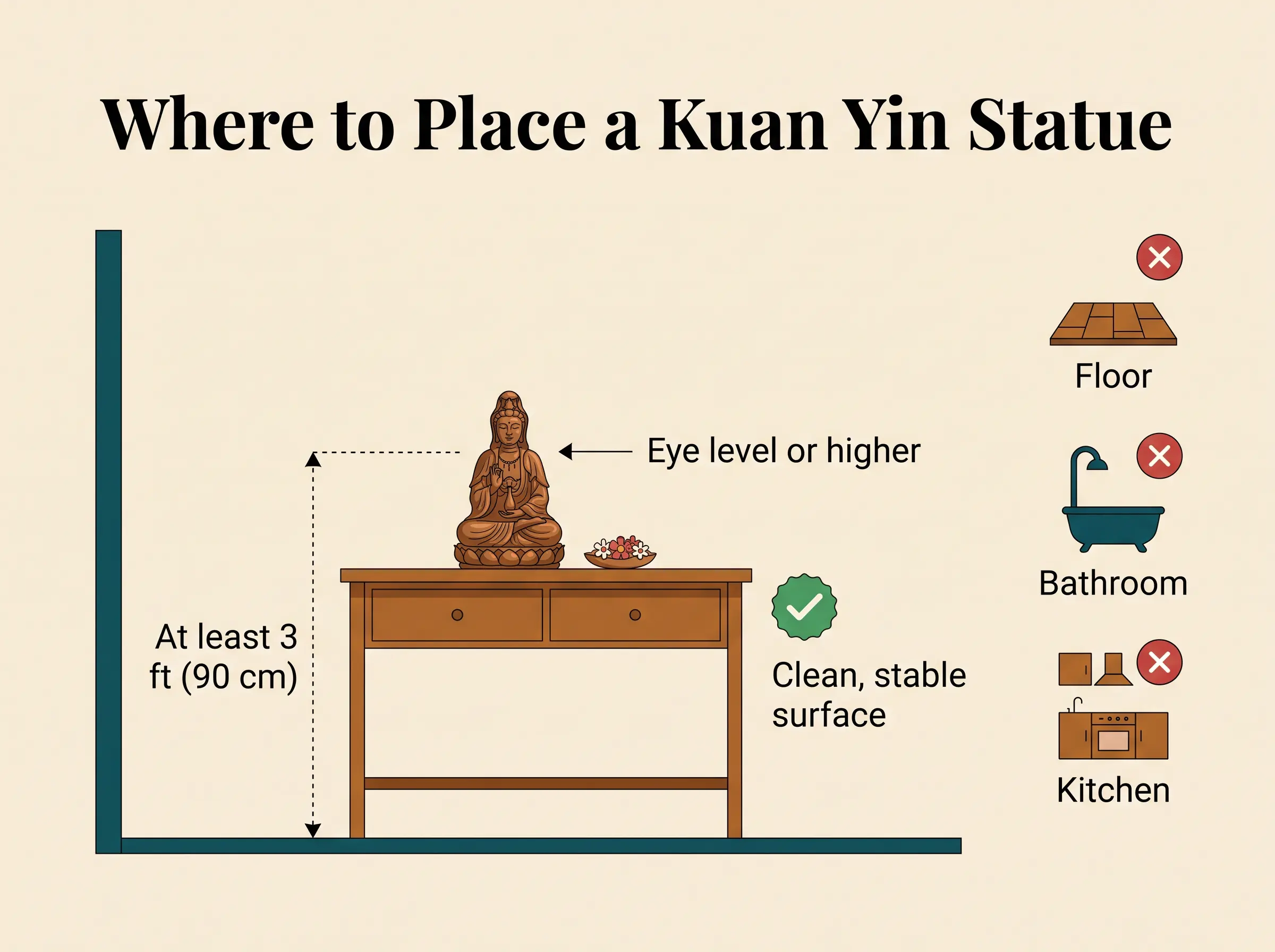
Place a Kuan Yin statue at eye level or higher, at least 3 ft (90 cm) off the floor, on a clean and stable surface, facing into the room rather than toward a wall, bathroom, or kitchen.
If you worry about getting placement wrong, take comfort in this: Buddhist tradition is gentler than many online rules suggest, and no single compass direction is mandatory. Respect and care matter more than the exact angle.
Height, Direction, and Rooms to Avoid
- Height: Eye level or above, and at least 3 ft (90 cm) off the floor.
- Direction: Face the space where you live or work, so the statue looks into the room.
- Surface: Choose a clean, quiet spot such as a desk, shelf, console, or home altar.
- Avoid: The floor, bathrooms, and kitchens.
- Space: Leave empty room around the figure. Many households add fresh flowers or a small dish of clean water as offerings.
Is It Disrespectful to Have a Guanyin Statue If You Are Not Buddhist?
No, it is not disrespectful when you display a Guanyin statue with care and not as a novelty. Many people keep one simply as a reminder of compassion and calm. Three simple rules cover most concerns:
- No jokes or props: Do not dress the statue up or use it as a party decoration.
- No lucky-charm talk: Treat it as a symbol of compassion, not a guarantee of results.
- Keep it clean and elevated: Dust it regularly and give it its own surface.
Caring for Copper, Wood, and Stone Statues
Dust copper with a soft, dry cloth and skip metal polish. Copper deepens in tone as a natural patina forms, and abrasive polish can strip the finish. Keep wood away from heaters and damp corners. Handle porcelain with both hands, and give outdoor stone a spot where water can drain.
What a Guanyin Statue Can and Cannot Do
A Guanyin statue can anchor a daily habit of compassion, but it cannot guarantee protection, healing, fertility, or luck. Any seller who promises those outcomes is overselling.
| A statue can | A statue cannot |
|---|---|
| Remind you to pause and respond with patience | Guarantee protection, healing, fertility, or luck |
| Give you a focal point for meditation or a mindful pause | Replace medical or mental health care |
| Mark a quiet corner of your home | Prove its age or origin from photos alone |
What a Statue Can and Cannot Tell You
Photos can show a statue’s form and attributes, but they cannot prove its age, consecration, or origin. You can confirm the crown, hands, held objects, and seat from an image. Anything about age or ritual needs a documented source, so read claims closely.
A 4-Point Checklist Before You Buy or Gift
- Form and attributes: Check that the crown, hands, held objects, and seat match the form the seller names.
- Material and weight: Look for a named material and a listed size and weight. Copper, bronze, wood, porcelain, stone, and resin all appear, and each handles differently. Resin is lighter and tips more easily.
- Blessing claims: Read the exact wording. The Royal Ease product page says Shaolin monks bless each statue with the intention of bringing steadiness and compassion to your space. Treat that as an intention, not a guarantee.
- Shipping and returns: Confirm costs and the return window before you order. The Royal Ease page lists free shipping and a 60-day return period.
Choosing between forms? Browse the full range of handmade Buddhist statues and compare materials, sizes, and poses side by side.
Frequently Asked Questions About Guanyin Statues
Some households avoid bedrooms out of respect, while others keep a small Guanyin there for calm at the start and end of the day. If you do, place it high, keep the surface clean, and avoid facing the bed directly.
Yes, when the recipient is comfortable with religious imagery. It suits a housewarming or a friend starting a new chapter, and a short note about what Guanyin represents helps the gift land well. A surprise gift to someone uneasy with it can feel awkward, so choose a size that fits their space.
In Buddhist practice, consecration is a ritual that marks an image for devotional use, and temple customs vary. Read the seller’s exact wording, and treat a blessing as an intention rather than a guarantee of results.
Om Mani Padme Hum is the six-syllable mantra traditionally linked to Avalokiteshvara, and in Chinese Buddhism it is mainly associated with Guanyin. It first appears in the Kāraṇḍavyūha Sūtra. A wearable version is one way to keep the practice close during the day.
In summary, a Guanyin statue means compassion that listens and responds. Read the crown, hands, held objects, seat, and arms to identify the form, choose the pose that matches the quality you want to live with, and place the figure at eye level, at least 3 ft (90 cm) high, facing into the room.
Carry the Six Syllables With You
ShaoLin Store’s handwoven six-syllable mantra bracelet pairs a cord with an S999 fine silver Om Mani Padme Hum bar, so the mantra stays in view through your day.See the Mantra Bracelet →
$89.95 (was $126.95), price checked 10/30/2026
Editorial note: Written by our editorial team and checked against the museum records listed below. Product details were checked against the live product pages on 10/30/2026.
📚 References
- Guanyin seated in “royal-ease” pose (ca. 1250): Museum label and handbook entry covering the name Guanyin, the Lotus Sutra, the royal-ease pose, the Amitabha crown, and the origin of “Goddess of Mercy.” Princeton University Art Museum
- The bodhisattva Avalokiteshvara (Guanyin): Collection essay on the Water-Moon form, Guanyin’s 33 manifestations, and the shift in gender presentation. Asian Art Museum, San Francisco
- Tileworks figure of Guanyin: Object record noting that Guanyin’s veneration reached China as early as the 1st century CE. University of Michigan Museum of Art
- Om Mani Padme Hum: Overview of the six-syllable mantra and the names Guanyin, Kannon, and Chenrezig. The Matheson Trust