
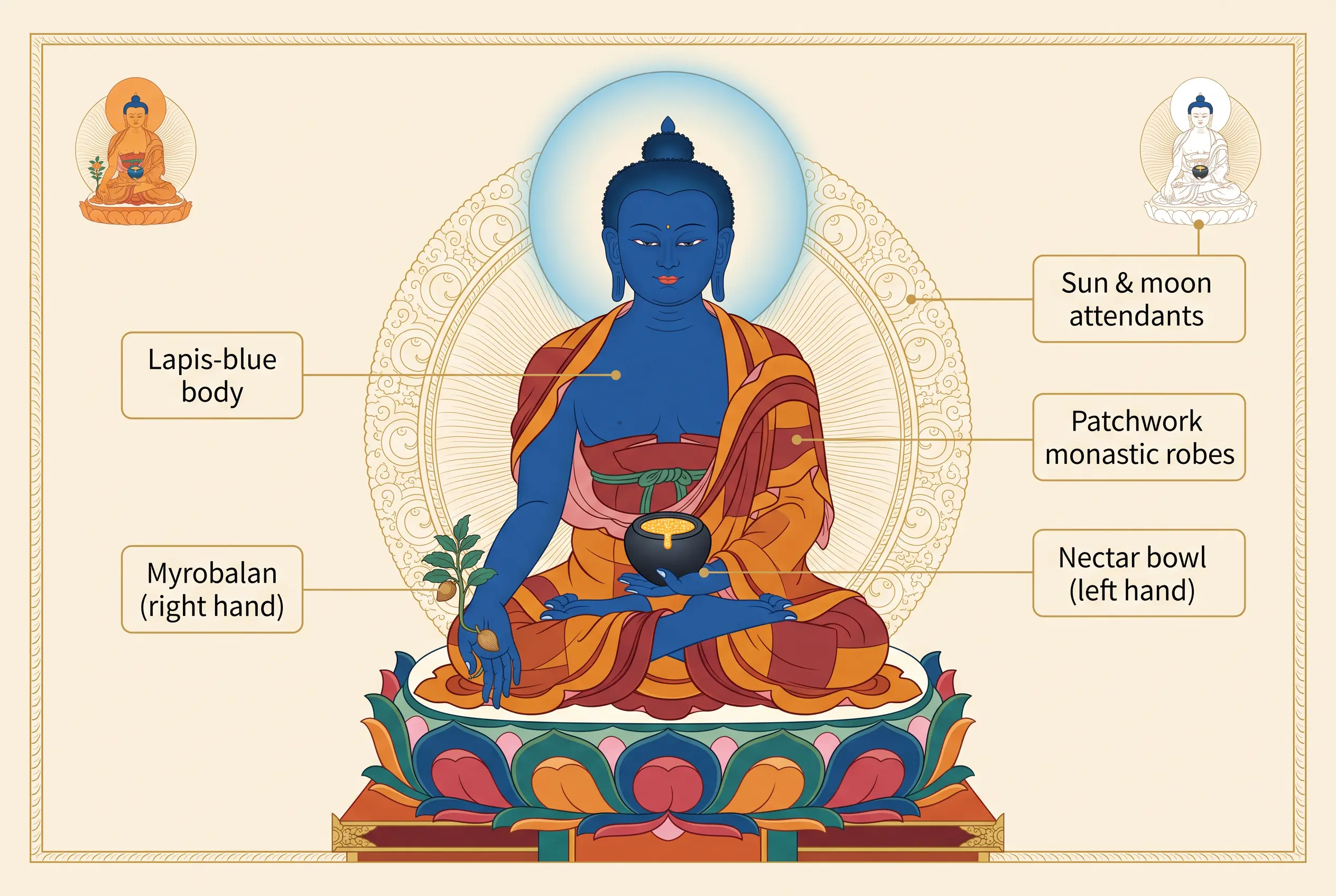
The Medicine Buddha, or Bhaisajyaguru, is the Mahayana Buddha of healing. He appears with a deep blue body, a medicinal myrobalan fruit in one hand, and a bowl of nectar in the other. Practitioners traditionally recite his mantra, a sacred phrase used in meditation, with the wish to ease suffering in body and mind.
You may have met him on a thangka (a Tibetan scroll painting) or in a museum case. What do the blue skin, the fruit, and the Sanskrit syllables mean? This guide reads each one in turn. You will learn how to recognize his image, follow his mantra line by line, and display a statue or thangka with care.
ShaoLin Store prepared this guide from museum records and teacher commentary, not from retail copy. We draw on the Rubin Museum of Art, Himalayan Art Resources, and the Smart Museum of Art at the University of Chicago. Where traditions disagree, we say so.
Important note: This guide explains religious symbolism and Buddhist tradition. It is not medical advice, and mantra practice does not replace care from a licensed health professional.
What Does the Medicine Buddha Represent?
The Medicine Buddha represents the Buddhist ideal of healing as the removal of suffering and its causes. Known in Sanskrit as Bhaiṣajya-guru-vaiḍūrya-prabha-rāja, “Medicine Guru, King of Lapis Lazuli Light,” he is a Mahayana Buddha whose twelve vows promise relief from illness, hardship, and ignorance.
As a Mahayana figure, he belongs to the tradition that honors many buddhas. Himalayan Art Resources (HAR) notes that all schools of Tibetan Buddhism honor him and that he is especially important to Tibetan medical traditions.
Bhaisajyaguru, Sangye Menla, Yaoshi Fo: One Buddha, Many Names
The Medicine Buddha is called Bhaisajyaguru in Sanskrit, Sangye Menla in Tibetan, and Yaoshi Fo in Chinese. Each name points to the same healer.
| Tradition | Name | Literal sense |
|---|---|---|
| Sanskrit | Bhaiṣajyaguru (full: Bhaiṣajya-guru-vaiḍūrya-prabha-rāja) | Medicine Guru; King of Lapis Lazuli Light |
| Tibetan | Sangye Menla (sangs rgyas sman bla) | The Buddha, Guru of Medicine |
| Chinese | Yaoshi Fo 藥師佛; Yaoshi Rulai 藥師如來; full name Yaoshi Liuliguang Rulai 藥師琉璃光如來 | Medicine Master Buddha; Medicine Master Tathagata of Lapis Lazuli Light |
The Chinese name holds a clue. Liuli (琉璃) renders the Sanskrit vaidurya, a blue gem that most translators identify as lapis lazuli. HAR offers “sapphire” as an alternative reading. If you have seen liuli on a piece of Chinese glasswork, you have met the same word.
What Are the 12 Vows of the Medicine Buddha?
The twelve vows are the aspirations the Medicine Buddha voices in the Bhaisajyaguru Sutra, a text that Shakyamuni is said to have taught. Three examples show their range:
- Vow 1, light: his body shines with boundless light that dispels ignorance and worry.
- Vow 3, needs: he supplies what beings require, so that they are free from want.
- Vow 7, relief: he eases the suffering of the sick and the poor.
Chinese translators rendered the sutra four times. Srimitra worked in the early fourth century, Dharmagupta in the early seventh, Xuanzang in 650, and Yijing in 707. Those versions carried the vows across East Asia.
Is the Medicine Buddha a Real Buddha?
Mahayana and Vajrayana Buddhists count the Medicine Buddha among the many buddhas, but he is a different figure from the historical Shakyamuni. In the sutra, Shakyamuni describes him and his eastern realm, as HAR and the 84000 translation project both explain.
Manuscripts show the text circulating early. The Gilgit collection alone holds at least five copies of the sutra, with two distinct versions in use during the fifth and sixth centuries. Whether you read him as a literal being or as a symbol of healing compassion depends on your tradition and your own practice.
How to Recognize Bhaisajyaguru in Art
Five visual clues identify the Medicine Buddha in most Tibetan paintings and statues.
| Element | What you see | Traditional meaning |
|---|---|---|
| Body color | Deep blue | The lapis lazuli radiance named in his sutra |
| Right hand | Extended in a gesture of generosity, holding a myrobalan | Healing fruit offered to those in need |
| Left hand | Resting in the lap, supporting a black monk’s bowl filled with nectar | Meditation and the “medicine” of his teaching |
| Robes and seat | Patchwork monastic robes, left arm covered, seated on a lotus and lion throne | The form of a fully ordained monk |
| Attendants | Sun and moon bodhisattvas, typically orange or gold for the sun and white for the moon | The light of the sun and the light of the moon |
Why Is the Medicine Buddha Blue?
His deep blue body echoes vaidurya, the lapis lazuli light named in his sutra, and Tibetan painters render it as a jewel-like radiance. HAR describes the figure in a 16th-century Rubin painting as dark blue. Art historian Amy Heller adds that the blue is clearly linked to the sutra’s lapis lazuli radiance.
Blue is common, not universal. Heller notes that Dunhuang murals most often show him blue or pale flesh-toned. Surviving portable paintings from Dunhuang and Central Asia tend to show him beige or gold. Color alone does not settle his identity either, because Akshobhya is also painted blue. Check the hands first.
What Is He Holding? Myrobalan and the Nectar Bowl
In his right hand the Medicine Buddha holds a myrobalan, and in his left he holds a nectar bowl. Myrobalan is the medicinal fruit of Terminalia chebula, also called haritaki. HAR describes the black begging bowl in his lap as filled with nectar.
The Smart Museum uses these two attributes to identify its bronze. Its catalog names the wish bowl in his left hand and the remains of a medicinal plant in his right. Traditionally, practitioners read the fruit as medicine offered freely, which fits HAR’s note that he matters especially to Tibetan medicine.
Mudras, Robes and Throne: Reading the Variations
Most Tibetan images show the right hand extended in the varada mudra and the left hand resting in the lap. A mudra is a symbolic hand gesture. HAR describes this arrangement in a 16th-century painting that measures 34 × 24.5 in (86 × 62 cm).
Earlier images differ. In an 836 silk painting from Dunhuang, the right hand rises toward the heart, close to the vitarka mudra of teaching. It pinches a golden leaf of a medicinal plant. The left hand still holds a bowl of nectar. Expect variation, then, and confirm the figure by its objects rather than by one fixed pose.
The robe and seat give further clues. HAR lists patchwork monastic robes, a covered left arm, and a seat in vajra posture on a lotus and lion throne.
To study a seated posture in three dimensions, see how hands and robe folds read on our aged copper meditating Buddha statue with a mud-gold finish. It is not a Medicine Buddha, so use it as a reference for form. The aged finish keeps your eye on the posture, so hand placement is easier to compare.
The Healing Mantra, Line by Line
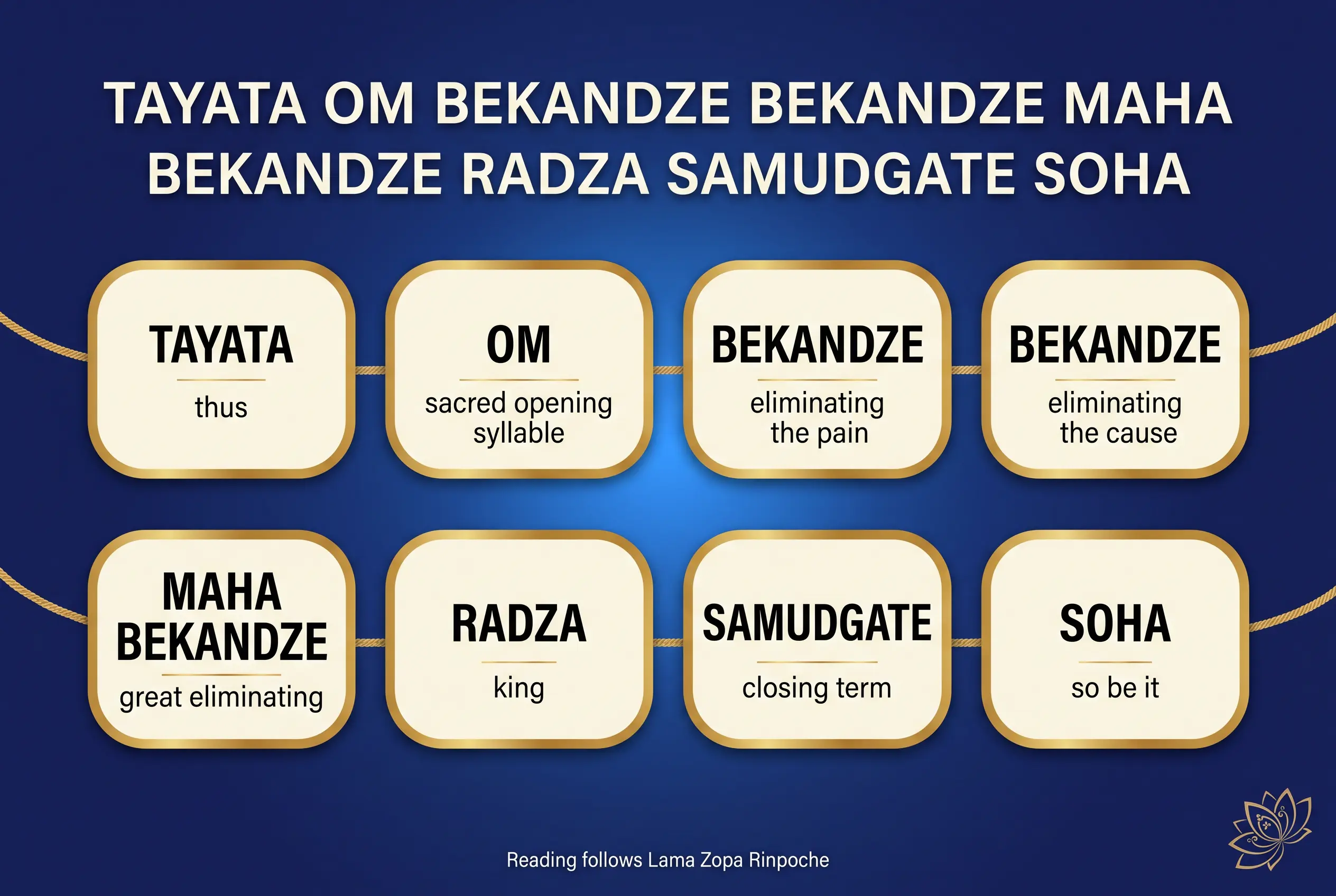
The mantra, Tayata Om Bekandze Bekandze Maha Bekandze Radza Samudgate Soha, breaks into eight parts:
- Tayata: “thus” or “it is like this,” the opening that introduces the words to follow.
- Om: the sacred opening syllable of many mantras.
- Bekandze (first): “eliminating the pain,” in Lama Zopa Rinpoche’s reading, the suffering itself.
- Bekandze (second): eliminating the cause of that suffering, karma and disturbing thoughts.
- Maha bekandze: “great eliminating of the pain.”
- Radza: “king,” from the Sanskrit rāja.
- Samudgate: a closing term that teachers gloss in different ways.
- Soha: the closing invocation, from the Sanskrit svāhā, often rendered “so be it.”
What Does “Tayata Om Bekandze” Mean?
In Lama Zopa Rinpoche’s explanation, bekandze means “eliminating the pain,” and the repetition works in layers. The first bekandze names the true suffering, the whole problem, including death. The second names its cause, which he describes as karma and disturbing thoughts. Maha bekandze then deepens the wish: great eliminating of the pain.
Other teachers read the same words as an address to the healer. The Tibetan Buddhist Institute quotes its founder, Kyabje Khensur Kangyurwa Rinpoche, and presents bekandze as “doctor.” Radza becomes “king of the doctors.” Both readings live in practice, so you can hold them side by side.
Samudgate or Samungate? Soha or Svaha? Why Spellings Differ
Spellings differ because the mantra passed from Sanskrit into Tibetan pronunciation and then into many English transliterations. Pages of the Lama Yeshe Wisdom Archive alone print “radza samudgate soha,” “randze samungate soha,” and “radza samudgate svaha.” Treat these as variants, not errors.
| Part | Sanskrit | Common pronunciation | Other spellings seen |
|---|---|---|---|
| Tayata | tadyathā | tayata | tadyatha |
| Bekandze | bhaiṣajye | bekandze | unchanged |
| Maha bekandze | mahā-bhaiṣajye | maha bekandze | unchanged |
| Radza | rāja | radza | randze |
| Samudgate | samudgate | samudgate | samungate |
| Soha | svāhā | soha | svaha |
The same archive marks one extra bekandze after maha bekandze as optional. Chinese Buddhist texts also preserve a shorter Sanskrit form, oṃ bhaiṣajye bhaiṣajye bhaiṣajya-samudgate svāhā.
Most guides we reviewed print a single form and never explain the others. If you chant with a teacher, follow the pronunciation your teacher gives you.
How Practitioners Traditionally Recite It
Practitioners traditionally recite the mantra in counted sets, tracked on a mala. A mala is a string of 108 prayer beads. Counts vary by teacher and text. Lama Zopa Rinpoche advises reciting the seven names of the Medicine Buddha seven times a day if you can. Many practitioners count the mantra itself in sets of 21 or 108.
Teachers also stress motivation: dedicate the practice to the benefit of others, not only yourself. If the closing words feel hard, split samudgate into sa-mud-ga-te and say it slowly.
Different mantras belong to different figures. The six-syllable mantra, Om Mani Padme Hum, belongs to Avalokiteshvara (Guanyin), not to the Medicine Buddha. For a wearable reminder of that practice, see our Om Mani Padme Hum six-syllable mantra bracelet.
A note on practice: Traditional texts describe the benefits of mantra recitation in religious terms. These descriptions are matters of faith, not medical claims. A qualified teacher can help you learn pronunciation and context.
Healing Buddha vs. Shakyamuni vs. Amitabha: How to Tell Them Apart
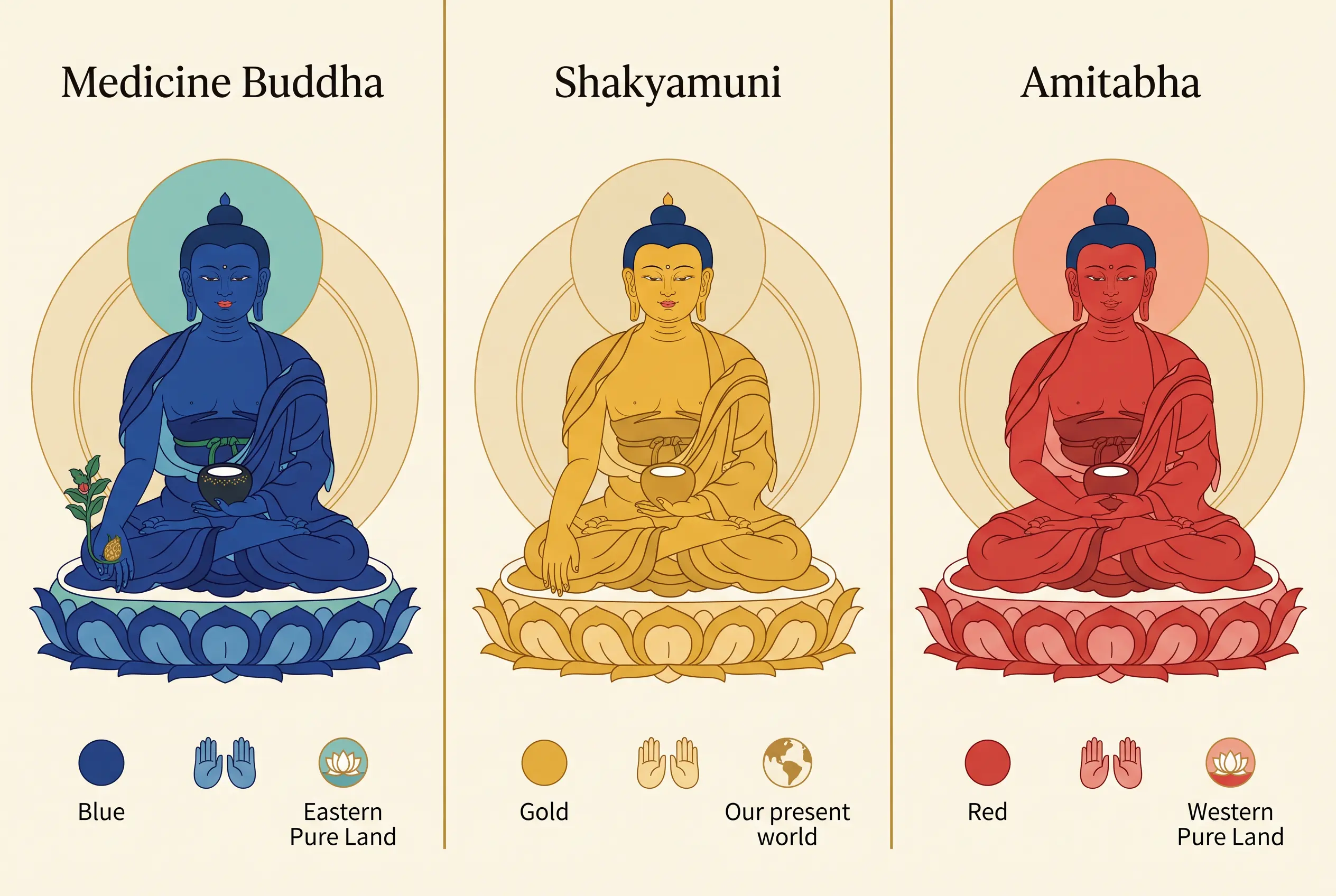
In Tibetan painting, three features separate these buddhas fastest: body color, hand objects, and pure land.
| Feature | Medicine Buddha | Shakyamuni | Amitabha |
|---|---|---|---|
| Body color | Deep blue | Gold-yellow | Red |
| Hands and objects | Myrobalan in the right hand, nectar bowl in the left | Often an earth-touching right hand, bowl in the lap | Both hands in meditation, holding a bowl |
| Realm | Eastern Pure Land, Vaiduryanirbhasa (“Pure Lapis Lazuli”) | Teaches in our present world | Western Pure Land, Sukhavati |
| Central concern | Relief from suffering and its causes | Teaching and awakening | Rebirth in his pure land |
Medicine Buddha vs. Shakyamuni: Color and Hands Tell Them Apart
In later Tibetan painting, Shakyamuni is usually gold and the Medicine Buddha is blue with a myrobalan in his hand. The two are also linked. HAR’s Rubin painting places Shakyamuni in the Medicine Buddha’s retinue, and the Rubin glossary defines the Eight Medicine Buddhas as seven buddhas plus Shakyamuni.
If you want a Shakyamuni figure for side-by-side comparison, look at the Shaolin Quiet Sakyamuni statue.
Eastern Pure Land vs. Western Pure Land
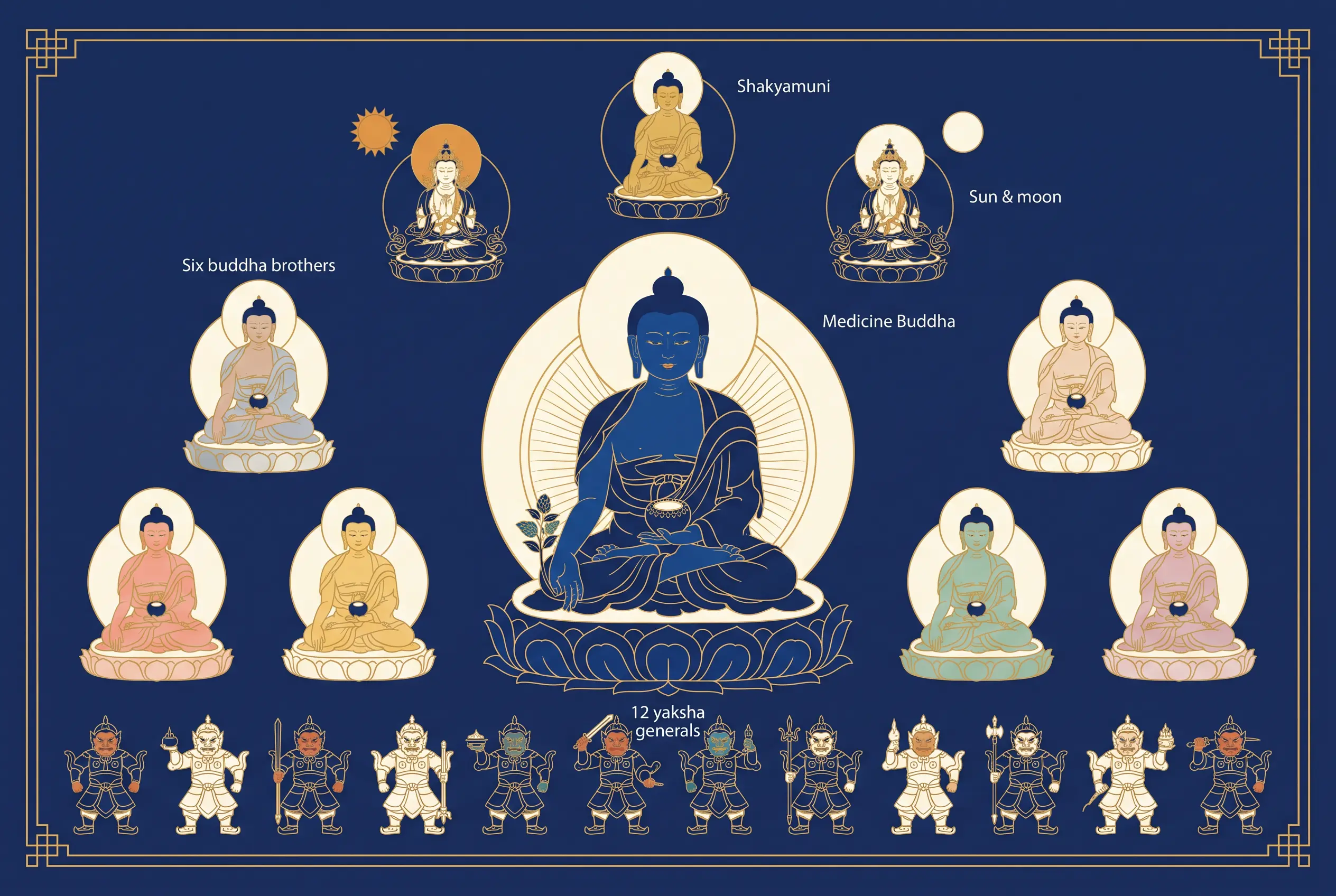
The Medicine Buddha presides over the Eastern Pure Land of Vaiduryanirbhasa, while Amitabha presides over Sukhavati in the west. In the Medicine Buddha’s realm, two bodhisattvas attend him as the light of the sun and the light of the moon.
The Seven (or Eight) Medicine Buddhas and Twelve Yaksha Generals
Tibetan paintings often surround the Medicine Buddha with six buddha brothers, a group called the Seven Buddhas of Medicine. The 16th-century Rubin painting shows the full arrangement. Its lower row holds the twelve yaksha generals, guardian spirits tied to the sutra. According to the sutra, they pledge to protect those who hold his name.
From Silk Road Scrolls to Your Shelf: Displaying Buddha Statues and Thangka with Care
Museum pieces show that artists adapted the Medicine Buddha to local taste for centuries, so no single image is the only correct one.
What Museum Pieces Reveal
A bronze at the Smart Museum shows a Chinese artist making a Tibetan Buddhist deity. The cast bronze dates to the late 14th or early 15th century, stands 10-1/8 in (25.7 cm) tall, and still carries traces of gilding. The museum suggests that a high-ranking member of the Chinese imperial court, or the emperor himself, most likely commissioned it. The likely purpose was a gift for a Tibetan Buddhist center or monk. Its record also lists the Chinese title 藥師如來, Yaoshi Rulai.
The 836 Dunhuang painting tells a more personal story. According to Heller, a Tibetan monk named Pelyang commissioned it for his own health and to transfer merit to his deceased parents. Heller describes it as the earliest extant dated portable painting, with a Tibetan inscription for the year 836. At Dunhuang, ninety-seven Bhaisajyaguru paradises have been identified in murals, from the Sui dynasty (581 to 618) to the Xixia period (1038 to 1227).
Choosing a Thangka or Statue with Care
Check four clues before you choose a figure: blue body, myrobalan in the right hand, nectar bowl in the left, and monastic robes. A blue statue without a fruit or a bowl may be a different buddha. Ask the seller to name the figure and describe its hand objects. A beige or gold figure can still be the Medicine Buddha, as the Dunhuang paintings show.
To compare postures, materials, and finishes in one place, browse our handmade Buddha and bodhisattva statues. Seeing several seated figures together makes it easier to match a piece to the practice you have in mind.
Placement and Respect at Home
Place a Buddha statue or thangka on a clean, raised surface at heart height or higher, facing into the room. Buddhist custom generally asks that sacred images stay clean and away from floors, shoes, and bathrooms. If you are not Buddhist, you can still display one respectfully as art that carries meaning.
Medicine Buddha FAQ
Many Buddhist teachers and centers share the mantra openly with sincere learners. If you plan a regular practice, learning the pronunciation and meaning from a qualified teacher helps you keep its context intact.
Buddhist tradition presents the mantra as a spiritual support for relieving suffering, and it describes the benefits in religious terms. It is not a substitute for medical treatment, so keep working with your doctor and treat recitation as a practice alongside care.
Counts vary by teacher. Traditional sets include 7, 21, and 108 repetitions, and a 108-bead mala makes counting easy. Begin with a number you can keep steadily.
Choose a clean, raised spot at heart height or higher, facing into the room. Before you buy, match the figure’s blue body, myrobalan, and nectar bowl to the traditional description above.
In summary, the Medicine Buddha stands for healing understood as the end of suffering and its causes. His blue body recalls lapis lazuli light, his hands hold fruit and nectar, and his mantra names the pain it hopes to remove.
Bring the symbolism home with care
Compare seated Buddhas, bodhisattvas, and finishes in ShaoLin Store’s handmade statue collection. Check each figure against the clues in this guide before you choose.
References
- Rubin Museum of Art, iconography and art history: Item description of a 16th-century Tibetan Medicine Buddha painting, Amy Heller’s essay on the 836 Dunhuang painting, and the glossary entry for the Eight Medicine Buddhas. Himalayan Art Resources, item 125; Heller, “Bhaishajyaguru: Tibetan Visual Models on the Silk Road”; Rubin glossary
- Smart Museum of Art, University of Chicago: Catalog record 2006.118 for a late 14th to early 15th century gilt bronze Medicine Buddha, with dimensions, provenance notes, and iconographic identification. Smart Museum collection
- Teacher commentary on the mantra: Sanskrit and common pronunciation, the meaning of bekandze in Lama Zopa Rinpoche’s teaching, and a second reading by Kyabje Khensur Kangyurwa Rinpoche. Lama Yeshe Wisdom Archive, daily practice advice; Lama Yeshe Wisdom Archive, Healing Course transcript; Lama Yeshe Wisdom Archive, mantra recitations; Tibetan Buddhist Institute
- 84000: Translating the Words of the Buddha: Scholarly introduction to the Bhaisajyaguru Sutra, covering the twelve aspirations, the Gilgit manuscripts, and the Chinese translations. 84000 translation, Toh 504