
Torn between a seated, standing, or walking Buddha statue? Choose seated for stillness, standing for welcome, and walking for movement. That is the short answer.
A Buddha statue is a sculpted image of the Buddha used for devotion and meditation, and its posture changes what it traditionally means. You will learn to tell the three apart in three steps and match each mudra (hand gesture) to its pose. Then you can pick a figure for your altar, entryway, or meditation corner. Pick well, and a single figure can quiet a whole shelf.
One thing up front. At ShaoLin Store, the full-figure Buddha statues we offer today are seated. So we lean on museum sources for all three postures, link them at the end, and tell you plainly where our range stops.
What Do Buddha Statue Postures Mean?
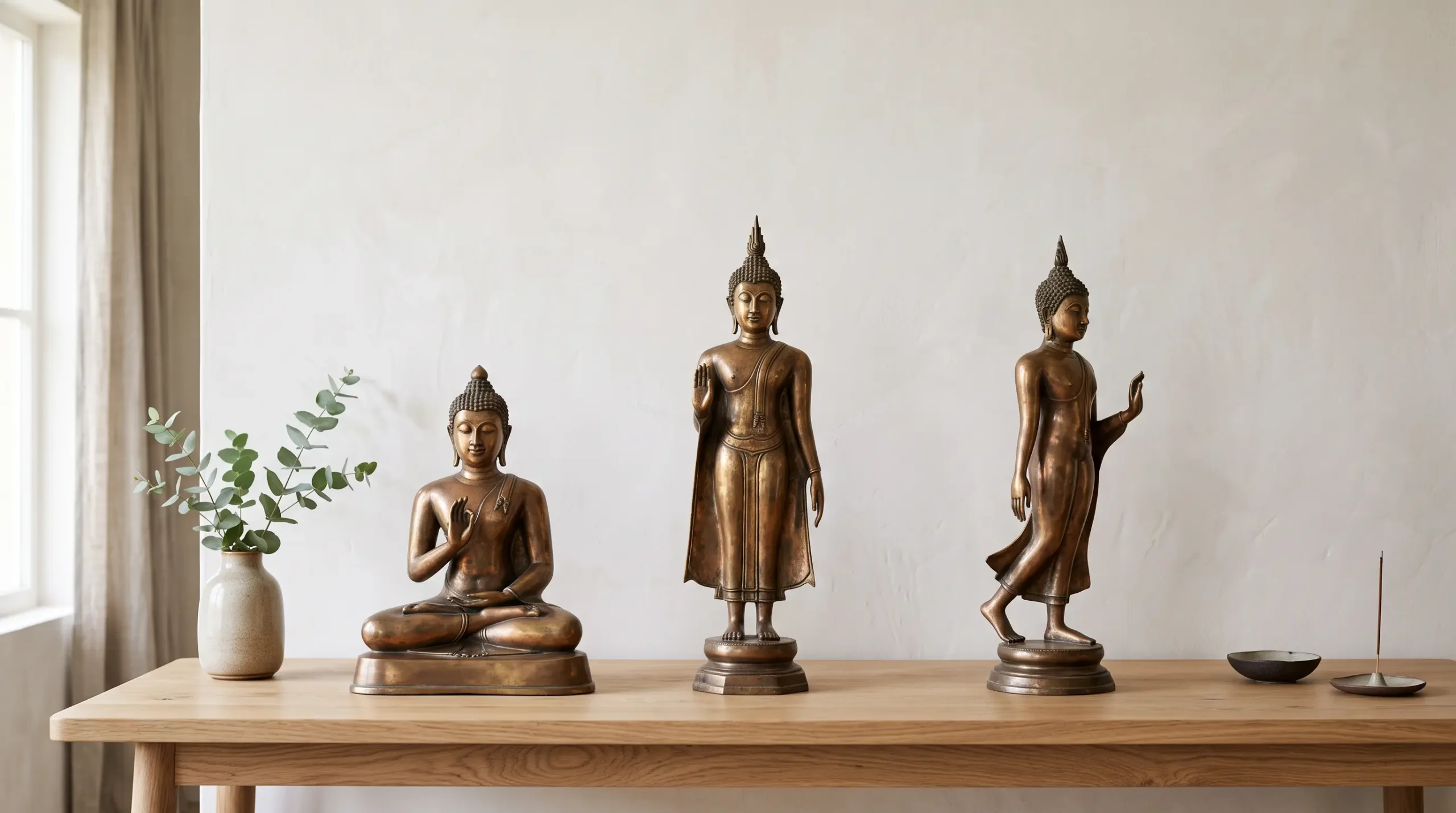
A seated Buddha statue is traditionally associated with meditation and the moment of enlightenment, a standing Buddha with teaching and protection, and a walking Buddha, a form created in Thailand’s Sukhothai kingdom, with the Buddha in motion, carrying the teaching outward. Choose seated for altars and meditation corners, standing for entryways, and walking for hallways or gardens.
Buddhist art recognizes four traditional postures: reclining, sitting, standing, and walking. According to Learn Religions, the seated Buddha is the most common of the four. This guide covers the three you are most likely to buy and leaves reclining figures for another day.
What does a seated Buddha statue symbolize compared to a standing one?
A seated Buddha is traditionally linked to meditation and the night of enlightenment under the Bodhi tree, while a standing Buddha shows him risen and ready to teach. Seated figures turn inward. Standing figures turn outward, with feet planted to signal readiness to travel and share the teaching. Neither is more sacred. They tell different moments of the same story.
Is a walking Buddha different from a standing one?
Yes. A walking Buddha is a standing figure caught mid-stride, with one heel lifted and the robe swaying. It is also the rarest of the four postures and appears almost exclusively in Thailand. Think of the three postures as verbs: sitting, standing, and walking.
Where did the walking Buddha come from?
The walking Buddha is a Thai creation from the Sukhothai kingdom, and Britannica notes it was not a standard type in India. The Asian Civilisations Museum in Singapore holds a 15th-16th century bronze it calls a cankrama image (“walking back and forth”). The museum links the pose to the Buddha’s return from Tavatimsa Heaven after teaching his mother.
You can see a real example online. The Metropolitan Museum of Art catalogs a Thai bronze walking Buddha (object 1984.481) that stands 11 3/8 in (29 cm) tall.
How to Identify Each Figure in Three Steps
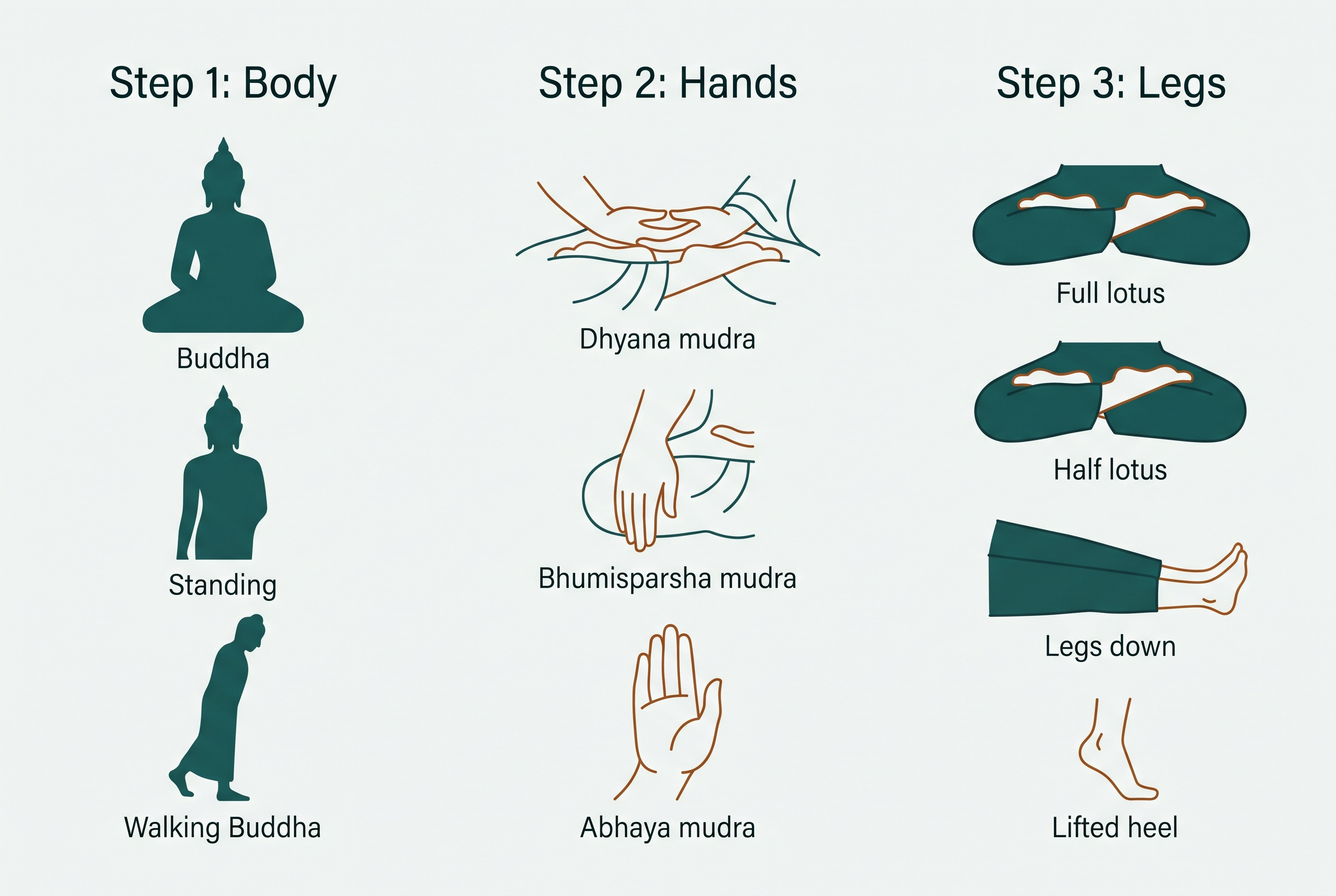
Use this three-step check:
- Body: Is the figure seated, standing, or mid-stride?
- Hands: Which mudra is it, such as Dhyana (hands in lap), Bhumisparsha (right hand touching the earth), or Abhaya (raised palm)?
- Legs and feet: Do you see full lotus, half lotus, legs down, or a lifted heel?
Step 1: Is the figure seated, standing, or mid-stride?
Start with the silhouette. A broad triangle means seated, a tall vertical line means standing, and a lifted heel with swaying robes means walking. This one glance sorts most figures.
Why do many standing Buddha statues raise one hand?
Most standing figures raise the right hand in Abhaya mudra, the gesture of fearlessness, with the palm turned outward toward you. Smarthistory lists five main mudras: Abhaya, Varada (giving), Dhyana (meditation), Bhumisparsha (touching the earth), and Dharmachakra (teaching). Bhumisparsha appears only on seated figures, with the right hand reaching over the knee to touch the ground.
On walking Buddhas, which hand is raised varies by sculpture, and museum notes disagree. Treat “one hand raised, palm out” as the safe description.
Step 3: Which leg position is the seated figure using?
Seated figures use one of three classic leg positions: full lotus (vajrasana), half lotus (virasana), or the legs-down pralambanasana, sometimes called the European pose. A fourth seat, royal ease (rajalilasana), keeps one knee raised and one arm resting on it.
Our solid copper Guanyin seated in royal ease stands 8.9 in (22.6 cm) tall and weighs 2.16 lb. Guanyin is a bodhisattva of compassion, not a Buddha, but the raised knee shows you the pose at a glance, and the weight keeps it steady on a desk.
Seated vs Standing vs Walking: Side-by-Side Comparison
Here is how the three postures compare at a glance.
| Feature | Seated | Standing | Walking |
|---|---|---|---|
| Traditional meaning | Meditation, enlightenment | Teaching, protection | Teaching in motion |
| Typical mudras | Dhyana, Bhumisparsha | Abhaya, Varada | One hand raised (Abhaya) |
| How common | Most common posture | Common across Asia | Rarest, mostly Thai |
| Best room | Altar, meditation corner | Entryway, living room | Hallway, garden path |
| Surface footprint | Wide and low | Narrow and tall | Narrow and tall |
| Watch-outs | Needs a stable, clean surface | Can tip on narrow shelves | Hard to source, check origin |
The bottom line is simple. Seated is the safest all-rounder, standing suits spaces where people arrive, and walking suits spaces where people pass through.
Seated figures: strengths and limits
Seated figures are the easiest to live with: stable, calm, and at home on an altar or shelf. The wide base lowers the center of gravity, so a seated statue rarely tips. The trade-off is width, because a seated figure needs more shelf depth than a standing one of the same height.
Standing figures: strengths and limits
Standing figures read as welcoming and alert, which suits spaces people walk through. Their narrow footprint saves shelf width. The limit is balance, since a tall, narrow figure can tip on a shallow console, so check the base depth before you buy.
Walking figures: strengths and limits
Walking figures bring rare grace and a sense of movement, but they are uncommon and work best along a path or passage. Ask the seller whether a piece is an antique or a modern piece in an older style, and expect an honest listing to say which. We say the same about our own aged copper pieces: they are new, with an antique-style finish.
Which Posture Fits Your Room?
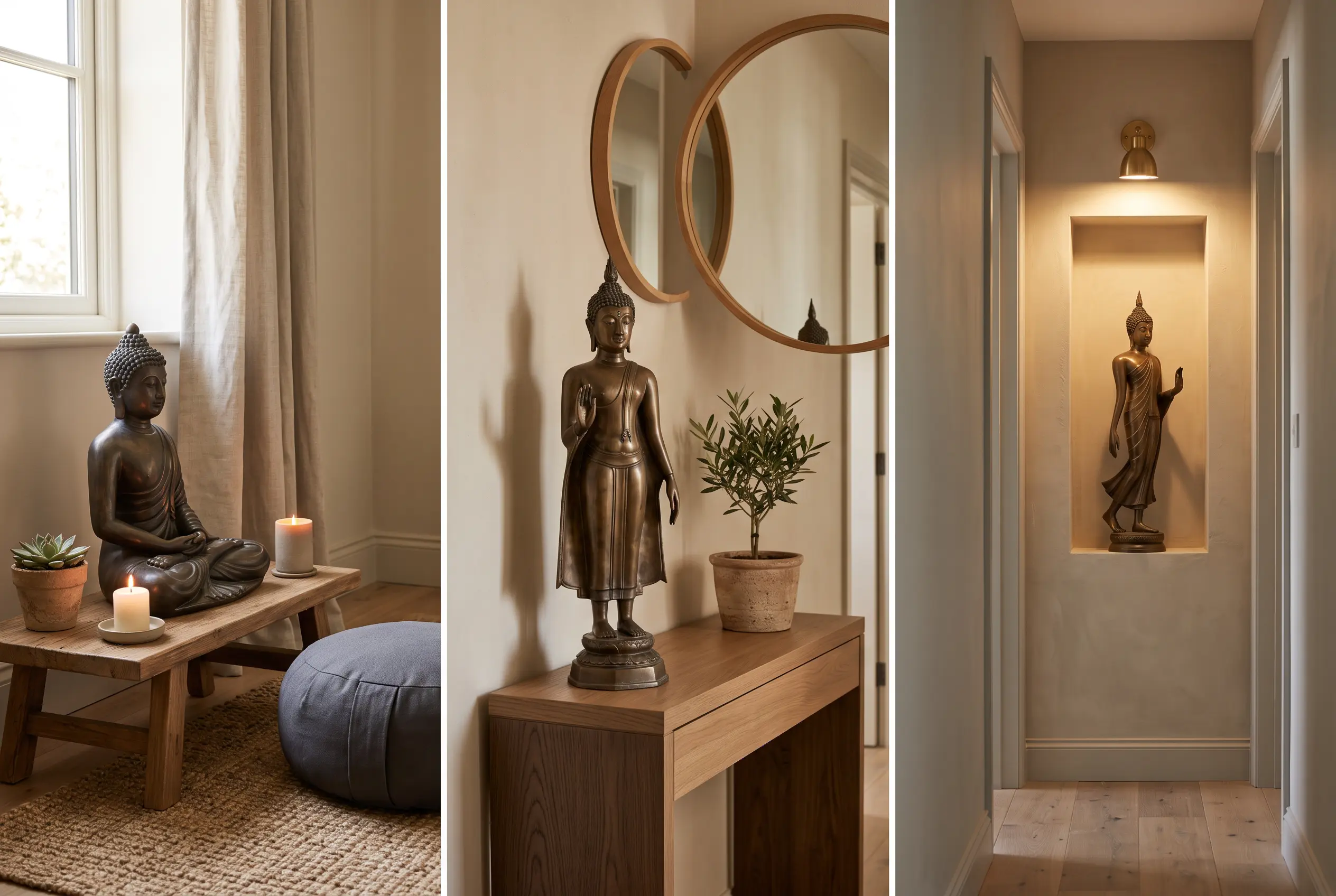
Match the posture to what happens in the room: stillness calls for a seated figure, arrivals for a standing one, and movement for a walking one.
| Space | Typical surface | Best posture | Why |
|---|---|---|---|
| Meditation corner or altar | Low table or shelf | Seated (Dhyana) | Matches the stillness of practice |
| Entryway console | Narrow, often 10-14 in deep | Standing (Abhaya) | Tall form greets arrivals |
| Hallway or stair landing | Niche or pedestal | Walking or standing | Echoes movement through the space |
| Desk or bookshelf | Small footprint | Small seated figure | Fits without crowding |
| Garden or patio | Raised pedestal | Stone figure, any posture | Material suits the weather |
Treat this matrix as a practical guide, not a Buddhist rule. It comes from how the postures read in a room, and it works best alongside your own sense of the space.
Which Buddha posture is best for a home altar?
For a home altar or meditation corner, a seated figure in Dhyana mudra, hands resting in the lap, is the most traditional and least distracting choice.
Our aged copper meditating Buddha in Dhyana mudra comes in two sizes. The Medium (9.1 in, 2.31 lb) fits a desk or nightstand, and the Large (11.8 in, 5.62 lb) suits a mantel or altar. The dense metal keeps it steady, and the lowered eyes give your gaze a place to rest.
It is listed at $298.95 at the time of writing. The gold tone is a mud-gold style finish, not 24K gilding, and the statue is a new piece with an antique-style surface. Shipping is free in the U.S., with an estimated 5-10 business days and 60-day returns.
Where should you place a standing Buddha statue at home?
Place a standing figure where people arrive, such as an entry console or a living-room wall, facing into the room. At or above eye level, the raised palm of Abhaya mudra reads as a welcome. We do not list a standing Buddha yet, so we will not point you to one. A stone or metal figure with a wide, flat base is the safest bet on a narrow console.
Can I place a standing Buddha statue outdoors in a garden?
Yes, if the material suits the weather. Choose stone or another weather-rated material, set the figure on a raised pedestal instead of bare soil, and keep it clear of sprinklers and mud splash. Our copper pieces are made for indoor display, so keep them away from damp spots.
Placement Height, Scale, and Etiquette
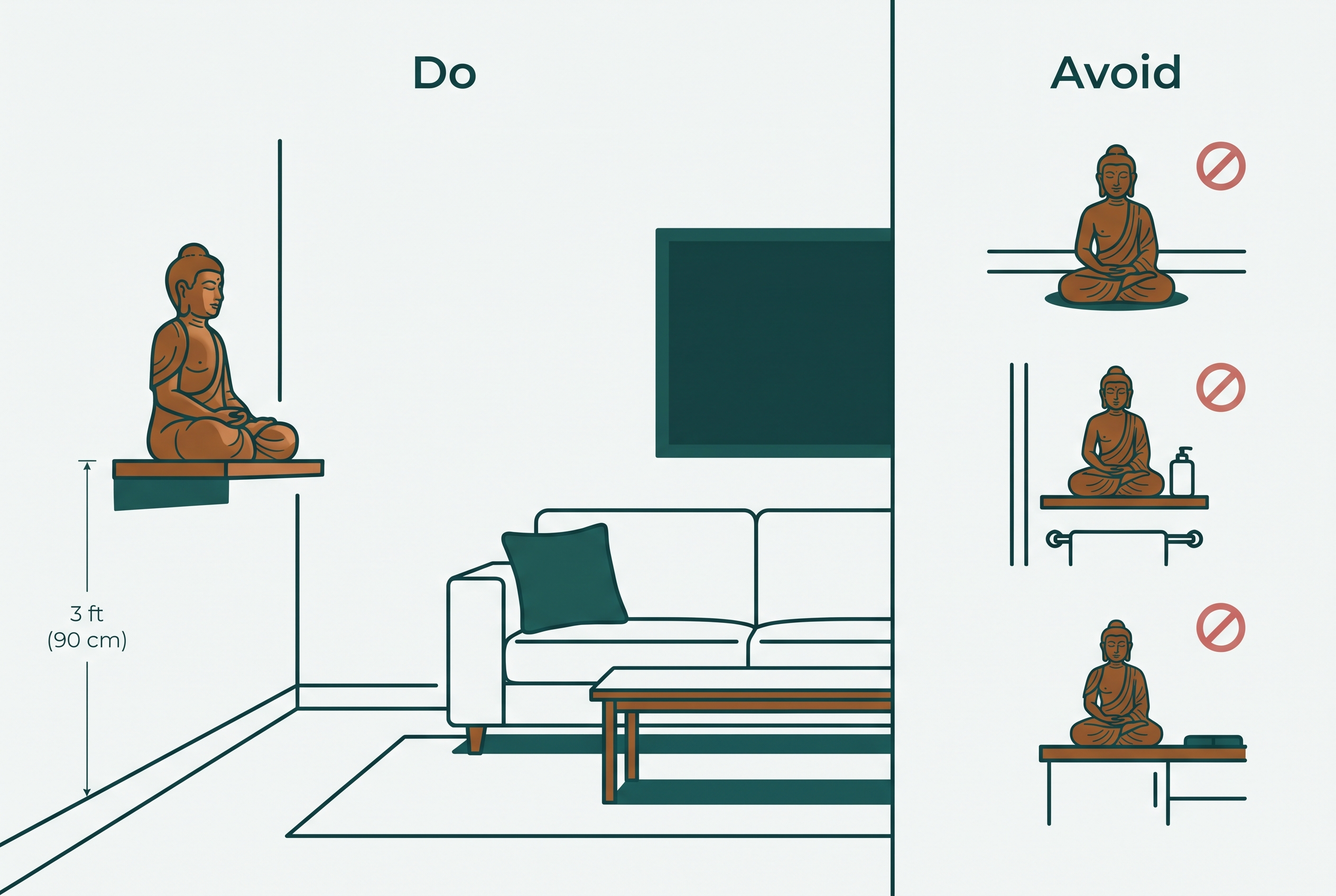
Three habits cover most of it:
- Height: Keep the figure at or above eye level when you can, and never on the floor.
- Direction: Face it into the room where you live or work.
- Location: Keep it out of bathrooms and kitchens, and away from shoes.
What placement height is best for seated versus standing statues?
A common rule of thumb: keep a seated figure’s face near your eye line when you sit. Raise a standing figure a little so its face and hands read from across the room. Guidance varies by seller. Our Royal Ease Guanyin page recommends eye level or above, at least about 3 ft (90 cm) off the floor. Our meditating Buddha page says waist height or higher. Both agree on one point: never the floor.
Where should a statue never go?
Avoid the floor, bathrooms, and kitchens, and do not use a figure as a bookend or doorstop. Treat it as a meaningful image, not a prop or a novelty. A single figure on a clear surface speaks louder than a crowded shelf.
How big should the figure be for your surface?
Leave breathing room on every side, because a figure that crowds its shelf looks smaller, not grander. For scale, our Royal Ease Guanyin is 8.9 in tall, about the height of a hardcover novel. The Large aged copper Buddha measures 8.3 × 7.1 × 11.8 in, so measure your shelf depth first and leave an inch or two above the crown.
Browse ShaoLin Store’s handmade seated Buddha statues in copper and sandstone and check each listing’s height, weight, and footprint before you pick a shelf.
Choosing Your First Buddha Statue: Final Recommendation
For most homes, start with a seated figure: it is the most common posture, the easiest to place respectfully, and it works in almost any room.
In summary, let the posture match the job. Seated is for stillness, standing for welcome, and walking for movement. If you already own a seated figure, add a standing one later to pair stillness with welcome.
The safest first pick
A seated figure in Dhyana or Bhumisparsha mudra is the safest first statue for an altar, desk, or gift. If you are buying for someone else, you do not want to give the wrong thing, and a seated figure with hands in the lap is the hardest one to get wrong.
Five mistakes to avoid before you buy
- Confusing figures: The laughing, round-bellied Budai is a different figure from Shakyamuni.
- Mixing up traditions: Many placement “rules” online come from feng shui or Vastu, not Buddhist teaching.
- Skipping the measuring tape: Check shelf depth and height before you order.
- Placing it low: The floor, bathrooms, and kitchens are out.
- Judging by looks alone: Check the posture, the mudra, and whether the seller states the material and age honestly.
Material check: copper, sandstone, or resin?
Solid copper is heavy and develops a patina, sandstone feels earthy and costs less, and resin is lighter and cheaper but can feel less substantial. Our Sandstone Buddha Statue with Open-Center Tealight Display is a low-cost way in at $96.95, and a tealight in its open center turns it into an evening light.
Important note: This guide describes artistic and cultural traditions. It does not promise luck, health, or protection. Meanings vary by school and region, and the placement tips here are common courtesy, not strict rules.
Start with a seated figure
Browse ShaoLin Store’s handmade Buddha statues, compare heights and weights, and add meditation cushions for a seated practice corner. Gifting this season? Thanksgiving is 11/26/2026 and Black Friday is 11/27/2026. U.S. delivery takes an estimated 5-10 business days, so order early.Shop Handmade Buddha Statues
Frequently Asked Questions
Not always. A seated figure mirrors the meditation posture, so many practitioners find it a natural focal point. A standing figure can suit walking meditation or a space built around mindful movement.
Yes, if each has its own clear space. Many people make the seated figure the focal point and place the walking figure along a path or wall leading toward it, so the pair reads as arrival and stillness.
Yes, when you choose it with care and display it thoughtfully rather than as a novelty. Keep it clean, raised, and off the floor, and treat it as a reminder of calm and compassion.
For most homes, a seated figure in Dhyana mudra is the most versatile first choice. Measure your shelf or altar first, then compare heights and materials in the Handmade Statues collection.
References
- Sukhothai style: Overview of Sukhothai art, including the walking Buddha as a Tai creation. Encyclopaedia Britannica
- Walking Buddha (Thailand, object 1984.481): Museum record with material and dimensions of a Thai bronze walking Buddha. The Metropolitan Museum of Art
- Sculpture of Walking Buddha, Sukhothai: Explains the cankrama image and its link to the descent from Tavatimsa Heaven. Roots.gov.sg (Asian Civilisations Museum collection)
- Mudras in Buddhist art: Clear guide to the five main hand gestures and the postures they appear with. Smarthistory
- Buddha Statues: Meaning of Postures and Poses: Plain-language overview of the four postures and the seated leg positions. Learn Religions