
Bodhidharma was a Buddhist monk from South India or Central Asia who taught in northern China in the early 500s CE. According to tradition, he is the first patriarch of Chan (Zen) Buddhism. His link to Shaolin kung fu, however, comes from a text written in 1624, about a thousand years after he lived.
If you have heard that one monk founded both Zen and Shaolin kung fu, this guide separates the records from the legends. You will also see what wall-gazing meditation meant, who Huike was, and why the Yijin Jing matters.
At ShaoLin Store, we compared Britannica, Jeffrey Broughton’s translation of the earliest Zen texts, and Meir Shahar’s history of the Shaolin Monastery. The oldest record of Bodhidharma, from 547 CE, runs only a few lines, so every claim below names its source.
Who Was Bodhidharma, and Was He a Real Person?
Most historians accept that a monk called Bodhidharma existed, but almost everything else about him is debated. His first mention dates to 547 CE and his first biography to about 645 CE. The two sources disagree on where he was born. Britannica calls the accounts of his life “largely legendary.”
Britannica places his activity in the 6th century CE, while other accounts reach back to the late 5th century. The safest range is the 5th to 6th century.
How we sourced this
We rely on translations of early texts and on academic studies, all listed in the References. When we first read the 547 CE record, we noticed how short it is. It says nothing about Shaolin or martial training. For more context, see our ShaoLin Store guides to Shaolin and Chan culture.
What Do the Earliest Sources (547 to 645 CE) Actually Say?
The three earliest sources describe the same monk in three different ways.
- 547 CE, Yang Xuanzhi: In Record of the Buddhist Monasteries of Luoyang, he describes a “Persian Central Asian” monk who claims to be 150 years old.
- 6th century, Tanlin: His preface to the Two Entrances and Four Practices calls Bodhidharma a South Indian and the third son of a great Indian king.
- c. 645 CE, Daoxuan: Further Biographies of Eminent Monks gives the first full biography. Its chronology places his death before the Northern Wei state split in 534.
Later biographies add far more detail. Historians treat those additions with caution.
Where Was Bodhidharma From, India or Persia?
No one can say for certain. Yang Xuanzhi points to Persia or Central Asia. Tanlin and later Chan tradition say South India. South India became the majority tradition, but it rests on later sources. Both accounts agree on one point: he came from the western regions, beyond China’s borders.
Bodhidharma, Damo, Daruma: One Monk, Many Names
These are one monk’s name in three languages.
- Bodhidharma (Sanskrit): “bodhi” means awakening and “dharma” means teaching.
- Putidamo, shortened to Damo (Chinese): also spelled Ta Mo.
- Daruma (Japanese): the name behind the round, self-righting Daruma doll.
Why Did He Travel to China? The Journey and Emperor Wu
According to tradition, Bodhidharma’s teacher Prajnatara told him to carry the Buddha’s teaching east to China. The dates vary by source. Britannica places his meeting with Emperor Wu at about 520 CE. The 952 Anthology of the Patriarchal Hall gives 527 CE for his arrival. Accounts also disagree on whether he came by sea or overland.
The Emperor Wu Exchange: “There Is No Merit”
In the famous story, Emperor Wu of Liang asked how much merit he had earned by building temples, and Bodhidharma replied that there was no merit. Wu then asked what the highest truth was. The monk answered, “Vast emptiness, nothing holy.” Asked who he was, he said he did not know.
Scholars trace this dialogue to about 758 CE, in an appendix to a text linked to the monk Shenhui. It became widely known through the Blue Cliff Record (1125 CE), which opens with this case. The point is that merit from good deeds is not the same as awakening, a theme Chan teachers repeated for centuries.
Crossing the Yangtze on a Reed: Legend in Art
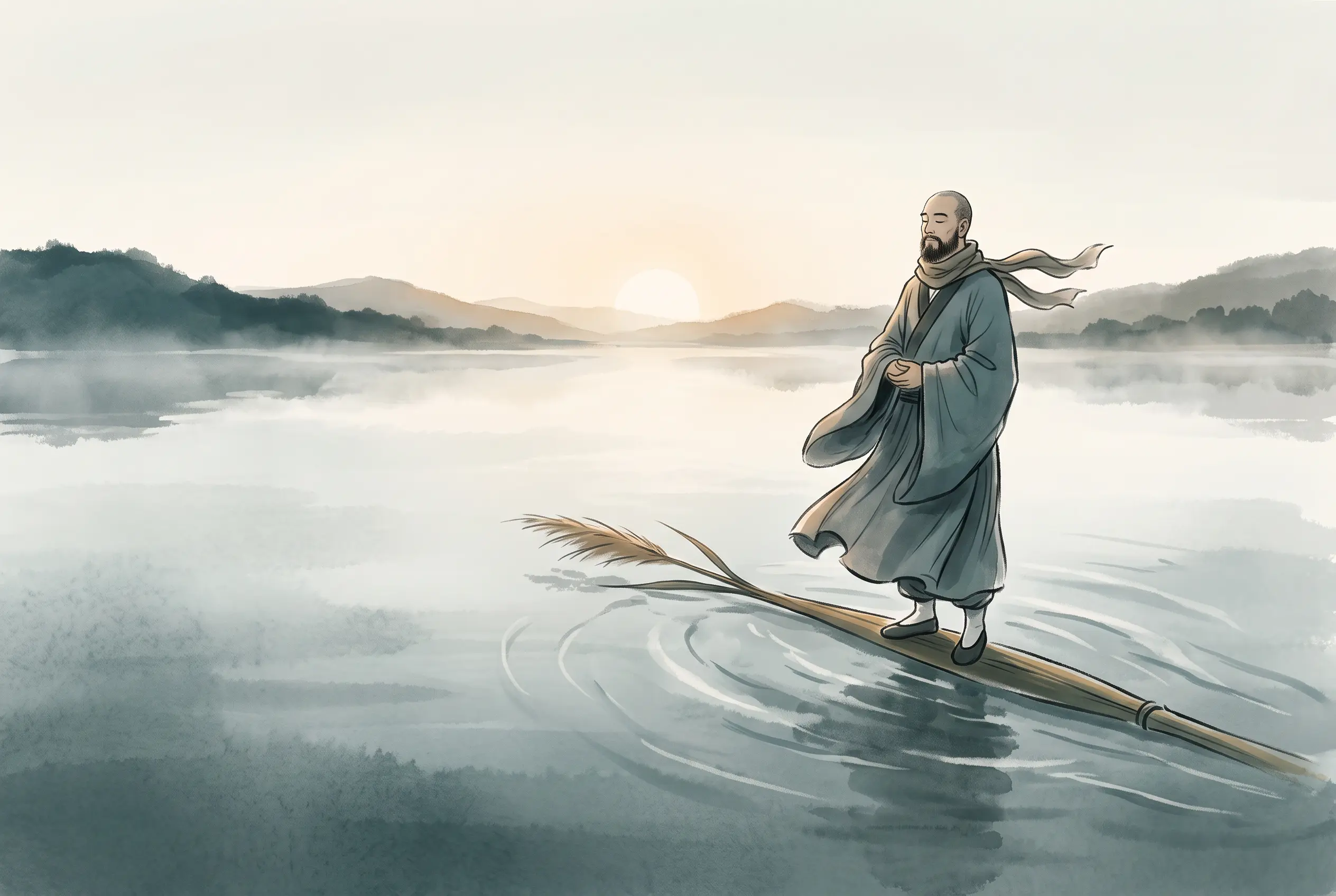
The reed crossing is a legend that appears in later art, not in the early records. After leaving Emperor Wu, Bodhidharma is said to have crossed the Yangtze River standing on a single reed. Painters in China and Japan made the scene a favorite subject. From there, tradition sends him north toward Luoyang and Mount Song.
Nine Years Facing a Wall: What Happened at Shaolin Temple?
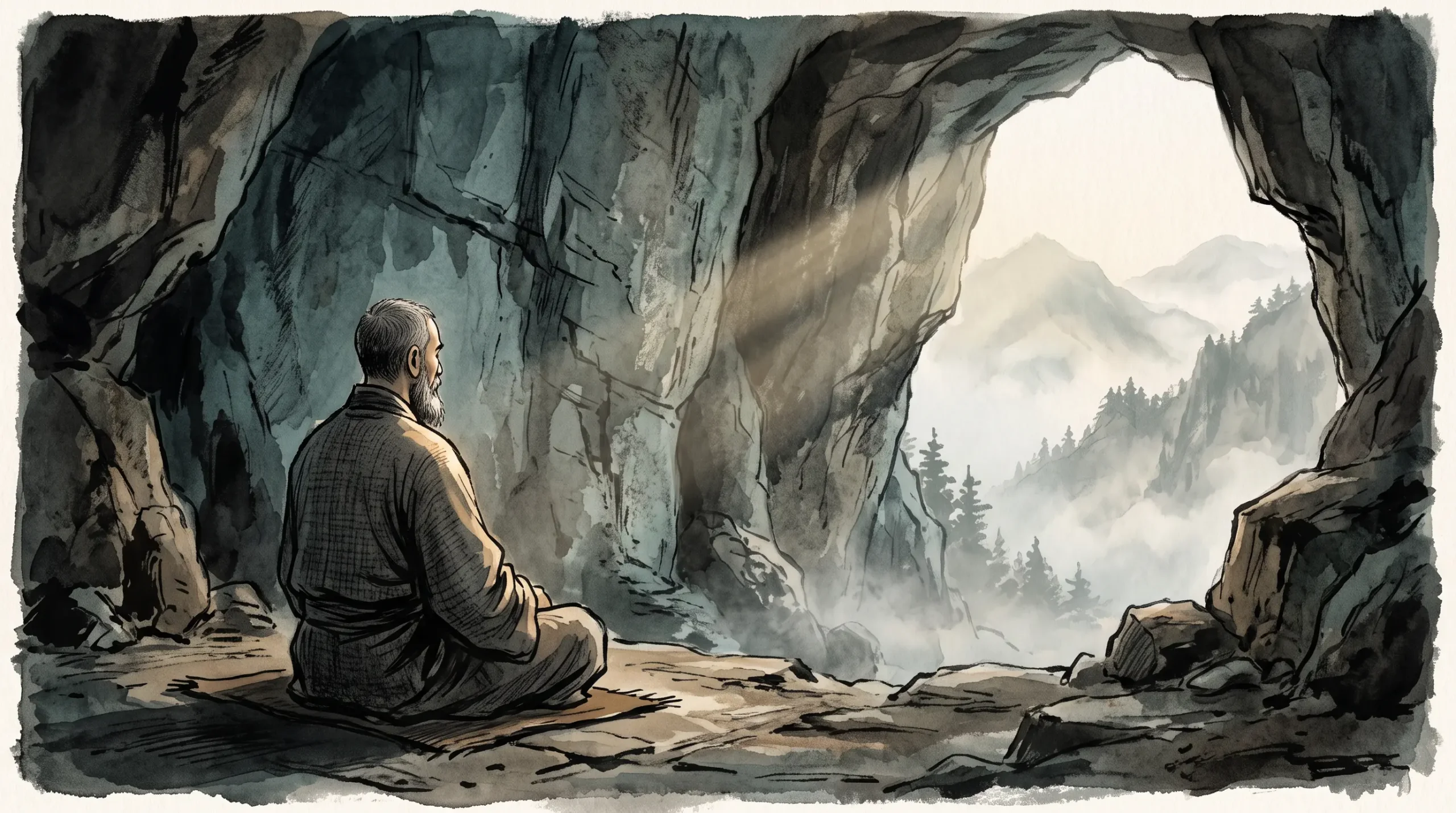
Legend holds that Bodhidharma sat facing a cave wall near Shaolin Temple for nine years. Shaolin Monastery stands on Mount Song in Dengfeng, Henan, and was founded in 495 CE for the Indian monk Batuo. Sources disagree on where the nine years took place. Some point to a temple near Luoyang, while the better-known tradition places them in a cave above Shaolin. The familiar cave story took shape in later chronicles such as the Jingde Record of the Transmission of the Lamp (1004 CE).
Wall-Gazing: Meditation Practice or Literal Legend?
In the oldest texts, wall-gazing (biguan) describes a way of settling the mind, not only a posture. The Two Entrances and Four Practices presents it as a form of dhyana, the Sanskrit word for meditation. A literal nine-year stare at a wall is a later image. It works as a vivid picture of steady, undistracted sitting.
Huike in the Snow: The First Zen Transmission
Huike became Bodhidharma’s heir and the second Chan patriarch. Later accounts say Huike stood in the snow and cut off his arm to prove his sincerity. In the best-known exchange, he asked Bodhidharma to calm his anxious mind. Bodhidharma told him to bring the mind forward. Huike could not find it, and the master said it was already calmed. Tradition calls this the first Zen transmission from Bodhidharma to Huike.
If you grew up on kung fu movies, this is the scene you know. It is also one of the least documented parts of his life.
The Eyelids-and-Tea Legend
The tea story is folklore with no early source. It says Bodhidharma fell asleep during meditation, cut off his eyelids in frustration, and the first tea plants grew where they fell. Storytellers used it to explain why tea helps meditators stay awake.
Why Is He Called the Founder of Zen?
Bodhidharma is called the founder of Zen mostly in hindsight. Chan schools of the Tang dynasty (618-907) traced their lineage back to him and named him the first Chinese patriarch, the 28th in a line of Indian teachers running back to the Buddha. Chan later became Zen in Japan.
The Two Entrances and Four Practices in Plain English
The Two Entrances and Four Practices is the oldest teaching text linked to him. It describes entering the path through understanding, then through practice, and it lists four practices:
- Accepting hardship: treat suffering as the result of past actions, without resentment.
- Adapting to conditions: meet gain and loss with the same calm, since both depend on conditions.
- Seeking nothing: see craving as the root of suffering.
- Accord with the Dharma: live by the teaching and give without attachment.
Broughton’s study treats the anthology that contains this text as the only collection generally believed to hold authentic Bodhidharma material.
The Lankavatara Sutra and “Pointing Directly at the Mind”
Early accounts link Bodhidharma to the Lankavatara Sutra, a Mahayana text on the nature of mind. Later Chan tradition summed up his approach as a transmission outside the scriptures that points directly at the mind. That famous four-line verse was attributed to him afterward. Scholars note it does not appear in the texts credited to him.
From Chan to Zen: How His Lineage Reached Korea, Vietnam, and Japan
Chan became Seon in Korea, Thien in Vietnam, and Zen in Japan. All four names come from dhyana. Each country kept Bodhidharma in its lineage, which is why his image, as Daruma in Japan, appears far beyond China.
Want to try the spirit of wall-gazing at home? Start with 10 quiet minutes on a stable seat. A firm cushion keeps your back upright, so you can sit longer without shifting. Browse our Chan-style meditation cushions and singing bowls.
Did Bodhidharma Really Create Shaolin Kung Fu?
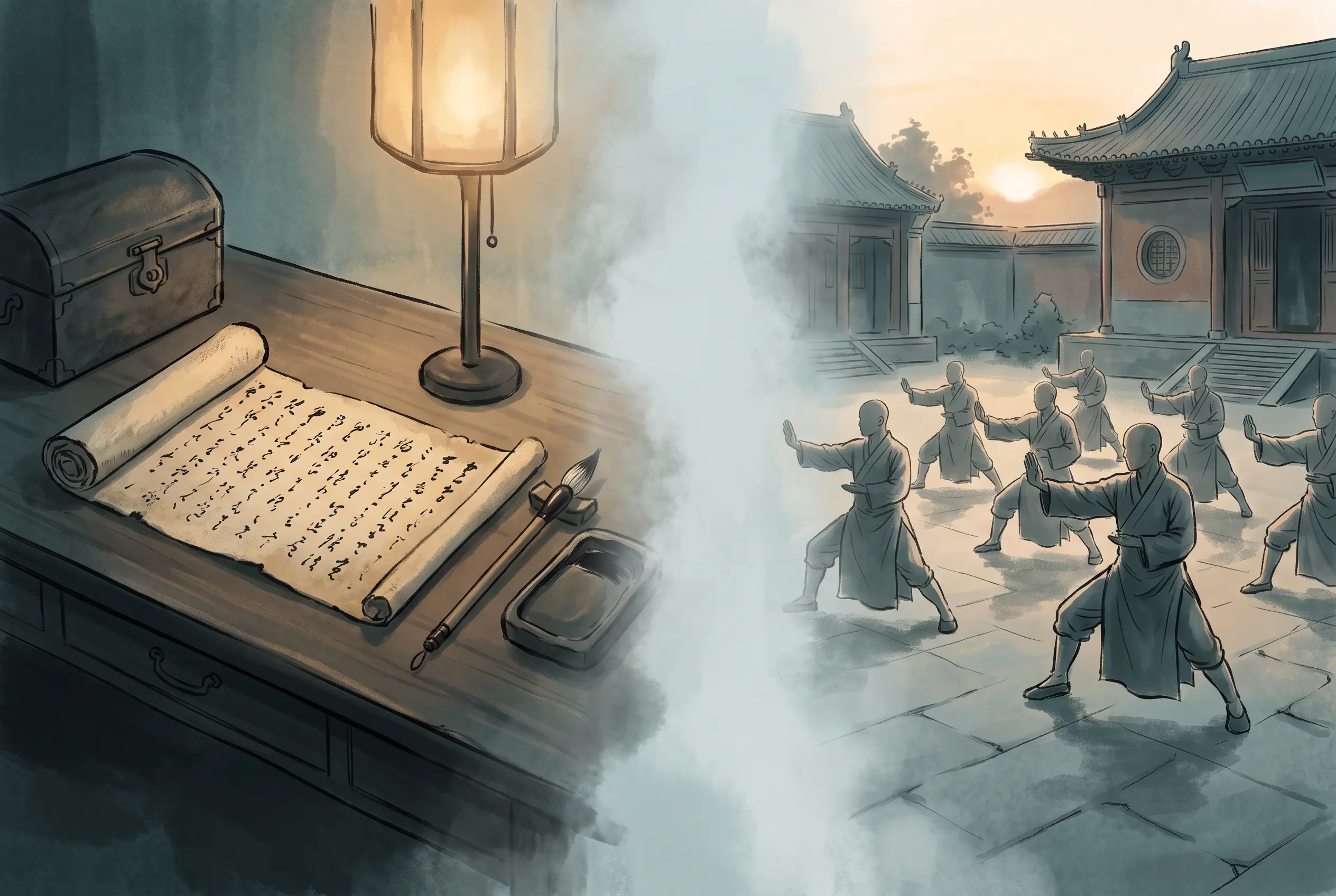
Probably not. The earliest text tying Bodhidharma to martial training is the Yijin Jing, usually dated to 1624, roughly a thousand years after his time. Historians such as Tang Hao and Meir Shahar consider the attribution false. Shaolin’s real martial history begins in the Tang dynasty (618-907).
The Yijin Jing (1624) and the Lost Xisui Jing
The Yijin Jing (Muscle/Sinew Change Classic) says Bodhidharma left a training manual at Shaolin, but it was written in 1624. Scholars attribute it to the Daoist priest Zining of Mount Tiantai. Its prefaces, credited to the Tang general Li Jing and the Song general Niu Gao, are forgeries. The oldest surviving edition dates to 1827.
Legend also credits Bodhidharma with a second manual, the Xisui Jing (Marrow Washing Classic). No early copy of it is known.
The text still matters. Shahar traces how Shaolin came to link martial discipline with the search for enlightenment, which is real cultural history even though the founder story is not.
How the 20th Century Made Him a Kung Fu Founder
Popular media spread the legend in the early 1900s. The novel The Travels of Lao Can, serialized from 1904 to 1907, brought the Yijin Jing story to a mass audience. A popular boxing manual and a 1919 history of Chinese physical culture spread it further. Historians note that Shaolin martial manuals written before the 19th century never mention Bodhidharma. Claims that he carried Indian martial arts such as Kalaripayattu to China also lack early textual support.
What Shaolin Itself Says: “Chan, Not Martial Arts”
Shaolin’s own leaders have long put Chan first. Shi Suxi (1924-2006), a former abbot, is quoted as saying that Shaolin is Chan, not martial arts.
The monastery’s martial tradition is still real. Shahar documents fighting monks at Shaolin from the Tang dynasty (618-907), including help they gave Emperor Li Shimin in the seventh century. The tradition simply has a different origin story than the one in the movies. Enjoying the legend is fine. Just do not cite it as history.
If you train, bring the Chan side into your practice: patience, focus, and steady repetition. Browse our Shaolin kung fu apparel for training when you need clothing made for the practice.
Fact vs. Legend: A Side-by-Side Guide
Here are six common claims, what the records support, and where the legend took over.
| Claim | What the record says | Verdict |
|---|---|---|
| A monk named Bodhidharma lived in China | Yang Xuanzhi mentions him in 547 CE. | Likely historical |
| He came from South India | Tanlin says South Indian. The 547 CE record says “Persian Central Asian.” | Disputed |
| He met Emperor Wu of Liang | Britannica dates the meeting to about 520 CE. The dialogue is first traced to about 758 CE. | Traditional, unconfirmed |
| He faced a wall for nine years | Tanlin describes wall-gazing as a method. The cave story appears in later chronicles (1004 CE). | Legend or metaphor |
| Huike cut off his arm | Later accounts tell it. Early sources do not. | Legend |
| He founded Shaolin kung fu | The Yijin Jing was written in 1624 by Zining. | Not supported |
Why Do the Legends Still Matter?
The legends preserve values that later Chan teachers wanted to pass on. The Emperor Wu story questions reward-seeking. The Huike story honors sincerity. The wall-gazing image honors patience. Knowing which stories are legend lets you enjoy them without mistaking them for biography.
How Can You Honor Bodhidharma’s Spirit at Home, Respectfully?
Place any Buddhist image at eye level or higher, on a clean, quiet surface. Many traditions suggest at least 3 ft (90 cm) above the floor. Avoid floors, bathrooms, and kitchens, and display the piece as a reminder of the teaching, not as a novelty. A Daruma figure, a scroll painting, or a simple Buddha statue all work.
The key takeaway is that Bodhidharma was a real but thinly documented monk, honored by tradition as the first patriarch of Chan. His meeting with Emperor Wu, his nine years of wall-gazing, and his role in Shaolin kung fu are later stories, valuable for what they teach rather than as biography. In summary, read him as both a historical figure and a symbol of steady practice.
Frequently Asked Questions About Bodhidharma
Most sources place him in the late 5th to early 6th century CE. Britannica says he was active in the 6th century, and the earliest mention of him dates to 547 CE.
In China he is Putidamo, usually shortened to Damo (also spelled Ta Mo). In Japan he is Daruma, which gives the round Daruma doll its name.
No text can be proven to be his own writing. The Two Entrances and Four Practices, preserved with a preface by Tanlin, a follower of his, is the oldest teaching linked to him. The Yijin Jing is a later attribution and not his work.
Start small. Sit upright on a firm cushion for 10 minutes and rest your attention on your breathing. This is a traditional practice, not medical advice, and a qualified teacher can guide you further. When you are ready for a dedicated corner, a firm cushion and an uncluttered wall are a good start.
Create a quiet corner inspired by Chan
ShaoLin Store’s Shaolin Quiet Sakyamuni Statue is a bronze-tone Qingsha stone Buddha bust with a silence gesture, priced at $195.95. It portrays Sakyamuni Buddha, not Bodhidharma, but its finger-to-lips pose echoes Chan’s emphasis on direct experience over words. Placed at eye level on a desk or shelf, it gives you a quiet cue to pause.
Shop the Quiet Sakyamuni statue with silence gesture
Important note: This article is for cultural and historical education. Traditional beliefs about meditation, Buddhist images, and their symbolism are described as tradition, not as scientific or medical claims. It is not religious instruction or professional advice. We are an independent retailer, and this article is not an official statement of any temple or monastic community.
References
- The Shaolin Monastery: History, Religion, and the Chinese Martial Arts (2008). Meir Shahar’s academic history of Shaolin’s martial tradition, including its Tang dynasty beginnings and the later Bodhidharma legend. University of Hawai‘i Press
- The Bodhidharma Anthology: The Earliest Records of Zen (1999). Jeffrey L. Broughton’s annotated translation of the earliest texts linked to Bodhidharma, with a study of their background. University of California Press
- Bodhidharma (Encyclopaedia Britannica). Reference biography noting the largely legendary nature of the sources and the dating of his activity. Encyclopaedia Britannica
- Background entries on Shaolin and the Yijin Jing. Used for dates, the 20th-century spread of the legend, and the Shi Suxi quotation. Check against the scholarship above. Shaolin Monastery, Yijin Jing, Shi Suxi