
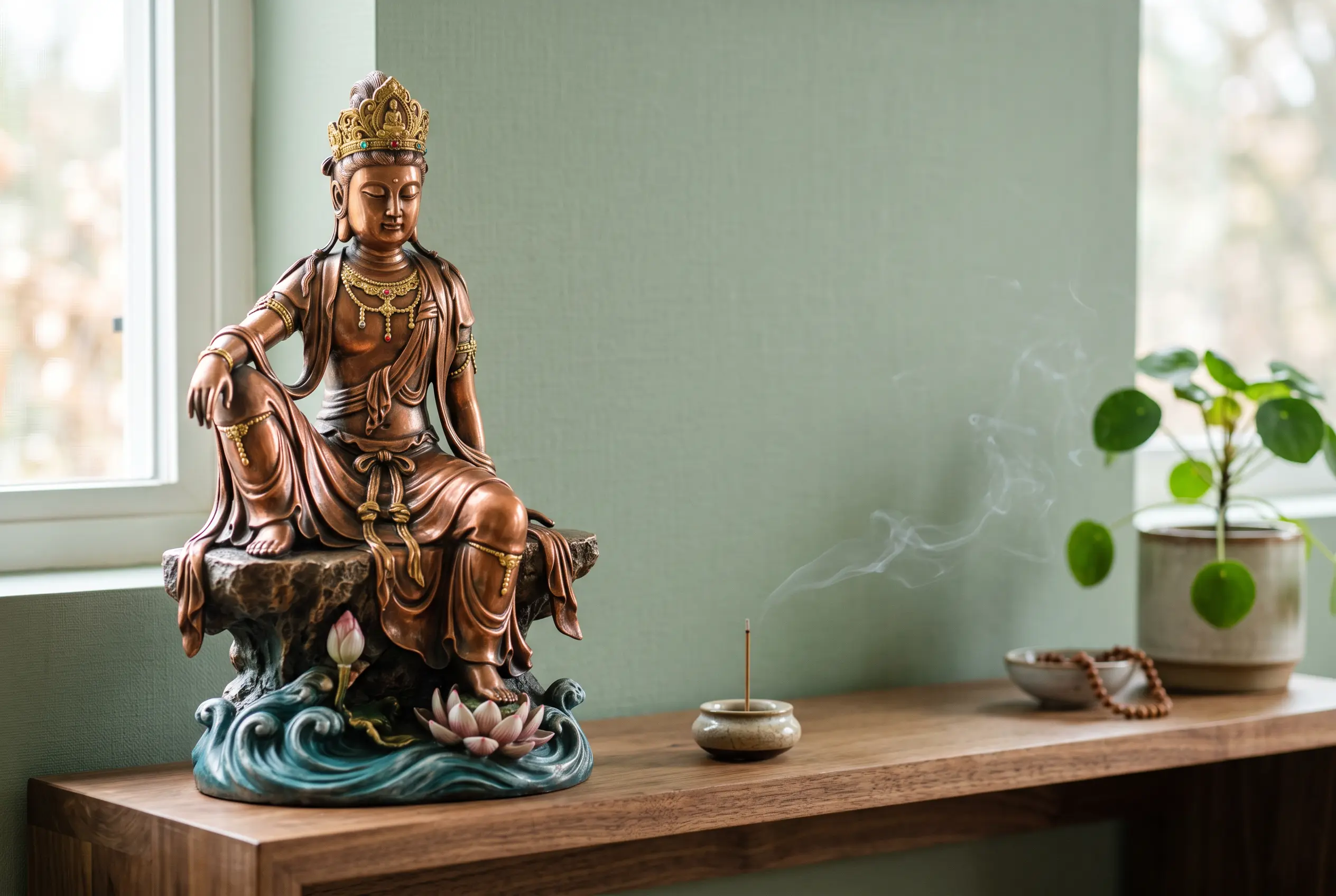
A Royal Ease Guanyin statue is more than a relaxed pose. It shows the bodhisattva of compassion at rest, with one knee raised and one arm draped over it, yet ready to respond the moment someone calls. That mix of calm and readiness is why people place it in a meditation corner or on a desk.
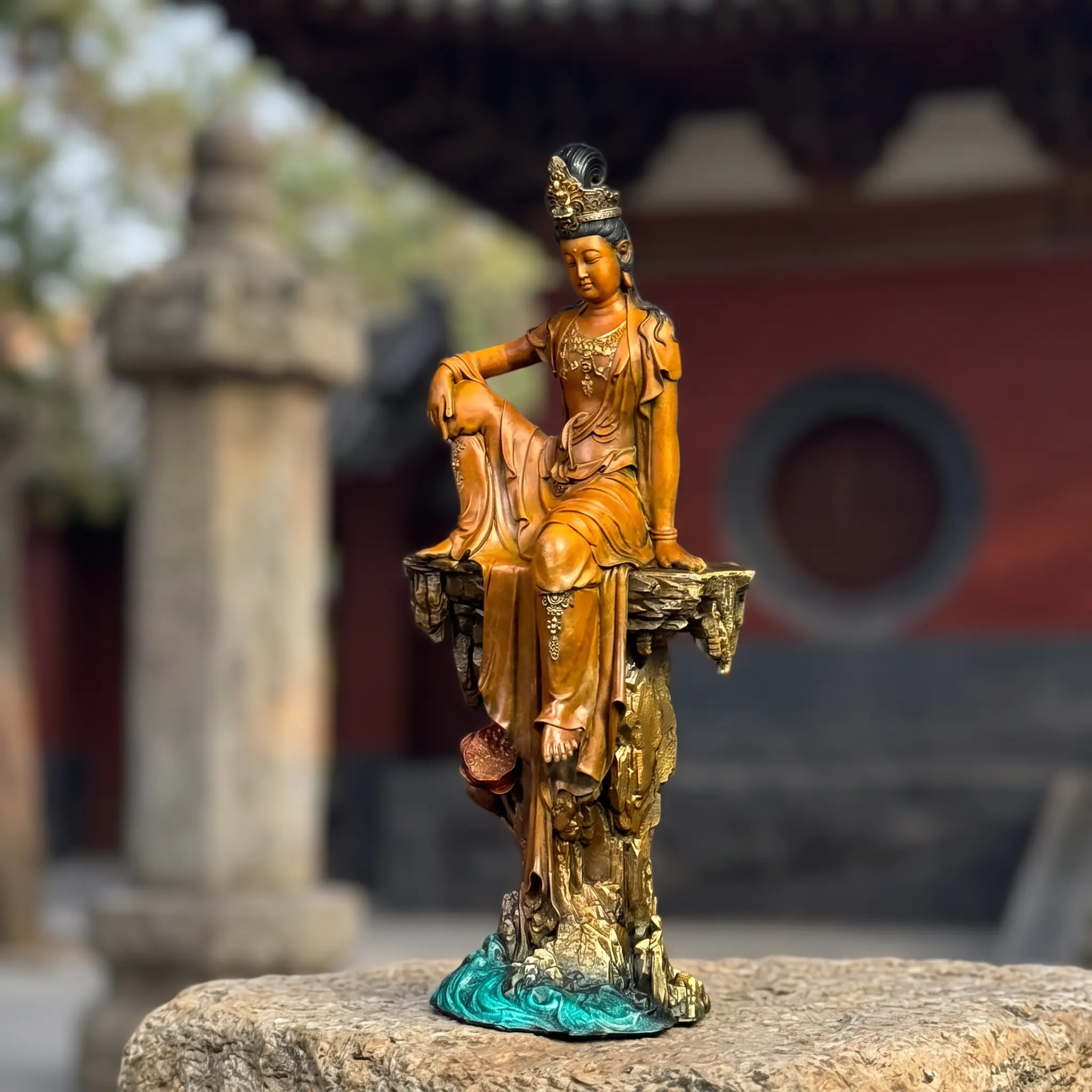
Royal ease (rajalilasana in Sanskrit) is a seated pose with one knee raised and one arm resting loosely on it. Chinese Buddhist art linked this posture to Guanyin, the Chinese form of the bodhisattva Avalokiteshvara, by the late ninth century, according to the Princeton University Art Museum.
At ShaoLinStore, we compared the design of our solid copper Royal Ease piece with catalog records from Princeton, The Metropolitan Museum of Art, the Penn Museum, and the Victoria and Albert Museum. The history below comes from those records. We also point out where our statue differs from the museum examples.
What Is a Royal Ease Guanyin Statue?
A Royal Ease Guanyin statue shows the bodhisattva of compassion seated in the royal ease posture, with one knee raised and one arm resting on it. Museum catalogs record the figure in wood, stone and metal, from the 11th century to the Ming dynasty.
How do you recognize the royal ease pose?
Look for a seat that reads as ease, not stiffness. Four features define it:
- A raised knee. Princeton describes a raised leg paired with a casually draped arm.
- An arm resting on that knee. The torso stays loose and the shoulders drop.
- The other leg hanging or crossed. The Penn Museum describes one leg pendant, with a bent knee against a ledge. The Met’s Water-Moon figure crosses the left leg in front of the body.
- A ledge or rock for a seat. This detail appears in many Water-Moon figures.
Guanyin, Kuan Yin and Avalokiteshvara: one bodhisattva, three names
Avalokiteshvara is the Indian name. Guanyin is the Chinese name, and Kuan Yin is a common English spelling. Princeton explains that Guanyin means one who perceives the sounds of the world’s sorrows. The earliest known mention of Guanyin in China appears in a Chinese translation of the Lotus Sutra dated 286.
Can a Guanyin statue look male or female?
Yes. Princeton notes that its Southern Song Guanyin can be read as either male or female. The museum links that openness to the deity’s universal and inclusive nature. So a gentle face and a crown on the same figure are not a contradiction.
What Does the Pose Symbolize? Ease, Readiness and the Water-Moon Seat
The royal ease pose symbolizes compassion at rest: a relaxed body that stays ready to help. Most readers take this as the heart of the figure.
Ease with readiness: what the pose teaches
The raised knee keeps Guanyin poised, as if one movement would bring the figure to its feet. The loose arm and lowered gaze say the opposite: nothing is rushed. Together they model calm that does not switch off.
The Penn Museum traces the pose to pre-Buddhist royalty, which fits the crown and jewelry on many figures. On a desk, the statue works as a reminder to stay steady while staying useful to others.
The Water-Moon seat: rock, water and moon
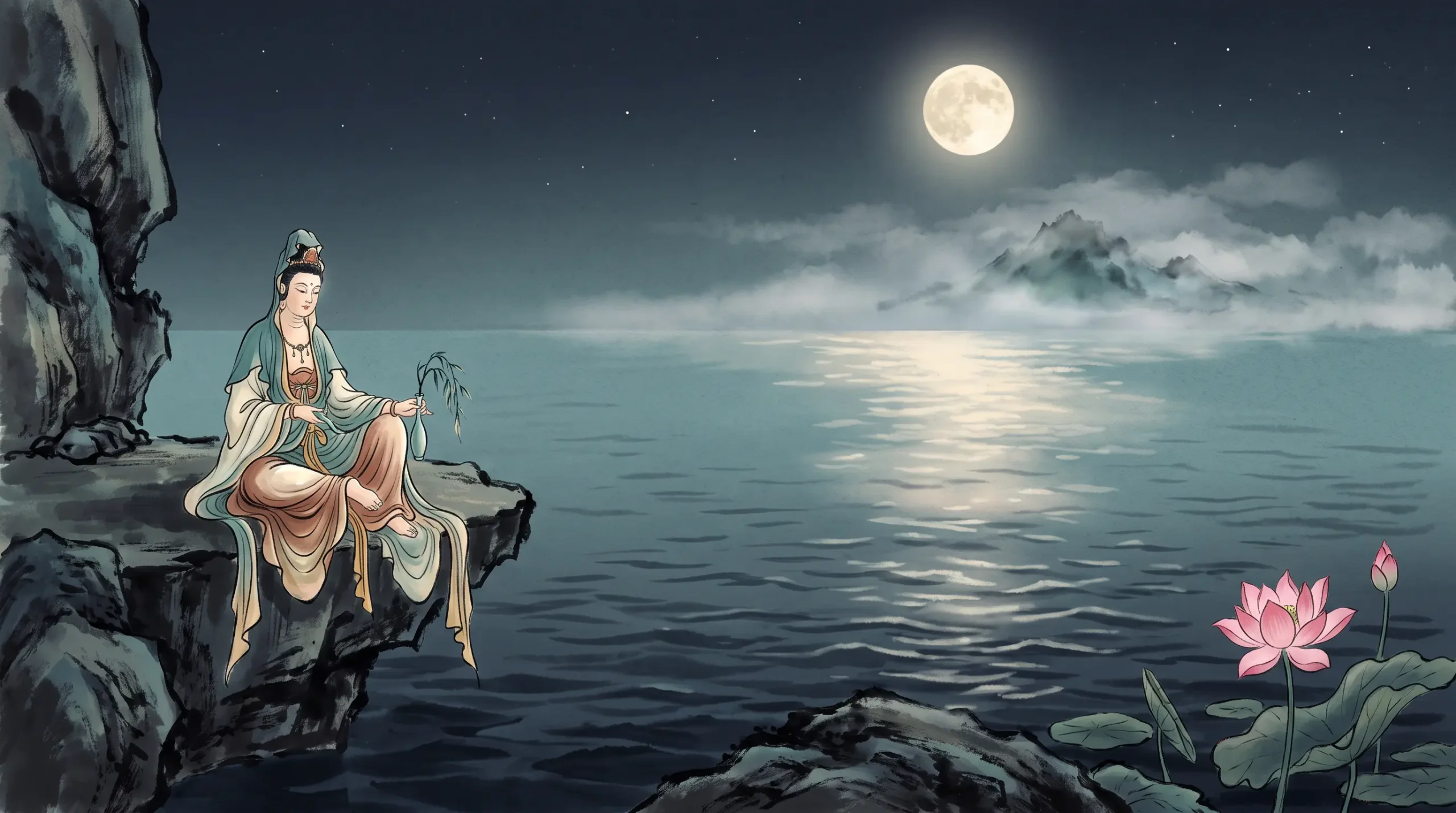
The Metropolitan Museum of Art explains that the Water-Moon form shows Avalokiteshvara in his Pure Land, Mount Potalaka. People first imagined the mountain as an island south of India. By the Ming dynasty, it was identified with Mount Putuo, an island off Zhejiang province that became a pilgrimage site. That is why you often see a rocky ledge and waves in these figures.
| Element | Common reading | Basis |
|---|---|---|
| Rock or ledge | Mount Potalaka, Guanyin’s Pure Land | The Met |
| Waves or water | The sea around the island paradise | The Met |
| Moon in water | Appearances are fleeting, like a reflection | Common Buddhist reading |
| Lotus | Purity rising from mud | Common Buddhist reading |
For more on the lotus and similar motifs, see our lotus, wheel and other Buddhist symbols explained.
Guanyin Statue History: From the Ninth Century to Ming Brass
The royal ease pose has been linked to Guanyin since the late ninth century, so a Royal Ease Guanyin statue follows a tradition more than 1,100 years old. Museum collections document the form in wood, soapstone and brass across the Liao, Song and Ming dynasties.
One caveat matters here. Princeton dates the pose’s link to Guanyin to the late ninth century, but the surviving statues in the table below start in the 11th century. The pose is documented earlier than the oldest figures listed.
A museum timeline of the royal ease pose
| Date | Object | Material | Notes |
|---|---|---|---|
| Late 9th century | Pose becomes linked to Guanyin in China | Not applicable | Princeton University Art Museum |
| 11th century (Liao) | Water-Moon Guanyin, The Met (28.56) | Willow wood with pigment | 46½ × 37½ × 28 in (118 × 95 × 71 cm) |
| 1100 to 1200 (Song) | Guanyin figure, V&A | Carved soapstone, traces of paint | Likely made in northern China |
| Ca. 1250 (Southern Song) | Guanyin, Princeton University Art Museum | Painted wood | Can be read as male or female |
| Jin to Yuan (dates uncertain) | Statue C408A, Penn Museum | Painted wood | One leg pendant, bent knee on a ledge |
| First half of 15th century (Ming) | Guanyin in royal ease, Hopp Ferenc Museum (88.14.1) | Brass, gilded, engraved and painted | 9.6 in (24.5 cm) tall |
| 2026 (this listing) | ShaoLinStore Royal Ease Guanyin | Solid copper | 8.9 in (22.6 cm) tall, 2.16 lb (980 g) |
Why historic figures are mostly wood and stone
Most pieces in the table are wood or soapstone. Only the Hopp Ferenc Museum figure is metal: a gilded brass statuette, and brass is a copper alloy. At 9.6 in (24.5 cm), it sits within an inch of the 8.9 in (22.6 cm) statue we discuss below.
So a modern copper statue is a new material choice with a metal precedent. It is not a replica of a temple icon, and we do not present it as one.
Where did the “Goddess of Mercy” name come from?
Princeton says the popular label “Goddess of Mercy” stems from early Jesuit interpretations of the deity’s function. The museum’s own term is Bodhisattva of Infinite Compassion, which is the phrasing this guide follows.
Six Marks of an Authentic Royal Ease Figure
Check six marks to judge whether a Royal Ease Guanyin statue follows the historic form: a raised knee with a draped arm, a rock seat, water or lotus, a small Amitabha in the crown, princely jewelry, and a calm inward face. Museum descriptions support each one.
The six-point iconography checklist
- Raised knee and draped arm. This is the core of the pose, as Princeton describes it.
- A rock or ledge seat. The Penn Museum describes a ledge, and The Met ties the Water-Moon form to Mount Potalaka.
- Water or lotus details. These point to the Water-Moon tradition.
- A miniature Amitabha in the crown. Princeton, The Met and the Hopp Ferenc Museum all describe a small Buddha in the headdress. It is the sign that identifies the figure as Guanyin.
- Princely jewelry and a flowing skirt. Princeton describes the draped skirt, and the Hopp Ferenc Museum notes a richly jeweled body.
- A calm, inward face. The Hopp Ferenc Museum describes a face deep in thought.
How the ShaoLinStore copper statue compares
We checked our listing against these six marks. The statue shows five of them: a raised knee with the arm resting on it, a rocky ledge, teal waves and a lotus, a gilded crown with jewelry, and lowered eyes in a calm face.
The listing does not mention a miniature Amitabha in the crown. Look closely at the product photos before you buy, because that detail is the museum’s identifying mark.
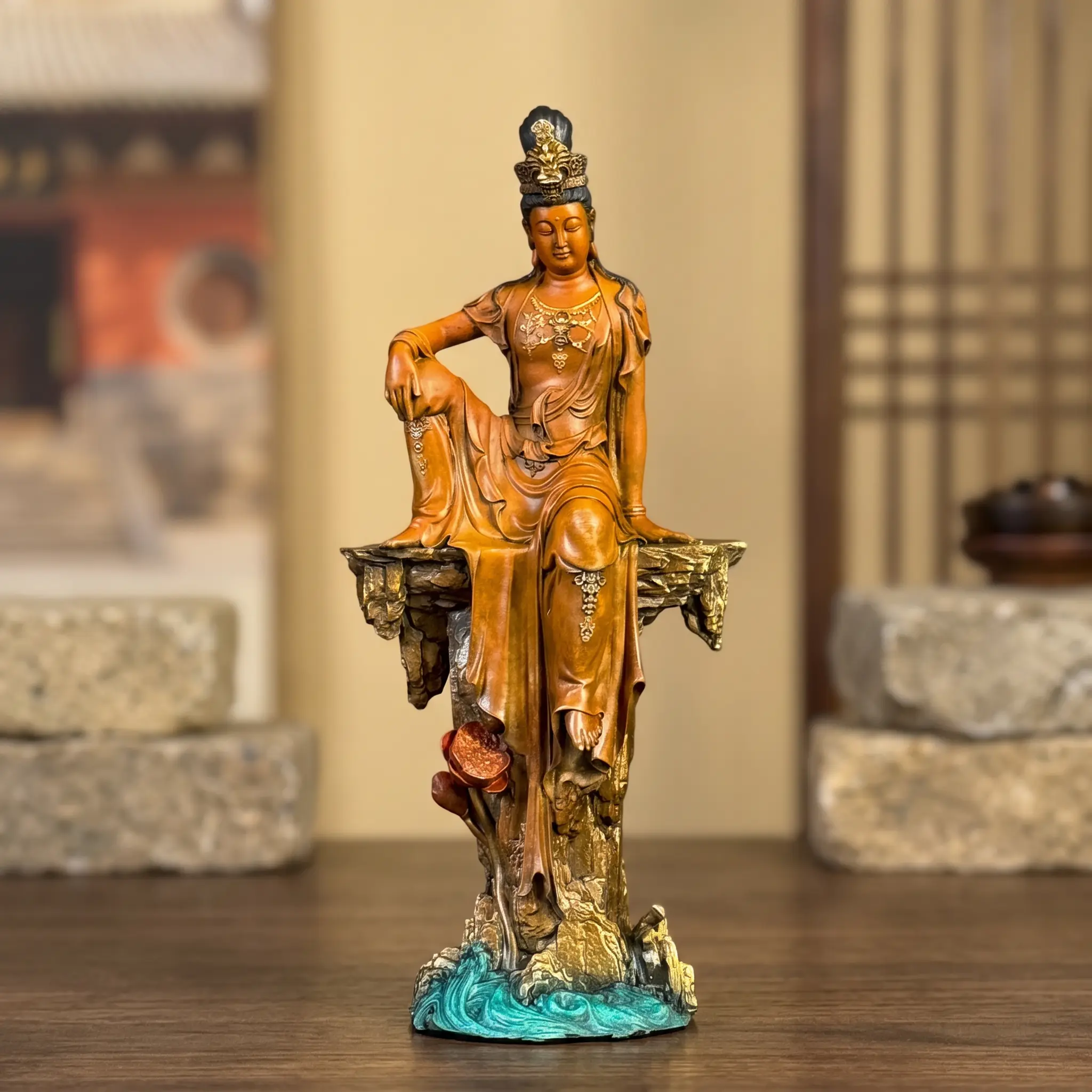
The solid copper Royal Ease Guanyin statue is made of premium solid copper. That gives it a weight of 2.16 lb (980 g), which lends a settled presence on a desk or shelf. It stands 8.9 in (22.6 cm) tall, about the height of a hardcover novel, so it fits a desk, shelf or altar.
Copper also deepens in tone with handling and time. The piece gains character instead of looking worn, which suits an object you will see every day. The price is $388.95 as of 10/23/2026, reduced from $426.95.
How to Display Your Figure at Home with Respect
Place a Guanyin statue on a clean, raised surface at eye level or higher, facing into the room. Keep it away from floors, bathrooms and kitchens.
Where should you put it?
- Choose a quiet surface. A desk, bookshelf, console table or altar works well.
- Raise it. Many traditions suggest about 3 ft (90 cm) off the floor as a minimum. This is a custom, not a rule.
- Leave space around the base. One figure on a clear surface reads better than a crowded shelf.
For size-to-surface rules that apply to every statue, see our guide to types of Buddha statues and the right size. For room-by-room layout, our feng shui for beginners guide for Western homes covers entryways, living rooms and bedrooms.
Is it respectful to own one if you are not Buddhist?
Generally yes, when you treat the figure as a sacred image and not a novelty. Keep it clean and raised. Do not use it as a prop, a bookend or a doorstop.
⚠️ Important Note: The meanings in this guide are traditional readings drawn from museum catalogs and Buddhist art history. They are offered for cultural education, not as medical, psychological or financial advice. “Blessed by Shaolin monks” is the seller’s statement about its own statues, not a measurable property.
Royal Ease Guanyin Statue: Frequently Asked Questions
It symbolizes compassion at rest: a relaxed body that stays ready to help. The Penn Museum traces the pose to pre-Buddhist royalty, and Princeton dates its link to Guanyin to the late ninth century.
The listing describes premium solid copper, not cold-cast resin. The statue stands 8.9 in (22.6 cm) tall and weighs 2.16 lb (980 g).
It is the seller’s statement that Shaolin monks bless each statue, with the intention of bringing steadiness and compassion to your space. It is a devotional practice, so treat it as meaning rather than a guarantee of any outcome.
Shipping is free on all orders. Estimated delivery is 5 to 10 business days to the U.S., Germany and the U.K., and 10 to 16 business days elsewhere. You can return the statue within 60 days of purchase.
In summary, a Royal Ease Guanyin statue pairs a pose documented since the late ninth century with a simple message: compassion can rest and still respond. Check the six marks, match the size to your surface, and choose a material you will enjoy living with.
Bring the Royal Ease posture into your space
See the solid copper figure up close, or compare it with other pieces in ShaoLinStore’s handmade statues collection.
Shop the Royal Ease Guanyin statue
Prefer painted detail? View the seated Guanyin in painted aged copper.
📚 References
- Royal ease and Guanyin: Describes the pose, its late ninth century link to Guanyin, and the male or female reading. Princeton University Art Museum, Guanyin seated in “royal-ease” pose
- Water-Moon form: Explains Mount Potalaka and the 11th century Liao dynasty wood figure. The Metropolitan Museum of Art, Bodhisattva Avalokiteshvara in Water Moon Form
- Pose origins: Traces the royal ease pose to pre-Buddhist royalty and describes a painted wood figure. Penn Museum, Statue C408A
- Song dynasty soapstone: Documents a 12th century Guanyin in royal ease. Victoria and Albert Museum, Guanyin figure
- Ming dynasty brass: Records a 24.5 cm gilded brass Guanyin with a miniature Amitabha in the crown. Hopp Ferenc Museum of Asiatic Arts, Guanyin in royal ease