
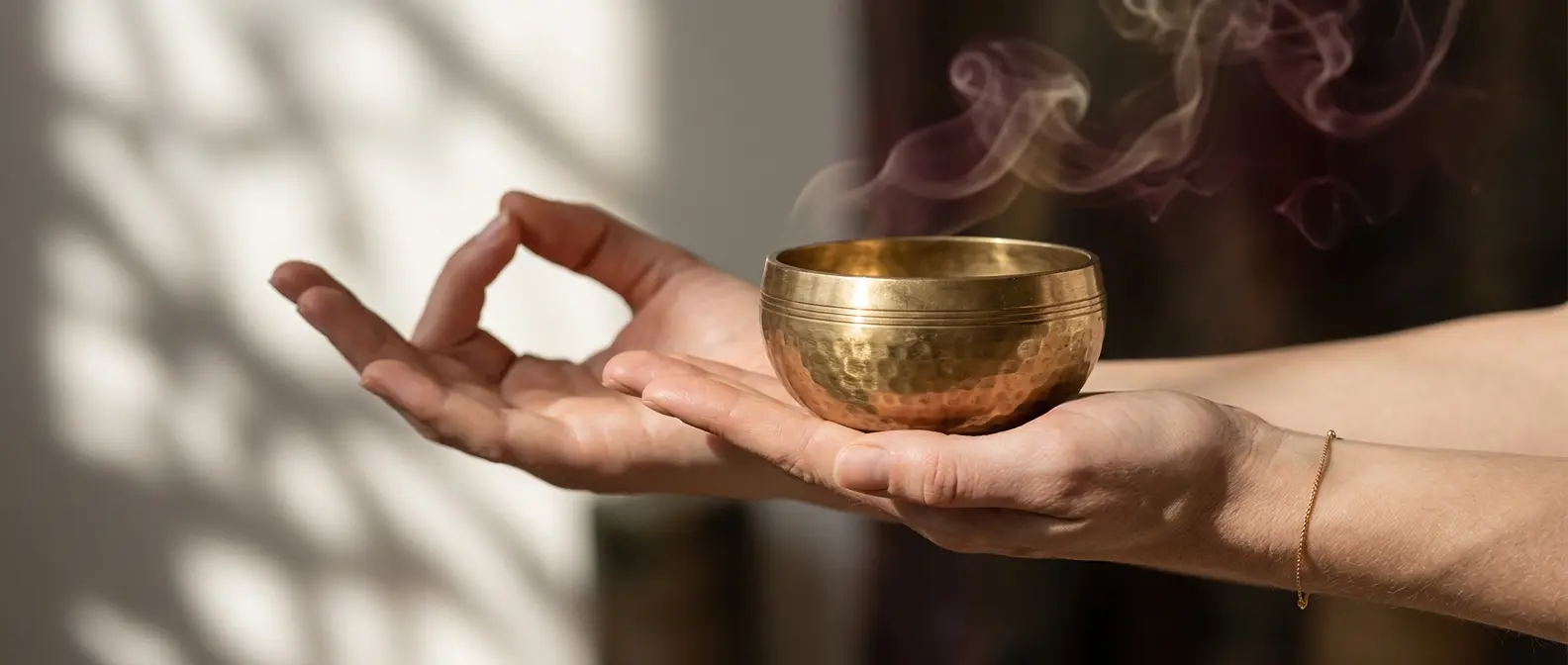
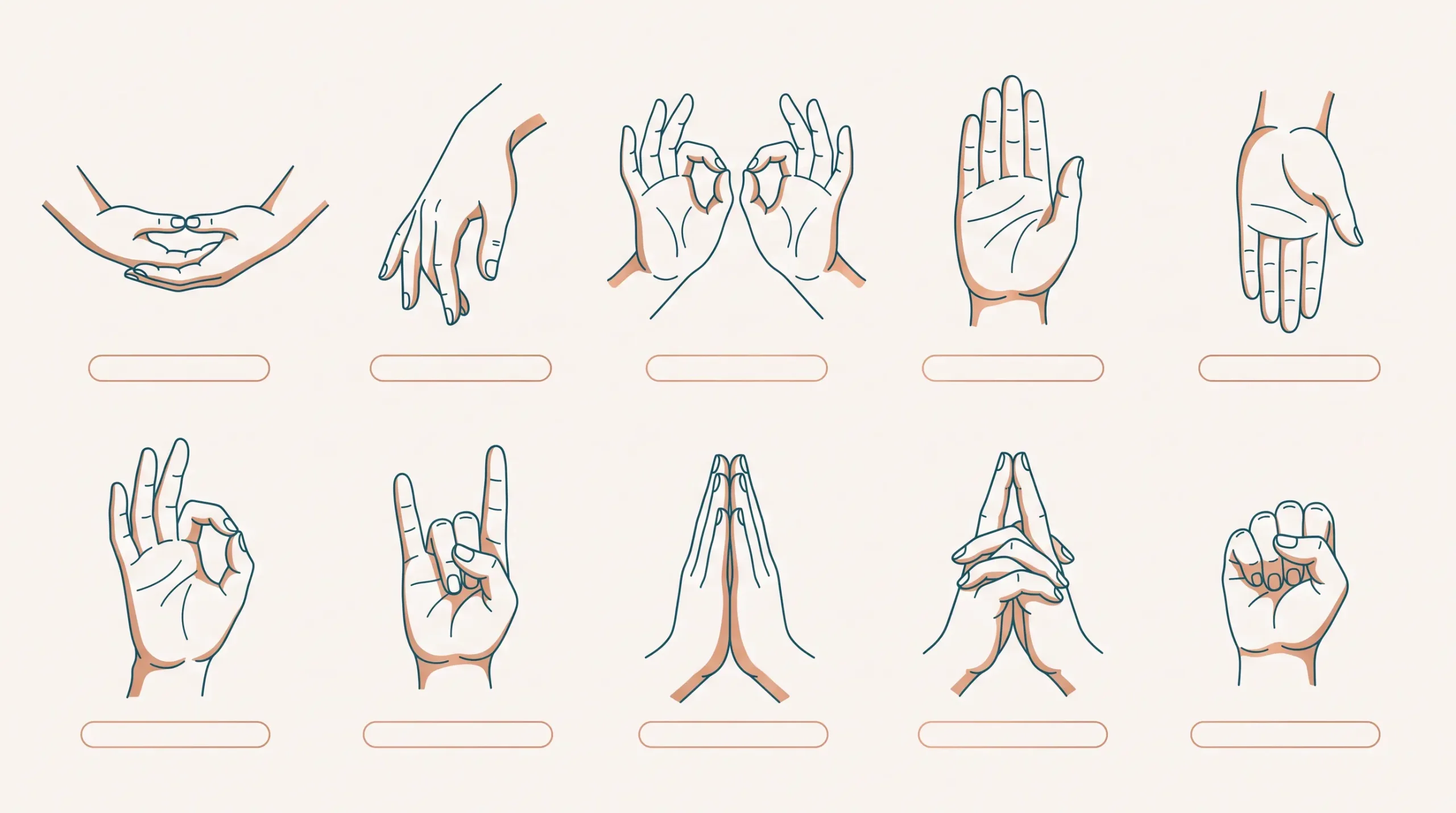
Buddha mudras are symbolic hand gestures in Buddhist art. Each one marks a moment in the Buddha’s life or a quality of mind, such as meditation, fearlessness, or generosity. Learn ten of them and you can read most Buddha statues on sight, in a museum, a temple, or your own home.
Most people spot a raised palm or a hand resting on a knee and cannot say what it means. This chart fixes that. You get all ten Buddhist hand gestures on one page, a four-step method to identify any mudra, and clear notes where museum sources disagree.
Every definition below traces to the museum and academic sources listed at the end. ShaoLin Store carries handmade Buddha and Guanyin statues in copper and sandstone, so the guide closes with how to match a gesture to your space.
Educational guide. Meanings reflect traditional interpretations and vary across Theravada, Mahayana, and Vajrayana lineages.
What Is a Mudra?
A mudra is a symbolic hand gesture, from the Sanskrit word for “seal” or “sign,” used in Buddhist art and practice to mark a moment in the Buddha’s life or a quality of mind. The most common include dhyana (meditation), bhumisparsha (earth-touching), and abhaya (fearlessness).
Think of a mudra as visual shorthand. Instead of a caption, the sculptor puts one idea in the hands. Smarthistory notes that the fingers are thought to stand for five levels of consciousness, so each hand shape also works as a small teaching diagram in statues, murals, and thangka paintings.
What does “mudra” mean in Sanskrit?
In Sanskrit, mudra means “seal,” “mark,” or “gesture,” and the hand seals a quality of awareness the way a stamp seals a letter. Britannica defines it as a symbolic gesture of the hands and fingers used in ceremony, dance, sculpture, and painting. It adds that sculpted mudras are relatively few because an image cannot move, while ritual mudras are numerous and often esoteric.
Where did Buddhist hand gestures come from?
Buddhist mudras grew out of older Indian ritual gestures and first appear on Buddha statues from Gandhara in the first century CE. Lion’s Roar traces the practice to ritual recitations of the Vedas, composed between roughly 1500 and 500 BCE. Smarthistory says the gestures were codified by the third century. Columbia University’s JAANUS dictionary adds that mudras became fully systematized once Esoteric Buddhism absorbed them, from about the fifth century onward.
The 10 Buddha Hand Gestures at a Glance
Here are the 10 Buddha hand gestures you will see most often, grouped by what the hands do: resting or reaching, raised toward the viewer, or joined together.
| Mudra | What the hands do | Traditionally associated with |
|---|---|---|
| DhyanaDYAH-nah | Both hands rest in the lap, right over left, palms up, thumb tips lightly touching | Meditation |
| BhumisparshaBOO-mee-SPAR-shah | Right fingertips reach down to touch the ground over the knee | Enlightenment, with the earth as witness |
| DharmachakraDAR-mah-CHUK-rah | Thumb-and-index circles at chest height, the two circles touching | The first sermon and the Wheel of Dharma |
| Vitarkavee-TAR-kah | Thumb and index tip form a circle, hand raised, other fingers extended | Teaching and discussion |
| Abhayaah-BAH-yah | Right palm raised outward, fingers pointing up | Fearlessness and protection |
| VaradaVAH-rah-dah | Open palm facing outward, fingers pointing down | Generosity and wish-granting |
| Karanakah-RAH-nah | Index and little fingers up, middle two held down by the thumb | Warding off obstacles |
| AnjaliAHN-jah-lee | Palms pressed together at the heart | Reverence and greeting |
| Uttarabodhioo-tah-rah-BOH-dee | Fingers interlaced, index fingers pointing up and touching | Supreme enlightenment |
| VajraVUJ-rah | Left index finger enclosed in the right fist | Indestructible wisdom |
Print this chart or save it as a PDF.Print the chart
Smarthistory counts five main mudras: abhaya, dharmachakra, bhumisparsha, varada, and dhyana. It treats vitarka and anjali as variations or derivations. The key takeaway is that five core gestures plus a handful of variations cover most Buddha images. Smarthistory also calls both abhaya and dharmachakra the most common, so treat any “most common” claim with care.
Resting and reaching gestures: Dhyana and Bhumisparsha
Two gestures keep the hands low and close to the body: dhyana rests them in the lap, and bhumisparsha sends the right hand to the ground.
In dhyana, the right hand lies palm-up on the left, and the thumb tips touch lightly. The thumb angle changes by tradition. Smarthistory says Indian images keep the thumbs parallel, while China’s Wei tradition angles them outward into a triangle that stands for the Three Jewels. Dhyana is the signature gesture of Amitabha, and Lion’s Roar calls it one of the most common hand positions in sitting meditation.
In bhumisparsha, the Buddha touches the earth to call the Earth Goddess as witness against Mara, the tempter who challenged his seat under the Bodhi tree. Smarthistory says the figure is always seated and links the gesture to Akshobhya. Lion’s Roar notes a variation on standing statues, so read “always” as a strong tendency.
Raised-hand gestures: Dharmachakra, Vitarka, Abhaya, Varada, and Karana
Five gestures lift a hand toward the viewer, and the fingers tell them apart: circles mean teaching, a flat upright palm means protection, and a downward palm means giving.
- Dharmachakra: Both hands form thumb-and-index circles at the chest, with the circles touching. It recalls the first sermon at Sarnath, when the Buddha set the Wheel of Dharma turning, and Smarthistory links it to Vairochana.
- Vitarka: One hand makes the thumb-and-index circle while the other rests in the lap. Smarthistory treats it as a variant of dharmachakra, and it signals teaching or discussion.
- Abhaya: The right palm faces outward with the fingers up. Tradition says the Buddha used it to calm a rampaging elephant, and it is linked to Amoghasiddhi.
- Varada: The open palm faces outward with the fingers pointing down. It signals giving and wish-granting, and it belongs to Ratnasambhava.
- Karana: The index and little fingers point up while the thumb holds the middle two down. Lion’s Roar reads it as warding off obstacles and negativity.
Joined-hand gestures: Anjali, Uttarabodhi, and Vajra
The last three gestures bring both hands together, and two of them, uttarabodhi and vajra, are rarer and easier to misread.
Anjali presses the palms together at heart level, and sometimes at the forehead or mouth. Britannica and Smarthistory agree the Buddha himself rarely, if ever, makes it. In uttarabodhi, the fingers interlace at the chest, the index fingers point up and touch, and the name means “highest awakening.” Vajra encloses the left forefinger in the right fist. Lion’s Roar says it is most common in Korea and Japan, where the fist protects the forefinger, which stands for wisdom.
How Do I Identify Different Hand Mudras on a Buddha Statue?
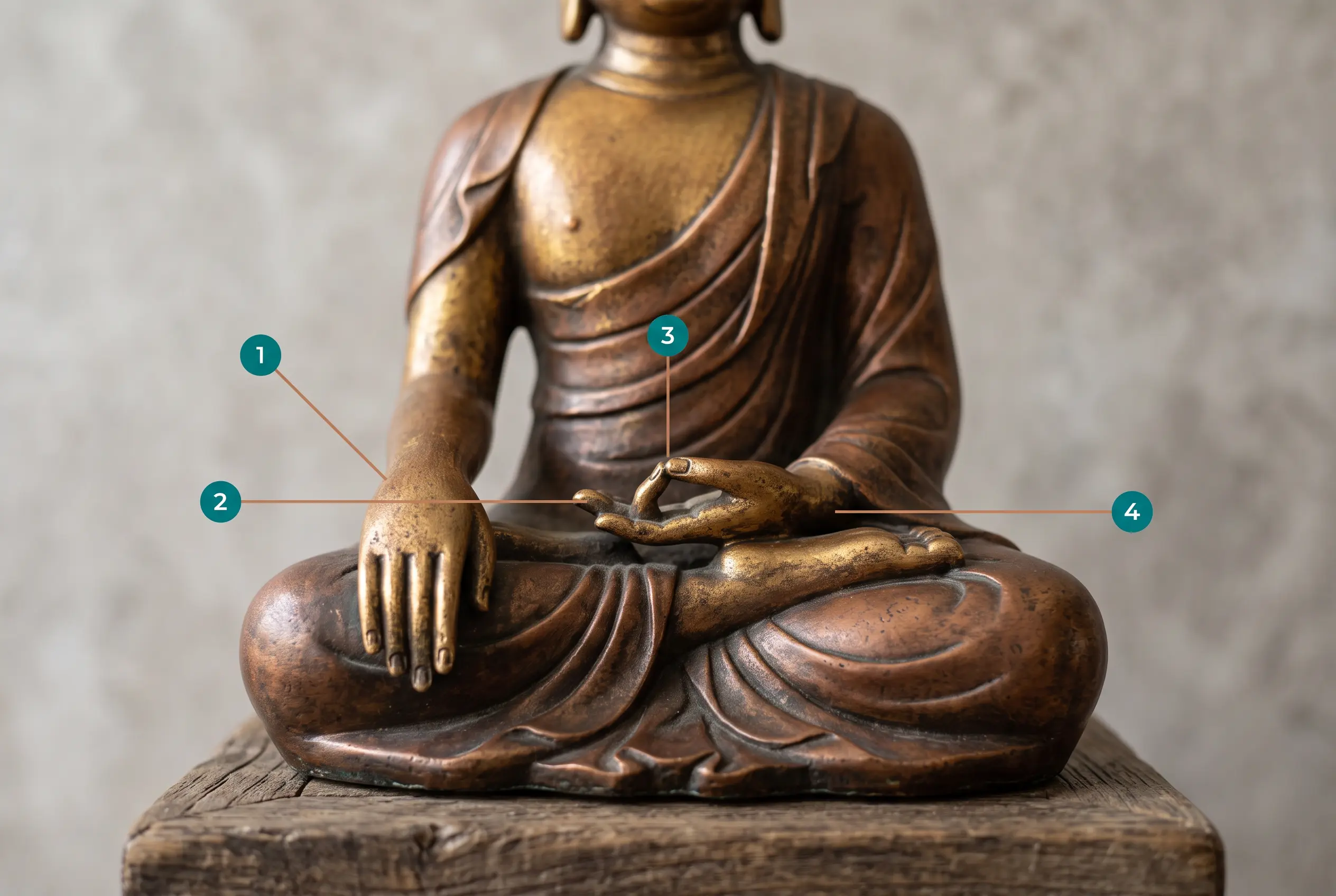
Check four things in this order: active hand, palm direction, finger contact, and hand height.
- Active hand: Start with the right hand. It carries the main gesture in most mudras, while the left rests in the lap.
- Palm direction: Palm out signals protection or giving. Palm up signals rest. A hand reaching down to the earth signals bhumisparsha.
- Finger contact: A thumb-and-index circle points to teaching. Touching thumb tips point to meditation.
- Height: Shoulder or chest suggests abhaya, vitarka, or dharmachakra. The lap suggests dhyana. The ground suggests bhumisparsha.
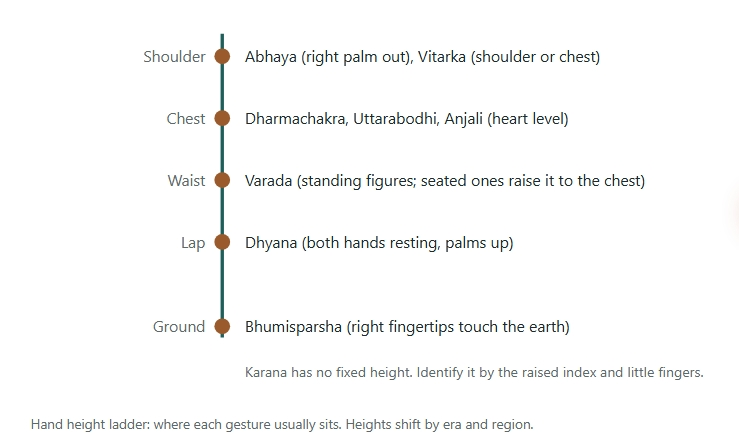
Height is a clue, not a rule. In Gandharan art the abhaya hand rises to shoulder level, but from about the fifth century onward it dips toward the hip, according to Smarthistory. The most common mistake is calling every raised hand abhaya. Check the fingers: vitarka joins the thumb and index tip, and abhaya does not.
Posture is a separate question. Britannica groups Buddha images into four postures (reclining, standing, walking, and sitting), and different mudras can appear in each. The posture (asana) tells you how the figure sits. The hands tell you what it says.
What Is the Difference Between the Abhaya and Varada Mudras?
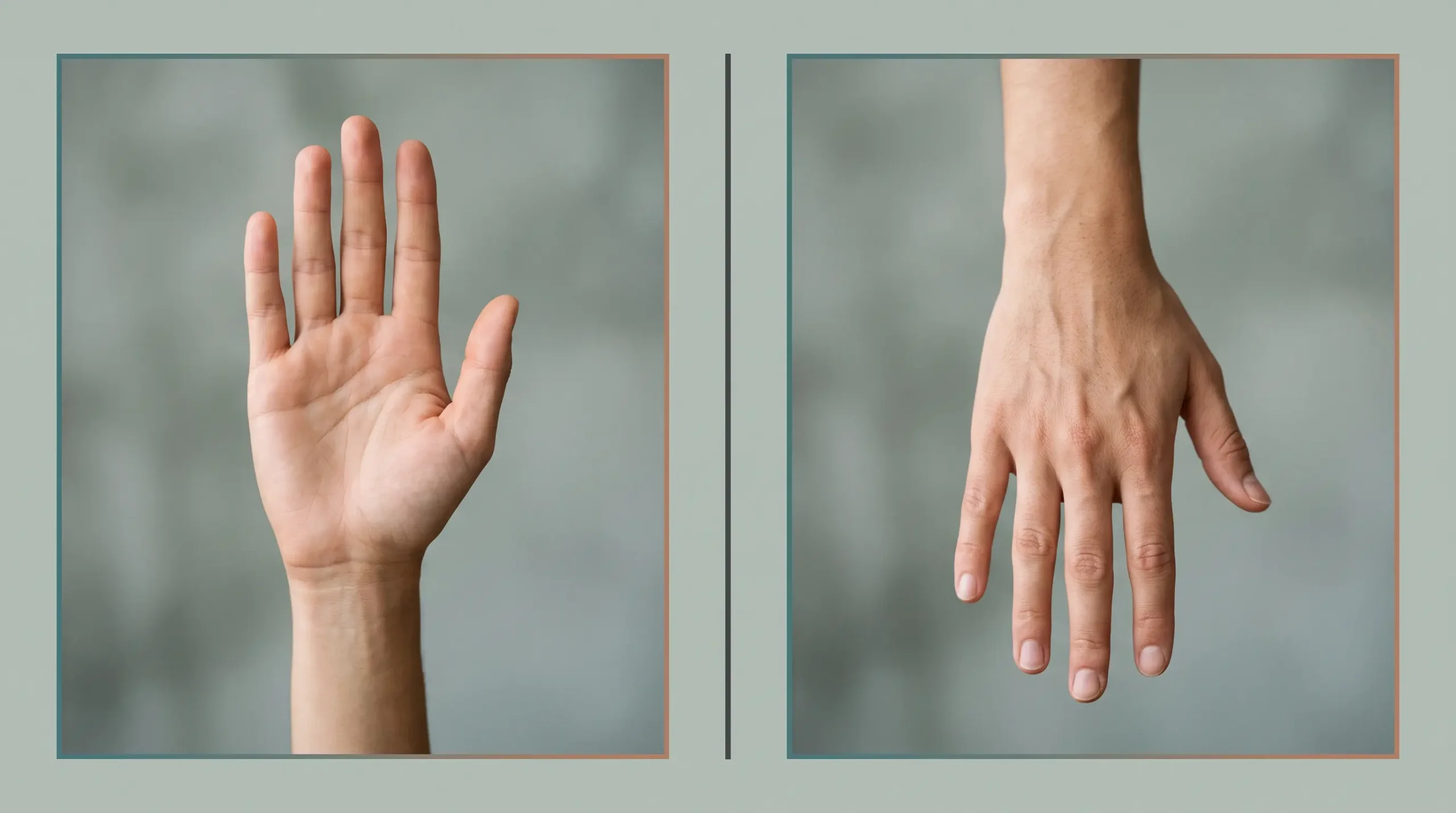
Abhaya and varada both show an open palm facing outward, but abhaya points the fingers up for fearlessness, while varada points them down for generosity.
The two often appear together, one on each hand. Columbia’s JAANUS dictionary describes a general Japanese style for Buddha images with abhaya in the right hand and varada in the left.
Where the sources disagree: Smarthistory says varada is almost always made with the left hand. Lion’s Roar describes the right arm and notes that the hands are sometimes reversed. JAANUS explains part of the gap: in Indian images a left-hand varada is exceptional, because the right hand was considered pure, while Japanese images commonly place varada on the left. When you read a statue, trust the fingers and palm first, and the hand second.
Which Look-Alike Gestures Do People Confuse Most?
Four pairs trip up most beginners, and each has one clear tell.
| Look-alike pair | What they share | The tell |
|---|---|---|
| Abhaya vs. Vitarka | Raised right hand, palm out | Vitarka joins the thumb and index tip into a circle |
| Varada vs. Bhumisparsha | Hand pointing down | Bhumisparsha reaches over the knee to touch the ground |
| Dharmachakra vs. Vitarka | Thumb-and-index circle | Dharmachakra uses two circles, one on each hand |
| Anjali vs. Uttarabodhi | Hands together at the chest | Uttarabodhi interlaces the fingers, with the index fingers up |
Which Dhyani Buddha Goes With Which Hand Position?
In Mahayana and Vajrayana art, each of the Five Dhyani Buddhas has one signature gesture, so the hands tell you which Buddha you are looking at.
| Dhyani Buddha | Signature mudra | Meaning |
|---|---|---|
| Vairochana | Dharmachakra | Teaching the Wheel of Dharma |
| Akshobhya | Bhumisparsha | Earth as witness to awakening |
| Ratnasambhava | Varada | Generosity |
| Amitabha | Dhyana | Meditation |
| Amoghasiddhi | Abhaya | Fearlessness and protection |
Does the Mudra Change Depending on Which Buddha or Bodhisattva Is Depicted?
Yes, the same gesture can shift in meaning or form with the figure: Amitabha forms dhyana with both hands, and in Japan Amida’s version has its own name, mida-no-jōin.
JAANUS notes that Amida’s left hand differs slightly from the right, while Japanese Esoteric art often shows Dainichi (Vairochana) with chiken-in, a related fist-and-forefinger gesture. For Shakyamuni, dhyana recalls the meditation before awakening. Smarthistory ties anjali to Avalokiteshvara, the bodhisattva known in China as Guanyin.
How Do Mudras Differ in Thailand, Tibet, and Japan?
Core gestures stay the same across regions, but emphasis shifts: Thai and Lao walking Buddhas favor abhaya, Japanese images often pair abhaya with varada, and Vajrayana art adds many ritual gestures.
Smarthistory adds that a left-handed abhaya, common in Theravada images, can read as a command to halt. The Encyclopedia of Buddhism notes that Mahayana and Vajrayana iconography grew the set into the hundreds.
How to Choose a Statue by Its Gesture
Match the gesture’s traditional meaning to the room: dhyana for a meditation corner, abhaya for an entryway, and bhumisparsha for a desk or study where steadiness matters.
- Dhyana: Pairs well with a seat or cushion, because the gesture itself shows sitting practice.
- Abhaya: Welcomes people with a gesture of protection and reassurance.
- Bhumisparsha: Suits a workspace, since it stands for staying steady under pressure.
Which Buddha Statue Gesture Is Best for a Meditation Space?
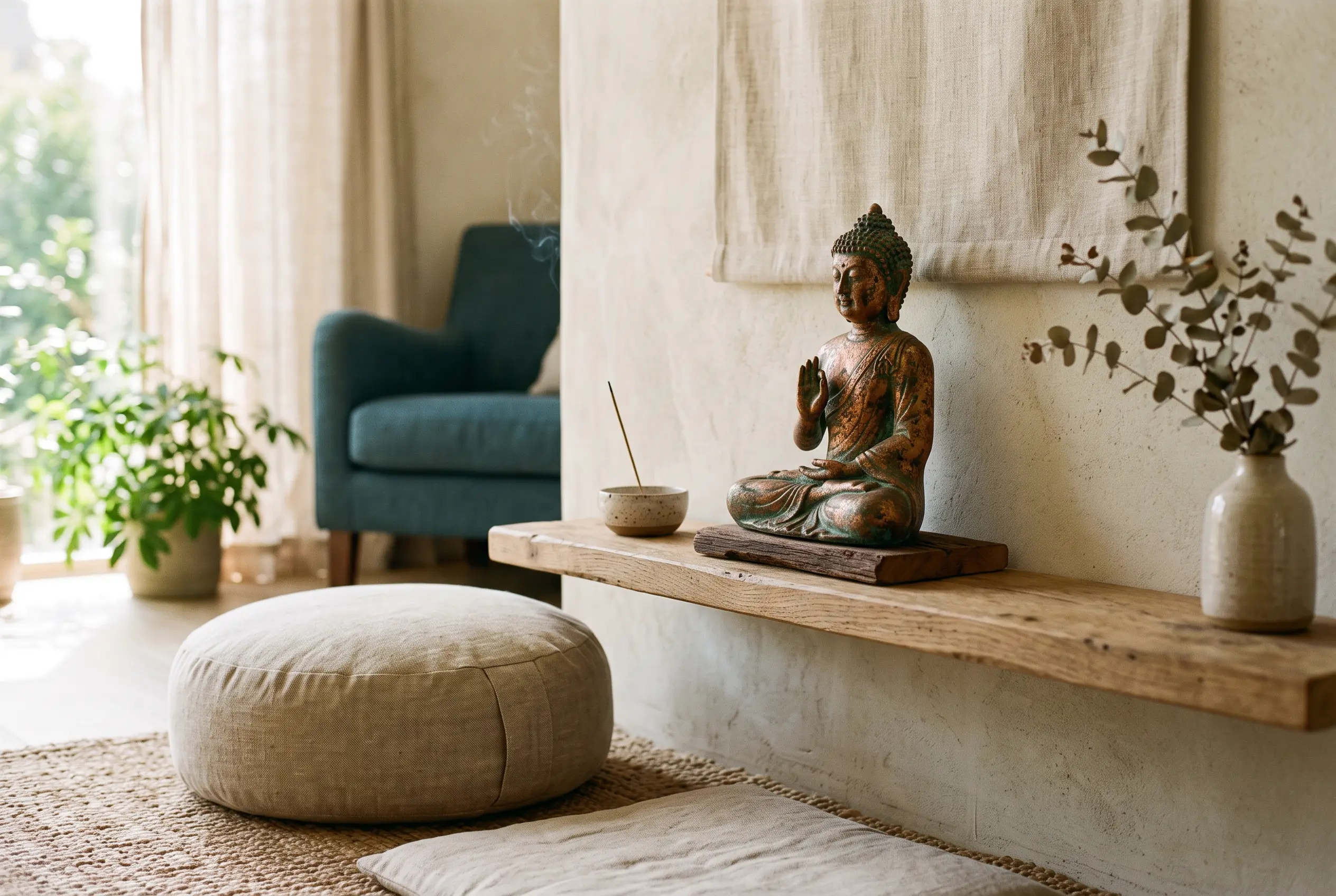
For a meditation space, a seated Buddha in dhyana mudra is the most direct choice, because the gesture itself depicts meditative absorption.
ShaoLin Store’s Aged Copper Meditating Buddha in the dhyana meditation gesture is one example, listed at $298.95 on 10/24/2026. In a corner where you sit each morning, the gesture works as an at-a-glance cue to settle your own hands the same way.
Starting a meditation corner? Choose one gesture, place the statue where you will see it when you sit, and let the dhyana shape guide your hands.
Display it with care. Eye level or higher is best, on a clean and quiet surface, and many traditions suggest at least about 3 ft (90 cm) off the floor. Keep statues out of bathrooms and kitchens. It is the simplest way to show respect, whether or not you are Buddhist.
Which Poses Look Like Mudras but Are Not?
Not every hand position is a classical mudra: a finger raised to the lips is a silence gesture, and Guanyin’s relaxed royal-ease seat is a posture.
None of the museum and academic sources used here list the silence gesture as a classical mudra. Our Shaolin Quiet Sakyamuni bust, for example, uses it as a design choice. Royal ease (rajalilasana) is a seat with one knee raised and one arm resting on it. The Princeton University Art Museum notes that the pose became linked with Guanyin by the late ninth century.
Our Royal Ease Guanyin shows that pose in solid copper, 8.9 in (22.6 cm) tall and 2.16 lb (980 g). The listing says it is metal, not cold-cast resin, so it has real heft on a desk or shelf. It was priced at $388.95 on 10/24/2026.
Can You Use These Mudras in Your Own Meditation?
Yes, many teachers invite students to try gestures such as dhyana and anjali, as long as you treat them as expressions of attention and respect, not magic shortcuts.
Lion’s Roar invites readers to try the gestures themselves to sense what each one evokes. The Zen teacher Thich Nhat Hanh introduced chanting a praise to Avalokiteshvara with gestures, saying it builds concentration by using mind, speech, and body at once. If you are new, fidgeting with your hands at first is normal. Begin with dhyana for your first few sittings.
Some gestures belong to a teacher. Lion’s Roar explains that in Vajrayana, ritual mudras are transmitted when practitioners are empowered for a given practice, so leave those to a qualified teacher. Hand mudras taught in yoga classes belong to a related but separate system, and this guide covers only Buddhist gestures.
If you like to wear or hold something while you sit, ShaoLin Store offers bodhi seed and Om Mani Padme Hum mantra bracelets.
Which Mudra Is Used for Meditation?
Dhyana is the classic meditation mudra: rest the left hand in your lap, lay the right on top, palms up, and let the thumb tips touch lightly.
Lion’s Roar says it represents meditative equipoise, and some commentators read the joined hands as nonduality. Smarthistory places the hands at about stomach level. Lion’s Roar describes the thumb tips as lightly touching, so there is no need to press.
Is It Disrespectful to Use Mudras if You Are Not Buddhist?
Using simple gestures such as dhyana or anjali with sincerity is generally welcomed by the teachers who share them, as Lion’s Roar’s invitation shows.
What reads as disrespectful is treating sacred imagery as a novelty, or copying gestures reserved for initiation. When in doubt, choose the simple gesture and keep your attention on your breath.
Important note: The meanings in this guide reflect traditional Buddhist interpretations and museum scholarship, not scientific claims. Interpretations vary across Theravada, Mahayana, and Vajrayana lineages. This content is educational and does not replace guidance from a qualified teacher.
Frequently Asked Questions About Buddha Mudras
There is no single fixed number. Sculpture uses a relatively small set, while Mahayana and Vajrayana ritual traditions grew into the hundreds. Ten gestures cover most Buddha statues you will meet.
Yes. Each hand can make its own gesture, and a common pairing is abhaya in one hand with varada in the other. Read each hand separately, then read the pair together.
Usually the right hand carries the main gesture while the left rests in the lap, but varada is the exception many sources reverse. Check the palm direction and the fingers before relying on handedness.
Start with the quality you want in your space: dhyana for calm focus, abhaya for reassurance, or bhumisparsha for steadiness. Then browse our handmade Buddha statues and match the gesture to the room using the chart above.
In summary, Buddha mudras come down to ten gestures and four checks. Read the active hand, the palm, the fingertips, and the height, and most statues explain themselves. Where museum sources disagree, trust the fingers and palm over the hand, and keep the meanings traditional rather than absolute.
Ready to set up your practice space? ShaoLin Store ships free on all orders and accepts returns within 60 days. Browse meditation cushions and singing bowls for a home practice space
📚 References
- Mudras in Buddhist art: Overview of the five main mudras and their derivations, with dates, Dhyani Buddha links, and regional notes. Smarthistory
- in 印 (mudra) entry: Scholarly dictionary entry on how mudras became systematized and on the Japanese abhaya and varada pairing. Columbia University, JAANUS
- Mudra: Encyclopedia definition covering meaning, ceremonial versus sculptural use, and Buddha postures. Encyclopaedia Britannica
- Hands of Wisdom: A Guide to Buddhist Mudras: Illustrated guide with hand positions, meanings, and practice notes by Barry Boyce (06/01/2026). Lion’s Roar