
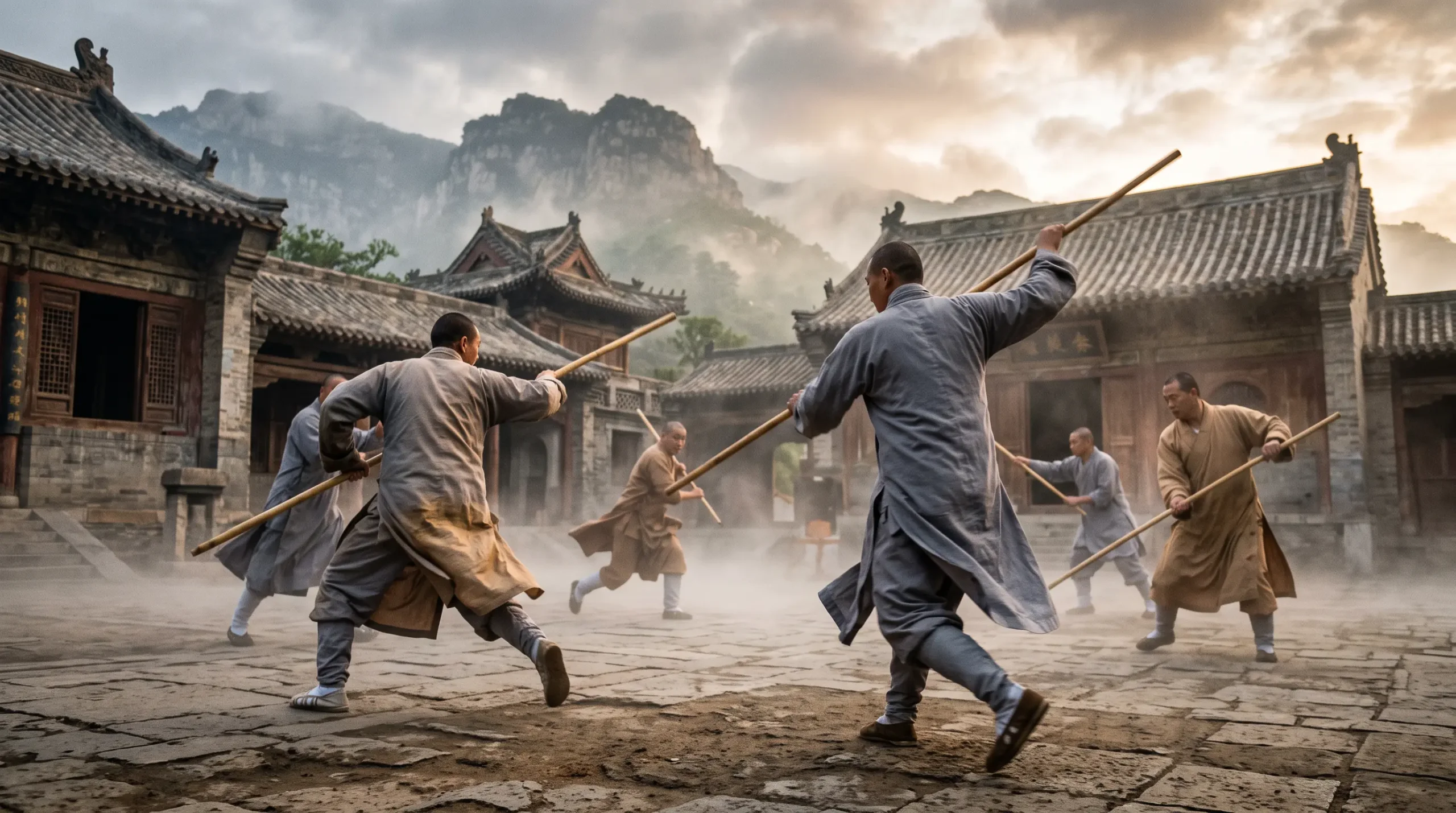
Shaolin warrior monks are Chan Buddhist monks of the Shaolin Monastery on Mount Song in Henan, China, and they really did fight. A stone stele carved in 728 records monks aiding the future Tang emperor in 621. The movie version, with flying kicks and a kung fu school founded by Bodhidharma, is mostly legend.
At ShaoLin Store, we sell meditation prayer beads, and we keep running into “secret Shaolin” claims that skip the historical record. So we cross-checked the stele, historian Meir Shahar’s research, and recent news reports. You will learn which stories are carved in stone, which are scholarly best guesses, and which were invented in the 20th century.
A note on sources: The history below follows scholarly work, mainly Meir Shahar’s The Shaolin Monastery (University of Hawai’i Press, 2008). Statements about meditation and prayer beads describe traditional practice. They are not medical claims.
Were Shaolin Monks Real Warriors?
Yes. Shaolin monks fought in real battles: a stele dated 728 records monks defending their estate around 610 and helping the future Tang emperor Li Shimin defeat the warlord Wang Shichong in 621. Their peak came in 1553, when 120 monks under Tianyuan routed coastal pirates. The superhuman kung fu, however, is mostly legend.
The evidence is strongest for three episodes: the 610 estate defense, the 621 campaign, and the 1553 pirate battle. Everything else rests on thinner, later sources, which we flag in the timeline below.
What the 728 Tang Stele Actually Records
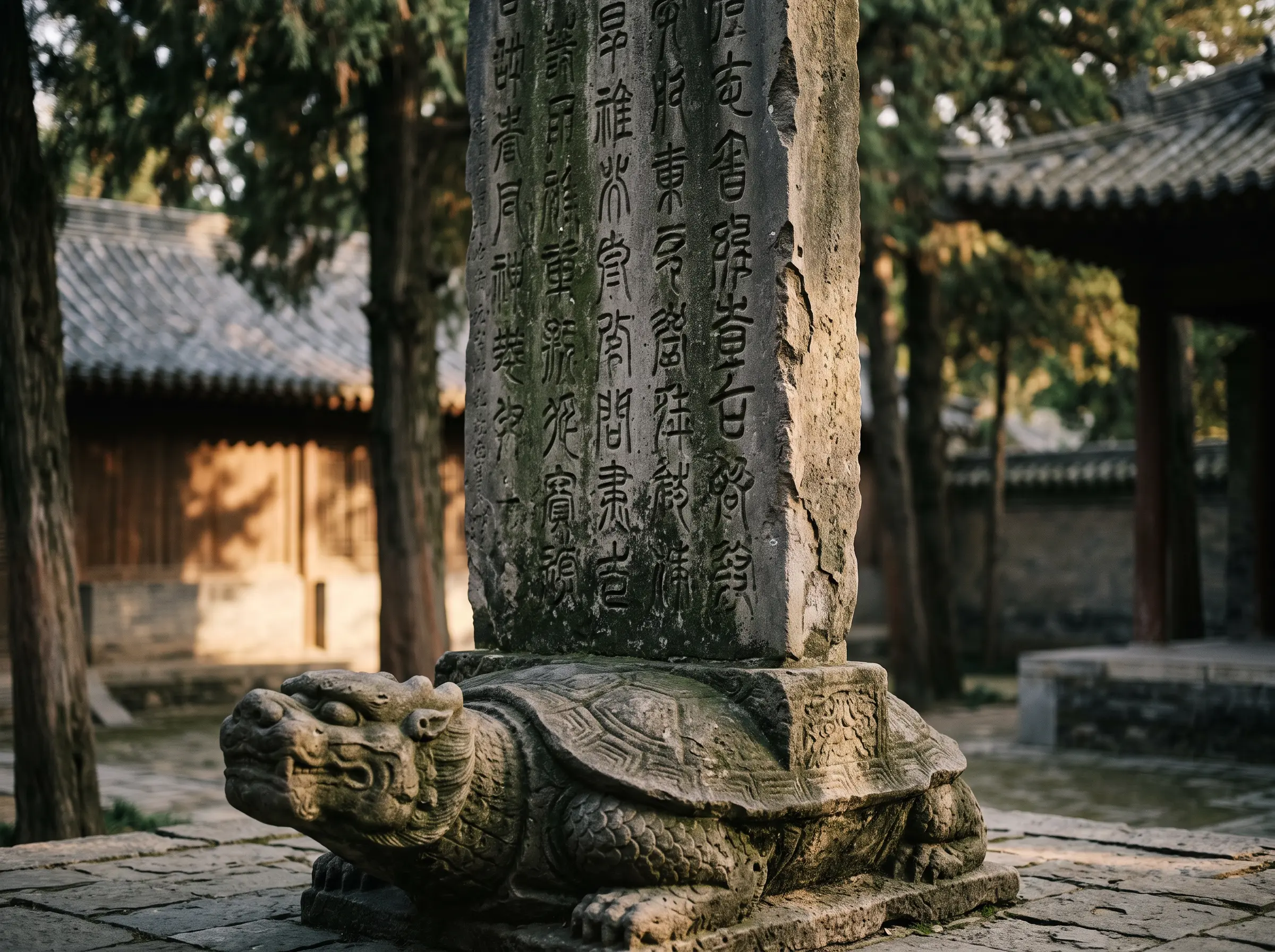
The Shaolin Monastery Stele, carved in 728, names thirteen monks rewarded for helping Li Shimin, the future Emperor Taizong, in 621. The same stone records an earlier defense of the monastery’s estate against bandits, around 610. It is the oldest source linking Shaolin monks to armed service.
Here is what the stele does not say. It never describes how the monks trained or which fighting style they used. That silence surprised us, and it matters for the Bodhidharma story below.
One more detail from our cross-check: some popular summaries date this episode to 618 and tie it to Li Yuan. Shahar’s account points to 621 and Wang Shichong, so we use 621.
Why Did Buddhist Monks Fight If Buddhism Forbids Killing?
Shaolin monks took the same precept against killing as other Buddhist monastics. Their fighting was framed as defending the monastery and the dharma, often under the guardian deity Vajrapani. Shahar ties this protective role to a cult of guardian figures at the monastery.
Practical motives mattered too. The monastery held large estates, and bandits and rebels threatened its land and grain. Historians treat the tension between nonviolence and defense as real, not as something the monks ignored.
Did Bodhidharma Really Invent Shaolin Kung Fu?
Probably not. Bodhidharma is honored as the founder of Chan (Zen) Buddhism, but the claim that he taught the monks kung fu traces to the 17th-century Yijin Jing and only went mainstream in the early 1900s. The Yijin Jing is an exercise manual credited to Bodhidharma, but scholars date it to the 1600s.
The calendar also works against the legend. The monastery was founded in 495 CE, by order of Emperor Xiaowen of the Northern Wei dynasty, for the Indian monk Batuo. In the traditional account, Bodhidharma arrived later and meditated in a nearby cave.
Britannica phrases it carefully. It says Bodhidharma is only “reputed” to have introduced martial arts as a complement to meditation. When a reference work hedges, a hedge is the right reading for the rest of us.
Where the Bodhidharma Kung Fu Story Came From (1600s–1919)
The story grew in three steps: a 17th-century exercise manual credited to Bodhidharma, early-1900s boxing manuals such as Secrets of Shaolin Boxing Methods, and a 1919 Chinese physical-culture history that repeated it. Historian Tang Hao was among the first to challenge the attribution in the early 20th century. Later scholars have largely agreed with his skepticism.
What Chan Buddhism Actually Gave the Monastery
Bodhidharma’s real legacy at Shaolin is Chan, a meditation-first school that later traveled to Japan as Zen. That spiritual identity is why the monastery still calls itself a Chan temple. Shi Suxi, a 20th-century abbot, is often quoted as saying Shaolin is Chan, not martial arts.
In Chan and Zen circles, a mala is often treated as a simple counting aid for meditation. For the symbolism behind those counting beads, see our explainer on why Buddhist malas carry 108 beads.
A Battle-by-Battle Timeline of Shaolin’s Fighting Monks (610–1928)
Sources place Shaolin monks in at least five armed episodes between 610 and 1928. Only three rest on strong evidence: the 610 estate defense, the 621 campaign, and the 1553 pirate battle.
| Year | Event | Monks involved | Outcome | Evidence level |
|---|---|---|---|---|
| c. 610 | Bandits threaten the monastery estate | Resident monks (number not recorded) | Monks defend the estate | Stele (728) |
| 621 | Campaign against Wang Shichong at Cypress Valley Estate | 13 named monks | Estate retaken; Wang Renze captured; court reward | Stele (728) |
| 1511 | Clash with bandits | Reportedly about 70 monks lost | Heavy losses reported | Secondary |
| 07/21/1553 | Battle of Wengjiagang against wokou pirates | 120 monks led by Tianyuan | 100+ pirate casualties; 4 monks lost | Scholarly research |
| 1555 | Reported setback against pirates | Not recorded | Monks reportedly defeated | Secondary |
| 1641 | Clashes with Li Zicheng’s rebel forces | Not recorded | Accounts vary | Secondary |
| March 1928 | Temple burned during warlord conflict | Resident monks (not a documented battle) | Most buildings reportedly destroyed | Secondary |
How to read the labels: Stele means a primary source carved in 728. Scholarly research means university-press or peer-reviewed work. Secondary means a later summary we could not trace to a primary source.
Tang Dynasty: The Thirteen Monks and the Future Emperor
In 621, Shaolin monks seized back the Cypress Valley Estate from Wang Shichong’s forces and captured his nephew, Wang Renze, siding with Li Shimin. Li Shimin went on to become Emperor Taizong, the second ruler of the Tang dynasty, and the stele records the court’s gratitude. The 610 estate defense is the earlier and smaller episode. Both appear on the same 728 stone.
Ming Dynasty: Monk-Soldiers Against the Wokou Pirates
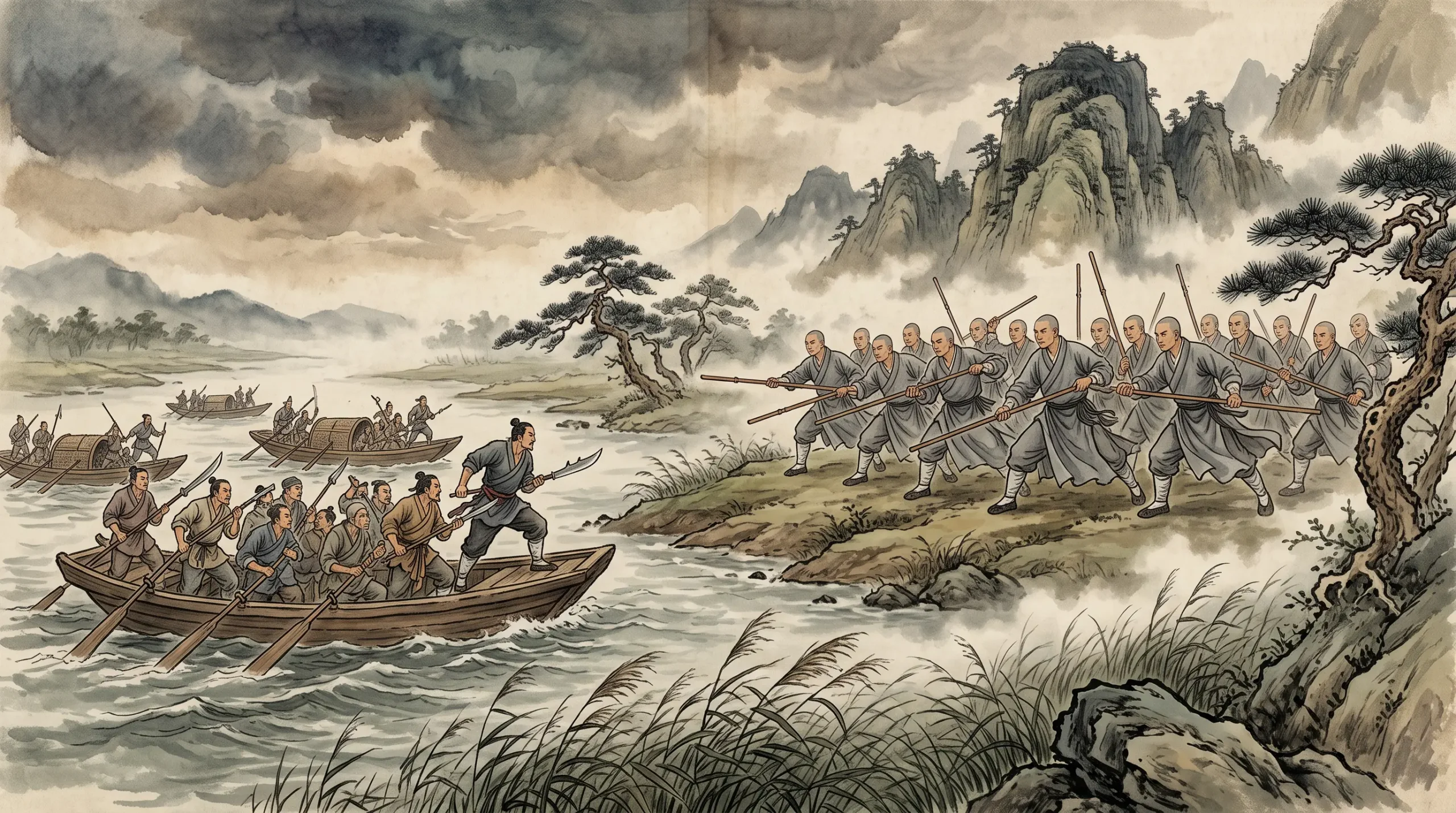
On 07/21/1553 at Wengjiagang, 120 monks led by Tianyuan defeated a pirate band, inflicting over 100 casualties while losing four men, according to Meir Shahar’s research. The attackers were wokou, coastal raiders who plagued Ming China. Staff fighting was the monks’ signature skill, and Ming military writers praised it. The general Qi Jiguang was among them.
A secondary account also describes a 1555 setback. We could not trace that report to a primary source, so we label it unconfirmed.
When Was the Shaolin Temple Burned? 1928 and the Cultural Revolution
The most destructive fire came in March 1928, when forces of the warlord Shi Yousan set the monastery ablaze. The New World Encyclopedia reports that it burned for more than 40 days and destroyed most of the buildings, including many manuscripts. Those figures remain reported rather than independently verified.
The Cultural Revolution, which began in 1966, brought further damage and pressure on the monastic community. The popular claim that the Qing government burned the temple in 1736 has no solid evidence behind it.
The fire also explains a limit we hit while researching. Because manuscripts were lost, early Shaolin history has to be rebuilt from stone inscriptions and outside records. That is why this article leans on the 728 stele.
Staff Before Fists: How the Monks Actually Fought
For most of its documented fighting history, the Shaolin specialty was the staff, not the fist; unarmed Shaolin boxing only became a systematized art in the 17th century. Staff fighting was the weapon of choice when monks faced Ming-era wokou pirates. Shahar adds that monks also used spears and blades in real combat, so the staff was a signature, not an exclusive tool.
The best-known source is Cheng Zongyou (1561–1636), who studied at the monastery. His Shaolin Staff Method is considered the first systematic account of Shaolin staff fighting.
Legend adds a divine origin. The guardian Kimnara, disguised as a kitchen worker, is said to have driven off Red Turban raiders with a fire poker. Treat that as folklore, not record.
One limit is worth stating plainly. Modern stage routines show choreography, not battlefield technique.
Why the Staff Came First
The staff was already part of a monk’s kit, it was less lethal than a blade, and it fit Buddhist ideas about restrained force, which made it the natural weapon for monastery defenders. A walking staff also drew less suspicion than a sword on the road between temple estates.
When Empty-Hand Shaolin Quan Took Shape
Hand-and-foot fighting at Shaolin appears in the 16th century and was organized into a system in the 17th, often blended with breathing exercises the monks saw as self-cultivation. Those exercises were later grouped under the word qigong. The Luohan 18 Hands, a short movement set traditionally associated with the monastery, is a well-known example. As with Bodhidharma, its oldest attributions are legendary.
Legend vs. Record: 7 Shaolin Myths Fact-Checked

Most Shaolin myths contain a grain of history wrapped in centuries of fiction, so the useful question is not “true or false” but “how good is the evidence?”
Shaolin Myths vs. Facts at a Glance
| Legend | What the record shows | Evidence level |
|---|---|---|
| Bodhidharma invented Shaolin kung fu | The attribution appears in the 17th-century Yijin Jing and spread in the early 1900s. | Legend |
| All martial arts came from Shaolin | Chinese fighting arts appear in Han-dynasty texts, centuries before the monastery’s founding in 495. | False |
| The Qing burned Shaolin in 1736 | Historians find no solid evidence for this event. | Legend |
| A Southern Shaolin Temple in Fujian was burned | Its existence is disputed. Former abbot Shi Yongxin said he never found the term in records. | Disputed |
| Thirteen monks helped found the Tang dynasty | They aided Li Shimin’s 621 campaign, three years after the dynasty began in 618. | Documented (stele) |
| Monks fought pirates | Wengjiagang, 07/21/1553: 120 monks, 100+ pirate casualties, per Shahar. | Documented |
| Monks mastered 72 secret arts | The 72-arts list traces to early 20th-century manuals and martial-arts fiction. | Fiction |
How to Spot “Shaolin” Marketing Myths Today
If a class or product promises “secret Shaolin powers” or official temple certification, ask for proof, because the temple has registered “Shaolin” as a trademark in China and has defended it in court. Feeling unsure about a class or a product is normal, and these three checks take about five minutes:
- Check the lineage: Ask which master and which monastery trained the instructor.
- Treat the “72 secret arts” as fiction: No monastery record supports a 72-art curriculum.
- Read the “blessed” label: Ask which temple, which date, and who performed the ceremony.
The same test applies to us. Our malas are traditional Buddhist prayer beads, not Shaolin products, and we make no temple-blessing or certification claims.
What Shaolin Warrior Monks Practice Today
Yes, Shaolin still houses practicing Chan Buddhist monks, and its abbot since 07/29/2025 is Shi Yinle. Daily life centers on Buddhist practice, with kung fu training as part of monastic culture. The monastery is also a major heritage site and a draw for visitors.
From Jet Li’s 1982 Film to UNESCO World Heritage (2010)
Jet Li’s 1982 film Shaolin Temple drew visitors back to a badly damaged monastery, and in 2010 UNESCO inscribed it within the Historic Monuments of Dengfeng. UNESCO’s listing, ID 1305, covers an 825-hectare (about 2,039-acre) core area. The Pagoda Forest, about a third of a mile (0.5 km) west of the temple, holds more than 240 pagodas dating from 791 to 1803.
The tradition also reached the United States. Shi Yan Ming arrived in 1992 and went on to found the USA Shaolin Temple in Manhattan. PBS’s Independent Lens documentary Shaolin Ulysses: Kungfu Monks in America explored that story.
Who Leads the Shaolin Temple Now?
Shi Yinle, previously abbot of the White Horse Temple in Luoyang, became Shaolin’s abbot on 07/29/2025, a day after Chinese authorities moved to revoke Shi Yongxin’s ordination certificate amid an embezzlement probe. Shi Yongxin had led the monastery since 1999.
On 05/29/2026, a court in Xinxiang sentenced Shi Yongxin to 24 years in prison for crimes including embezzlement and bribery, the Associated Press reported. As of 10/30/2026, the reports we reviewed still name Shi Yinle as abbot.
Bringing a Chan-Style Practice Home
You do not need a monastery to borrow Shaolin’s quieter half: a daily sit and a string of counting beads are how many practitioners traditionally keep focus. A mala is a Buddhist prayer bead string, usually with 108 beads, used to count mantra or breath repetitions.
Our 108-bead wood mala bracelet for prayer and meditation puts that structure on your wrist. One full circuit counts 108 repetitions, so your attention stays on your breath or mantra instead of on keeping track. The elastic cord makes it easy to slip on before you sit.
Mala beads are a traditional counting tool, not a substitute for instruction or medical care. For more on practice and symbolism, browse our guides to Buddhist practice and symbols.
Quick Answers About the Fighting Monks
Historians still dispute it. Stories of a Fujian “Southern Shaolin” burned by the Qing spread in the late 1700s, but no firm evidence confirms the legendary temple. Former abbot Shi Yongxin said he never saw the name in Shaolin records.
Shi Yinle was named abbot on 07/29/2025, according to Xinhua. He replaced Shi Yongxin, who had served as abbot since 1999 and was later sentenced to 24 years in prison.
It was founded in 495 CE by order of Emperor Xiaowen of the Northern Wei dynasty for the monk Batuo, which makes it more than 1,500 years old. Many of the buildings standing today date from the Ming and Qing dynasties or later rebuilding.
Yes. Several Shaolin-lineage centers operate in the US, including the USA Shaolin Temple in Manhattan, founded by Shi Yan Ming after he arrived in 1992. Check an instructor’s lineage before you enroll, and if the meditation side draws you in, start with our guide on how to choose mala beads for meditation practice.
In summary, Shaolin warrior monks were real fighters with documented battles in 621 and 1553, while the Bodhidharma kung fu origin story belongs to legend. The key takeaway is to ask for evidence, whether you are reading history, joining a class, or buying a string of beads.
Start a simple counting practice at home
Pair a few minutes of quiet sitting each day with a 108-bead mala from ShaoLin Store. It is a traditional Buddhist counting tool, with no temple claims attached.Shop the 108-bead mala bracelet
References
- The Shaolin Monastery: History, Religion, and the Chinese Martial Arts (Meir Shahar, 2008): University-press study of the stele, the Ming-era monk-soldiers, and the Bodhidharma legend. Project MUSE review
- Historic Monuments of Dengfeng in “The Centre of Heaven and Earth”: Official World Heritage listing, ID 1305, inscribed in 2010. UNESCO World Heritage Centre
- Shaolin Temple: Reference overview of the founding, the Chan connection, and the Bodhidharma tradition. Encyclopaedia Britannica
- New abbot of Shaolin Temple announced (07/29/2025): News report on Shi Yinle’s appointment. Xinhua