
Most zafus are 5 to 7 inches tall, and the right meditation cushion is the one that lets your knees rest below your hips. Three choices decide that: height, fill, and shape. You do not need thirty product pages to make them.
A meditation cushion (zafu) is a firm, round seat that lifts your hips above your knees for seated practice. Pick one that is too flat, and your feet fall asleep or your lower back rounds within minutes. That is a cushion problem, not a willpower problem.
At ShaoLin Store, we built this guide from published maker specs and posture research, with every source listed at the end. Use it to match buckwheat or kapok fill and a round or crescent seat to your body. When you are ready, explore our meditation supplies collection with cushions and singing bowls.
Quick answer
- Height: 5 to 7 inches for most adults. Go taller if you are over about 5’10” or your hips are tight.
- Fill: Buckwheat adjusts and holds its shape. Kapok is lighter and softer.
- Shape: Round for a centered seat, crescent for thigh support, rectangular or bench for kneeling.
Know your height range? Browse our meditation cushions collection and check each listing for fill, height, and weight before you choose.
What Does a Zafu Actually Do for Your Posture?
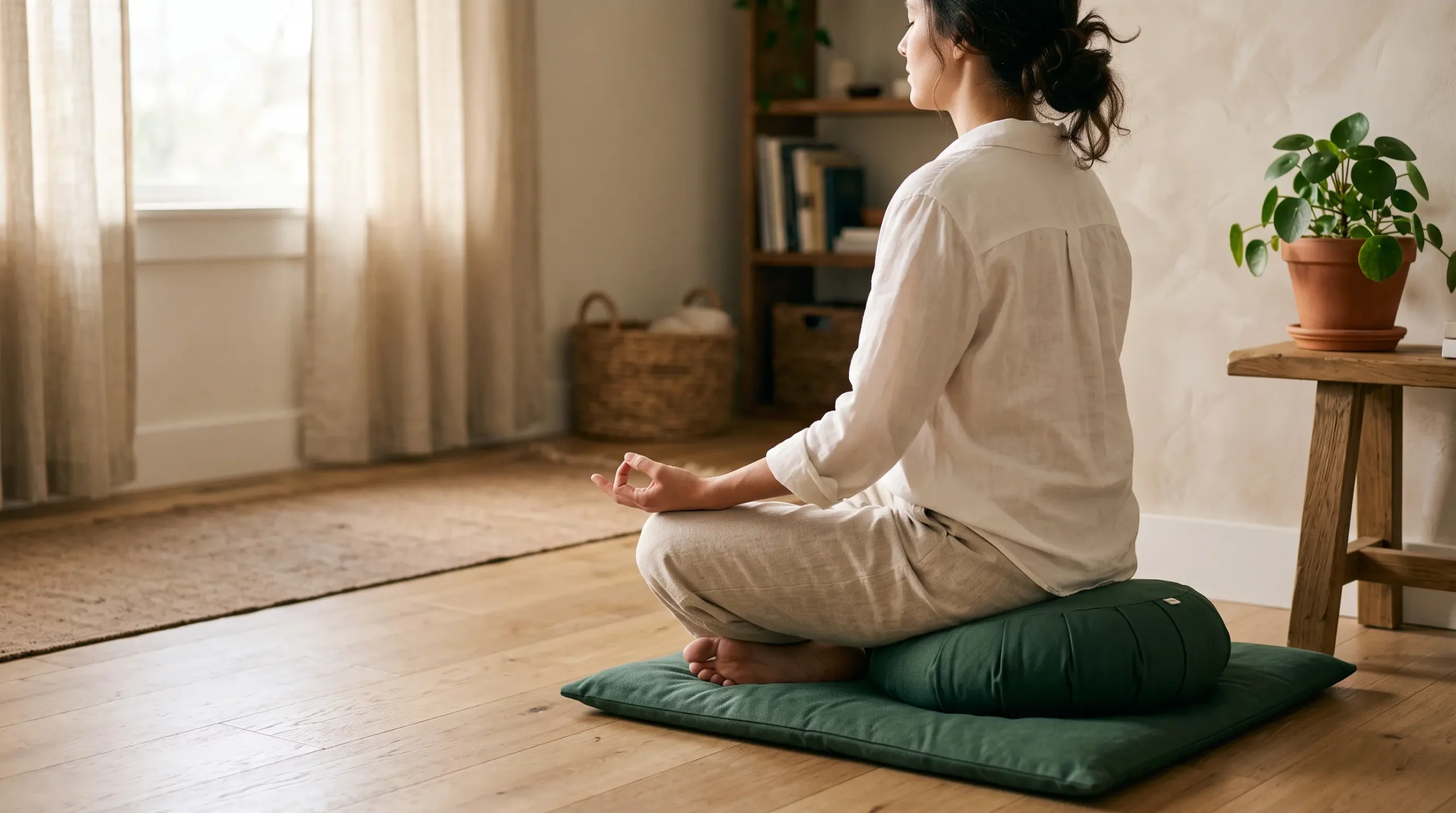
A zafu lifts your sit bones so your knees drop below your hips. That lets your pelvis tip slightly forward and your spine stack instead of slump. The result is a seat you can hold through a full zazen sit, the seated Zen meditation practice.
Why Sitting Flat on the Floor Rounds Your Lower Back
Sitting flat rolls your pelvis backward and flattens the natural curve of your lower spine, called lumbar lordosis.1 A radiographic study in Spine measured about 49° of lumbar lordosis standing and 34° sitting.2 That drop is why a floor sit can feel like your back is melting around minute ten.
Raising your hips opens the trunk-thigh angle, the angle between your torso and thighs. Many sitters find that makes an upright spine easier to hold. Research on pelvic support while sitting points the same way,3 though it studied chairs, not cushions. Treat it as supporting logic, not proof.
From Putuan to Zafu: A Chan Seat With Chinese Roots
The putuan (蒲团) is the Chinese meditation seat, and the Japanese zafu descends from it.4 Early Chinese seats were stuffed with cattail down, a soft fiber that compresses much like modern kapok.
Chan Buddhism, the Chinese school behind Zen, is traditionally traced to Shaolin Monastery. That lineage is why we care about the seat. A meditating figure such as this aged copper meditating Buddha statue with mud-gold finish pairs naturally with a cushion in a home meditation corner.
What’s the Difference Between a Zafu and a Zabuton?
A zafu is the round seat that lifts your hips, and a zabuton is the flat mat under it. The zabuton pads your knees and ankles against the floor. Most people who sit on hardwood or tile use both. Sizes for each appear in the size section below.
How High Should a Meditation Cushion Be?
Most zafus are 5 to 7 inches tall, and the right height is the one that lets your knees rest below your hips. Go toward 6 inches or more if you’re taller than about 5’10” or have tight hips, and toward 4 to 5 inches if you’re petite or very flexible.
Height is the first number to check on any listing, because fill and shape cannot fix a seat that is too low.
Cushion Height Chart by Body Height and Hip Flexibility
| Body height | Hip flexibility | Starting cushion height |
|---|---|---|
| Under 5’4″ | Flexible | 4 to 5 inches |
| 5’4″ to 5’10” | Average | 5 to 6 inches |
| Over 5’10” | Tight | 6 inches or more |
These starting points are a retailer rule of thumb, not a clinical standard. Sage Meditation lists a 7-inch zafu for people about 5′ to 6′ tall, a 4.5-inch low-loft zafu for people 5’6″ and under, and a 7.5-inch oversize zafu for people 6’2″ and taller or 225 lbs and heavier.
Makers differ by an inch or two, and fill compresses once you sit. Use your own knee test to settle it.
The 60-Second Knees-Below-Hips Test
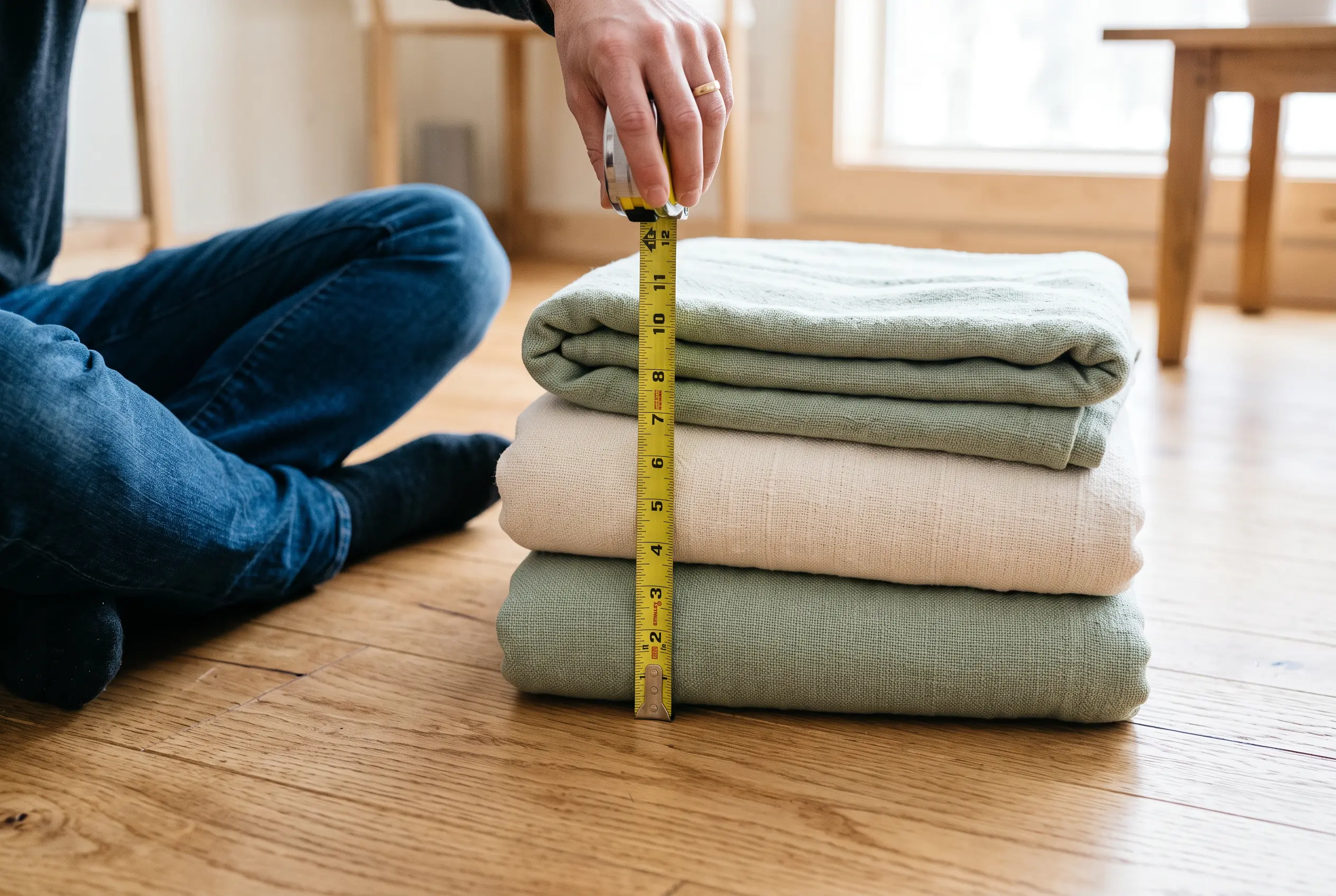
You need a tape measure and a few folded blankets. The whole test takes about 1 minute.
- Sit without a cushion (10 seconds). Take your usual cross-legged or half lotus posture on the floor.
- Check your knees (10 seconds). Ask a friend, or prop up your phone, to see whether your knees sit above your hips.
- Stack blankets (30 seconds). Add folded blankets under your hips until your knees drop below hip level.
- Measure the stack (10 seconds). Measure its height while you sit on it. That number, in inches, is your starting cushion height.
Too High or Too Low? Warning Signs
The most common beginner mistake is buying a cushion that sits too low. Here is how each problem feels:
- Too low: your knees float above your hips, your lower back rounds, and your legs fall asleep early.
- Too high: you slide forward, the fronts of your thighs tighten, and you feel perched.
If your knees float above your hips, that is the cushion, not you. A low cushion can borrow height from a folded blanket underneath, though the stack can shift. A zippered buckwheat zafu lets you add hulls instead. If you land between sizes, compare listed heights across zafu and floor-seat meditation cushions before you buy.
Buckwheat vs Kapok: Which Fill Fits Your Body?
Choose buckwheat if you want a firm, adjustable seat that molds to you. Choose kapok if you want a lighter, softer cushion that is easy to carry. Buckwheat zafus weigh roughly twice as much.
| Feature | Buckwheat hulls | Kapok fiber |
|---|---|---|
| Weight (14-inch zafu) | About 6 lbs | About 3 to 4 lbs |
| Feel | Firm, shifts to cradle your sit bones | Soft and buoyant |
| Height adjustment | Yes. Remove or add hulls through the zipper | Limited. Fiber compresses and needs fluffing |
| Upkeep | Keep dry. Replace hulls if musty | Fluff regularly. Top up fiber over time |
| Sound | Slight rustle when you shift | Quiet |
| Best for | Tight hips, taller sitters, long sits | Travel, classes, a softer seat |
Weights come from Sage Meditation and Sun and Moon Originals listings for 14-inch zafus, checked 10/30/2026. Makers vary by about a pound.

How Buckwheat Hulls Feel: Firm, Moldable, Adjustable
Buckwheat hulls are the dried outer shells of buckwheat seeds. They shift to cradle your sit bones, then hold that shape. A zipper lets you remove or add hulls for adjustable height, so you can tune the lift without buying a second cushion.
The trade-offs are weight and sound. At about 6 lbs, a buckwheat zafu is a chore to carry, and the hulls make a slight rustling noise when you shift.
How Kapok Feels: Light, Buoyant, Needs Fluffing
Kapok is a silky plant fiber from the seed pods of the Ceiba tree. A kapok zafu is lightweight at about 3 to 4 lbs, roughly half the weight of buckwheat, so it travels to class easily. Its loft feels soft and buoyant, but the fiber compresses with use, so fluff it often.
Why Specs Disagree: A Kapok Zafu Can Sit Taller
Fill names do not predict height. Still Sitting lists its kapok round zafu at about 14 inches wide, 8.5 inches tall, and 2.5 lbs. Its buckwheat round zafu is about 16 inches wide, 5.5 inches tall, and 5.5 lbs. That puts the kapok seat 3 inches higher.
Fiber also settles with use, so a freshly fluffed kapok seat measures taller than one you have sat on for months. Read the listed height and diameter, not just the fill.
Buckwheat or Kapok for Beginners? Resolving the Split Advice
Makers disagree here. Still Sitting steers beginners toward kapok for its higher, softer seat. Sage Meditation suggests starting with buckwheat when you are unsure.
Here is the rule we use. If you do not know your height number yet, pick buckwheat, because you can adjust it. If you carry your cushion often or dislike a firm seat, pick kapok. Sage also reports that more than 80% of its zafu and Cosmic Cushion orders are buckwheat. That is the maker’s own sales figure, not independent research.
Compare fills side by side. Shop meditation cushions and floor seats and check each listing for fill type, listed height, and weight. We offer free shipping on all orders and a 60-day return window, so you can test the fit at home.
Round, Crescent, or Rectangular: Picking a Seat Shape
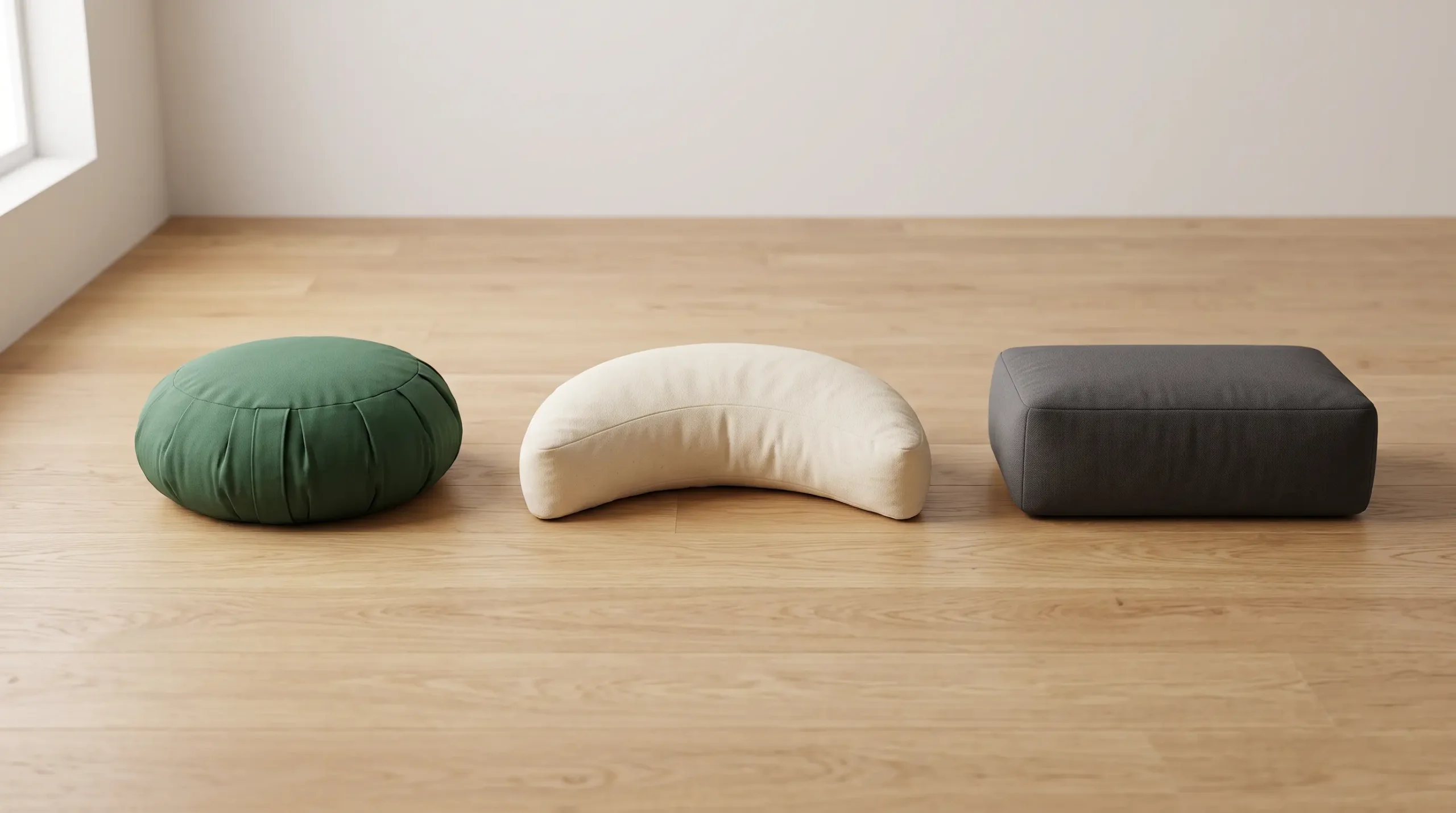
Pick a round zafu for a centered, traditional seat, a crescent if your hips are tight or your legs fall asleep, and a rectangular cushion or bench if you kneel in seiza.
- Round zafu: about 14 inches wide, with a centered seat for Burmese, half lotus, and cross-legged sitting.
- Crescent zafu: about 20 inches across, tapering from about 6 inches at the back to 2 inches at the front.
- Rectangular cushion or bench: a flat-topped seat that lifts you off your heels in seiza.
Round Zafu: The Centered Tripod
A round zafu gives you a three-point base: both knees on the floor and your sit bones on the cushion. That symmetrical tripod keeps you stable without effort. You can settle into your breath instead of correcting your balance.
Crescent Zafu: More Thigh Support for Longer Sits
A crescent zafu supports your thighs as well as your sit bones. Many practitioners find that slope eases pins and needles on longer sits, especially with tight hips. The trade-off is a less centered feel, so some sitters prefer the round shape.
Is a Crescent Better Than a Round Zafu?
Not automatically. If your knees already rest below your hips and your legs stay comfortable, a round zafu is simpler. If your thighs ache or your feet go numb, try a crescent and rerun the knee test.
Rectangular Cushions and Benches for Kneeling (Seiza)
Seiza is the kneeling posture where you sit back toward your heels. A meditation bench or a firm rectangular cushion, sometimes shaped like a bolster, lifts your hips off your heels and eases pressure on your ankles. Choose this shape only if kneeling is your regular posture.
Size, Cover, and Care: Details That Decide Long-Term Comfort
A 14 to 16 inch diameter fits most adults, a 28 to 32 inch zabuton protects your knees on hard floors, and a removable, washable cover is the upgrade worth paying for.
Diameter and Zabuton Dimensions That Fit Your Frame
Wider hips need a wider seat. A standard zafu runs about 14 inches across, while Still Sitting’s buckwheat round zafu measures about 16. A zabuton measures about 30 by 28 inches according to Wikipedia, and retailers list squares of 28 to 32 inches that are 2 to 3 inches thick.4 Choose the size that lets both knees land on the mat.
Cover Fabrics and Why a Removable Cover Matters
Cotton duck and twill are common cover fabrics, and both are sturdy enough for daily use. A zipper on the cover lets you wash it without disturbing the fill. A sewn handle makes a 6 lb buckwheat seat easier to carry between rooms.
Care: Refreshing Hulls, Fluffing Kapok, Keeping It Dry
Wash the cover, not the hulls. Hand wash the cover, hang it to dry, and refill only when it is completely dry. Keep buckwheat away from damp rooms, and replace the hulls if the cushion smells musty. Fluff kapok by hand regularly, and top up the fiber when the seat sits lower than it used to.
Your 5-Step Checklist Before You Buy a Meditation Cushion
Before you buy, run five checks: your posture, your height range, your fill, your shape, and your floor.
- Posture: Note whether you sit cross-legged, in half lotus, or kneeling.
- Height: Run the 60-second knee test and write down your number in inches.
- Fill: Choose buckwheat for adjustability or kapok for low weight.
- Shape: Choose round for a centered seat or crescent for thigh support.
- Floor: Add a zabuton if you sit on hardwood or tile.
Match Your Posture and Height Range
Your posture decides the shape, and your knee test decides the height. Write both on your phone before you shop, so listings stop blurring together. Buying a holiday gift and not sure of their height? Choose a zippered fill so they can tune the lift themselves.
Set a Realistic Budget ($49 to $80 for a Quality Zafu)
A quality zafu typically costs $49 to $80. Monastery Store lists a buckwheat Bodhi Seat at $49 and a kapok version at $59. Sage Meditation lists zafus from $69.99 to $79.99 (October 2026). If your budget is tight, buy the zafu first and add a zabuton later.
Build the Set: Zafu, Zabuton, and a Calm Corner
Set your seat in the same corner every day. Add handmade incense for a home meditation corner to mark the start of each sit, and keep your zabuton under the zafu so your knees stay padded.
In summary, the best meditation cushion matches your knees to your hips first, your body to a fill second, and your posture to a shape third. Get the height right, and the rest is refinement.
Set up your sitting corner
Pair your seat with meditation singing bowls for opening and closing a sit. ShaoLin Store carries both, so you can build the whole corner in one visit.Shop meditation cushionsShop singing bowls
Zafu FAQs: Quick Answers Before You Order
No, you can meditate anywhere, including in a chair. But if your knees sit above your hips or your back rounds within minutes, a cushion may make longer sits more comfortable.
Buckwheat hulls are plant material, so keep the cushion dry and out of damp storage. If it smells musty, replace the hulls. Ask the seller how the hulls are cleaned before you buy.
Yes. Quality buckwheat and kapok zafus were listed between $49 and $80 in October 2026. That leaves room to add a zabuton later if you sit on hard floors.
Start with an adjustable buckwheat zafu, then run the 60-second knees-below-hips test. Match your number to a height listed in our meditation cushion collection.
⚠️ Important note: This guide offers general comfort information, not medical advice. If you have back, hip, or knee pain or a recent injury, talk with a qualified clinician before you change how you sit.
How we compiled this guide: maker specs were checked on 10/30/2026, and posture research is cited below. Where makers disagree, we say so. Browse more posts on the ShaoLin Store blog.
References
- Sitting biomechanics Part I: Review of the Literature. Review of how sitting changes pelvic position and lumbar curvature. Journal of Manipulative and Physiological Therapeutics (ScienceDirect)
- Lumbar lordosis: effects of sitting and standing. Radiographic measurements of lumbar curve in standing and sitting. Spine, 1997 (PubMed)
- The Effect of a Pelvic Support Chair on Sagittal Lumbosacral Alignment in Sitting Position. Study of pelvic support and sitting alignment in adults with lower back pain. NIH PubMed Central
- Zafu and zabuton. Origins of the seat in Chinese practice and typical zabuton dimensions. Wikipedia: Zafu and Wikipedia: Zabuton