
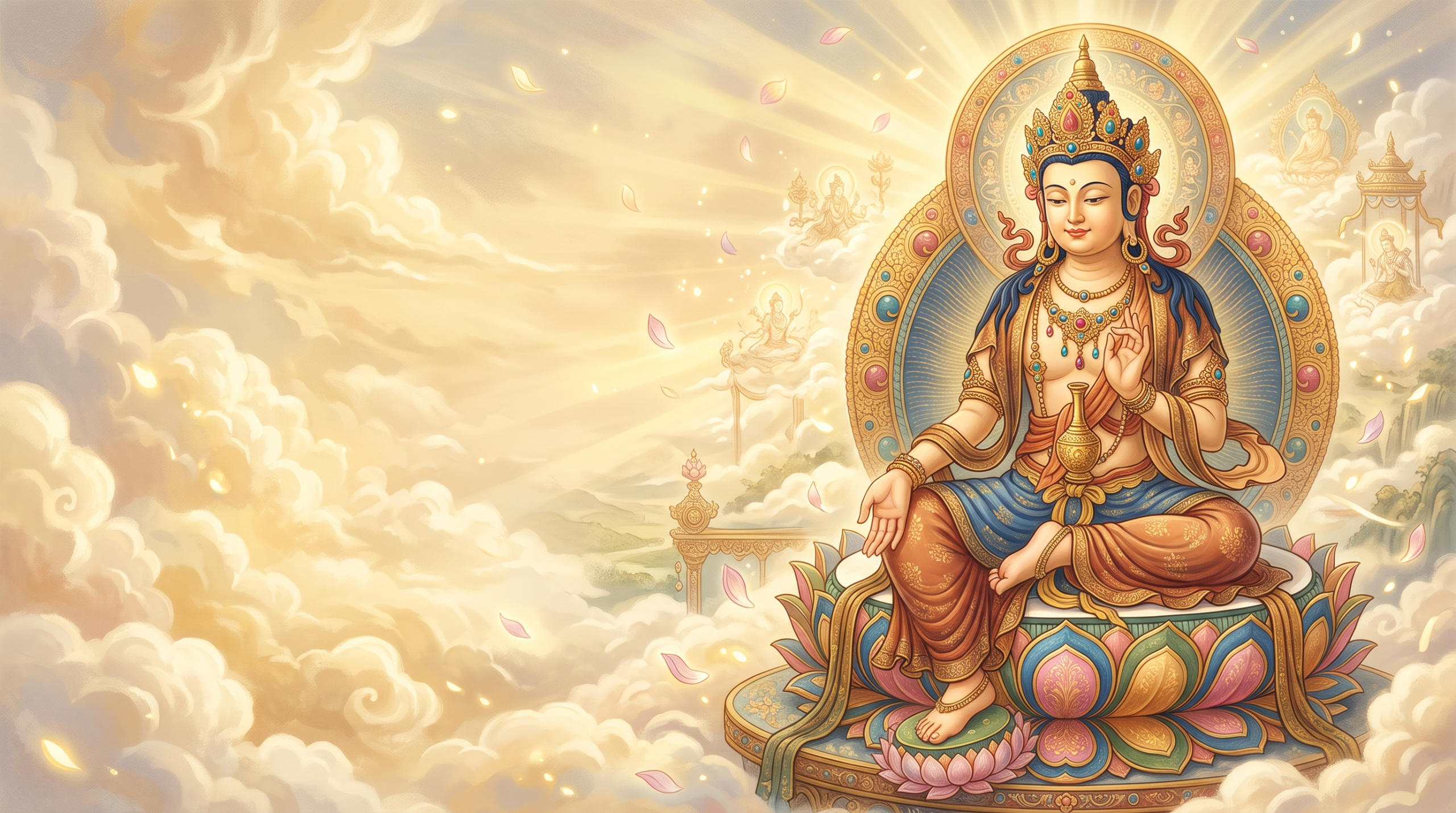
Maitreya Buddha is the future Buddha of Buddhist tradition, a bodhisattva who waits in Tushita heaven and will return to teach the Dharma when Gautama’s teachings have faded. The smiling, round-bellied figure Americans call the Laughing Buddha is a different image, tied to Maitreya through a Chinese monk named Budai.
Searched for a Maitreya statue and found a laughing monk instead of a crowned prince? The confusion has a clear history. This guide explains who Maitreya is, what the texts say about his arrival, how Theravada, Mahayana, and Tibetan traditions differ, and how to recognize him in art. It draws on Britannica, the Pali canon, and museum records, not on retail folklore.
At ShaoLin Store, we sell Buddha and bodhisattva statues, so we want you to know exactly what you are looking at. When you are ready to bring one into your meditation space, browse our handcrafted Buddha and bodhisattva statues.
Maitreya at a glance
- Status: the future Buddha, and a bodhisattva today.
- Home: Tushita heaven.
- Name: from maitrī, meaning loving-kindness.
- Sequence: the fifth Buddha of this eon, after Gautama.
- Laughing Buddha link: Budai, a monk many Chinese Buddhists honor as his incarnation.
Who Is Maitreya, the Future Buddha?
Maitreya is the future Buddha of Buddhist tradition: a bodhisattva who, according to the scriptures, now lives in Tushita heaven and will be reborn on Earth to teach the Dharma again after Gautama Buddha’s teachings have been forgotten. His name comes from the Sanskrit maitrī, meaning friendship or loving-kindness.
A bodhisattva is a being committed to full awakening for the sake of others. Maitreya holds that role today and, according to tradition, will become a Buddha at his final rebirth. Britannica calls him the earliest bodhisattva around whom a devotional cult developed, with scriptures mentioning him by the 3rd century CE. It also notes that he is the only bodhisattva generally honored in Theravada Buddhism.
Many readers are surprised that a Buddha of the future already has a paper trail of more than 1,700 years. Traditions also know him as Metteyya (Pali), Jampa (Tibetan), Milefo (Chinese), Miroku (Japanese), and Maidari (Mongolian).
What Does the Name “Maitreya” Mean?
The name Maitreya comes from maitrī, the Sanskrit word for friendship or loving-kindness, which itself derives from mitra, “friend.” The Pali form, Metteyya, comes from mettā. Buddhists link this quality to the compassion he is expected to show as a teacher.
Where Does Maitreya Live Now?
Maitreya lives in Tushita heaven, a realm sometimes translated as the Heaven of Joy. Tradition says bodhisattvas wait there for their final birth, and the Metropolitan Museum of Art describes him as resting there until his last rebirth. Gautama is also said to have lived in Tushita before his own final birth.
When Will the Successor to Gautama Arrive, According to Buddhist Texts?
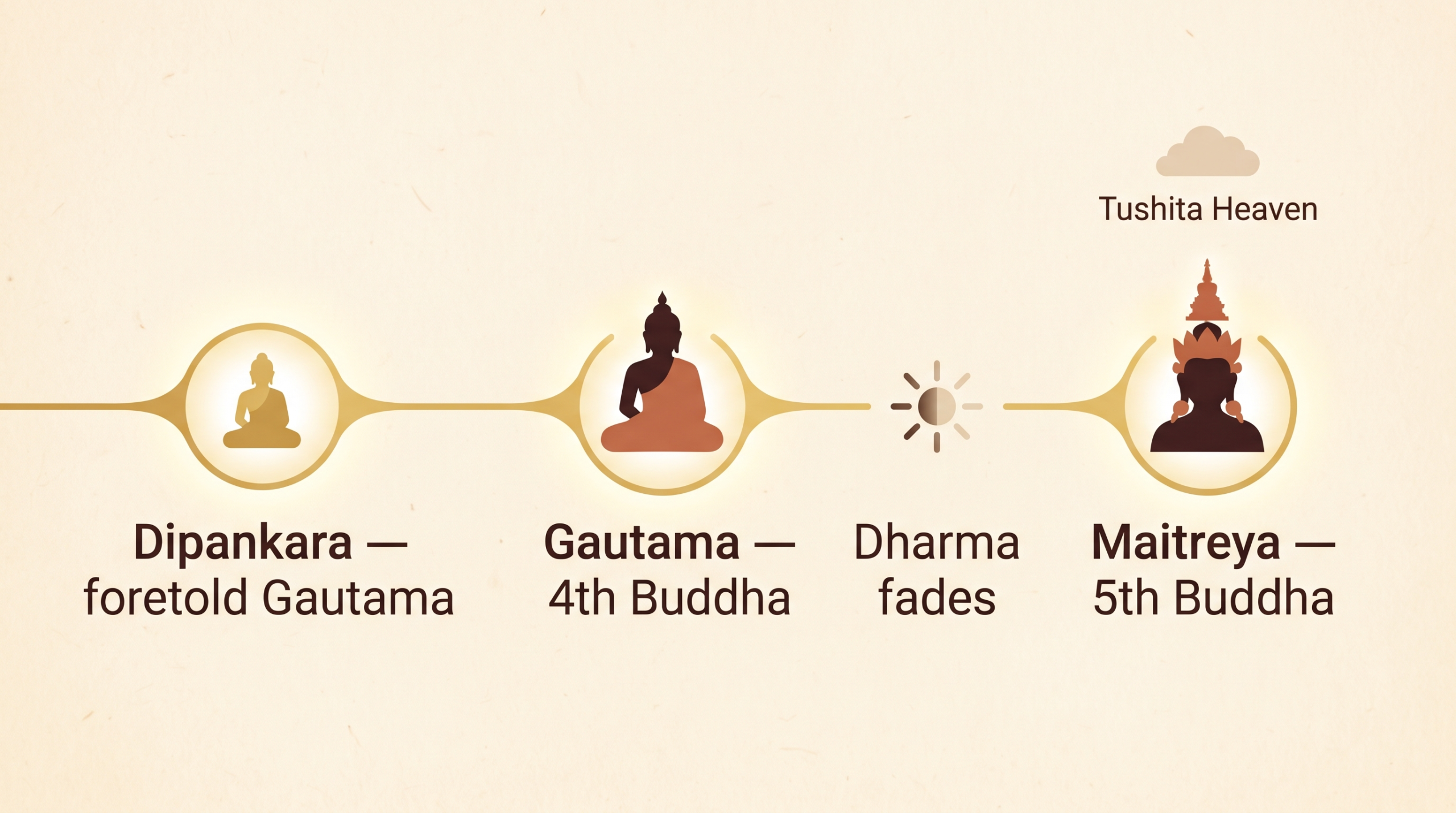
Buddhist texts do not give a calendar date; they say Maitreya will appear only after Gautama Buddha’s teachings have faded completely from the world. That condition, often called the decline of the Dharma, belongs to a vast cosmic cycle, not a countdown.
Popular summaries sometimes cite 5,000 years after Gautama, yet other traditions give far longer spans. Treat any single number you see online with caution.
What Does the Cakkavatti Sutta Say About Metteyya?
The Cakkavatti Sutta (Dīgha Nikāya 26) is the Pali discourse that names the future Buddha Metteyya. The SuttaCentral translation by Bhikkhu Sujato notes that it is the only sutta in the early texts where he appears.
In the sutta, the Buddha describes moral decline and then a slow recovery, in which human lifespans rise to 80,000 years. In that age, the text says, Metteyya will arise, and the wheel-turning king Sankha will renounce the world under him. The Anāgatavaṃsa, a later Pali text, adds details about his future life.
Why Is Maitreya Called the Fifth Buddha of This Eon?
Maitreya is called the fifth Buddha because Theravada tradition counts five Buddhas in the present eon, or bhadrakalpa, and places Gautama fourth. A kalpa is a vast cosmic age, so the count spans immense time. Tradition says the Buddha Dipankara foretold Gautama’s awakening, and Gautama in turn foretold Maitreya’s. His arrival will complete the eon’s list of Buddhas.
How Do Theravada, Mahayana, and Tibetan Traditions See Metteyya and Jampa?
All major Buddhist schools accept Maitreya as the next Buddha, but each tradition emphasizes a different side of him.
| Tradition | Name used | Status today | Key texts | Emphasis |
|---|---|---|---|---|
| Theravada | Metteyya | Bodhisattva awaiting his final birth | Cakkavatti Sutta (DN 26), Anāgatavaṃsa | The future Buddha foretold in the canon |
| Mahayana | Maitreya (Chinese: Milefo; Japanese: Miroku) | Bodhisattva of compassion in Tushita heaven | Lotus Sutra, Maitreya sutras, Yogācāra works credited to him | Compassion and a teacher of doctrine |
| Tibetan | Jampa | Great bodhisattva and coming Buddha | Five treatises attributed to Maitreya through Asanga | Loving-kindness; often shown as a large seated image |
Metteyya in Theravada Buddhism
Theravada texts treat Metteyya as the future Buddha who will attain awakening after a very long interval. The Cakkavatti Sutta is the canonical anchor. Many lay Theravada Buddhists express the wish to be reborn in his era, so that they can hear his teaching.
Maitreya Bodhisattva in Mahayana and Yogācāra Thought
Mahayana texts present Maitreya as a bodhisattva of great compassion. He appears in the Lotus Sutra and in the Maitreya sutras, which describe his birth and his future descent. Tradition credits the 4th-century teacher Asanga with receiving Yogācāra teachings from him in Tushita heaven, though scholars debate whether this figure was heavenly or human.
Jampa in Tibetan Buddhism
Tibetan Buddhists call him Jampa, a name that also carries the sense of love. Tibetan tradition attributes five treatises to Maitreya through Asanga. Large temple images of Jampa are often shown seated with the legs down. If you visit a Thai temple and a Tibetan monastery in the same year, you may not realize you met the same figure twice.
Is the Laughing Buddha the Same as Maitreya?
Not exactly: the Laughing Buddha is Budai, a Chinese Chan monk named Qieci who died in 917, and many Chinese Buddhists honor him as an incarnation of Maitreya. In China, Budai’s image became one of the main ways to depict Maitreya, which is why the two names blur.
Who Was Budai, the Cloth-Bag Monk?
Budai means “cloth sack.” It is the nickname of Qieci, a wandering Chan monk from Fenghua in Zhejiang who lived during the Later Liang dynasty (907 to 923). A note dated March 28, 917 claims he was an incarnation of Maitreya, and a body said to be his was displayed at Yuelin Temple. Tradition also credits him with a verse before his death, saying the true Maitreya has countless incarnations.
Japanese Buddhists know him as Hotei. Sources date his death to 917, and some give 916. Budai is a figure of folk devotion as much as of history, so details vary by source.
Maitreya vs. Budai vs. Shakyamuni: A Side-by-Side Comparison
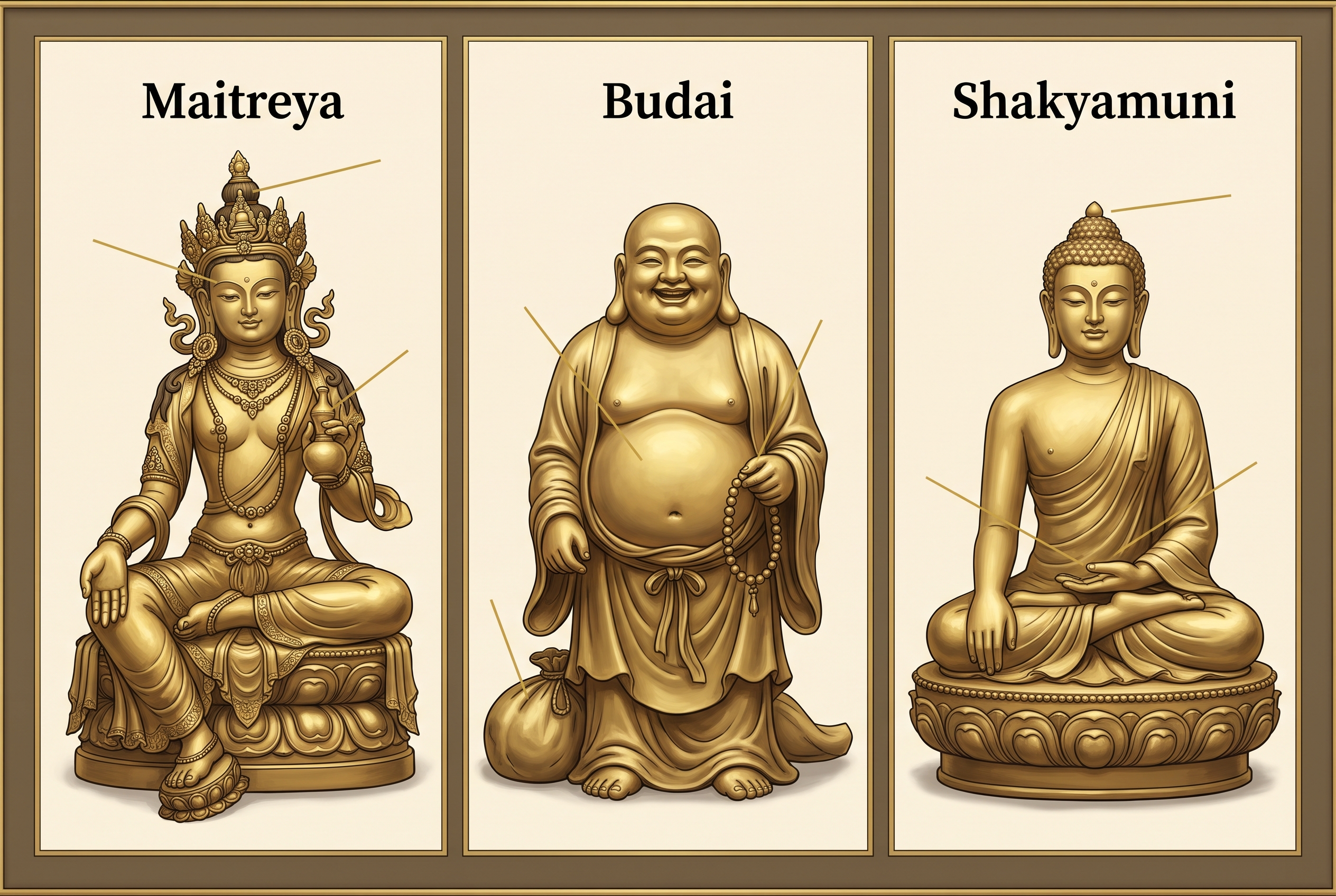
| Feature | Maitreya | Budai | Shakyamuni |
|---|---|---|---|
| Identity | Future Buddha; a bodhisattva today | Chan monk Qieci, honored as Maitreya’s incarnation | The historical Buddha, Siddhartha Gautama |
| Era | Awaited in a future age | Died in 917 (Later Liang dynasty) | Ancient India, usually dated to the 5th century BCE |
| Typical look | Crowned, jeweled bodhisattva; legs down or crossed at the ankles | Round belly, broad smile, simple robe | Monk’s robe, uncrowned head, ushnisha (topknot bump) |
| Common symbols | Water flask, small stupa in the crown | Cloth sack, prayer beads | Hand gestures (mudras) such as meditation or earth-touching |
| Where you see it | Gandharan and Yungang art, Tibetan temples | Chinese temples, Dehua porcelain, Hotei figures in Japan | Altars and meditation spaces worldwide |
Here is the practical catch. Search “Maitreya statue,” and most results show the laughing monk. If a listing says Maitreya but shows a smiling figure with a sack, you are looking at the Budai form. Both are respected, but they are not the same image.
For a Shakyamuni reference, our Shaolin Quiet Sakyamuni stone Buddha bust is a minimalist image in sandstone. Placed beside a crowned bodhisattva, it shows the plain, uncrowned style that sets Shakyamuni apart.
How Can You Recognize a Bodhisattva of the Future in Statues and Murals?
Look for three clues: a water flask in the left hand, a small stupa in the crown, or a seated pose with legs down or crossed at the ankles. These signs appear on Maitreya images long before the laughing Budai form.
Bodhisattva Form: Crown, Jewelry, and Water Flask
Early images show Maitreya as a prince, not a monk. A Gandharan Maitreya at The Met, made around the 3rd century in schist, stands 31 3/4 inches (80.7 cm) tall. The museum’s entries for Gandharan Maitreya figures point to the sacred water flask in the left hand and a looped topknot as the identifying marks. Jewelry signals a bodhisattva rather than a Buddha. Tibetan and East Asian images often add a small stupa to the crown.
To see bodhisattva styling in three dimensions, look at our Royal Ease Guanyin statue in solid copper. The figure stands 8.9 inches (22.6 cm) tall and weighs 2.16 lb. Guanyin carries different symbols from Maitreya, but the piece lets you compare posture and dress with the images above.
Seated Maitreya: Crossed Ankles and the “Waiting” Pose
A seated Maitreya often keeps his legs down or crossed at the ankles. The Met holds a Northern Wei bodhisattva from about 470 to 480, carved in sandstone with traces of pigment, 57 1/2 inches (146.1 cm) tall. The museum says it is most likely Maitreya, and it compares it with Maitreya statues at the Yungang caves in Shanxi. Many scholars read the pendant legs as a sign that he is ready to step down to Earth.
One caution: crossed ankles alone prove nothing. The Musée Cernuschi in Paris notes that scholars once assumed every crossed-ankle bodhisattva at Yungang was Maitreya, and that idea has been dropped.
By the 10th century, the Budai form had entered Chinese art, and Dehua kilns later produced white porcelain Budai figures. The Paradise of Maitreya, a Yuan-dynasty mural now at the Royal Ontario Museum, shows how far the image traveled. It is attributed to Zhu Haogu and his pupil Zhang Boyuan, came from Xinghua Temple in Shanxi, and measures 502 by 1,101 cm (198 by 433 inches). Every figure in it wears Chinese dress.
Is This Statue Maitreya? A 5-Step Checklist
- Check for a crown or jewelry. A crowned, jeweled figure is a bodhisattva, which fits Maitreya before his awakening.
- Look for a water flask. In Gandharan images, it is held in the left hand.
- Find a small stupa. Tibetan and East Asian images often place it in the crown.
- Check the seat. Legs down or crossed at the ankles point toward Maitreya, but they are not proof on their own.
- Rule out Budai. A round belly, a cloth sack, prayer beads, and a broad smile mean you are looking at the Budai form.
How Should You Display a Buddha Statue at Home?
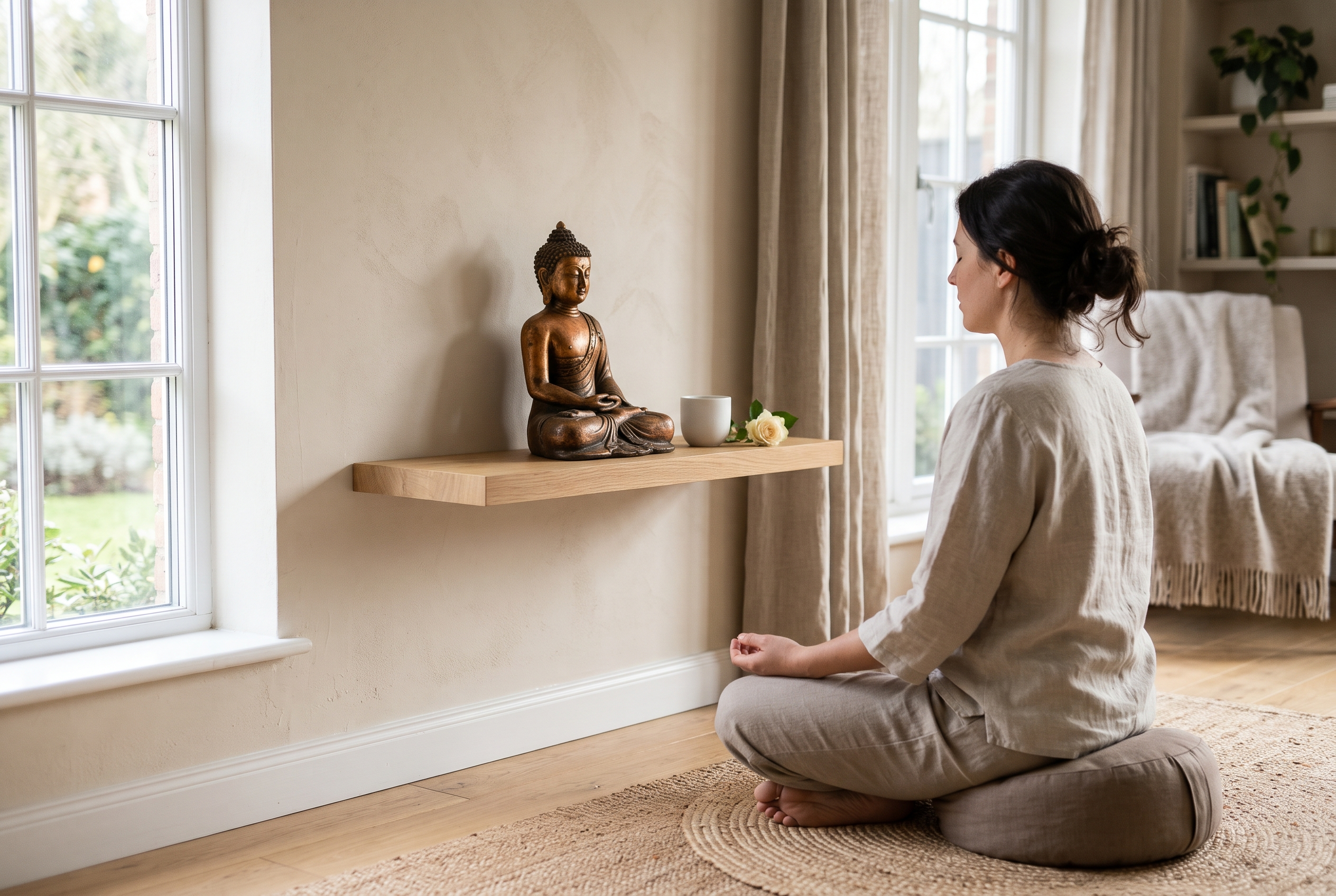
Place the image at or above eye level on a clean, quiet surface, and keep it away from floors, bathrooms, and kitchens. Buddhist households commonly follow these simple rules:
- Height: set the image at or above eye level when you sit, so you look up slightly.
- Surface: use a clean shelf, altar table, or desk corner, never the floor.
- Rooms: avoid bathrooms, kitchens, and shoe areas.
- Space: leave clear room around the image so it reads as devotion, not decoration.
Where to Place a Buddha or Bodhisattva Statue
You do not need to be Buddhist to display a Buddha image, but treat it as a sacred object rather than a novelty. Many Buddhists would be uncomfortable seeing a Buddha image on the floor, in a bathroom, or used as a prop. A statue crowded among everyday clutter can read as decoration, so a little clear space shows respect.
Choosing Material and Size for a Meditation Corner
Choose a size that fits the surface with room around it. Pieces near 8 to 9 inches suit desks and shelves, while altar tables can hold larger images. Copper develops a warmer finish over time, and a soft, dry cloth is enough for dusting. Avoid abrasive polish, which can wear a finish.
Our aged copper meditating Shakyamuni Buddha statue with a mud-gold finish is one example: a seated Buddha in aged copper that gives a meditation corner a steady focal point.
The key takeaway: Maitreya Buddha is the next Buddha in Buddhist tradition, now a bodhisattva in Tushita heaven. Budai is a Chinese monk whom many Buddhists honor as his incarnation, and Shakyamuni is the historical Buddha. Crowns, water flasks, and stupas point to Maitreya; a round belly and a cloth sack point to Budai.
Frequently Asked Questions About the Future Buddha
Both, at different times. According to Buddhist tradition, Maitreya is a bodhisattva today, living in Tushita heaven, and he will become a fully awakened Buddha when he is reborn on Earth.
Yes, when you treat it with care rather than as a novelty. Give it a clean, raised spot of its own, and avoid floors, bathrooms, and kitchens.
Mainstream Buddhist traditions teach that he has not. Several historical figures and modern movements have claimed the title, but Buddhist schools do not recognize those claims.
Start with the figure you want to honor, then pick a size that fits your surface. A desk or shelf usually suits a piece around 8 to 9 inches tall, such as the 8.9 inch Royal Ease Guanyin above, while an altar table can hold something larger. Use the five-step checklist to confirm that the figure matches the name on the listing.
Bring a Mindful Presence Home
Now that you can tell Maitreya Buddha from Budai and Shakyamuni, explore handmade Buddha and bodhisattva statues in solid copper and natural stone.Explore ShaoLin Store’s handmade statues →
Important note: This article describes traditional Buddhist beliefs for educational purposes. It does not claim that any statue brings spiritual, financial, or health outcomes.
References
- Maitreya (Buddhism): Definition, early cult, and tradition-by-tradition honors. Encyclopaedia Britannica
- Cakkavatti Sutta (DN 26): The Pali discourse that names Metteyya, in the Sujato translation. SuttaCentral
- Maitreya in early art: Museum records for a Gandharan Maitreya (ca. 3rd century) and a Northern Wei Maitreya with crossed ankles. The Metropolitan Museum of Art, Gandhara and The Metropolitan Museum of Art, Northern Wei
- Budai and the Paradise of Maitreya: Dates and traditions for Qieci, and the Yuan mural in Toronto. Wikipedia, Budai and Royal Ontario Museum, Bishop White Gallery