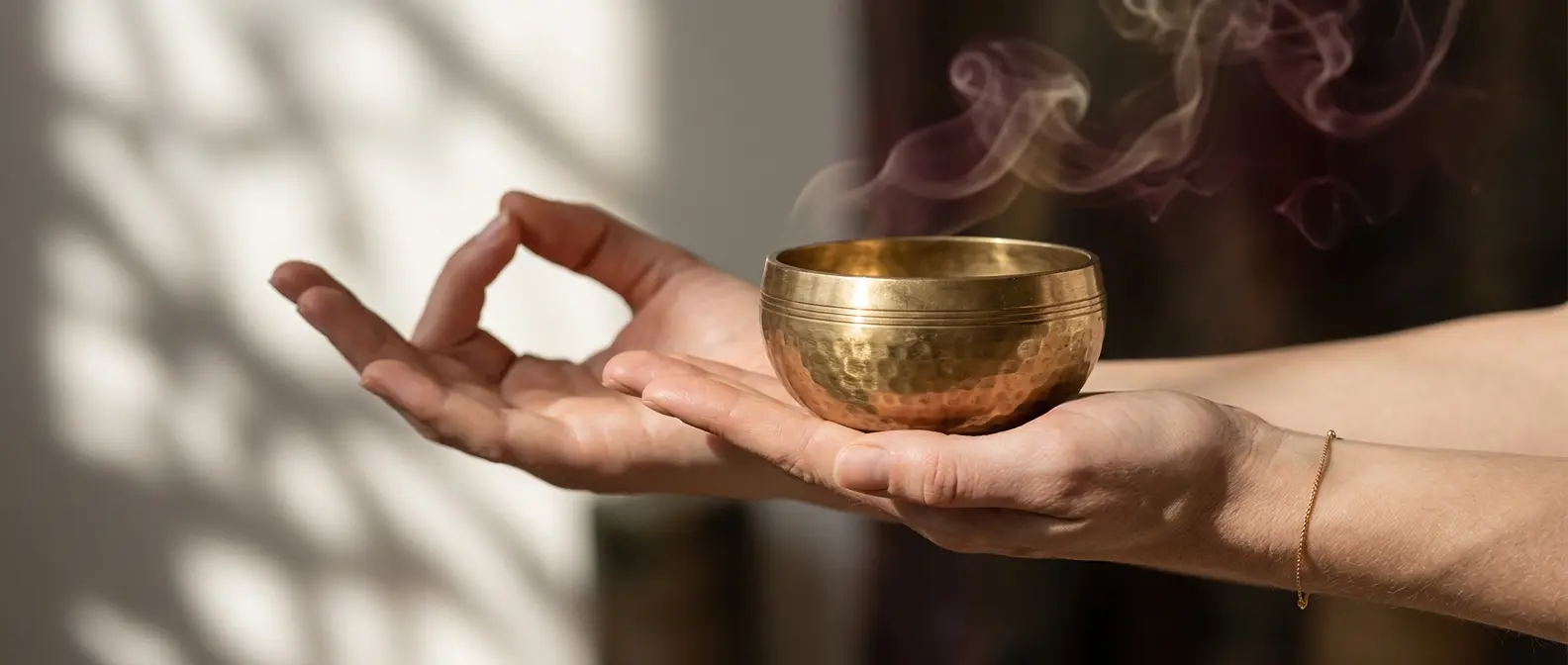
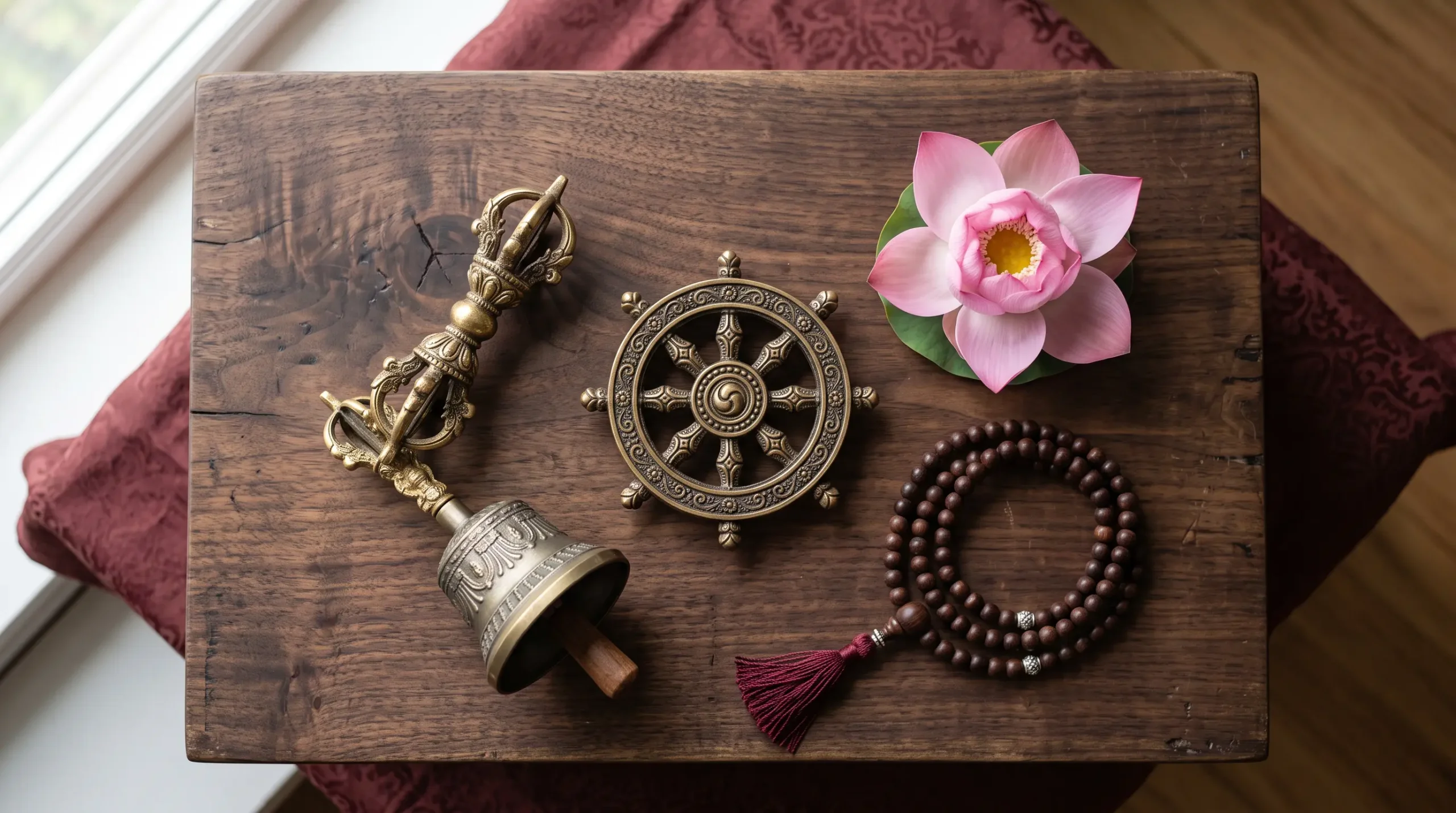
Buddhist symbols are visual shortcuts for the Buddha’s teachings. A wheel stands for the path, a lotus for purity and a knot for interdependence.
At ShaoLinStore, new practitioners ask us one question again and again: what does this symbol actually mean? This glossary answers it for 40 terms, grouped into six families. Each entry gives the name, the meaning and where you will see it.
The short answer: the Dharma Wheel is the main symbol of Buddhism. Start with the Eight Auspicious Symbols, then add mudras and ritual objects.
What Are Buddhist Symbols, and Why Do They Matter to Beginners?
Buddhist symbols are images and objects that stand for the Buddha, his teachings or the path to awakening. For centuries they were the only way to show the Buddha at all.
Early Buddhist art avoided human images of the Buddha. This aniconic phase (art without a figure of the Buddha) lasted until about the 1st century CE. Artists used a tree, an empty throne, footprints or a wheel instead.
| Entity | Attribute | Value |
|---|---|---|
| Aniconic phase | Time span | Until about the 1st century CE |
| Aniconic stand-ins | Examples | Bodhi tree, empty throne, footprints, wheel |
| Eight Auspicious Symbols | Origin story | Offerings from the gods after the Buddha’s enlightenment |
Many of these signs were shared Indian emblems, also seen in Hinduism and Jainism. Buddhism gave them new meanings. Scholars still debate how strictly early artists avoided the Buddha’s image, so treat the rule as a tendency.
The key takeaway: a Buddhist symbol is a compressed teaching, not a lucky charm. Each entry below carries a tradition tag where meanings differ: Theravada, Mahayana, Vajrayana (Tibetan) or Zen.
Here is how the 40 terms break down, so you can jump straight to the family you need.
| Family | Terms | Best for |
|---|---|---|
| Eight Auspicious Symbols | 1–8 | Learning the basics |
| Early symbols of the Buddha | 9–14 | Reading temple art and history |
| Ritual objects | 15–22 | Meditation and daily practice |
| Hand gestures (mudras) | 23–29 | Choosing or reading a statue |
| Sacred animals | 30–32 | Strength and courage themes |
| Regional and modern symbols | 33–40 | Tattoos, travel and flags |
What Are the Eight Auspicious Symbols of Buddhism (Terms 1–8)?
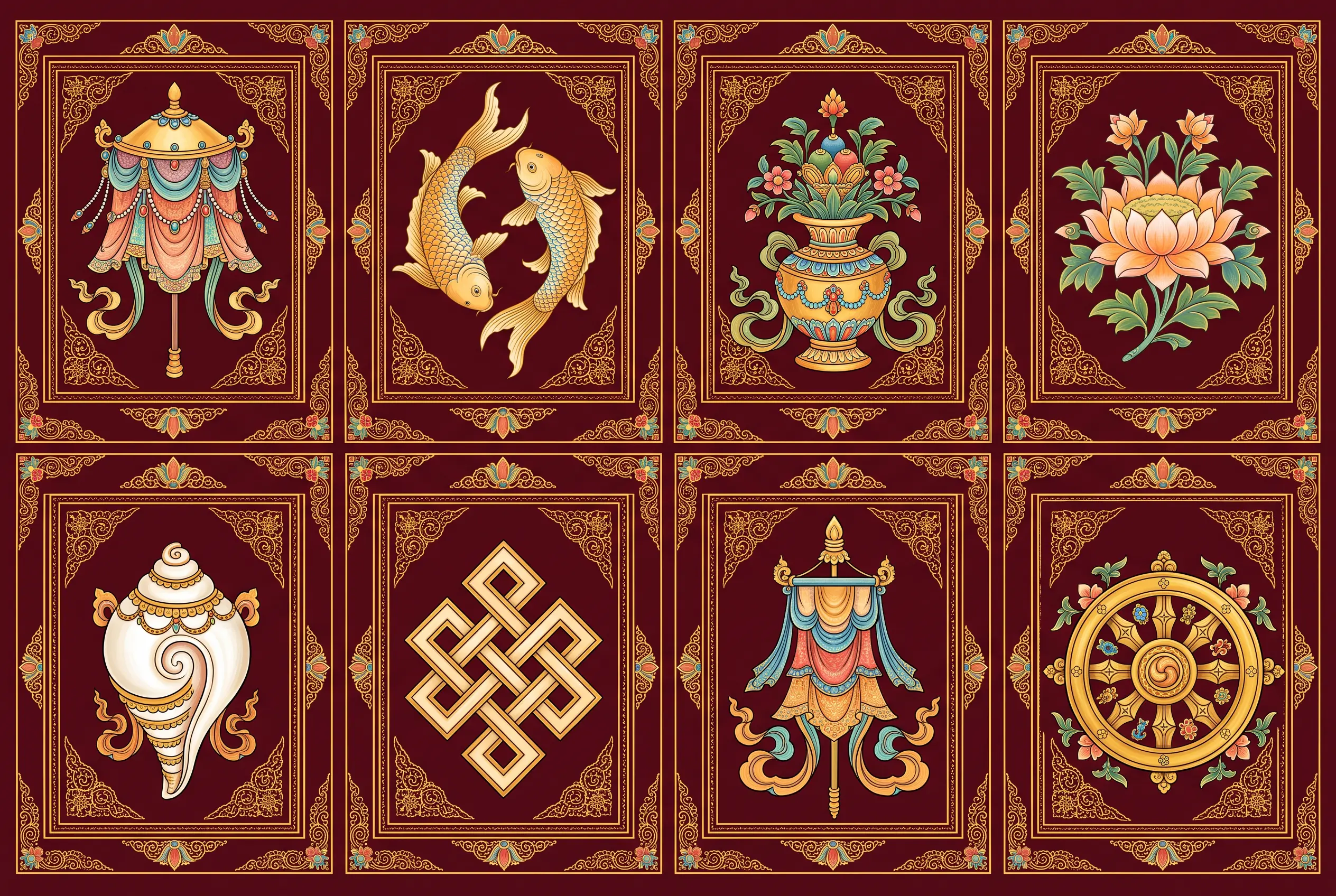
The Eight Auspicious Symbols (Ashtamangala) are the Parasol, Golden Fish, Treasure Vase, Lotus, Conch Shell, Endless Knot, Victory Banner and Dharma Wheel. Tradition says the gods offered them to the Buddha right after his enlightenment.
| # | Term | Core meaning | Where you’ll see it |
|---|---|---|---|
| 1 | Parasol (Chattra) | Protection from illness, harm and obstacles | Stupa spires, thangkas |
| 2 | Golden Fish (Kanakamatsya) | Fearless freedom, like fish moving freely in water | Door hangings, altar art |
| 3 | Treasure Vase (Kalasha) | Inexhaustible teachings and abundance | Altars, offering sets |
| 4 | Lotus (Padma) | Purity rising from mud; awakening | Buddha thrones, temple ponds |
| 5 | Right-turning Conch (Shankha) | The Dharma’s sound spreading in all directions | Tibetan rituals |
| 6 | Endless Knot (Shrivatsa) | Interdependence; wisdom and compassion joined | Textiles, jewelry |
| 7 | Victory Banner (Dhvaja) | Wisdom winning over ignorance | Monastery rooftops |
| 8 | Dharma Wheel (Dharmachakra) | The Buddha’s teaching; 8 spokes = Noble Eightfold Path | Temple roofs, flags, pendants |
Spoke counts vary: Buddhist wheels appear with 8, 12 or 24 spokes. In the Indo-Tibetan tradition, the hub, rim and spokes also stand for three trainings: ethics, wisdom and concentration.
Teachers order and interpret the eight symbols differently. Nepalese Buddhists, for example, usually leave the Wheel out of their set.
What Do the Different Lotus Colors Mean in Buddhism?
In the classical system, a white lotus means mental purity, pink means the Buddha himself, red means compassion and blue means wisdom.
| Lotus color | Meaning | Linked figure |
|---|---|---|
| White | Mental purity, spiritual perfection | — |
| Pink | The historical Buddha | Shakyamuni |
| Red | Compassion, love | Avalokiteshvara |
| Blue | Wisdom | Manjushri |
Purple, gold and black meanings found online sit outside this classical four-color scheme. Treat them as modern interpretations.
Which Symbols Represented the Buddha Before Statues Existed (Terms 9–14)?
The oldest Buddhist symbols are the Bodhi tree, footprints, empty throne and stupa. The Three Jewels and Buddha eyes joined them as core emblems of the faith.
| # | Term | Core meaning | Where you’ll see it |
|---|---|---|---|
| 9 | Bodhi Tree | Awakening; a sacred fig (Ficus religiosa) | Bodh Gaya, temple courtyards |
| 10 | Buddhapada (footprints) | The Buddha’s presence and path | Stone slabs, temple floors |
| 11 | Empty Throne (Vajrasana) | The Buddha’s seat of awakening | Early reliefs at Sanchi |
| 12 | Stupa | The Buddha’s enlightened mind; a relic mound | Boudhanath, Sanchi, village shrines |
| 13 | Triratna (Three Jewels) | Buddha, Dharma, Sangha: the three refuges | Chanting, carvings |
| 14 | Buddha Eyes | All-seeing wisdom in four directions | Stupas in Nepal |
The Bodhi tree has a real-world anchor. UNESCO listed the Mahabodhi Temple Complex at Bodh Gaya in 2002. Emperor Asoka built its first temple in the 3rd century BCE. The present 50 m temple dates from the 5th–6th centuries CE.
The stupa also works as a map. In Tibetan stupas (chortens), the base, dome, spire, crescent and top jewel stand for the five elements: earth, water, fire, air and space.
Each early symbol maps to a life event. The riderless horse marks the renunciation, the tree and throne mark enlightenment, the wheel marks the first sermon and the stupa marks the Buddha’s passing.
What Do Buddhist Ritual Objects Symbolize (Terms 15–22)?
Buddhist ritual objects turn a teaching into something you hold, turn or hang. The vajra, bell, mala, prayer wheel and prayer flags are the most common.
| # | Term | Core meaning | Key detail |
|---|---|---|---|
| 15 | Vajra (Dorje) · Vajrayana | Thunderbolt and diamond: indestructible awakened mind | Held in the right hand |
| 16 | Bell (Dril-bu) · Vajrayana | Wisdom and emptiness | Held in the left hand |
| 17 | Mala | Prayer beads for counting mantras | 108 beads plus 1 guru bead |
| 18 | Prayer Wheel · Vajrayana | Each turn equals reciting the mantra inside | Spun clockwise |
| 19 | Prayer Flags · Vajrayana | Blessings carried by the wind | 5 colors = 5 elements |
| 20 | Mandala | Sacred map of the awakened mind; impermanence | Sand mandalas are swept away |
| 21 | Alms Bowl | Renunciation, simplicity, monastic life | Early symbol of the Buddha |
| 22 | Cintamani (wish-fulfilling jewel) | Grants wishes; pacifies desire | Three jewels on prayer flags |
Two of these objects work outdoors. A prayer wheel holds a scroll of mantras, usually Om Mani Padme Hum, and each clockwise spin counts as one recitation. Prayer flags come in five colors: blue, white, red, green and yellow. They stand for space, air, fire, water and earth, and they fade in the weather on purpose, a reminder of impermanence.
Why Does a Mala Have 108 Beads?
A mala has 108 beads because most teachers link the number to 108 mental afflictions (kleshas), such as anger and greed. Many other explanations circulate, and none is canonical.
| Entity | Attribute | Value |
|---|---|---|
| Full mala | Counting beads | 108, plus 1 guru bead |
| Short malas | Bead counts | 27 or 54, counted in multiples to reach 108 |
| Number 108 | Most-cited meaning | 108 kleshas |
Be careful with retail blogs. Claims about astrology or body channels are modern additions, not Buddhist doctrine.
How Do the Vajra and Bell Work as a Pair?
In Tibetan ritual, the vajra is held in the right hand and the bell in the left. Together they stand for method and wisdom, the two wings of the path.
The Metropolitan Museum of Art describes the pair as reflecting “method and wisdom, intuition and compassion.” Practitioners use them together during recitation, moving both hands in set gestures.
How Do You Read Buddha Hand Gestures (Terms 23–29)?
A mudra (Sanskrit for “seal”) is a symbolic hand gesture. On a Buddha statue, the hands tell you which moment or quality is being shown.
| # | Mudra | Hand position | Meaning |
|---|---|---|---|
| 23 | Dhyana | Both hands in lap, palms up | Meditation |
| 24 | Bhumisparsha | Right hand touches the earth | Earth as witness; victory over Mara |
| 25 | Dharmachakra | Both hands at chest, fingers forming circles | Turning the wheel; first sermon |
| 26 | Abhaya | Right hand raised, palm out | Fearlessness, protection |
| 27 | Varada | Hand lowered, palm out | Generosity, compassion |
| 28 | Vitarka | Thumb and index finger touch, hand raised | Teaching, discussion |
| 29 | Anjali | Palms pressed together | Reverence, greeting |
Use a 10-second rule to identify a statue. Palm out and raised is Abhaya. Palm out and lowered is Varada. A hand touching the ground is Bhumisparsha. Hands in the lap are Dhyana.
Choosing a statue for home? A Dhyana Buddha suits a meditation corner. An Abhaya Buddha suits an entryway.
What Is the Difference Between the Abhaya and Varada Mudras?
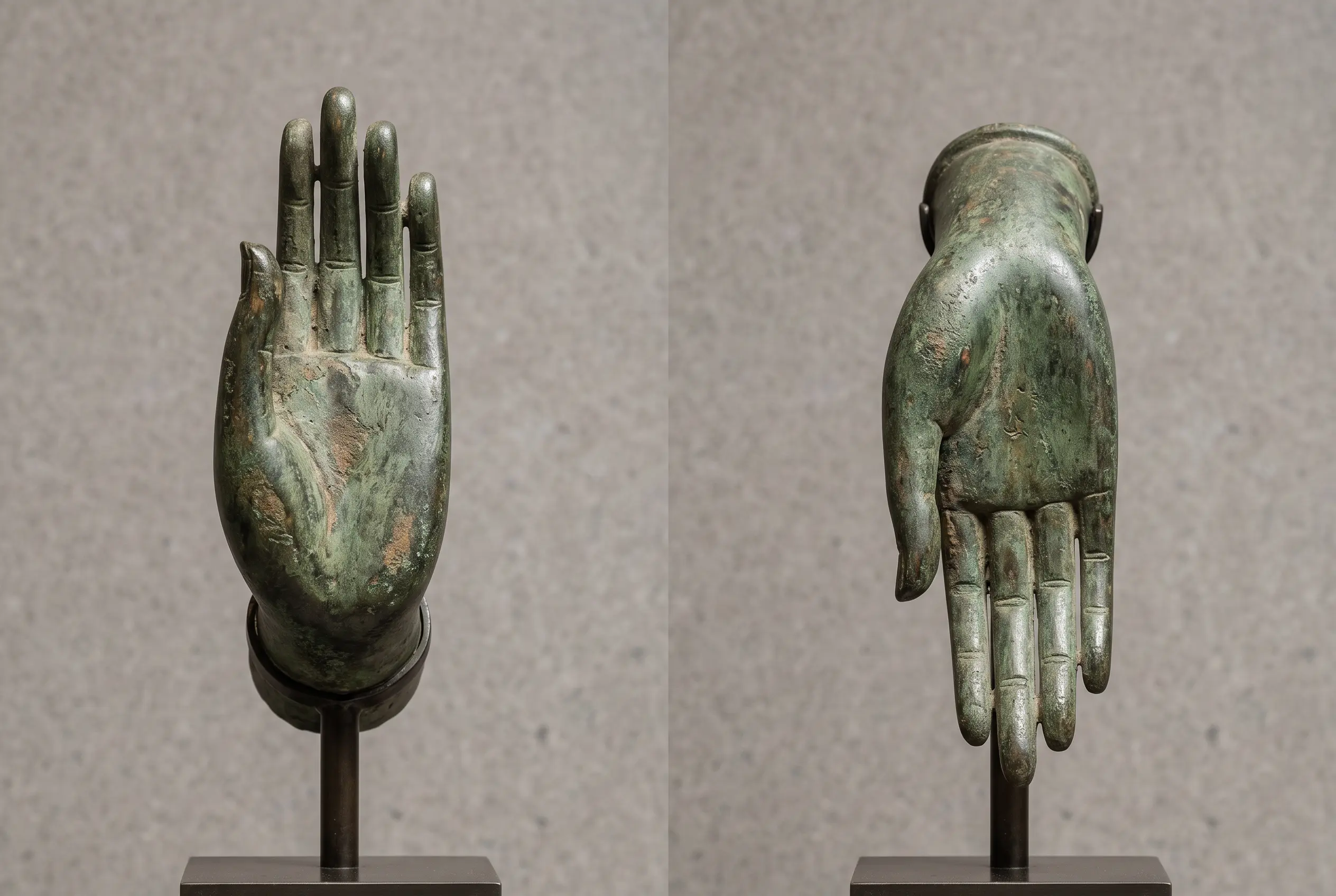
Both mudras show an open, outward palm. Abhaya is raised to shoulder height and means “fear not.” Varada points downward and means giving.
A popular legend ties Abhaya to a charging elephant that the Buddha calmed with a raised hand. In some images the gesture appears in the left hand, so check the palm direction first.
Which Animals Are Buddhist Symbols (Terms 30–32)?
Three animals appear again and again: the lion for the Buddha’s courage, the deer for his first teaching and the elephant for steady mental strength.
| # | Term | Core meaning | Where you’ll see it |
|---|---|---|---|
| 30 | Lion | The Buddha’s courage; the “lion’s roar” of the Dharma | Ashoka’s pillars, temple guardians |
| 31 | Deer | First sermon at the Deer Park, Sarnath; gentleness | A pair flanking the Wheel on monastery roofs |
| 32 | Elephant | Mental strength; Queen Maya’s dream of a white elephant | Temple art, statues |
If you want a strength symbol, the lion and the vajra (term 15) are the usual picks. For gentleness, choose the deer. See the choosing guide below for more pairings.
Which Buddhist Symbols Are Regional or Modern (Terms 33–40)?
Not every Buddhist symbol is ancient or pan-Asian. The unalome comes from Thai Sak Yant tradition, the enso from Japanese Zen and the Buddhist flag from 1880s Sri Lanka.
| # | Term | Origin | Meaning and key fact |
|---|---|---|---|
| 33 | Unalome | Thai and Cambodian Sak Yant | Spiral to straight line: path from confusion to clarity |
| 34 | Enso | Japanese Zen | One-brushstroke circle; emptiness and completeness |
| 35 | Manji (卍) | East Asian Buddhism | Well-being; marks temples on Japanese maps |
| 36 | Om Mani Padme Hum | Tibetan | Six-syllable mantra of compassion (Avalokiteshvara) |
| 37 | Buddhist Flag | Sri Lanka, 1880s | Blue compassion, yellow Middle Way, red blessings, white purity, orange wisdom |
| 38 | Wheel of Life (Bhavacakra) | Tibetan | Cycle of rebirth: 3 poisons at the hub, 6 realms, held by Yama |
| 39 | Ashoka Chakra | India | 24-spoke wheel from Ashoka’s pillars; on India’s flag |
| 40 | Laughing Buddha (Budai) | Chinese folk Buddhism | A monk who stands for contentment; not the historical Buddha |
Do not mix up two wheels. The Dharma Wheel (term 8) represents the teaching. The Wheel of Life (term 38) shows the cycle of rebirth that the teaching helps you escape.
The Buddhist flag was first raised in 1885 and gained international recognition from 1952. Its sixth band blends all five colors.
Is the Buddhist Swastika the Same as the Nazi Symbol?
No. The Buddhist swastika (manji) is an ancient sign of well-being, unrelated to Nazi ideology.
The Sanskrit word svastika means “conducive to well-being.” The Nazi Party adopted a tilted, black version in 1920. Japanese maps still use the manji to mark temples.
Bottom line: the sign is sacred in Asia but easily misread elsewhere. Add context when you share or sell it outside Asia.
Is the Unalome Really a Buddhist Symbol?
Yes, mostly. The unalome comes from Southeast Asian Sak Yant tradition, but many online “meaning charts” are modern tattoo-culture inventions.
| Entity | Attribute | Value |
|---|---|---|
| Unalome | Origin | Thai and Cambodian Sak Yant; linked to the urna curl between the Buddha’s brows |
| Unalome | Structure | Spiral (confusion), loops (struggle), straight line (clarity) |
| Unalome | Alternate reading | Some sources tie it to Shiva’s third eye (Hindu) |
How Do Buddhist Symbols Differ Across Theravada, Mahayana, Vajrayana and Zen?
The core Buddhist symbols, the wheel, lotus and Bodhi tree, are shared by every tradition. The rest cluster by region.
| Tradition | Regions | Signature symbols | Style |
|---|---|---|---|
| Theravada | Sri Lanka, Thailand, Myanmar | Dharma Wheel, Bodhi tree, Buddhapada, unalome | Classic Indian symbols |
| Mahayana | China, Vietnam, Korea | Guanyin, Amitabha, manji, Laughing Buddha | Bodhisattva-centered |
| Vajrayana | Tibet, Nepal, Mongolia | Eight Auspicious Symbols, vajra and bell, mandala, prayer wheels, Buddha eyes | Dense and color-coded |
| Zen | Japan | Enso, ink painting | Sparse and quiet |
In summary, the eight auspicious symbols, vajra and mandala belong most to Tibetan Buddhism. The enso belongs to Japanese Zen.
Which Buddhist Symbol Should You Choose for Peace, Protection, Strength or Wisdom?
Choose a symbol by the quality you want to grow, not the luck you want to attract. A lotus fits peace, a parasol fits protection and a vajra fits strength.
| Your goal | Best-fit symbol | Why it fits |
|---|---|---|
| Peace and calm | Lotus, Dhyana Buddha, enso | Purity amid difficulty; stillness |
| Protection | Parasol, Abhaya mudra | Shelter from harm; “fear not” |
| Strength | Vajra, lion | Indestructibility; courage |
| Wisdom | Blue lotus, bell, Buddha eyes | All-seeing insight |
| Compassion | Red lotus, endless knot, Om Mani Padme Hum | Avalokiteshvara; interdependence |
| Abundance | Treasure vase, golden fish | Inexhaustible teachings; freedom |
| Personal growth | Unalome, lotus | Path from confusion to clarity |
Our team at ShaoLinStore suggests starting with one meaningful piece, such as a mala for daily practice or a lotus pendant. Pick the meaning first, then the design.
Watch for one-word shortcuts online. The swastika is not a “peace symbol,” and the Hamsa hand is not a Buddhist emblem.
Take it with you. Screenshot the tables above or save this page as your quick chart. Each term has a name, meaning and tradition tag.
How Do You Wear or Display Buddhist Symbols Respectfully?
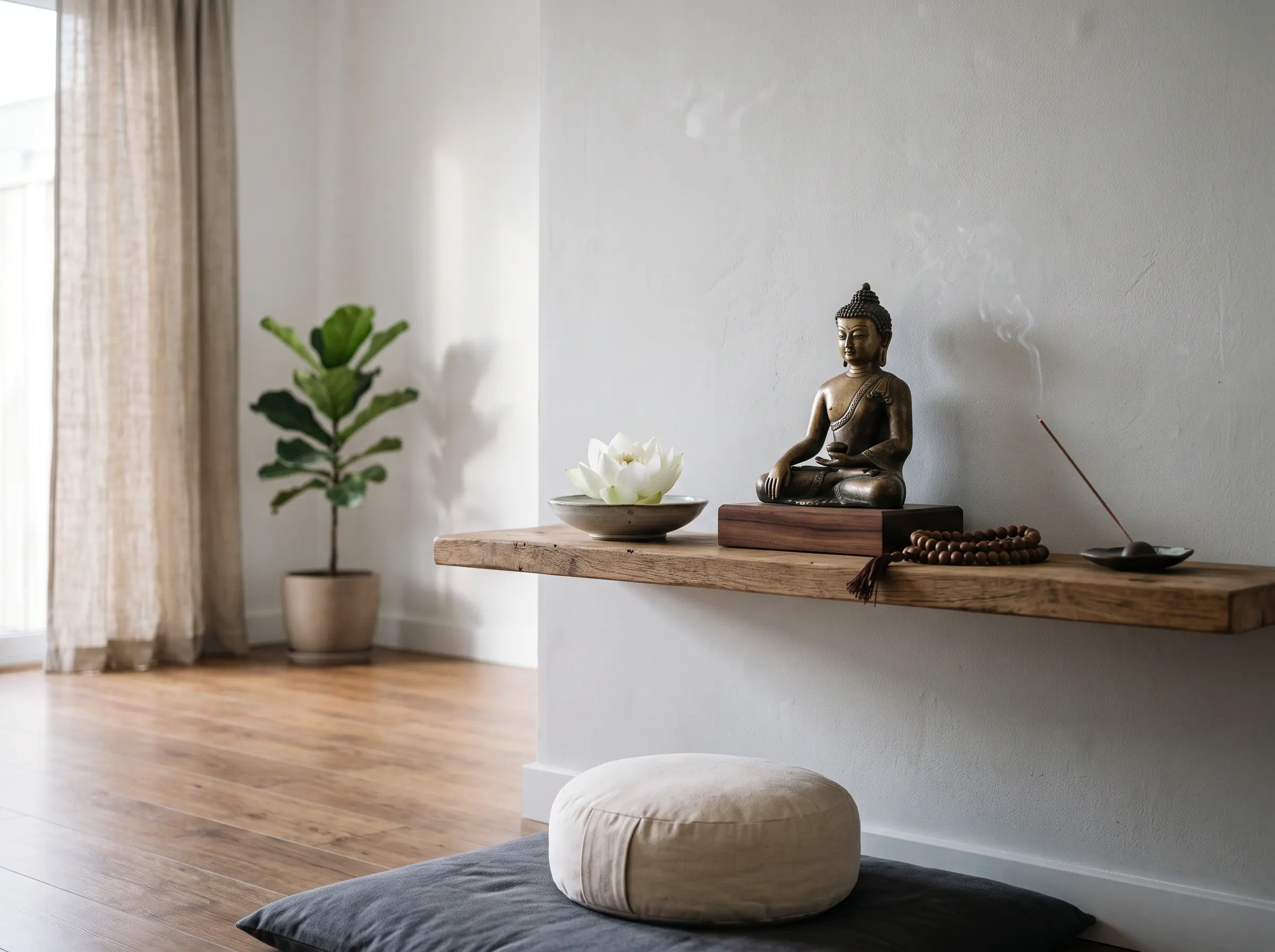
Wearing Buddhist symbols is generally fine when you understand them and follow one rule: keep sacred images, especially the Buddha, above the waist.
| Item | Rule | Why |
|---|---|---|
| Buddha image | Above the waist; never on feet, ankles or shoes | It is treated as sacred |
| Isolated Buddha head | Avoid as décor | Seen as offensive in many Buddhist cultures |
| Home Buddha statue | Highest clean spot in the room | Shows respect |
| Abstract symbols (lotus, knot) | Generally low sensitivity | They are not a figure of the Buddha |
Travel adds a real risk. In 2014, Sri Lanka deported a British tourist over a Buddha tattoo on her arm. Check local rules before you fly.
Displaying symbols at home is simple. Follow these three steps:
- Choose the highest clean surface in the room, such as a shelf or altar table.
- Keep the statue away from floors, shoes and bathrooms.
- Dust it with a soft, dry cloth, and never place items on top of it.
Intention matters. Learn what a symbol means before you wear it.
❓ Frequently Asked Questions About Buddhist Symbols
The Dharma Wheel is the most widely recognized Buddhist symbol. Its 8 spokes stand for the Noble Eightfold Path, and its turning marks the Buddha’s first teaching at Sarnath. The lotus and the Bodhi tree are close runners-up.
There is no official list of five. Beginner guides most often name the Lotus, Dharma Wheel, Conch, Parasol and Endless Knot. All five come from the Eight Auspicious Symbols.
The Parasol (Chattra) is the classic protection symbol. It shelters beings from harm the way an umbrella blocks the sun. The Abhaya mudra, a raised open palm, is the gesture form of protection.
Om is shared by Hinduism and Buddhism. In Buddhism it mostly appears as the opening syllable of mantras such as Om Mani Padme Hum. It is not the central emblem of Buddhism the way the Dharma Wheel is.
Yes, if they understand the symbol and treat it with respect. Keep Buddha images above the waist and avoid isolated Buddha-head designs. If someone from a Buddhist culture explains why a use feels hurtful, listen.
Final Thoughts on Buddhist Symbols
Buddhist symbols turn a 2,500-year-old teaching into images you can read at a glance. Start with the eight auspicious symbols, learn the five mudras in this guide, and you will recognize most of what you see in any temple.
When you are ready to bring a meaningful piece home, explore the collection at ShaoLinStore.
📚 References
- Vajra and bell: A museum description of how the dril-bu bell and dorje scepter pair method with wisdom in Tibetan ritual. The Metropolitan Museum of Art, “Dril-bu”
- Dharma Wheel: Explains the wheel as the Buddha’s teaching, with eight spokes tied to the Noble Eightfold Path. The Metropolitan Museum of Art, “Wheel of the Buddhist Law (Rinpō)”
- Bodhi tree and Bodh Gaya: Official World Heritage record covering the temple’s dates, height and 2002 inscription. UNESCO World Heritage Centre, Mahabodhi Temple Complex at Bodh Gaya
- Eight Auspicious Symbols: Origin story, symbol-by-symbol meanings and regional variations. Wikipedia, “Ashtamangala”
- Spoke counts and symbolism: Covers 8-, 12- and 24-spoke designs and the three trainings. Wikipedia, “Dharmachakra”