Burning incense takes four things: a lit tip, a few seconds of flame, a heat-proof holder, and fresh air. Get these right, and you avoid the usual beginner problems. No more sticks that go out, ash on the table, or a smoky room.
At ShaoLinStore, we hear the same three questions from first-time buyers. Which type should I start with? What holder do I need? Is it safe? This guide answers all three, step by step.
The short answer: light the tip, wait 5–10 seconds, blow out the flame, and rest the incense in a heat-proof holder. Open a window while it burns.
Below, you will learn how to burn incense sticks, cones, and coils. You will also get burn times, holder rules, and an honest look at smoke and health.
Which Incense Should You Burn First: Sticks, Cones, or Coils?
Incense sticks are the best first choice for most beginners. They are easy to light, burn for 30–60 minutes, and need only a simple holder.
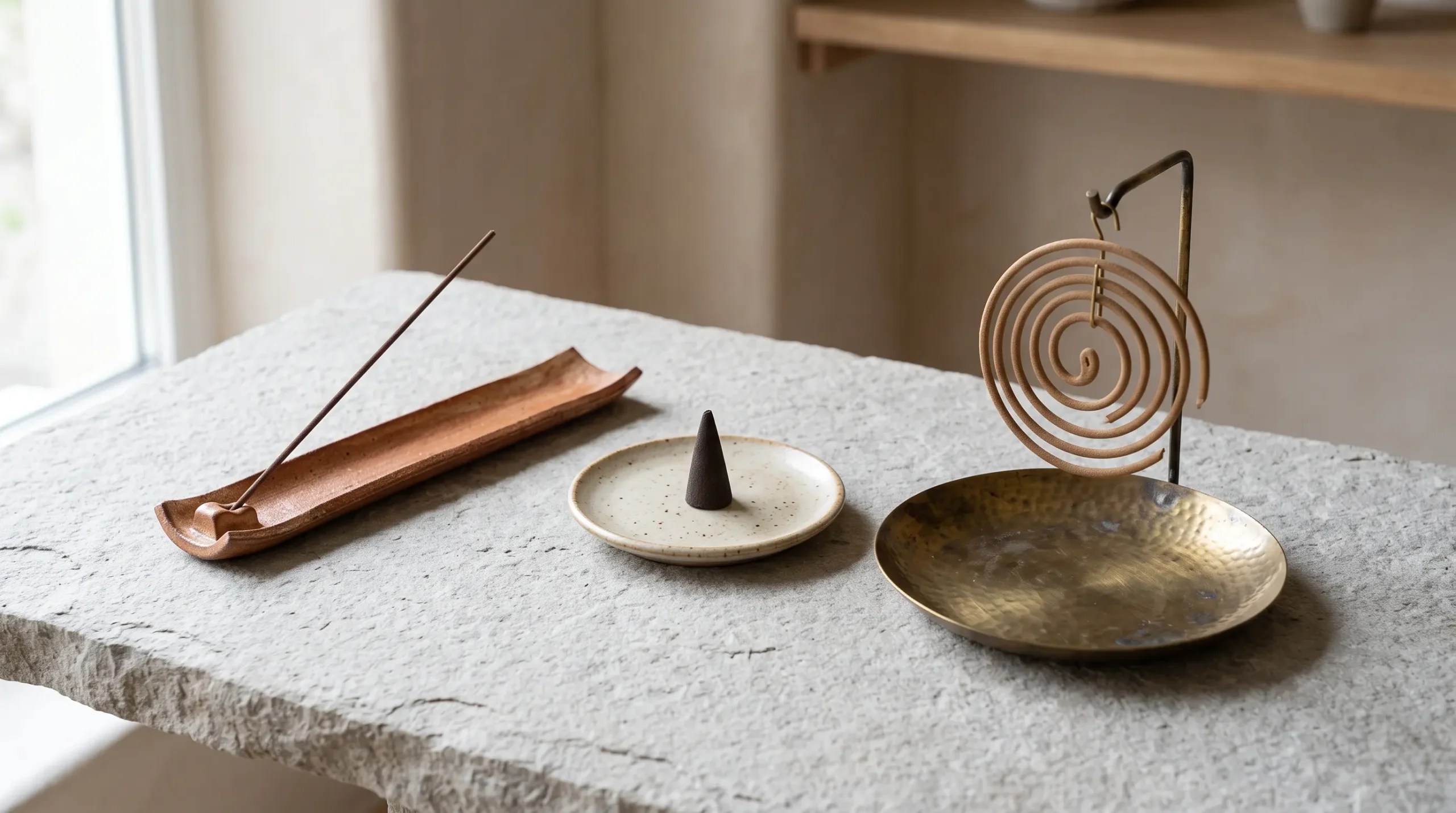
Here are the three main forms in plain terms:
- An incense stick is a thin stick of aromatic paste. Some have a bamboo core, and others are solid.
- An incense cone is a small, solid pyramid. It burns from the tip down to the base.
- An incense coil is a flat spiral. It burns slowly from the outer edge inward.
| Type | Typical burn time | Scent strength | Holder needed | Best for |
|---|---|---|---|---|
| Stick | 30–60 min (thick sticks up to 90) | Medium, steady | Stick holder or ash dish | Daily relaxation, first purchase |
| Cone | 15–30 min | Stronger, faster release | Flat heat-proof dish or ash bed | Quick room refresh |
| Coil | 2–4 hours | Soft, continuous | Hanger or mesh burner with wide dish | Large rooms, long sessions |
Cones give a stronger scent in less time. They also make more heat, so they need a sturdier surface.
Coils suit big, open rooms. A home coil burns for 2–4 hours, so ventilation matters more. We cover that in the safety section.
Not sure which to pick? Use this quick guide:
- Want a calm 30-minute wind-down? Choose a stick.
- Need a fast scent boost before guests arrive? Choose a cone.
- Want a scent that lasts all afternoon? Choose a coil, and plan to be home.
Most makers print the burn time on the box. Check it before you buy.
What Do You Need Before You Burn Incense?
You need four items to burn incense safely: a heat-proof holder, a stable surface, a lighter or match, and an ash catcher.
The incense holder matters most. It is a non-flammable base that keeps the burning piece in place and catches the ash. Many safety problems come from makeshift dishes that were never designed for incense.
Follow these rules:
- Stick holders must be longer than the stick. That way, ash lands in the holder, not on your table.
- Cones need a flat, heat-resistant surface, such as a ceramic dish.
- Ash beds work well for sticks and cones. An ash bed is a layer of clean ash or sand in a bowl. Fill the bowl about three-quarters full.
- Avoid unlined wood. It can scorch over time.
- Use a butane lighter or a match. Skip flammable liquids and improvised tools.
| Incense type | Right holder | Why it works |
|---|---|---|
| Stick | Trough, long dish, or holder with a small hole | Catches ash along the full length |
| Cone | Flat ceramic dish or ash bed | Handles higher heat and holds the cone upright |
| Backflow cone | Backflow burner | Channels smoke downward |
| Coil | Hanger or mesh-bed burner with a wide dish | Keeps air flowing around the spiral |
When you shop for a holder at ShaoLinStore, use this table as your checklist. Check which incense type the holder supports, what it is made of, and how large it is. A holder that fits your incense catches ash better and keeps the burn steady.
How Do You Burn Incense Sticks, Step by Step?
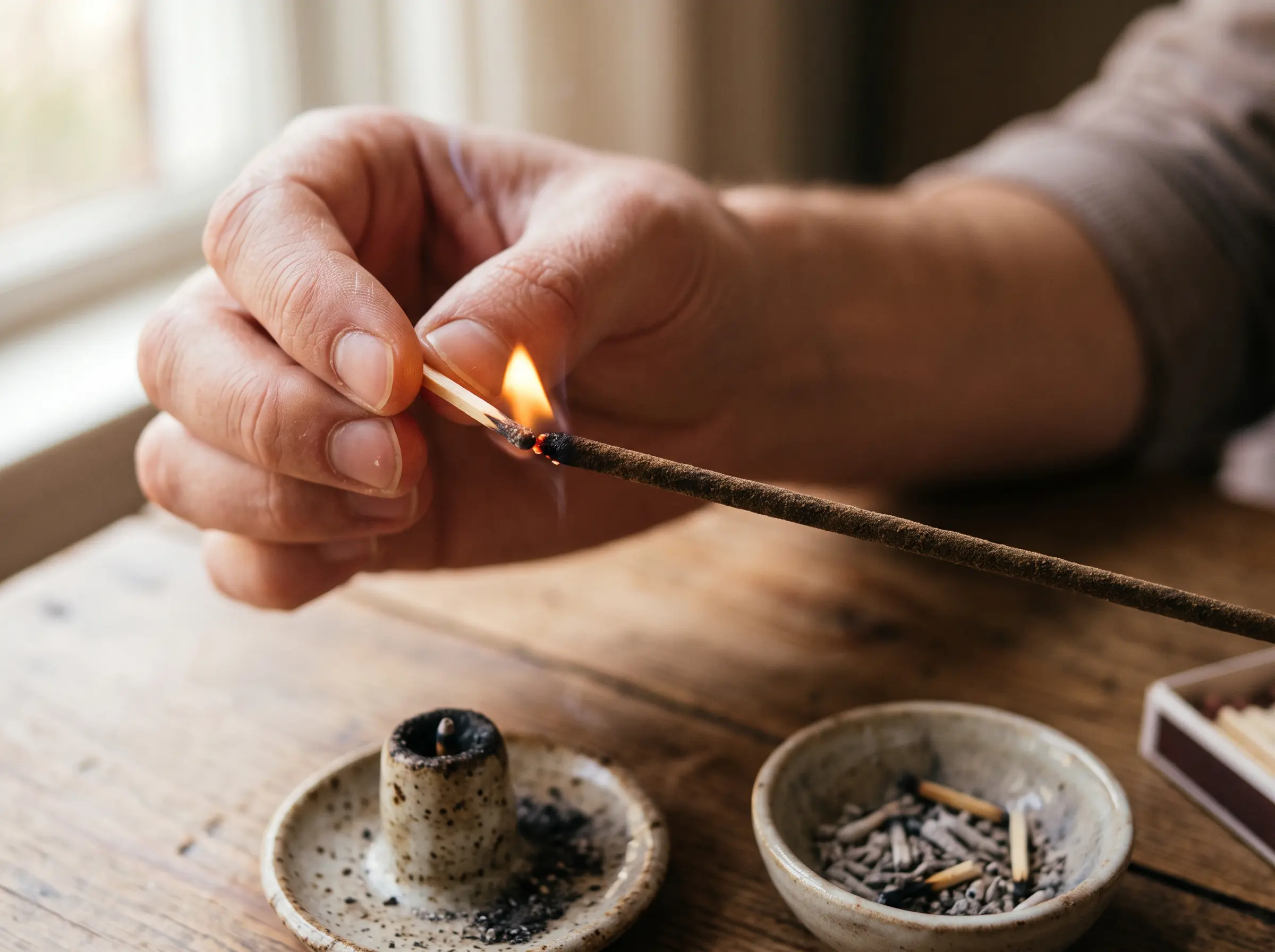
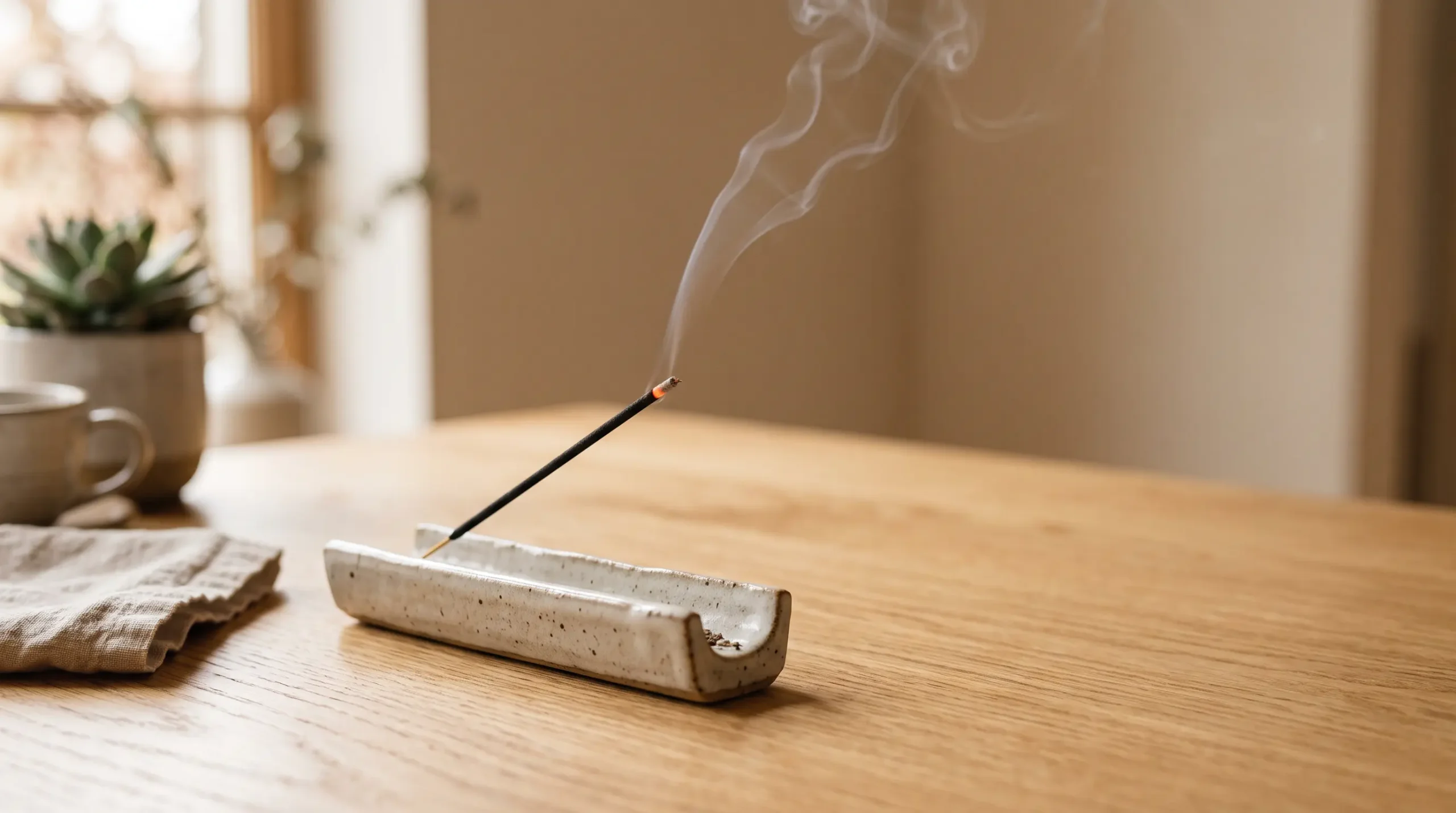
To burn an incense stick, light the tip, wait 5–10 seconds, blow out the flame, and place the stick in a holder.
- Set up your holder. Put it on a stable, heat-resistant surface, away from curtains and paper.
- Light the tip. Hold a match or lighter to the end until it catches. Light the tip only, never the whole stick.
- Wait 5–10 seconds. This helps the stick light evenly. Stop too early, and it may go out.
- Blow out the flame gently. Blow softly until only a glowing ember remains. Hard blowing can scatter embers.
- Check the ember and smoke. A thin trail of smoke means it is working. No glow? Relight it and wait a few seconds longer.
- Place it in the holder. Make sure the burning tip sits over the ash catcher.
Why blow out the flame? Incense is made to smolder. It should release scent from a glowing ember, not burn with an open flame.
A standard stick burns for 30–60 minutes. Thick, dense sticks can run 50–90 minutes. You do not have to burn the whole stick. Put it out whenever you have enough scent.
What Is the Difference Between Bamboo-Core and Coreless Incense Sticks?
Bamboo-core sticks have a bamboo center, while coreless sticks are solid incense that burns all the way down.
Agarbatti is the Indian term for the bamboo-core kind. Joss sticks are stick-shaped incense with no bamboo inside. Japanese sticks are a common coreless example.
| Feature | Bamboo-core stick | Coreless stick |
|---|---|---|
| Structure | Bamboo core coated with aromatic paste | Solid compressed incense |
| Holder rule | Standard stick holder; check the hole size | Brass or ceramic holder that grips without crushing the stick |
| Watch out for | Thick sticks that do not fit narrow holes | The last glowing end touches the holder |
Measure your stick’s thickness before you buy a holder. Some thick sticks, such as Tibetan-style ones, do not fit small holes.
How Do You Burn Incense Cones?
To burn an incense cone, set it upright on a flat, heat-proof surface, light the tip, and blow out the flame after 5–10 seconds.
- Pick a heat-proof dish. A ceramic dish or an ash bed works well.
- Stand the cone upright. Center it so it does not lean.
- Light the tip. Hold the flame to the point until it catches.
- Wait 5–10 seconds. The tip should glow orange.
- Blow out the flame. The cone will keep smoldering down to the base.
A cone burns for 15–30 minutes. It makes more heat than a stick or coil, so avoid thin metal dishes. Thin metal can get hot enough to burn your fingers.
A tilted cone burns unevenly and may go out early. Cones also make more smoke, so open a window before you light one.
How Do Backflow Incense Cones Work?
Backflow cones have a hole in the base, so their smoke pours downward through a special burner.
A backflow burner is a holder with a channel that guides the smoke in a slow, falling stream. Without it, a backflow cone will not work as designed.
- Hold the cone by the tip with tongs, and light it.
- Place it on the burner with the base hole lined up with the channel.
- Expect a short session of about 10–15 minutes.
Backflow smoke looks calm, but it is still smoke. Burn these cones in a room with good airflow.
How Do You Burn Incense Coils Safely?
To burn an incense coil, light the outer end, then hang it or rest it on a mesh burner so air reaches every ring.
- Set up a coil burner. Use a wide, flat dish that is bigger than the coil.
- Mount the coil. Clip the center to a hanger, or lay the coil on a mesh pad.
- Light the outer end. Use a lighter or match, then blow out the flame once the tip glows.
- Let it burn inward. The ember travels around the spiral toward the center and leaves ash behind.
- Stay nearby. A coil burns for hours, so burn it only while you are home, with a window open.
A standard home coil burns for 2–4 hours. Large ceremonial coils last even longer. Coils are also fragile, so handle them gently.
What Holder Does an Incense Coil Need?
An incense coil needs a center hanger or a mesh-bed burner, because a flat dish can smother the ember.
The whole spiral glows as it burns. If it rests on a flat, non-breathable surface, it can go out.
| Holder type | How it works | Ash behavior |
|---|---|---|
| Suspended hanger | Holds the coil by its center, above the dish | Ash falls straight down in a circle |
| Mesh-bed burner | Coil lies flat on a fireproof mesh; air flows underneath | Ash drops through into the dish |
Leave clear space below and around the coil. Choose a dish wider than the spiral, because coils drop a lot of ash in a wide circle.
How Do You Put Out Incense Safely?
Press the glowing tip into sand or ash, or against a ceramic or metal surface, until no ember remains.
- Lift the stick from its holder with care.
- Press the lit tip into sand or ash, or against a heat-resistant surface.
- Hold it there until the ember goes dark.
- Wait for everything to cool before you handle the ash or empty the holder.
| Method | Works for | Verdict |
|---|---|---|
| Press tip into sand or ash | Sticks, cones | Best choice |
| Press onto ceramic tile or metal plate | Sticks, cones | Good when you have no sand |
| Metal container with a tight lid | Cones | Good option |
| Water | Any | Not ideal; it can sputter, spread embers, and leave a soggy mess |
| Blowing on the ember | Any | Avoid; it scatters embers |
A stick that is fully out can be relit later. Advice on relighting cones varies, so we suggest using a fresh cone instead.
Is It Safe to Burn Incense Indoors?
Burning incense indoors is never risk-free, but good ventilation and moderate use lower the risk.
The American Lung Association (ALA), a US lung-health charity, says no indoor burning is completely safe. Incense smoke contains fine particles and gases, including carbon monoxide, formaldehyde, and PAHs (chemicals made when material burns incompletely).
The numbers explain why. Burning one gram of incense can create about 45 milligrams of particulate matter, roughly four times what a cigarette produces, according to research the ALA cites. PM2.5 means particles small enough to travel deep into your lungs.
Ventilation makes a measurable difference. In a university study of incense smoke, rooms with no ventilation exceeded WHO indoor air guidelines, and particles cleared the slowest.
| Risk | What the evidence says | What you can do |
|---|---|---|
| Fine particles (PM2.5) | High particle output; levels stayed above WHO guidelines without ventilation | Open a window, burn near it, use a fan or HEPA air cleaner |
| Asthma and allergies | An allergist group (ACAAI) warns incense can be a significant risk for people with asthma or allergies | Skip indoor incense, or burn it while they are away |
| Children | A study linked daily incense exposure with lower lung function in adolescents | Avoid burning around young children |
| Lingering residue | Smoke particles can cling to furniture, curtains, and fabrics | Keep the burn spot away from soft furnishings |
We love incense, and we want you to enjoy it with clear eyes. Anyone with asthma, COPD, or a heart condition should talk to a doctor before burning incense at home.
How Do You Reduce Smoke Exposure When You Burn Incense?
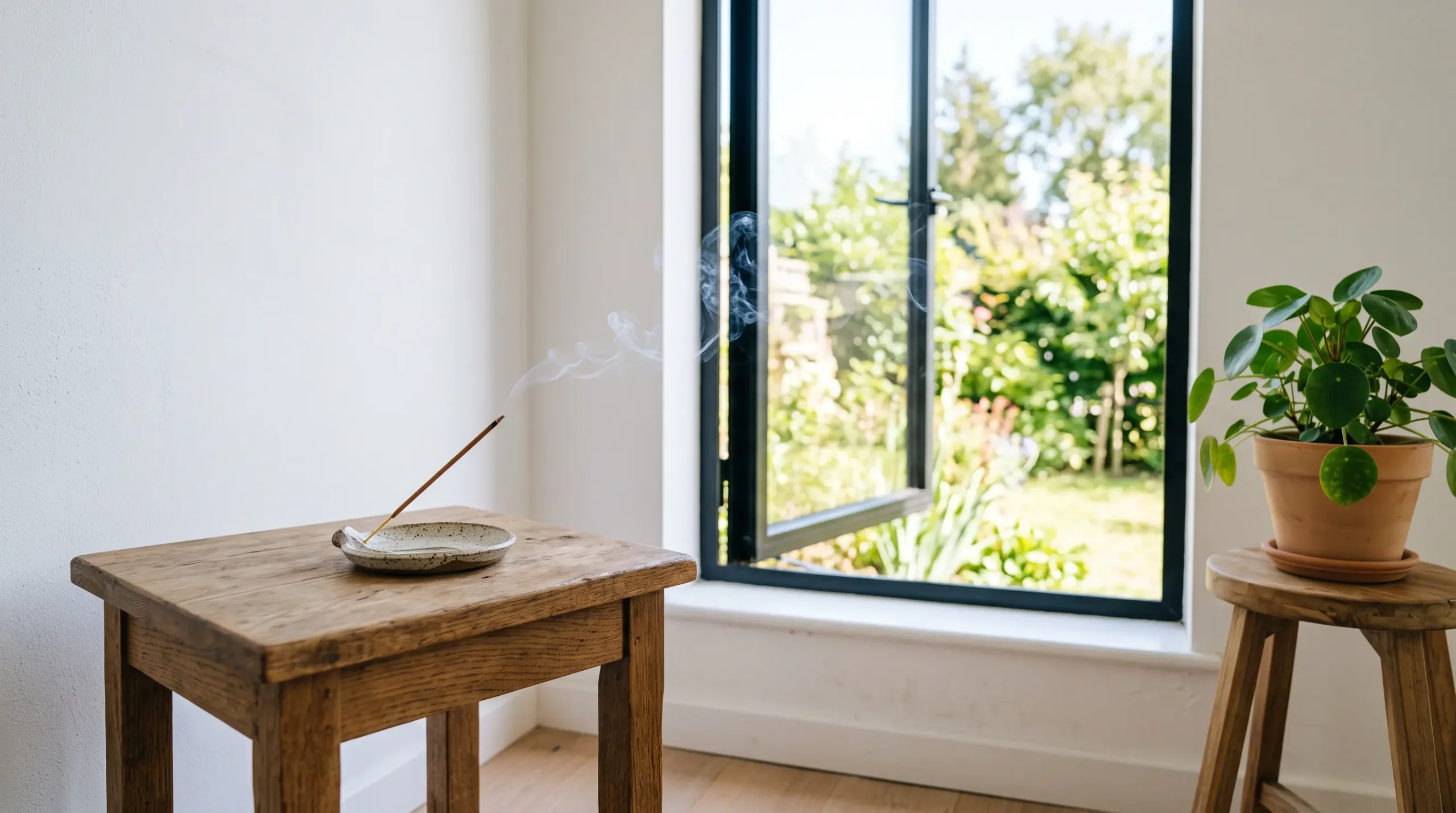
To reduce smoke exposure, burn one piece at a time, open a window, and keep sessions short and occasional.
- Burn near an open window. The ALA says this helps cut exposure for everyone in the home.
- Run a fan or a portable HEPA air cleaner. A HEPA filter traps very fine particles.
- Light one stick or cone at a time. More pieces mean more smoke.
- Choose high-quality, plant-based incense. The ALA suggests this over synthetic types. Check the label for ingredients.
- Try the outdoors. A balcony or patio with airflow is a better spot than a small closed room.
- Plan around vulnerable people. If someone at home has a lung condition, burn when they are out.
How Do You Prevent Fires and Keep Pets and Kids Safe?
Keep burning incense on a stable, heat-proof surface, away from flammable items, pets, and children.
- Never leave it unattended. Put it out before you leave the room.
- Keep a safe distance from curtains, paper, clothing, and furniture.
- Watch your cat. Cats love moving smoke, and a swiping paw can knock over a holder.
- Store lighters and matches apart from the incense, out of children’s reach.
- Check the ember is dead before you walk away.
What Are Common Mistakes When Burning Incense, and How Do You Fix Them?
Most problems come from removing the flame too early, using the wrong holder, or burning in a draft.
| Problem | Likely cause | Fix |
|---|---|---|
| Stick keeps going out | Flame removed too soon, or low-quality incense | Hold the flame for 5–10 seconds; try another brand |
| Stick burns unevenly | Draft or a poor angle | Move away from airflow; rotate the stick |
| Cone tilts or dies early | Not centered, or crooked in the dish | Stand it upright on a flat surface |
| Coil goes out | Resting on a flat, non-breathable surface | Use a hanger or a mesh-bed burner |
| Ash spills everywhere | Holder too shallow, or drafts | Use a deeper, wider holder; empty ash often |
| Room feels smoky or irritating | Too many pieces, or poor ventilation | Burn one at a time; open a window |
Ready to Start Burning Incense the Safe, Simple Way?
In summary, burning incense safely comes down to three habits. Match the holder to the incense type. Blow out the flame and keep the ember. Ventilate the room and never leave it unattended.
Start with a stick if you are new. Move to cones for a stronger scent, and try coils for long sessions. Whichever form you choose, the same rules apply.
Ready to begin? Explore the incense collection at ShaoLinStore, pick your first stick, cone, or coil, and pair it with the right holder. Then light it, open a window, and enjoy the quiet.
❓ Frequently Asked Questions
No. You can put out an incense stick at any point. A full stick burns for about 30–60 minutes, but you only need as much scent as you enjoy.
Incense is made to smolder from a glowing ember, not burn with an open flame. Blowing out the flame after 5–10 seconds lets it burn slowly and release its scent.
Not safely. Sticks and coils need a non-flammable holder, and cones need a flat, heat-proof surface. A bowl filled three-quarters with ash or sand also works for sticks and cones.
It can be, especially in closed rooms or for people with asthma, allergies, or lung and heart conditions. The short answer: the American Lung Association says no indoor burning is completely safe, so ventilate well and burn only occasionally.
No. Never leave burning incense unattended, and put it out fully before you leave the room.
📚 References
- Health effects of incense smoke: The American Lung Association explains what is in incense smoke, who is most at risk, and how to reduce exposure. American Lung Association – The Hidden Health Dangers of Burning Incense
- Asthma and allergy risks: A medical society presentation on health hazards from incense burning, including respiratory and allergic effects. American College of Allergy, Asthma & Immunology (ACAAI) – Burning Incense Can Pose Health Risks
- Lung function in young people: A peer-reviewed study linking daily incense burning at home with impaired lung function in adolescents. PubMed Central – Incense burning and adolescent lung function
- Ventilation and particle levels: A university study that measured PM10 and PM2.5 from burning incense under three ventilation scenarios. Yonsei University Repository – Reduction of Inhalation Exposure to Particulate Emissions from Burning Incense
- Burners and burning methods: An encyclopedia overview of censers, direct-burning incense, and stick holders that catch ash. Wikipedia – Censer