
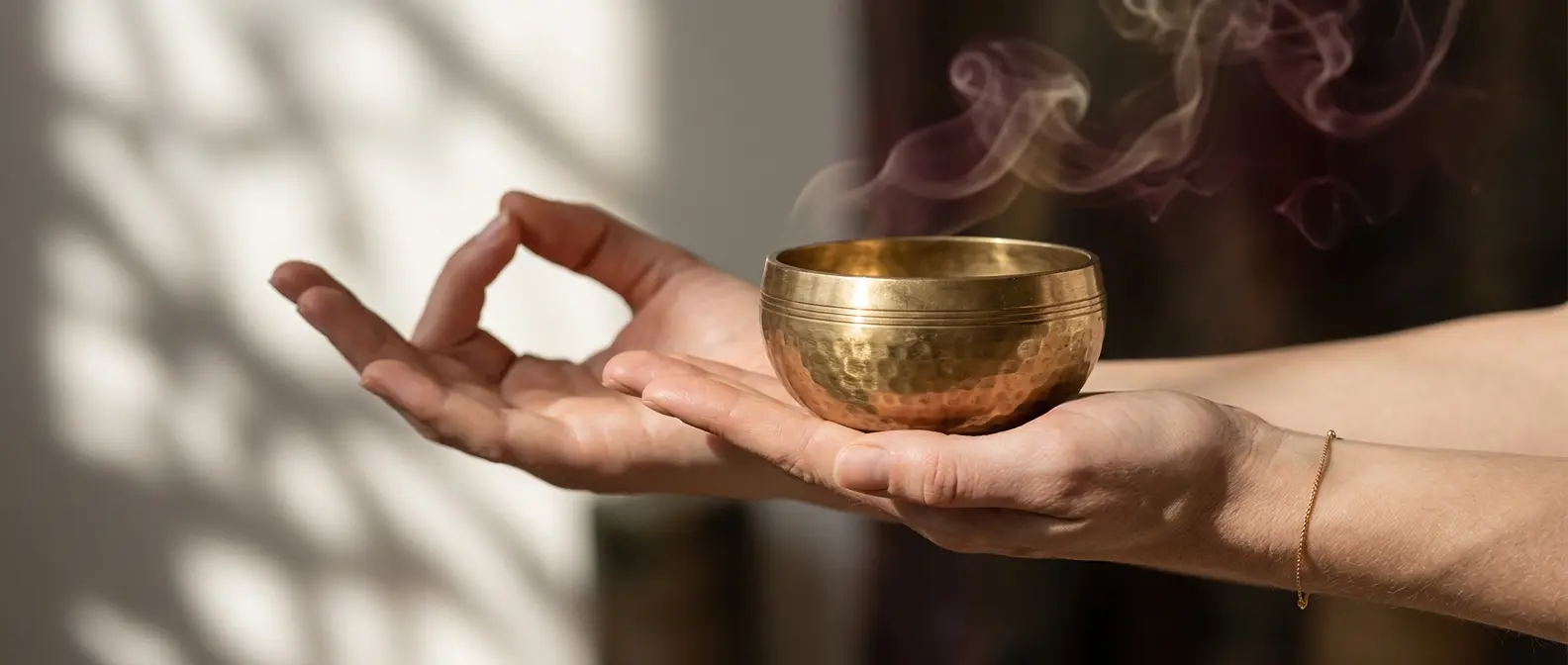
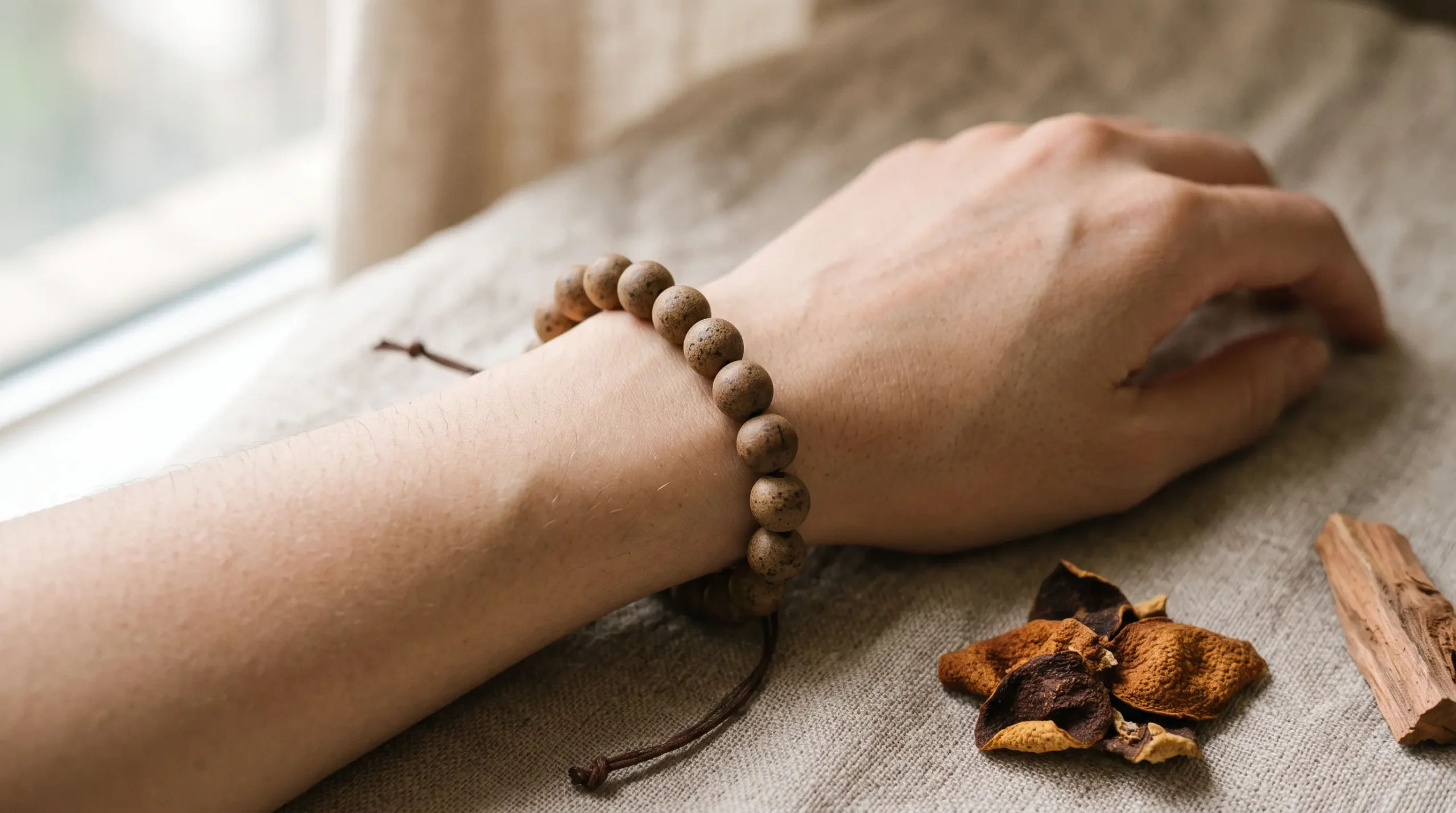
A herbal bracelet, known in Chinese as He Xiang Zhu (合香珠), is a string of hand-rolled beads made from ground aromatic woods, resins and herbs. The scent comes from the beads themselves, not from added perfume. At ShaoLinStore, we think that is what makes these bracelets special, and why they deserve an honest explanation.
Online, herbal bracelets arrive wrapped in big promises: “cures insomnia,” “balances your qi,” “TCM approved.” Most of that is marketing. This guide shows you what is really inside, where the tradition comes from, what research does and does not support, and two ingredients you should never wear.
This article shares cultural and fragrance information. It is not medical advice.
Here’s what you need to know:
- A herbal bracelet is worn, not burned. Body warmth releases the scent.
- Most beads combine three layers: a wood base, resins and spices, and herbs or flowers, held by a plant binder.
- Studies on inhaled aromatherapy show modest, short-term effects. We found no trial of herbal bracelets themselves.
- Skip any bracelet that lists cinnabar or realgar.
- Keep it dry and sealed between wears.
What Is a Herbal Bracelet (He Xiang Zhu)?
A herbal bracelet, or He Xiang Zhu (合香珠), is a strand of beads made from powdered aromatic woods, resins and herbs. A plant-based binder holds the powder together. Makers roll it by hand into spheres. Your skin’s warmth releases the scent, so no flame is needed.
The name has three parts. He (合) means “combined.” Xiang (香) means “fragrance.” Zhu (珠) means “bead.” So He Xiang Zhu means “compound-fragrance beads.” He Xiang is the wider tradition of blending several aromatics into one formula, instead of using a single material.
You will see many names for the same product: Chinese herbal bracelet, TCM bracelet (TCM is Traditional Chinese Medicine), incense beads and aromatic beads. They all point to this one category.
| Attribute | Detail |
|---|---|
| Chinese name | 合香珠 (He Xiang Zhu) |
| Made from | Powdered woods, resins and herbs, plus a plant binder |
| Scent release | Body warmth and handling; no burning |
| Common ingredients | Sandalwood, agarwood, clove, frankincense, mugwort, tangerine peel, rose |
| Category | Wearable, non-burning incense |
How Is a Herbal Bracelet Different from Wood or Lava-Stone Bracelets?
A sandalwood or agarwood bracelet is carved from one solid wood, while a herbal bracelet is molded from a blend of many powdered aromatics. You are comparing a single note with a composed fragrance. A lava-stone bracelet is different again. It is porous volcanic rock that holds essential oil you add yourself.
| Type | Made from | Scent source | Upkeep |
|---|---|---|---|
| Herbal bracelet (He Xiang Zhu) | Compounded powders and binder | The beads themselves | Keep dry; rest in a sealed pouch |
| Sandalwood bracelet | Solid carved sandalwood | The wood | Avoid water and perfume |
| Agarwood bracelet | Solid carved agarwood | Resin in the wood, warmed by skin | Avoid water and perfume |
| Lava-stone bracelet | Porous volcanic rock | Essential oil you add | Re-apply oil when the scent fades |
Bottom line: a herbal bead is the fragrance. A lava stone only carries one.
Where Do Chinese Aromatic Beads (He Xiang Zhu) Come From?
Herbal bead making is genuinely old. The Song-dynasty (960–1279) book Chen’s Book of Incense (陈氏香谱), compiled by Chen Jing, records formulas for incense beads. It describes the method as long established among Daoist practitioners. That makes He Xiang Zhu a tradition of roughly 800 years or more, not a recent invention.
Incense was part of daily life for Song scholars. Burning incense, brewing tea, hanging paintings and arranging flowers were known as the “four leisurely arts.” Wearable beads were one more way to carry fragrance with you.
| Period | What happened |
|---|---|
| Song dynasty (960–1279) | Chen’s Book of Incense records compound-incense and bead formulas |
| Qing dynasty (1731) | The palace makes “summer-heat beads” for the Dragon Boat Festival |
| Today | Small workshops hand-knead, polish and string herbal beads |
The modern revival is real. Global Times describes women in a Zhejiang village kneading herbal powders into beads, then polishing and stringing them into “wellness bracelets” that are popular with young people.
What Did the Qing Court Put in Its “Summer-Heat” Beads?
The Qing palace’s 1731 summer-heat bead recipe used cooling herbs, sandalwood, borneol and rose petals. It also used two toxic minerals: cinnabar and realgar. Court records, as discussed in the research collection Qing Gong Yi An Yan Jiu (《清宫医案研究》), say officials received these beads as Dragon Boat Festival gifts.
Here is why this matters. Historical authenticity does not equal modern safety. A recipe can be 300 years old and still be one you should not wear on your wrist today. We return to this in the safety section below.
What Ingredients Are in a Herbal Bracelet?
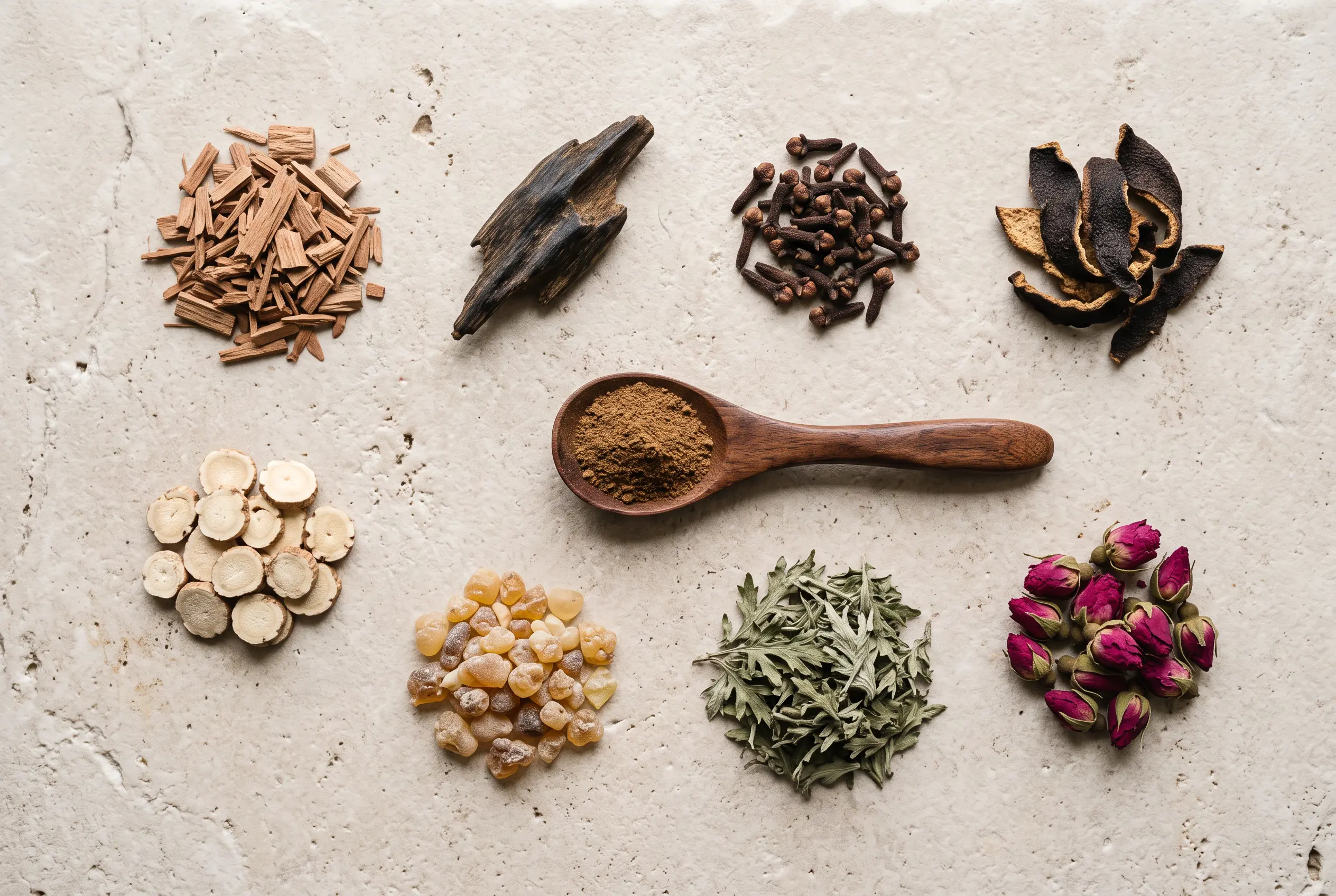
Most herbal bracelets combine three layers: an aromatic-wood base, resins and spices for body, and herbs or flowers for character. A plant binder holds everything together. A trustworthy maker names every one of them.
| Layer | Common ingredients | Role in the scent |
|---|---|---|
| Wood base | Sandalwood (檀香), agarwood (沉香) | Creamy or deep foundation |
| Resins and spices | Frankincense, myrrh, benzoin, clove, borneol | Warmth, body and a cool, sharp lift |
| Herbs and flowers | Mugwort, tangerine peel, rose, osmanthus, patchouli | Freshness and character |
| Binder | Bletilla root, elm-bark powder, nanmu powder | Holds the bead together |
Traditional formulas follow a rule called jun chen zuo shi (君臣佐使), meaning “sovereign, minister, assistant, envoy.” One lead ingredient sets the main note. The others support or soften it. Think of it like a band: one lead voice, with others in harmony.
Vague labels are a red flag. A listing that names three ingredients and then says “and 11 others” tells you nothing. Ask for the full list.
What Holds the Beads Together?
Traditional beads use plant mucilage, mainly bletilla root (白芨), elm-bark powder or nanmu powder, instead of industrial glue. Mucilage is a sticky, gel-like substance that plants make naturally. The ratio matters. Too little binder and the beads crumble. Too much and the binder mutes the scent.
Ask any seller which binder they use. A real answer is a good sign. A plastic-like sheen on the bead is not.
Which Ingredients Should You Avoid in a Herbal Bracelet?
Avoid any herbal bracelet that lists cinnabar (朱砂) or realgar (雄黄). Cinnabar is mercury sulfide (HgS). Realgar is arsenic sulfide (As4S4). Both appear in historical recipes, and both are toxic minerals.
A published toxicology review notes that absorbed mercury from cinnabar accumulates mainly in the kidneys. It also notes that heating cinnabar releases mercury vapor. Bracelets are not burned, but there is no reason to wear a mercury compound against your skin every day. Children and pregnant people should be especially careful.
Some historical red beads got their color from cinnabar. If a bead is strongly red, ask what makes it red.
| Warning sign | What it may mean |
|---|---|
| Lists cinnabar or realgar | Toxic mineral additive |
| One-note, sweet scent that never changes | Possible synthetic fragrance oil |
| Plastic-like shine | Possible industrial glue |
| “And 11 other ingredients” | Poor transparency |
How Are He Xiang Zhu Beads Made?
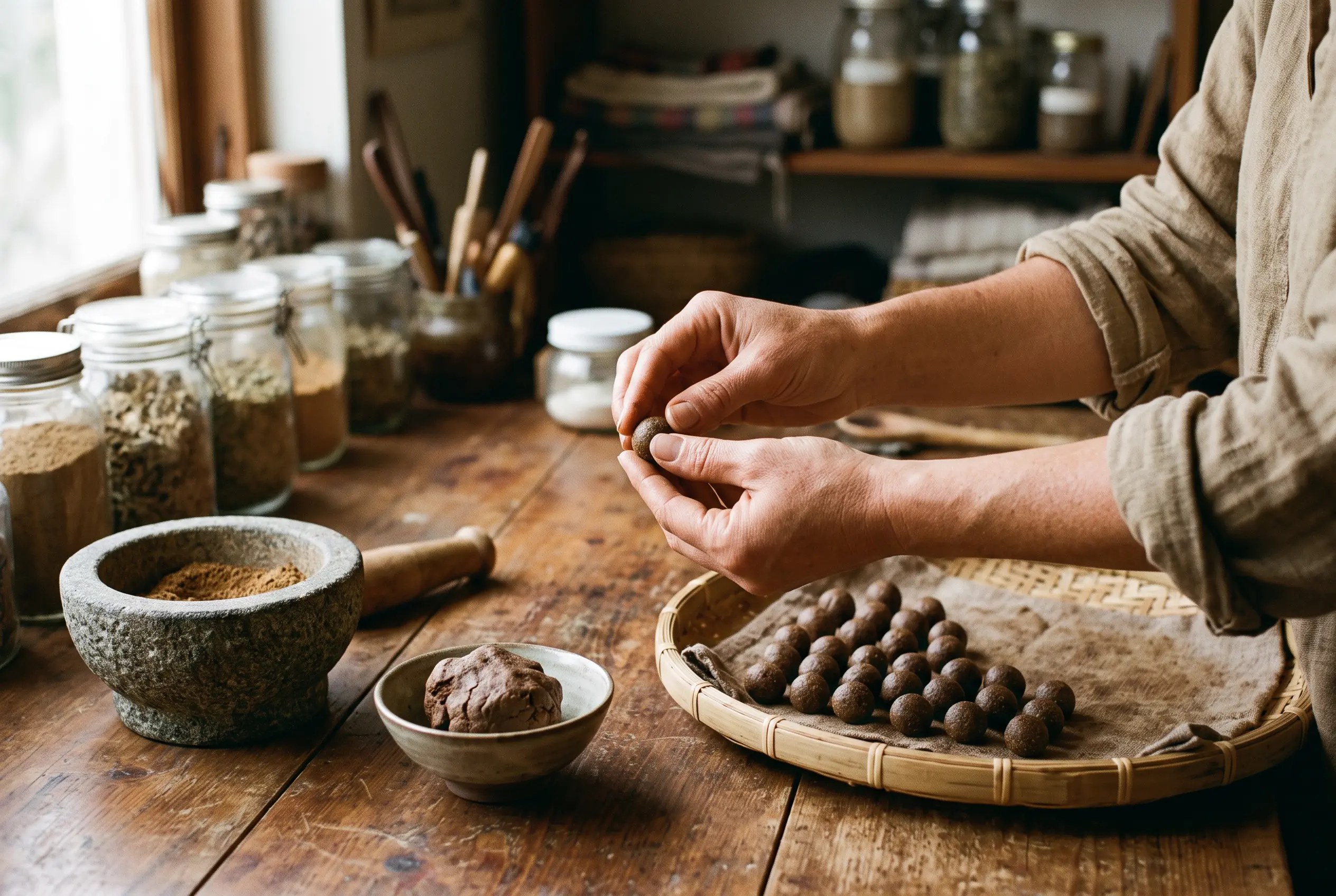
Makers produce He Xiang Zhu in six steps: grind, blend, knead, roll, dry, then polish and string. Each step affects how the bead smells and how long it lasts. Workshops commonly report drying beads in the shade for about 7–10 days.
- Grind and sieve. Woods, resins and herbs become fine powders. Finer powder makes a smoother bead.
- Blend by formula. The maker weighs each powder to match the recipe.
- Knead with binder. Powder, binder and a little water become a firm dough.
- Roll and pierce. The maker rolls each bead by hand and makes the string hole.
- Dry slowly in shade. Fast or sunny drying can crack beads and fade the scent.
- Polish and string. Some makers add a light finish, then thread the beads.
These steps explain the price range. Better ingredients, more hand work and slower drying all cost more. A very cheap bracelet usually cuts one of them.
Do Herbal Bracelets Actually Work? What to Honestly Expect
Honestly, a herbal bracelet is a pleasant scent ritual, not a treatment. A 2023 meta-analysis of 7 randomized trials with 425 students found that inhaled aromatherapy lowered test anxiety (SMD −0.67). Results varied a lot between studies (I² = 72%). And aromatherapy did not beat placebo scents (SMD −0.65, p = 0.25).
Two terms need a quick explanation. SMD (standardized mean difference) is a way to measure effect size. A negative number here means lower anxiety. I² shows how much results differ between studies. A value of 72% is high.
The bigger point: those trials tested inhaled scents, often essential oils at set doses. We did not find a clinical trial of herbal bead bracelets. A bead releases far less scent, close to your skin. So the research cannot promise that a bracelet will do the same.
It helps to separate three layers:
- Tradition: Chinese culture links aromatic herbs with calm and wellbeing.
- Plausible mechanism: Smell is closely tied to mood and memory, and a bracelet gives you a daily cue to pause.
- Evidence gap: No trial shows a herbal bracelet treats any condition.
| Reasonable expectation | Exaggerated claim |
|---|---|
| A pleasant, subtle scent close to your skin | “Cures insomnia” |
| A small daily ritual or calming cue | “Balances your organs” |
| A connection to Chinese incense culture | “Detoxes your body” |
| A thoughtful gift for scent lovers | “Clinically proven” |
Can a Herbal Bracelet Help with Sleep, Stress or Focus?
A herbal bracelet can work as a calming cue, but it is not a sleep or anxiety treatment. Many people put one on during a set routine, such as reading, journaling or desk work. Over time, the scent can signal “this is my quiet time.” That is a habit effect. If you have ongoing insomnia or anxiety, see a healthcare professional.
Which Marketing Claims Should Make You Skeptical?
Be skeptical of any herbal bracelet sold with a “secret formula,” a “TCM approved” label, or a promise to treat a named condition. A trustworthy maker publishes the full ingredient list and makes no medical claims. If a seller says “TCM approved,” ask who approved what. Single-person stories, like “my sleep tracker improved,” are not evidence either.
Are Herbal Bracelets Safe to Wear Every Day?
For most adults, a herbal bracelet made from ordinary plant aromatics is low-risk. The real hazards are toxic mineral additives, fragrance allergies and mold on beads that stay damp.
- Allergies: Clove contains eugenol, a well-known fragrance allergen. Do a skin test first. Wear the bracelet on your inner wrist for 24 hours. Remove it if you see redness or itching.
- Strong scents: People with asthma or scent sensitivity should start with a mild formula.
- Children and pregnancy: Avoid cinnabar and realgar. Check with a clinician before daily wear.
- Mold: Moisture and sweat are the cause. Dry beads fully and store them sealed.
Is the Agarwood in Herbal Beads Sustainable?
All agarwood-producing trees of the genera Aquilaria and Gyrinops are listed in CITES Appendix II. CITES is the international treaty that regulates trade in wild species. Aquilaria malaccensis was listed in 1995. The remaining species followed in 2004, with controls in force from January 2005.
Appendix II covers species that may become threatened if trade is not controlled. So an ethical seller should say whether its agarwood is plantation-grown. Be wary of very cheap “wild agarwood” claims.
How Do You Choose a Good Herbal Bracelet?
Choose a bracelet with a full ingredient list, a plant-based binder, no cinnabar or realgar, and a soft scent that shifts as it warms. Do not judge by “ancient secret recipe” claims or by price alone. When you browse herbal bracelets at ShaoLinStore, or anywhere else, run through this checklist:
- Full ingredient list. Every named ingredient, not “and others.”
- No cinnabar or realgar. This is non-negotiable.
- Named binder. Bletilla, elm bark or nanmu, not glue.
- Layered scent. It should change as the bead warms on your skin.
- Natural surface. A matte or satin finish with slight variation between beads.
- Plain claims. No cure, detox or “clinically proven” language.
- Sourcing note. Agarwood should come with a plantation or CITES statement.
Is a Herbal Bracelet a Good Gift?
A herbal bracelet makes a thoughtful gift for someone who loves quiet scents, tea, incense or meditation. It suits people who dislike perfume, because the scent stays close to the skin. Skip it for anyone with fragrance allergies, and be careful with young children or pregnant recipients. Include the ingredient list and care card so the gift is enjoyed safely.
Can You Make Your Own He Xiang Zhu?
Yes. Herbal bead workshops and DIY kits are now common, and making your own is the clearest way to know what is inside. The key rule: string beads only after they are fully dry. Damp beads can grow mold and lose scent. Avoid any DIY recipe that calls for cinnabar or realgar.
How Do You Wear and Care for a Herbal Bracelet?
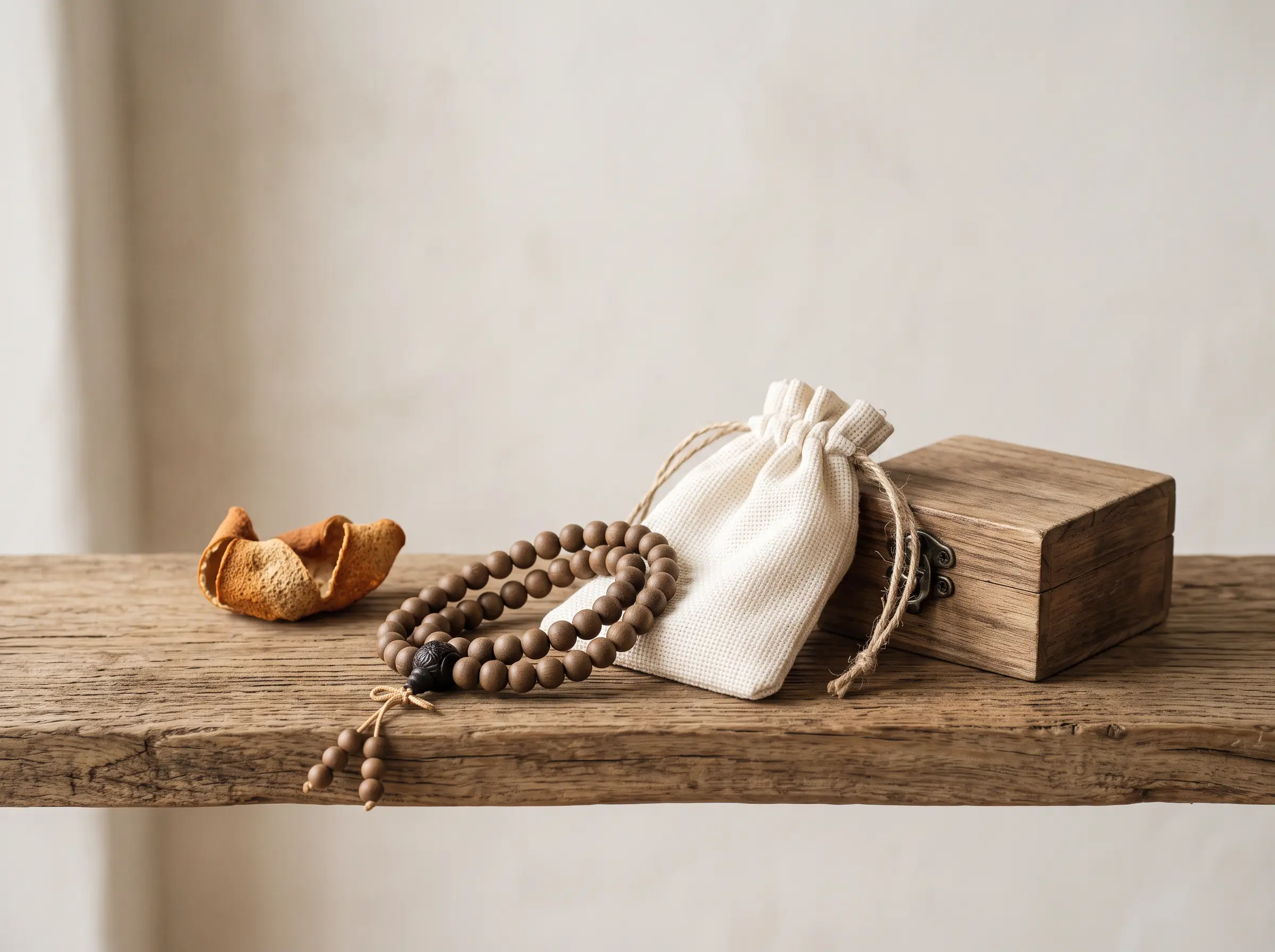
Keep your herbal bracelet dry, away from perfume and lotion, and sealed in a pouch when you are not wearing it. Water is the main enemy. It weakens the binder, which can crack the beads, fade the scent and invite mold.
- Remove it for showers, handwashing, swimming, workouts and sleep.
- Apply perfume and lotion first, and let them dry before putting the bracelet on.
- If it gets wet, pat it dry and air-dry it in the shade. Avoid sun and heaters.
- Store it sealed in the pouch or a small box.
How Long Does the Scent of a Herbal Bracelet Last?
Seller claims range from several months to a year or more, depending on formula, bead size, storage and moisture. These are maker claims, not lab-tested figures. In general, the scent is strongest in the first weeks, then softens.
If you stop noticing it, the bracelet may not be fading. Your nose may simply be used to it. This is called olfactory fatigue. Rest the bracelet in a sealed pouch for a few days, then smell it fresh.
Is a Herbal Bracelet (He Xiang Zhu) Worth It?
In summary, a He Xiang Zhu herbal bracelet is worth buying as what it really is: a wearable piece of China’s compound-incense tradition. It gives you a quiet, evolving scent and a small daily ritual. It is not a remedy.
The most important thing to remember is to read the ingredient list. Choose plant binders, avoid cinnabar and realgar, and keep your expectations honest. At ShaoLinStore, we believe that is the best way to enjoy Chinese aromatic beads. Browse our herbal bracelets, and use the checklist above to find the one that suits you.
❓ Frequently Asked Questions
He Xiang Zhu beads are meant to be worn or held, not burned. Your body warmth and handling release the scent. Burning a bead destroys it and is not how a bracelet is normally used.
Studies of inhaled aromatherapy show modest, short-term reductions in anxiety. We found no trial of herbal bead bracelets themselves, and a bead gives off a much fainter scent. Treat it as a calming ritual, and see a doctor for ongoing insomnia.
No. Water weakens the plant binder, which can crack the beads, fade the scent and cause mold. Take it off before showers, handwashing and heavy workouts. If it gets wet, pat it dry and air-dry it in the shade.
Avoid any formula with cinnabar or realgar, and check with a healthcare provider before a child or pregnant person wears one daily. Strong aromatics such as clove can also trigger skin or breathing reactions. Choose a mild, fully disclosed formula.
Natural herbal beads smell layered and soft, and the scent changes as they warm. Synthetic-scented beads usually smell loud, sweet and the same all the time. Ask the seller for the full ingredient and binder list.
📚 References
- Aromatherapy research: The meta-analysis on inhaled aromatherapy and test anxiety, including the placebo comparison cited above (Luan et al., Frontiers in Psychology, 2023). PubMed Central (NIH)
- Cinnabar safety: A toxicology minireview comparing cinnabar (mercury sulfide) with other mercury compounds, including kidney accumulation and mercury vapor when heated. PubMed (NIH)
- Agarwood and CITES: A review of the agarwood-producing genera Aquilaria and Gyrinops, covering CITES listings, trade and conservation. CITES Secretariat
- Classical source: The Song-dynasty Chen’s Book of Incense (陈氏香谱) by Chen Jing, digitized in the Siku Quanshu edition. The bead formulas appear in its later volumes. Wikisource
- Modern workshops: A news feature on Zhejiang workshops kneading herbal powders into aromatic beads and “wellness bracelets” for young buyers. Global Times