
You can buy a Buddha statue for yourself, and no one has to hand it to you. A Buddha statue is a sculpted image of Shakyamuni or another Buddhist figure, kept as a reminder for meditation. No Buddhist teaching says it must arrive as a gift. This guide traces that myth to its source, covers gifting etiquette, and helps you choose a figure with intention.
At ShaoLin Store, first-time buyers often ask this question right before checkout. A friend’s warning about bad luck is enough to make anyone hesitate. We traced the most common myths to their sources, and the answers are calmer than the warnings.
Can You Buy a Buddha Statue for Yourself?
Yes, you can buy a Buddha statue for yourself. No Buddhist teaching says a statue must arrive as a gift; that rule is a folk belief. What tradition asks is that you treat the statue with care: clean, elevated, and never used as a joke.
Temples commission statues for their own halls, and practitioners buy figures for home altars every day. Self-purchase is fine when your intention is respect. You are choosing a focal point for mindfulness, not a lucky charm.
In our experience, people who ask this question already plan to treat the statue with more care than most.
Ready to choose one for yourself? Start with the Shaolin Quiet Sakyamuni statue in Qingsha stone, $195.95 with free U.S. shipping.
Is it bad luck to buy a Buddha statue for yourself?
No. In Buddhist terms, luck is not the issue; conduct and intention are. Buddhist teaching points to what you do and intend, not to how an object changed hands. Buying a statue to support your meditation is a respectful reason. Buying one to mock it is not.
What does Buddhist tradition actually emphasize instead?
Respect lives in the handling, not the receipt. Keep the statue clean, give it an elevated spot, and never use it as a prop. Many practitioners in the Chan (Zen) tradition treat a statue as a reminder to sit and breathe, not as a source of fortune.
Where Did the “Gift-Only” Rule Come From? 5 Myths Traced to Their Source
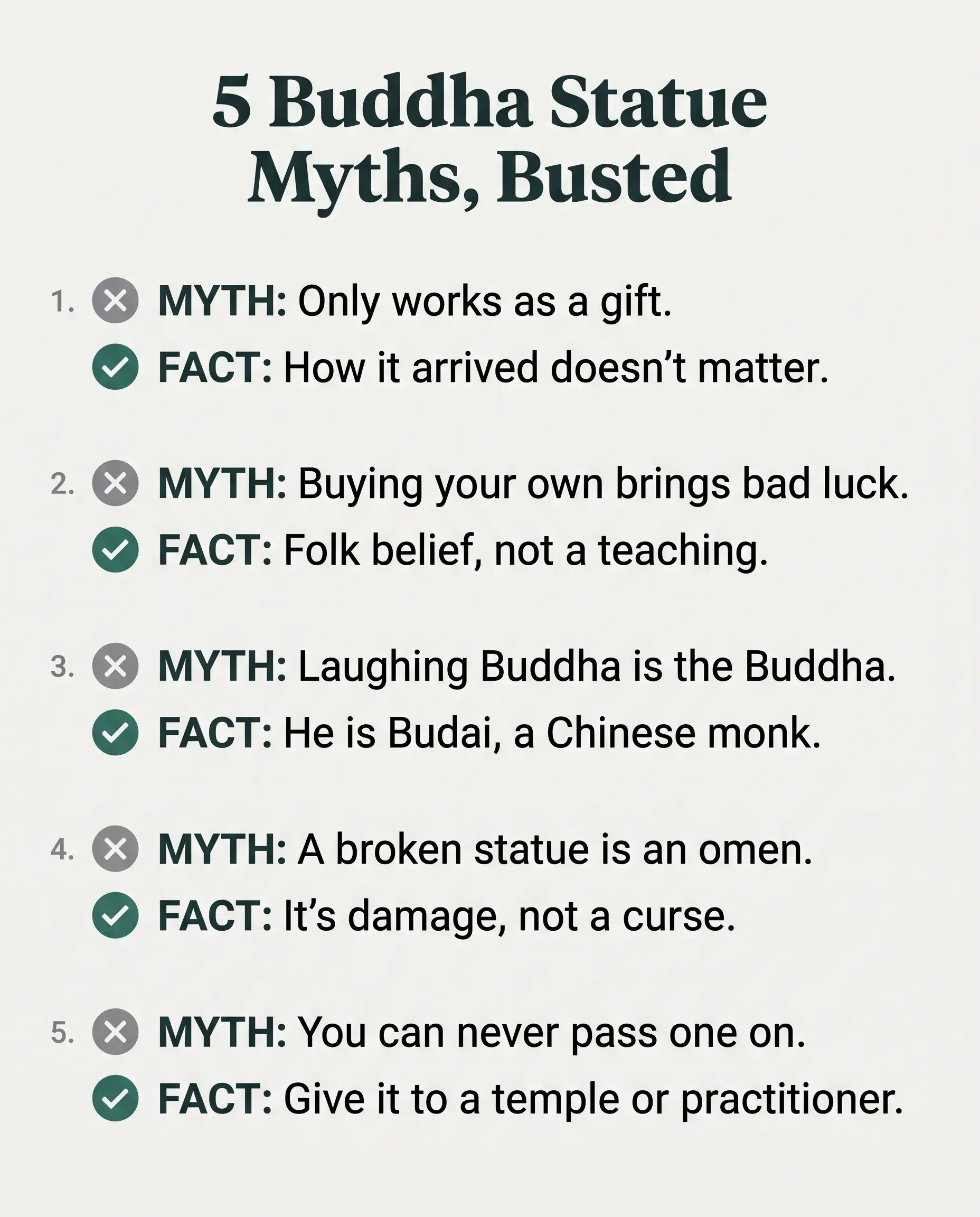
Five myths account for most of the worry, and none of them is a Buddhist requirement.
- “It only works as a gift.” A statue is an image for reflection, and the route it took to you does not change that.
- “Buying your own invites bad luck.” This is a folk superstition, and we found no scripture behind it.
- “The Laughing Buddha is the Buddha.” He is Budai, a Chinese monk, not Shakyamuni.
- “A broken statue spells disaster.” A crack is damage, not an omen.
- “You can never pass one on.” Giving a statue to a temple or a practitioner is a respectful option.
Why do so many people believe a Buddha must be gifted?
The belief spreads by word of mouth, and it sounds more official each time someone repeats it. A 2019 LankaWeb essay by M D P Dissanayake recalls a 2006 purchase of a 40-inch (102 cm) statue. A neighbor then said such statues should be received as gifts, not bought.
The essay presents this as neighborhood folk belief. Some home-décor and feng shui writing now repeats it as a rule about luck. We treat it as a cultural habit, and we found no basis for it in the Buddhist sources we checked.
Is the Laughing Buddha the same as the Buddha?
No. The Laughing Buddha is Budai, a Chinese monk remembered from the early 10th century, while Shakyamuni is the historical Buddha, Siddhartha Gautama. Many Chan traditions associate Budai with Maitreya, the Buddha of the future. The most common mix-up we correct is the smiling, round-bellied figure mistaken for the Buddha himself.
Does a cracked or broken statue bring bad luck?
No. A crack is damage, not an omen. The FAQ below explains what to do with the pieces.
Is It Disrespectful to Own a Buddhist Figure If You’re Not Buddhist?
No. Owning a Buddhist figure is not disrespectful; treating it as scenery is. You do not need to be Buddhist to keep a statue. You do need to place it with some thought.
What makes displaying a sacred figure respectful, according to Buddhist teachers?
Context and intent decide it. Zen teacher Vanessa Zuisei Goddard, writing in Tricycle, notes that a statue suits a temple but can offend, or at least show insensitivity, when used as bathroom decor or in a car advertisement.
A practical test follows from that. Can you say in one sentence why the figure is in your home? If you can, you are already on solid ground.
Where should a Buddhist figure never go in an American home?
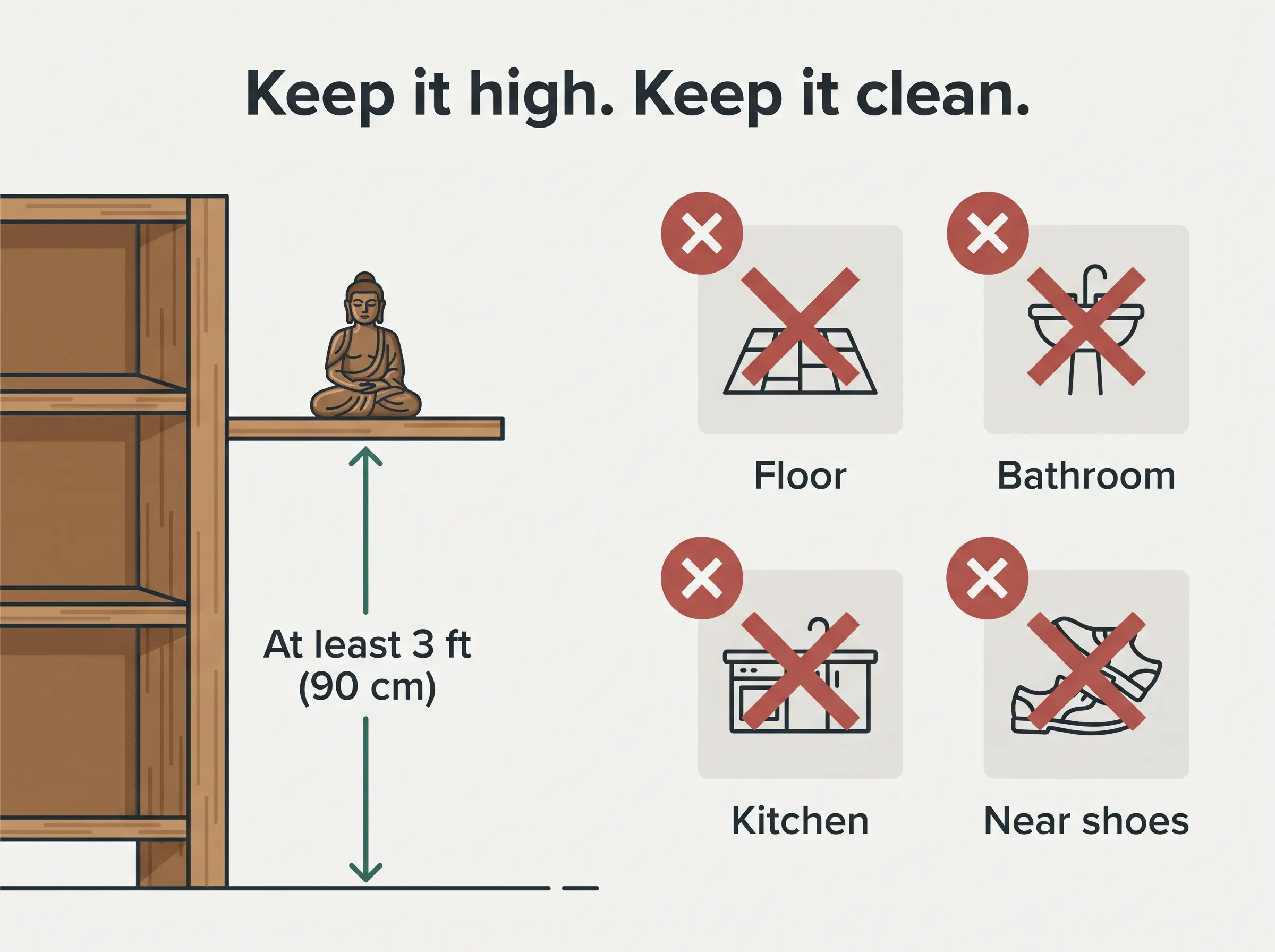
Keep it off the floor, out of the bathroom, away from the kitchen, and clear of shoes. Place it on a clean, stable surface at least 3 feet (90 cm) above the floor, ideally at or above seated eye level, facing the room.
One thing worth checking: a floor-level TV console is not “elevated,” even if it looks tidy. A bookshelf works better. For a worked example, see the placement notes on the solid copper Royal Ease Guanyin statue page.
Gift or Self-Purchase? How the Etiquette Actually Differs
The etiquette barely differs: a gift adds two steps, matching the figure to the person and presenting it without pressure.
| Etiquette point | Giving one to someone else | Buying one for yourself |
|---|---|---|
| Choosing the figure | Match it to the person’s taste. Do not assume their beliefs. | Match it to your intention: calm, compassion, or focus. |
| Presenting it | Hand it over with both hands and a short note. | Unbox it gently and set it in its permanent spot the same day. |
| What you say | Why you thought of them. No promises about luck. | One sentence on why it is in your home. |
| Who handles placement | The recipient. A tip card on height and cleaning helps. | You: clean, elevated, and off the floor. |
| Figures to avoid | Reclining Buddha for housewarmings; Medicine Buddha during an illness. | Any figure you cannot name or explain. |
| If it stops fitting | Tell the recipient they may pass it on to a temple or practitioner. | Pass it on to a temple, a practitioner, or a friend who will value it. |
How should you present a Buddha figure as a gift?
Hand it over with both hands and a short note that says why you thought of this person. In Buddhist tradition, giving is practiced as dāna, or generosity, and it works best when offered freely. Skip promises about luck or protection, because a gift should not carry claims the recipient never asked for.
Americans most often give these at housewarmings, at Christmas, and for retirement. For a housewarming, our sandstone Buddha with an open-center tealight display ($96.95) is a gentle first gift. For a friend who already meditates, the aged copper meditating Buddha with a mud-gold finish ($298.95) suits a practice space. If gifting is on your list this season, see meaningful spiritual gifts for housewarmings and holidays.
Which figures should you avoid gifting, and when?
Avoid a reclining Buddha for housewarmings, because it depicts the Buddha’s passing into parinirvana. Also skip a Medicine Buddha while the recipient is ill, since it can read as a comment on their health.
One thing worth knowing before you wrap it: when in doubt, choose a seated Shakyamuni with a calm expression.
What etiquette applies when you buy one for yourself?
The same care applies, minus the gift note. Unbox the statue gently, wipe it with a dry cloth, and set it in its permanent spot the same day. Writing down your reason for buying it can help you stay intentional.
Does a Monk-Blessed Sculpture Mean More Than a Store-Bought One?
A blessing is a ritual of intention, not a guarantee of results, and an unblessed statue is not empty or unlucky. No tradition we found requires a statue to be blessed before you display it. A blessing matters only if it matters to you.
At ShaoLin Store, the stated intention is that Shaolin monks bless each statue to bring steadiness and compassion to your space. Treat that as a seller’s statement, ours included. A credible monk-blessed claim comes with documentation, so we would rather you ask “which monks, and when?” than take the word “blessed” on faith.
What does “blessed” or “consecrated” actually mean?
A blessing sets an intention, while a full consecration is a longer ritual in which monks fill the statue with mantras. Monasteries that offer consecration do so on limited terms. Namgyal Monastery says its monks consecrate statues on a limited basis, with fees that vary by time, number of monks, and statue size.
The Gyuto Foundation asks $100 per statue over 12 inches (30 cm), consecrates new statues once a year, and does not accept fiberglass. Confirm current terms with the monastery before you send anything.
How can you verify a blessing claim before you buy?
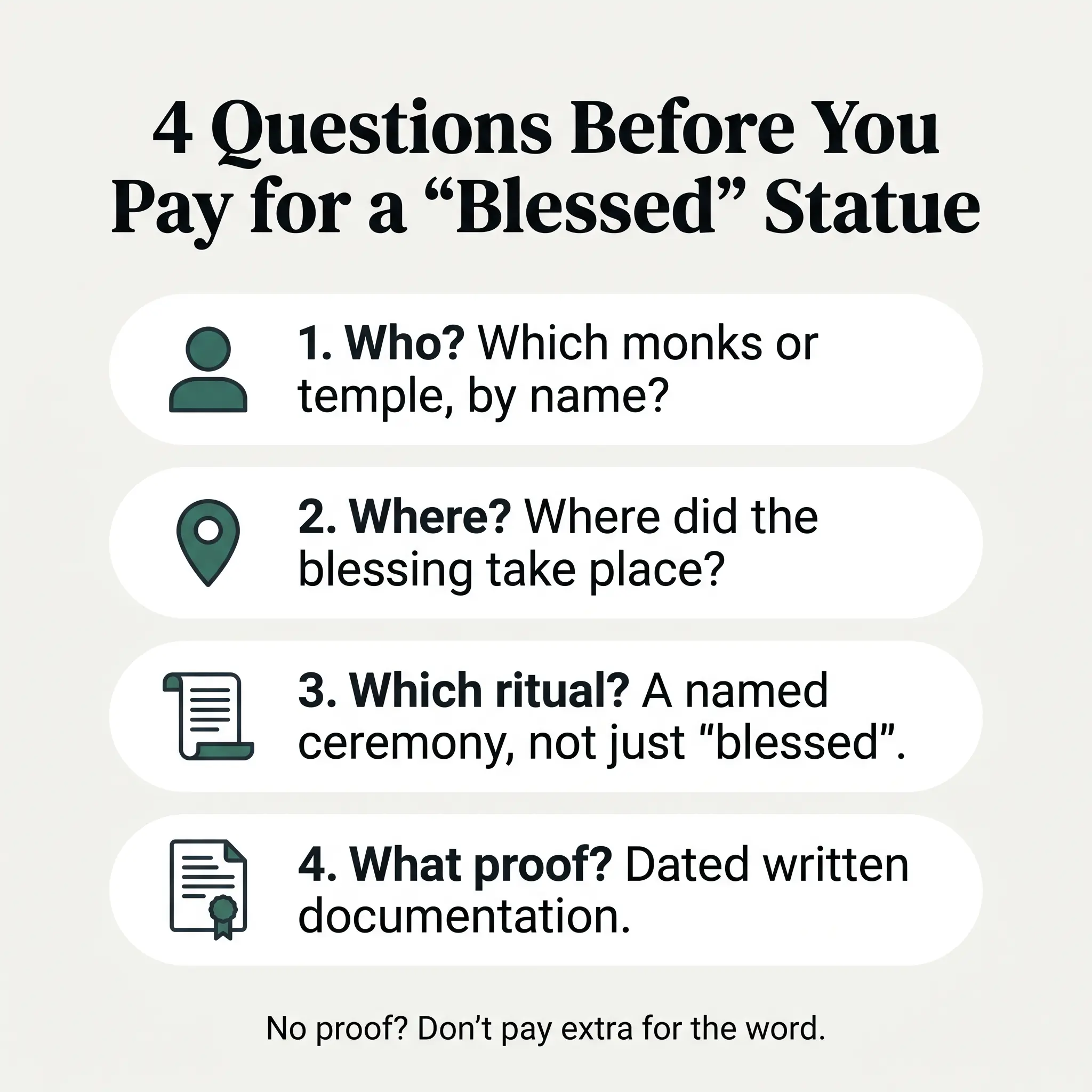
Ask four questions to test the authenticity of any blessing claim.
- Who: the monks or temple, named.
- Where: the monastery or hall where it took place.
- Which ritual: a named ceremony, not just “blessed.”
- What proof: a date and written documentation that ships with the statue.
If a seller cannot answer, the statue can still be a good purchase. You just should not pay extra for the word.
See what a monk-blessed, solid copper Guanyin looks like up close: the solid copper Royal Ease Guanyin sculpture ($388.95) stands 8.9 inches tall and weighs 2.16 lb.
How Do You Choose Your First Buddha Statue With Intention?
Start with the intention, then the figure, then the size, in that order.
- Name your intention. Calm, compassion, or focus.
- Pick the figure. Seated Shakyamuni for calm, Guanyin for compassion, a silence-gesture bust for quiet focus.
- Check the size. 8 to 9 inches (20 to 23 cm) fits most shelves and desks.
- Set the material and budget. Prices here run from $96.95 to $388.95.
Which figure matches your intention: calm, compassion, or focus?
Match calm to a seated Shakyamuni, compassion to Guanyin, and quiet focus to a figure with a silence gesture. Guanyin, also written Kuan Yin, is the bodhisattva of compassion. Each figure’s hand position is a mudra, a symbolic gesture, so check what it signals before you buy.
The Qingsha stone Quiet Sakyamuni statue with silence gesture is a bronze-tone bust ($195.95, regularly $250.95). Its understated look suits a secular household, which eases the worry that your living room will seem too religious.
The Royal Ease Guanyin is solid copper, 8.9 inches (22.6 cm) tall, and weighs 2.16 lb. That weight keeps it steady on a shelf, so you worry less about it tipping when someone brushes past.
What size and material fit a typical American shelf or desk?
An 8 to 9 inch (20 to 23 cm) figure fits most bookshelves, desks, and mantels. It is about the height of a hardcover novel. Larger statues need their own stand and a clear wall, which adds cost and decisions to a first purchase.
- Solid copper: heavy and steady, with a metal feel.
- Qingsha stone: a stone bust with a bronze-tone finish.
- Sandstone: textured, with room for a tealight.
- Cold-cast resin: light and often cheaper, so check the stability of the base.
By budget: under $100 is the sandstone tealight Buddha ($96.95). From $150 to $300 are the Quiet Sakyamuni ($195.95) and the aged copper meditating Buddha ($298.95). Above $300 is the Royal Ease Guanyin ($388.95). U.S. orders ship free, usually in 5 to 10 business days, with 60-day returns, so you can see the figure on your own shelf before you commit.
Browse handmade Buddha and Guanyin statues in copper and Qingsha stone to compare them side by side.
When we assess a figure, we look at the face first. A calm, even expression and balanced proportions matter more than ornament. The Shaolin Temple in Dengfeng, Henan, belongs to UNESCO’s 2010 World Heritage listing and is widely known as a center of Chan (Zen) Buddhism. We are a retailer, and that listing covers the temple’s historic monuments, not our products.
A statue will not fix a stressful season. It gives your eyes a place to pause.
Frequently Asked Questions
No. Many people display unblessed statues respectfully, and tradition does not treat an unblessed statue as unlucky. If a blessing matters to you, ask a monastery or temple directly about its consecration terms and timing.
Stay calm, because a broken statue is not an omen. Wrap the pieces in a clean cloth or paper. Then offer them to a local temple, or dispose of them respectfully and separately from household trash.
Yes. If a statue no longer fits your home, passing it to a temple, a practitioner, or a friend who will value it is a respectful route. Moving it on does not break any rule.
Generally yes, if it sits on a clean, elevated surface such as a dresser or shelf, not on the floor. Many people keep a small meditation corner in the bedroom for exactly this reason.
In summary: you can buy a Buddha statue for yourself, and intention matters more than how it arrived. Three habits do most of the work.
- Buy it with a reason you can state in one sentence.
- Place it at least 3 feet (90 cm) above the floor, away from bathrooms, kitchens, and shoes.
- Ask for documentation before you pay extra for a blessing.
Find a statue you will treat with intention
Whether you buy a Buddha statue for yourself or give one to someone you love, ShaoLin Store’s handmade figures ship free in the U.S., and you have 60 days to return one.Shop handmade statues
Important note: This article shares cultural and traditional perspectives for general education. It is not religious instruction, and practices vary by lineage and teacher. Beliefs about blessings and luck are traditional views, not scientific claims.
References
- When Is a Buddha Statue Appropriate or Offensive? Vanessa Zuisei Goddard on context and respect when displaying Buddha images. Tricycle: The Buddhist Review
- Historic Monuments of Dengfeng in “The Centre of Heaven and Earth.” The 2010 UNESCO World Heritage listing that includes the Shaolin Temple area. UNESCO World Heritage Centre
- Giving Buddhist Statue as a Gift – Good or Bad? M D P Dissanayake, 06/10/2019. A first-person account of the folk belief, used here as cultural evidence, not as doctrinal authority. LankaWeb
- Statue consecration practices. Namgyal Monastery’s page on blessing and consecrating statues, and the Gyuto Foundation’s annual statue consecration page. Terms change, so confirm directly. Namgyal Monastery and Gyuto Foundation