
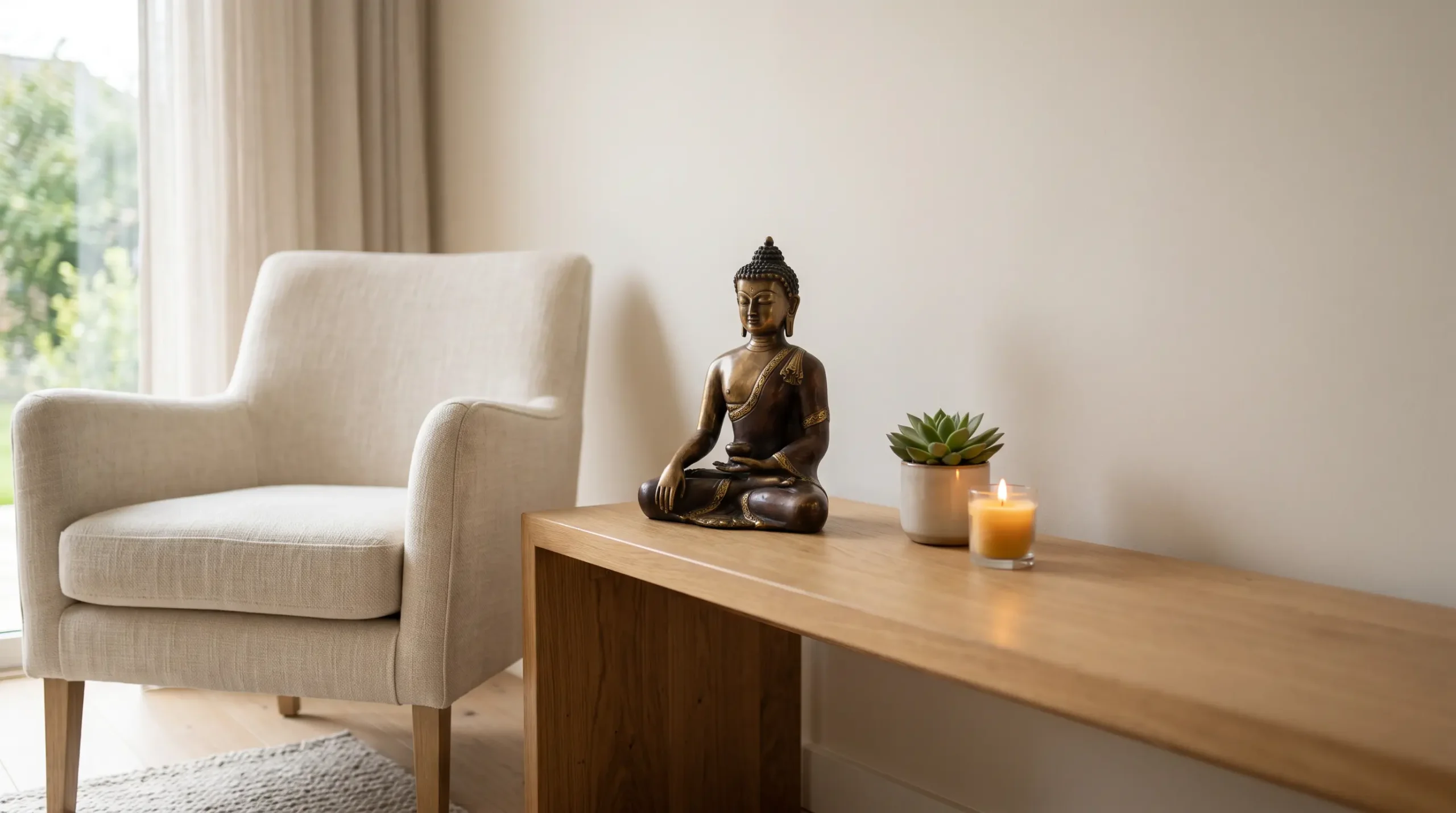
You brought a Buddha statue home, and now you worry about putting it in the wrong spot. At ShaoLinStore, we hear this question every week.
Here is the short answer on where to place a Buddha statue at home. Put it on a clean, raised surface, with its face at or above your seated eye level. Face it into the room. Never place it on the floor or in a bathroom.
Below are 9 do’s and don’ts, a room-by-room guide, and a quick check you can finish in 60 seconds. We also point out the few rules where traditions disagree, and how to choose.
Why Does Buddha Statue Placement Matter?
Placement matters because height and cleanliness show respect for what the statue represents. A Buddha statue is an image of Siddhartha Gautama, the founder of Buddhism. In many Asian cultures, it reminds people of awakening and compassion.
Where you put it sends a message. A high, tidy shelf says “I value this.” A spot near shoes or trash says the opposite. In many Asian cultures, the head is seen as high and the feet as low. That is why floor level feels wrong to many people.
Three systems shape the advice you will read online. Each one gives you a different kind of rule.
| System | What it is | What it tells you |
|---|---|---|
| Buddhist etiquette | Customs of respect in Buddhist cultures | Height, cleanliness, no disrespectful use |
| Feng shui | Chinese practice of arranging spaces to guide chi (life energy) | Entrance views, wealth corners, room choice |
| Vastu Shastra | Traditional Indian system of directions for buildings | East and northeast facing, rooms to avoid |
The most important thing to remember is that etiquette sets the non-negotiables. Feng shui and Vastu add direction and room preferences. Their claims about energy and luck are traditional beliefs, not proven effects.
One Thai Buddhist advocacy group, the Knowing Buddha Organization, teaches that statues belong on a high shelf and not as decoration. Its stance is strict, and not every Buddhist tradition shares it. Still, it shows how seriously many people take this topic.
Where Is the Best Place to Put a Buddha Statue at Home?
The best place to put a Buddha statue at home is a clean, stable shelf or console in a calm room. The living room and a meditation corner are the most common choices. The statue’s face should sit at or above seated eye level, facing into the room.
If you would not meditate or relax in that spot, do not put your Buddha statue there.
| Question | Quick answer |
|---|---|
| Where? | Living room, meditation corner, study or tidy entryway |
| How high? | Face at or above seated eye level; never below waist level |
| Which way? | Into the room: toward the entrance or east |
| Avoid | Floors, bathrooms, laundry rooms, shoe racks, under stairs |
9 Do’s and Don’ts of Buddha Statue Placement at Home
Rules 1 to 5 tell you what to do. Rules 6 to 9 tell you what to avoid. Together they cover every Buddha statue placement mistake we see most often.
Do #1: How High Should You Place a Buddha Statue?
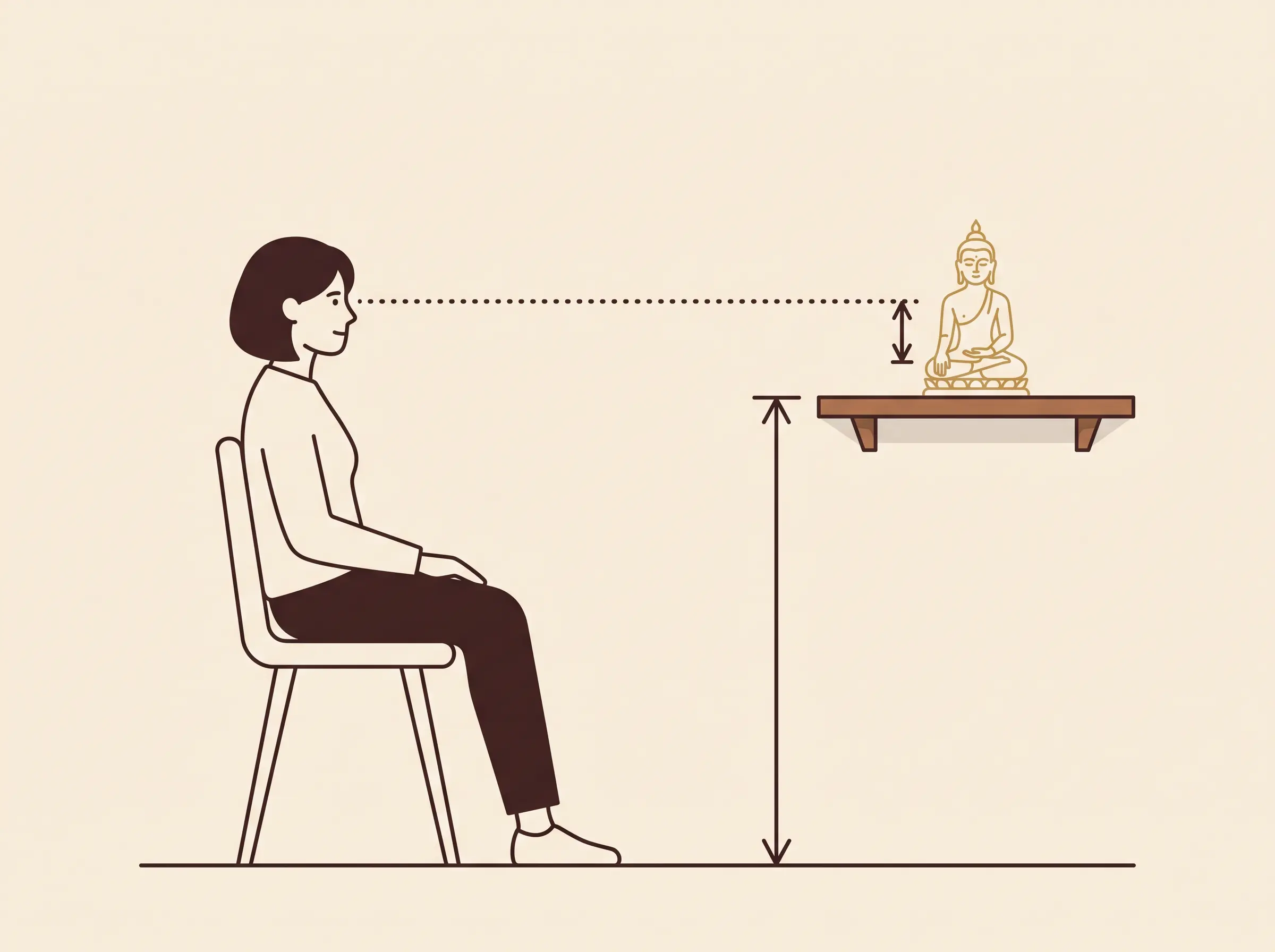
Place your Buddha statue so its face sits at or just above your seated eye level. In most homes, that means a shelf or console about 70 to 120 cm (28 to 47 inches) high. The absolute minimum is above waist level.
Use this simple method. Sit where you will look at the statue most often. Measure from the floor to your eyes. Then subtract the height from the statue’s base to its face. The answer is your ideal shelf height.
For example, say your seated eye level is 110 cm, and the statue’s face sits 20 cm above its base. Your shelf should be about 90 cm high. Feng shui guides often suggest about 30 inches (80 cm) for a front-door table. Both numbers fit the same rule: up high, never low.
Do #2: Which Rooms Are Best for a Buddha Statue?
Choose a calm, clean room such as the living room, a meditation corner, a study, or a tidy entryway. These are spaces where you would happily sit and reflect. A meditation corner is a quiet spot set aside for sitting practice, and it is the top choice.
| Room | Suitability | Good statue style |
|---|---|---|
| Meditation corner | Highest | Meditating (Dhyana) |
| Living room | High | Meditating or Laughing Buddha |
| Study or home office | High | Teaching Buddha |
| Entryway | High, if raised and tidy | Protection (Abhaya) |
In an entryway, keep the statue well above the level of shoes and bags. A console table works well.
Living with roommates or family? Talk about the spot first. A shared living room is usually the easiest compromise. It keeps the statue out of private sleeping areas, and everyone can respect it. If guests often sit on the floor, make sure the statue stays above their heads when they sit.
Do #3: Which Direction Should a Buddha Statue Face?
A Buddha statue should face into the room, ideally east or toward the main entrance. It should never face a wall. Sources disagree on the exact direction, so the table below shows who recommends what.
| System | Recommended facing | Reason given |
|---|---|---|
| Buddhist convention | East, into the room | Sunrise, linked to awakening |
| Vastu Shastra | East or northeast | Considered an auspicious corner |
| Feng shui | Toward the main entrance, facing inward | Greets incoming chi |
A few sources suggest south or warn against north, but these are minority views. Here’s what you need to know: use a three-step rule. If you follow Vastu, face east or northeast. If you follow feng shui, face the entrance. If you follow neither, face the spot where you usually sit.
To find east, open the compass app on your phone while standing where the statue will sit. Turn until the needle points to 90 degrees. Then check that the statue can face that way without looking at a wall, a mirror, or a bathroom door. If east is not possible, choose a view into the room. A respectful angle beats a perfect compass bearing.
Do #4: Which Buddha Statue Type Goes Where?
Match the statue’s pose to the room. A mudra is a symbolic hand gesture in Buddhist art, and each one carries a meaning. For example, the Met Museum notes that the raised-hand abhaya mudra signals reassurance.
| Statue or mudra | Meaning | Best placement |
|---|---|---|
| Abhaya (raised palm) | Protection, fearlessness | Entryway, facing the door |
| Dhyana (hands in lap) | Meditation | Meditation corner |
| Bhumisparsha (earth-touching) | Awakening, grounding | Facing east; garden |
| Vitarka (teaching) | Sharing the teachings | Study or home office |
| Reclining Buddha | Final passing | Quiet corner; often faced west |
One gifting note: a reclining Buddha shows the Buddha’s passing. Some people avoid giving it as a housewarming present for that reason.
Do #5: What Should Surround a Buddha Statue?
Give the statue its own clean surface, with a plain wall behind it and open space around it. A simple starter altar uses just 3 items: the statue, a small water bowl, and one candle. Skip clutter and keep the look calm.
Keep it away from air vents, heaters, and harsh afternoon sun. Direct sun can fade finishes and warp wood. Dust it weekly with a soft cloth.
Match your care to the material. Wipe bronze with a dry, soft cloth, and avoid harsh polish. Dust wood gently, and keep it away from damp walls. Brush stone lightly, and wipe it with a barely damp cloth. Clean the statue, not just the shelf, because care is part of respect.
Don’t #6: Can You Put a Buddha Statue on the Floor?
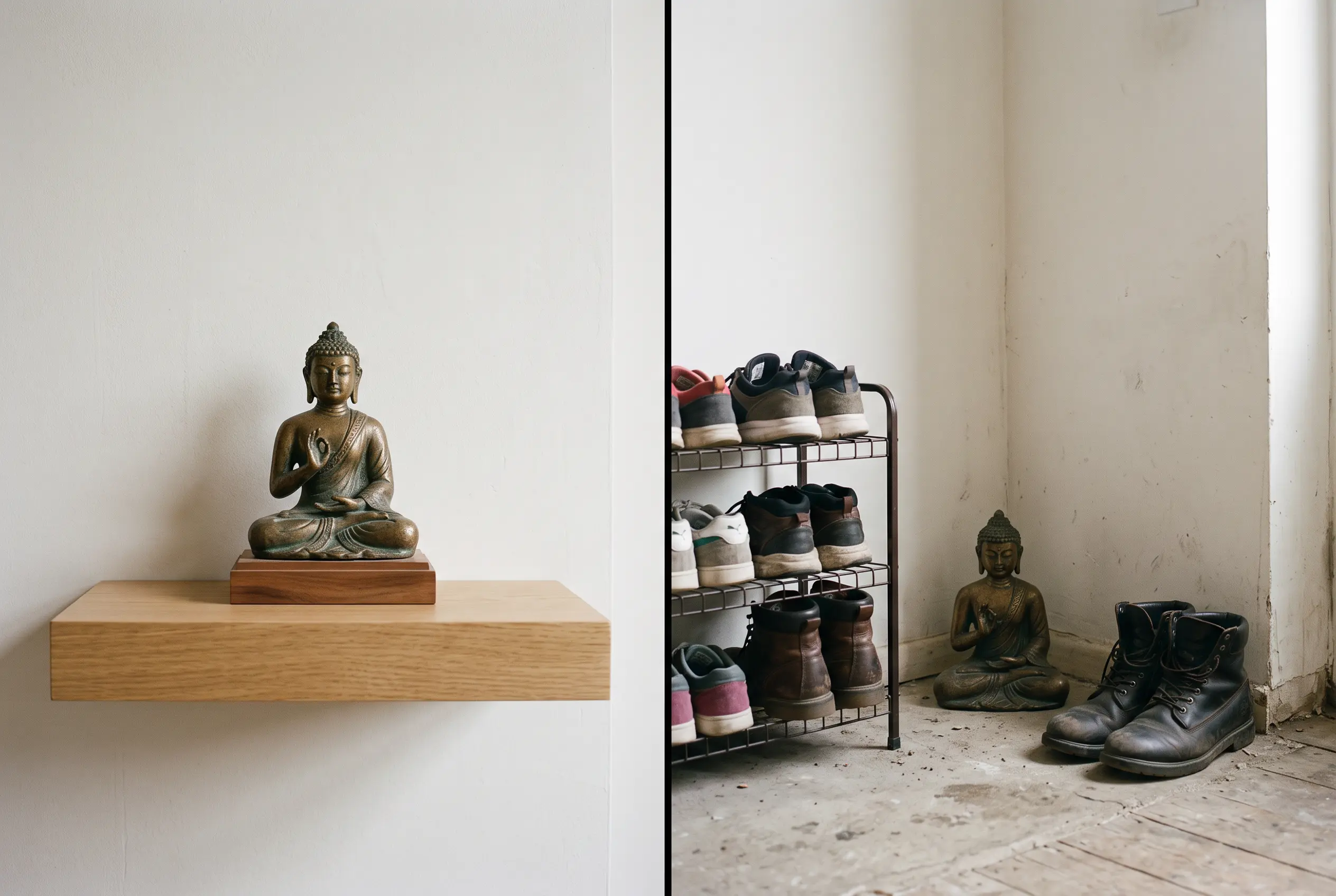
No. Placing a Buddha statue on the floor is the most widely cited mistake. Floor level is linked to feet, which many Buddhist cultures see as the lowest and least respectful part of the body.
There is also a practical reason. A statue on the floor can be kicked, splashed, or knocked by pets. Chipped bronze or stone is costly to repair. Also avoid spots beside a shoe rack or under a staircase.
Have a large statue that needs a base? Use a low plinth of about 10 to 30 cm, not bare floor.
Don’t #7: Where Should You Never Put a Buddha Statue?
Never put a Buddha statue in a bathroom, laundry room, storeroom or garage. These rooms are linked with waste and dirt. Avoid any wall that is shared with a toilet, too.
| Location | Advice |
|---|---|
| Bathroom or toilet | Always avoid |
| Laundry, storeroom, garage | Avoid |
| Kitchen | Mostly avoid; a few sources allow a high shelf far from the stove and sink |
| Wall shared with a toilet | Avoid (check the other side before mounting a shelf) |
Don’t #8: Can a Buddha Statue Go in the Bedroom?
Yes, but only if it sits on a clean, raised dresser or shelf and does not face the bed. Strict Vastu and some feng shui sources still advise against bedrooms. Other guides accept them when the setup is respectful.
Never place it above the bed, at the foot of the bed, or on the floor. In a studio apartment, try a wall shelf in a corner. Position it so your feet do not point at the statue when you lie down.
Don’t #9: Is It Disrespectful to Use a Buddha Statue as Decor?
Owning a Buddha statue as a non-Buddhist is generally fine. Using it as a prop is not. Bar carts, spots below a TV, bookends, and novelty displays are widely seen as disrespectful.
Scholars at the University of Edinburgh have noted how Buddha images get bought as ornaments, like garden gnomes. They also note that using them in places such as bars can be considered problematic. A good test: would you place a cherished family photo that way? If not, reconsider.
Be careful with Buddha heads too. These sculptures were once attached to full bodies, and many came from looted sites. A 2013 Bangkok Post legal report says Thailand bans exporting parts of Buddha images, such as heads, hands and feet. Rules may have changed since, so check current law before buying. A full figure is the safer choice. If you own a head, raise it and keep it in a dignified place.
In summary, rules 1 to 5 build respect through height, direction and care. Rules 6 to 9 protect it by avoiding low, dirty, or careless spots.
How to Place a Buddha Statue in Each Room

Where to place a Buddha statue depends on the room. Use a console above shoe level in the entryway. Use a shelf facing the seating in the living room. Use an eye-level altar in a meditation corner. Use a raised plinth in the garden.
| Space | Placement | Common size | Facing |
|---|---|---|---|
| Entryway | Console above shoe and bag level | 10–18 in | Door, facing inward |
| Living room | Shelf or mantel with open space | Medium | Seating area or east |
| Meditation corner | Altar at seated eye level | 6–14 in | Your cushion |
| Home office | Desk-side shelf, not on electronics | 4–12 in | Your chair |
| Small apartment | Wall-mounted shelf | 6–10 in | Into the room |
| Garden | Plinth 12–30 in high | Stone or bronze | House or east |
The sizes above are common guidance from statue retailers, not fixed rules. Pick a statue that fits your shelf without crowding it.
For the garden, never set a statue on bare soil. Keep it away from bins, compost and utility areas. Seal porous stone so rain does not stain it.
A good garden spot is a quiet corner with a plain backdrop, such as a hedge or a fence. Surround the base with a few plants or a gravel bed. Check the statue after storms. Moss and mud build up fast at ground level, so a raised plinth also keeps the base clean and dry.
Not sure what size suits your shelf? At ShaoLinStore, you can browse Buddha statues by height and pose, so the piece fits the spot you have already chosen.
Is Laughing Buddha Placement Different From Buddha Statue Placement?
Partly. The Laughing Buddha is Budai (called Hotei in Japan), a Chinese monk said to have lived around the 10th century. He is not the historical Buddha. Budai means “cloth sack,” after the bag he carried.
| Figure | Who he is | Typical placement belief |
|---|---|---|
| Shakyamuni Buddha | Historical Buddha, born in India | Raised, calm spot; east or entrance |
| Laughing Buddha (Budai) | Chinese monk, often linked to Maitreya, the future Buddha | Southeast corner for wealth; east for family harmony |
Many Vastu pages mix the two figures, which causes confusion. The respect rules still apply to both: raised, clean, and never on the floor or in a bathroom.
Sources disagree on whether the Laughing Buddha should face the door. Our suggestion is to face him inward, with a clear view of the door. Also, the belief that buying a statue for yourself brings bad luck is a folk idea, not a Buddhist teaching.
How Can You Check Your Buddha Statue Placement in 60 Seconds?
Run this 6-point check. If every row passes, your placement is respectful by every tradition covered in this guide.
Use it again whenever something changes. Moving house, rearranging furniture, or adding a TV can quietly break a rule. If you need to move the statue, lift it with both hands and carry it upright. Set it down gently on its new, clean spot, and wipe the shelf first.
| Check | Pass condition |
|---|---|
| Height | Face at or above seated eye level; never below waist |
| Surface | Stable, with the whole base supported |
| Facing | Into the room, not a wall, mirror or bathroom door |
| Surroundings | No shoes, trash, alcohol or clutter nearby |
| Wall behind | Plain wall; no toilet on the other side |
| Environment | No harsh sun, vents or damp |
Bottom line: height, cleanliness and a calm setting matter more than any single compass direction.
❓ Frequently Asked Questions
Face it into the room, ideally east (favored by Vastu and many Buddhist homes) or toward the main entrance (favored by feng shui). Never face it toward a wall, mirror or bathroom door.
No. The idea that a statue must be a gift is a folk superstition, not a Buddhist teaching. What matters is how you place and treat it.
Yes, if you treat it as a sacred image and not a novelty. Keep it raised and clean, and away from floors, bathrooms and bars.
In feng shui, facing the main entrance from inside the home is a classic placement. Keep the statue raised and facing inward, and keep the spot free of shoes and bags.
Yes. Raise it on a plinth about 12 to 30 inches high, face it toward the house or east, and keep it away from bins, compost and utility areas.
The Bottom Line on Buddha Statue Placement at Home
Wherever you place a Buddha statue at home, remember three things. Raise it, keep it clean, and give it a calm spot with a clear view into the room. Direction is a bonus, and you can choose east or the entrance based on the tradition you follow.
Ready to choose a statue that fits your space? Explore the ShaoLinStore collection, and use the 60-second check above once your piece is in place.
📚 References
- Laughing Buddha (Budai): Explains who Budai is, his link to Maitreya, and why Westerners often mistake him for the Buddha. Wikipedia: Budai
- Mudras in Buddhist art: A museum record explaining how mudras are used in meditation and to read the meaning of Buddhist images. The Metropolitan Museum of Art: Scroll of Mudras
- Buddha images as ornaments: A university teaching blog on how Buddha images are used as decor and why some uses are seen as problematic. University of Edinburgh: Teaching Buddhism
- Buddha heads as home decor: A fellowship project on Buddhist sculptural fragments and mass-produced Buddha heads in home decor. John Simon Guggenheim Memorial Foundation: Gregory P. A. Levine
- Exporting Buddha images from Thailand: A 2013 legal summary of Thai export permits and the ban on exporting Buddha image parts. Bangkok Post: Exporting Buddha