
Thanksgiving is the one day set aside for gratitude, and it is often the day with the least quiet time to feel it. A gratitude meditation fixes that in five minutes: one minute to settle your breath, three minutes to name specific things you appreciate, and one minute to close.
This guide gives you the timed sequence for Thursday, 11/26/2026, a 60-second version for the dinner table, and a plain summary of what research suggests this gratitude practice can and cannot do. If mindfulness is new to you, you can start today with no equipment.
At ShaoLin Store, we write our meditation guides to stay close to the published research. You will see which claims have studies behind them and which come from tradition.
Important note: This article offers general well-being information and is not a substitute for professional mental health care. Research findings are described as suggestive, not as proof of treatment effects. If you are in crisis, call or text 988 in the U.S.
What Is Gratitude Meditation?
Gratitude meditation is a short, focused practice in which you rest your attention on specific people, moments, and things you appreciate, and let yourself feel that appreciation rather than just list it. Unlike a gratitude journal, it happens in your breath and body, and five minutes is enough to start.
Gratitude is the recognition that something good in your life came, at least in part, from outside yourself. In meditation, you hold that recognition steady for a few minutes while you breathe. The word that matters is specific: a named moment gives your attention something to hold.
How Is It Different from a Gratitude Journal?
A gratitude journal records appreciation in writing, while gratitude meditation holds it in silent attention. Both can use the same prompts. Writing leaves a record you can reread later.
Meditation asks you to stay with one image long enough to feel it. Many people combine the two by meditating for five minutes and then writing a single line.
How Is It Different from Mindfulness Meditation?
Mindfulness is the practice of noticing what is happening in the present moment without judging it. Gratitude meditation narrows that attention to one direction: what you appreciate. The breath stays the anchor in both.
A mindfulness session might follow thoughts as they pass. A gratitude session returns, again and again, to a chosen person or moment.
Does a Thankfulness Practice Really Work? What Research Suggests
Research suggests that regularly focusing on what you are grateful for may lift well-being, but most studies tested weeks of repeated practice, not a single five-minute session. Two published studies shape this guide. Both appear in the References below.
What the 2003 “Counting Blessings” Studies Found
Robert A. Emmons (University of California, Davis) and Michael E. McCullough (University of Miami) reported three studies in the Journal of Personality and Social Psychology in 2003. In Studies 1 and 2, participants were randomly assigned to gratitude listing, a hassles condition, or a neutral or social comparison condition. They kept weekly or daily records of mood and health behaviors.
Study 3 randomly assigned people with neuromuscular disease to a gratitude condition or a control. The gratitude groups showed higher well-being on several, though not all, measures. The effect on positive affect was the most robust finding. The authors suggested that deliberately noticing blessings may help both mood and relationships.
How Often People Practiced in the Studies
A 2015 trial by Karen O’Leary and Samantha Dockray at University College Cork is the closest match to a short, regular habit. It randomly assigned 65 women aged 18 to 46 to a wait-list control, a gratitude condition, or a mindfulness condition. Both active conditions ran four times a week for 3 weeks.
The gratitude condition used a gratitude diary and a grateful reflection. Outcome measures, which included stress, depression, and happiness, improved over time in both active groups but not in the wait-list group. The authors called for further research. Four short sessions a week is the frequency worth copying.
What the Evidence Does Not Show
Neither study tested a single five-minute meditation, and neither shows that gratitude practice treats depression or anxiety. The 2015 sample was 65 women, so the findings may not apply to everyone.
Treat the five-minute practice as a low-cost habit that resembles what researchers studied, not as a treatment. If low mood, stress, or sleep problems last, talk with a licensed professional.
How to Do a 5-Minute Gratitude Meditation
- Sit and start the timer (10 seconds). Sit upright with your feet flat and your hands resting on your knees, then start a 5-minute timer with a soft chime.
- Settle your breath (50 seconds). Breathe in through your nose for about 4 counts and out for about 6, letting your shoulders drop with each exhale.
- Name your first specific thing (1 minute). Choose one concrete moment from the past 24 hours and picture it in detail.
- Name two more, including one person (2 minutes). Picture the person’s face and silently say thank you, then add one small thing you can see or hear right now.
- Close with one breath and one intention (1 minute). Take one slow breath, then set a one-line intention for the rest of the day.
Slow breathing gives a gratitude meditation its steady rhythm, so return to your breath whenever your attention drifts.
The 1-3-1 Timeline, Step by Step
The 1-3-1 timeline divides five minutes into one minute of settling, three minutes of naming, and one minute of closing. Three minutes leaves about a minute per item. That is long enough to picture each one and notice how it feels, instead of rushing to the next.
What If Your Mind Goes Blank?
A blank mind is a common stall point, and it usually means the prompt is too big. That happens to many beginners, and it does not mean you are doing it wrong.
Shrink the prompt to your five senses. Name one thing you can see, hear, touch, taste, or smell that you are glad to have right now, such as the warmth of a mug or the sound of someone laughing in the next room. If nothing comes, stay with your breath until the timer ends. The attempt still counts.
Optional Anchor: Counting a 27-Bead Round
A mala is a loop of prayer beads, traditionally 108 in total, used to count breaths or repetitions during meditation. One quarter of a 108-bead mala is 27 beads.
If you own one, roll one bead between your thumb and finger with each slow breath in the settling step. The touch gives your attention a physical rhythm. Stop when the timer says to; the rhythm matters more than the count.
When Is the Best Time to Practice? A Thanksgiving Week Schedule
The best time is the one you can protect: on 11/26/2026, that usually means five minutes before the kitchen gets busy, or one minute at the table before the meal.
| When | Version | Length | What to do |
|---|---|---|---|
| Thursday 11/26/2026, morning | Full 1-3-1 | 5 minutes | Practice before cooking, hosting, or travel begins. |
| Thursday 11/26/2026, before dinner | Table pause | 60 seconds | Take one breath together, then each person names one specific thing. |
| Friday 11/27/2026 (Black Friday) or a travel day | Breath-first | 2 minutes | Spend 1 minute settling and 1 minute naming one thing. Never practice while driving. |
| The weeks after Thanksgiving | Full 1-3-1 | 5 minutes, 4 times a week | Repeat through mid-December to match the frequency in the 2015 trial. |
Thanksgiving Morning (11/26/2026)
Thanksgiving morning is the best slot for the full practice because nobody has asked you for anything yet. A five-minute pause before the day starts lets you carry one specific image of gratitude into everything that follows. Set the timer, sit somewhere you will not be interrupted, and follow the five steps above.
A 60-Second Version for the Dinner Table
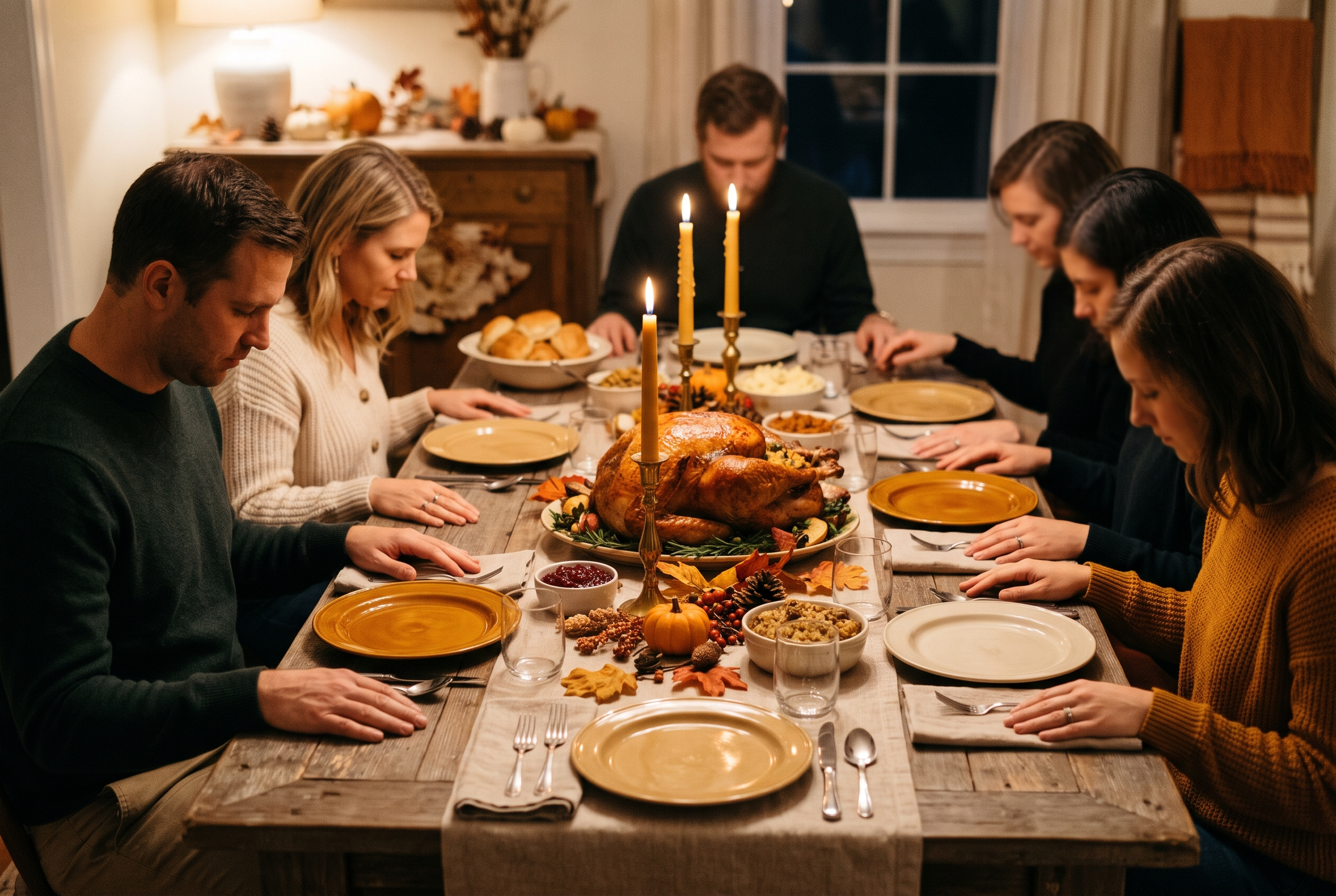
The dinner-table version takes 60 seconds and replaces the usual round of quick thank-yous with one slow breath and one specific answer per person. Ask everyone to put down their forks and breathe once together. Then each person names one specific thing from this year, in one sentence. Concrete answers land better than general ones.
When Holiday Stress Peaks
If the holiday feels heavy this year, do only the settling step. Thanksgiving can bring up loss, tension, or old family patterns, and a gratitude practice does not need to override those feelings. A few quiet breaths still count.
If your distress feels unmanageable, call or text 988. SAMHSA describes the 988 Suicide & Crisis Lifeline as a national hotline offering one-on-one support, 24 hours a day, for mental health and related problems.
How to Set Up a Meditation Corner for the Holidays
A meditation corner needs only two things: one object that tells you it is time to pause, and a spot you will walk past every day. You can practice with nothing at all. The corner simply makes the daily habit easier to repeat after Thanksgiving. A cushion or chair, a candle or incense, and a singing bowl are optional extras.
Choose One Visual Focal Point
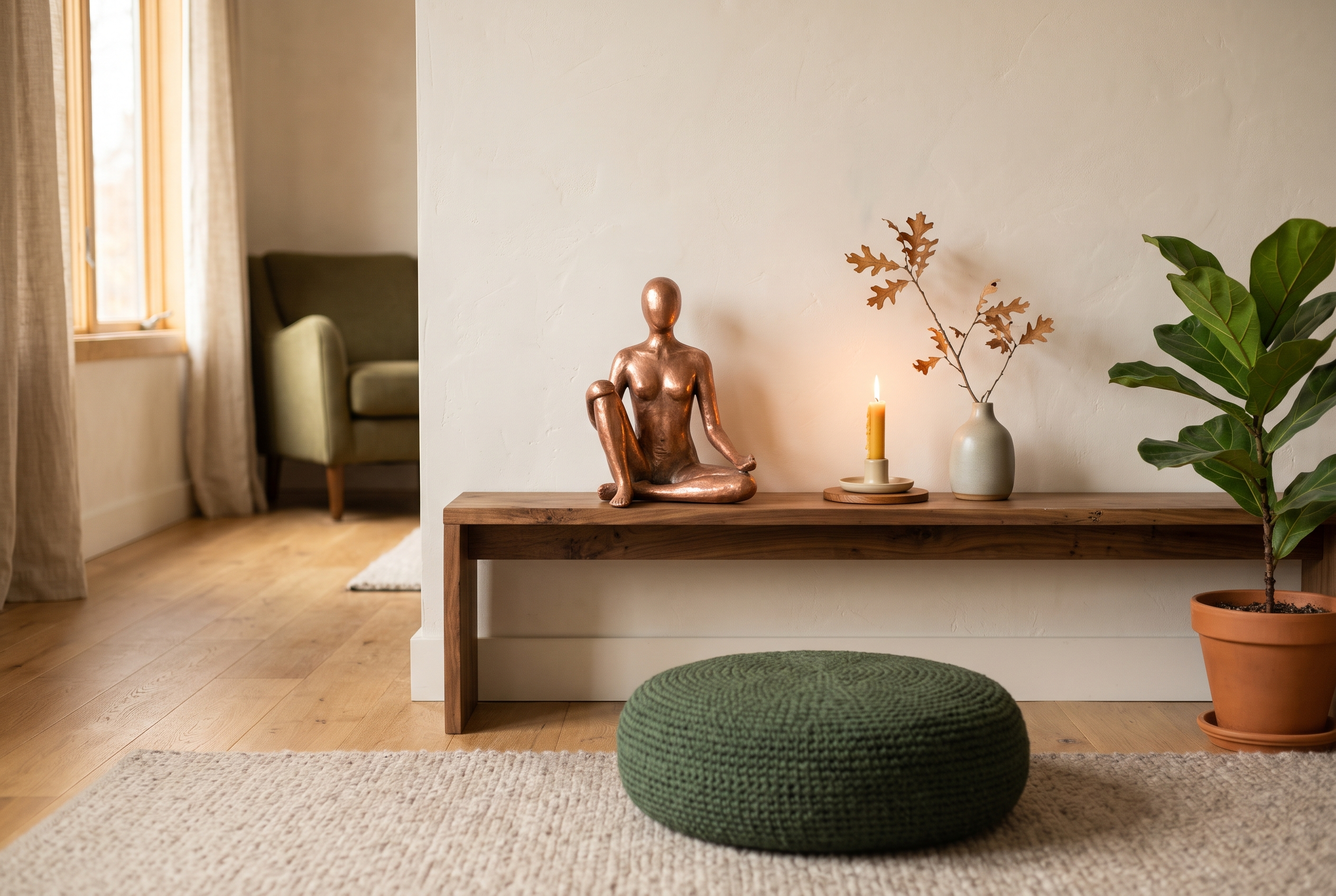
The Royal Ease Guanyin statue in solid copper from ShaoLin Store stands 8.9 in (22.6 cm) tall and weighs 2.16 lb (980 g). It was listed at $388.95 at the time of writing. That size fits a shelf or desk, so the statue sits where you will see it each day and cues you to start your five minutes.
The pose is called royal ease: one leg raised and one arm resting casually. The Princeton University Art Museum notes that this flexible posture became associated with Guanyin in China by the late ninth century. For a gratitude meditation, it works as a visual reminder to stay relaxed and upright at the same time. The product page suggests placing the statue at least about 3 ft (90 cm) off the floor.
Tip: Place your focal point at eye level when seated, so your gaze can rest on it during the settling step.
Add a Touch Cue You Can Carry
A touch cue is a small object you can turn or hold while you breathe. An adjustable sterling silver dragon ring, listed at $169.95, can play that role at the dinner table or on a trip, because turning it needs no setup and nobody has to notice. Its product page frames wearing it as a 30-second pause you can take anywhere.
Giving It as a Thanksgiving Gift: Order-By Dates
The Royal Ease statue page lists free shipping, an estimated 5 to 10 business days for U.S. delivery, and a 60-day return window. To stay inside that estimate before 11/26/2026, order by 11/10/2026. Delivery windows are estimates, so confirm the date at checkout.
Explore ShaoLin Store’s meditation essentials for a home practice if you want to build a corner before the holiday.
Frequently Asked Questions
Five minutes is a realistic starting point, and consistency matters more than length. The 2015 trial above used sessions four times a week for 3 weeks, so a short, regular habit is closer to what researchers tested than one long session.
Yes. The practice asks you to notice and name specific things you appreciate, which needs no prior training. Start with the 1-3-1 timeline and use a timer, so you do not have to watch the clock.
Research suggests gratitude practices may support well-being, but they are not a treatment for depression or anxiety disorders. If low mood persists or you feel unsafe, contact a licensed professional or call or text 988 in the U.S.
You need a quiet spot and a timer, nothing more. If you want a visual reminder to keep the habit going after Thanksgiving, browse the ShaoLin Store meditation collection and order by 11/10/2026 for delivery before the holiday.
In summary, a gratitude meditation fits inside five minutes when you split the time 1-3-1: settle, name three specific things, and close. Research suggests this kind of gratitude practice may support well-being when repeated through the weeks after Thanksgiving, though it is not a treatment. Start on 11/26/2026, keep the dinner-table version ready, and repeat it four times a week.
Build your meditation corner before Thanksgiving
Choose one focal point and one touch cue, then keep your five minutes. ShaoLin Store lists free U.S. shipping, with orders placed by 11/10/2026 estimated to arrive before the holiday.Shop meditation essentials
References
Research Studies
- Emmons, R. A., & McCullough, M. E. (2003). Counting blessings versus burdens. Three randomized studies of gratitude and well-being, Journal of Personality and Social Psychology, 84(2), 377-389. PubMed
- O’Leary, K., & Dockray, S. (2015). The effects of two novel gratitude and mindfulness interventions on well-being. A randomized trial with 65 women, Journal of Alternative and Complementary Medicine, 21(4), 243-245. University College Cork
Pages Cited for Posture and Support
- Royal ease posture in Chinese art: Museum catalog entry on a Guanyin seated in the royal-ease pose. Princeton University Art Museum
- 988 Suicide & Crisis Lifeline: Official frequently asked questions on call, text, and chat support. SAMHSA