He Xiang beads are handmade bracelet beads rolled from powdered aromatic woods, resins and herbs, and you wear them for scent instead of burning them. At ShaoLinStore, we get three questions about them again and again. Which is better, sandalwood or agarwood? Are the beads burned or worn? And is incense smoke bad for you? This guide answers all three in plain language, with research where it exists and honest gaps where it doesn’t.
What Are He Xiang Beads (Herbal Incense Bracelets)?
He Xiang beads (合香珠, He Xiang Zhu, “blended-fragrance beads”) are compound incense beads made from several aromatics ground, blended, rolled and dried. “He Xiang” means blended incense, the old Chinese art of mixing many aromatics into one scent. The beads belong to a family called Leng Ning Xiang (冷凝香, “cold condensation incense”), meaning fragrance that is set into a solid form and is not lit.
One honest footnote: the craft is old, but the label is new. Baidu Baike says the term “Leng Ning Xiang” was first proposed in 2012. The beads themselves have a much longer history.
A typical herbal incense bracelet uses beads about 0.8-1.0 cm across, per one maker’s specification. Sizes vary in practice, and many sellers offer 8-12 mm beads. The powder is held together with natural plant binders, and some makers knead it with honey.
The earliest known text reference comes from the San Dong Zhu Nang (三洞珠囊), a Daoist compilation usually attributed to the Tang-era Daoist Wang Xuanhe (around the 680s). It says to pound mixed aromatics, roll them into pills “the size of parasol-tree seeds,” and thread them on a blue-green cord. The passage survives because the Song-dynasty Chen’s Incense Manual (陈氏香谱) quoted it.
Here’s what you need to know: He Xiang beads are solid, wearable blends of woods, resins and herbs, threaded like a mala but valued for scent.
Is a “Herbal Bracelet” the Same as a He Xiang Bracelet?
No. At least three different products get sold as “herbal bracelets,” and only one is a true he xiang bead bracelet. The table below shows how they differ.
| Type | What it is made of | Where the scent comes from | Typical care |
|---|---|---|---|
| Botanical-cast herb charm bracelet | Bronze or silver cast from real herbs, using a method similar to lost-wax casting | None; it is a visual keepsake | Metal polish; water-tolerant |
| Essential-oil aromatherapy bracelet | Lava stone, wood or a felt/cotton pad | Added oil; makers usually suggest 1-2 drops per application | Re-apply oil every few hours to a day |
| He Xiang bracelet | Compressed beads of powdered herbs, woods and resins | The beads themselves, released slowly by warmth and touch | Keep dry; handle gently |
The key takeaway is that only the third type is the fragrance. The other two either carry no scent or borrow it from a bottle.
Are He Xiang Beads Burned or Worn?
He Xiang beads are worn or placed nearby, not burned. Their scent comes from the slow release of herbs and resins, which body warmth and friction speed up. To wake up the aroma, many makers suggest you rub the beads between your palms for 10-20 seconds.
He Xiang sticks are a separate product. They use similar blended powders, but they are made to be lit and burned briefly. So if a shop sells both, read the label carefully.
History adds a twist. The same San Dong Zhu Nang passage says these early beads could be burned so their fragrance “reached heaven.” Modern wearable herbal incense keeps the blending tradition but leaves out the flame.
The short answer is: wear them, rub them, enjoy them, but never light a bead.
Is Burning Incense Bad for You, and Do Worn He Xiang Beads Avoid the Problem?
Frequent, long-term incense burning in closed rooms is linked to respiratory risks, while occasional, well-ventilated use carries much lower risk. Worn beads avoid combustion smoke entirely, but nobody has studied their long-term wear. The sections below explain both sides.
What Is in Incense Smoke?
Incense smoke contains particles plus a mix of gases and organic compounds. A 2008 review in Clinical and Molecular Allergy lists the main ones:
- Gases: carbon monoxide, carbon dioxide, nitrogen dioxide and sulfur dioxide.
- VOCs (volatile organic compounds, chemicals that evaporate easily): benzene, toluene and xylenes.
- Aldehydes, such as formaldehyde.
- PAHs (polycyclic aromatic hydrocarbons, combustion by-products, some of them carcinogens).
The American Lung Association cites research showing 1 gram of incense can create about 45 milligrams of particulate matter, around four times more than a cigarette. The U.S. EPA lists incense alongside wood burning, candles and smoking as indoor combustion sources of particles.
What Do Long-Term Studies Say?
The biggest study links long-term, heavy incense use with certain respiratory cancers, but it cannot prove cause and effect. The Singapore Chinese Health Study followed 61,320 adults aged 45-74, recruited from 1993 to 1998 and tracked through 2005.
- Regular exposure almost doubled the risk of squamous cell carcinomas of the upper respiratory tract (nose, sinuses, mouth, tongue, larynx).
- Long-term users had a relative risk of 1.8 for squamous cell carcinoma across the whole respiratory tract, including the lung.
- There was no increase in overall lung cancer.
Children appear more vulnerable. A Taiwan study of 5,010 non-smoking students aged 14-16, published in Indoor Air in 2017, found lower lung-function measures among those with daily home incense exposure. A 2025 lab study in Archives of Environmental Contamination and Toxicology (April 2025) tested four incense types. It estimated the highest cancer risk for cone dhoop, at 5 in 100,000 people, and found 8-year-olds had higher deep-lung particle deposition than adults.
Bottom line: these are observational and modelling studies. They show associations, mostly from decades of frequent use, not proof that an occasional stick causes harm.
Who Should Avoid Burning Incense, and How Can Others Lower the Risk?
People who are pregnant or breastfeeding, and anyone with asthma or a known respiratory condition, should avoid burning incense. The American Lung Association names people with COPD, asthma and heart conditions as the highest-risk groups. Pets breathe the same air, so keep them out of rooms where incense burns.
If you still enjoy burning incense, these steps lower your exposure:
- Limit use — shorter sessions, fewer days per week.
- Choose carefully — the 2025 study found cone types scored worst of the four tested.
- Ventilate — open a window and burn near it, or run a HEPA air purifier (a filter that traps fine particles).
- Never leave it unattended, and never burn it while you sleep.
Does Wearing He Xiang Beads Avoid Smoke Exposure?
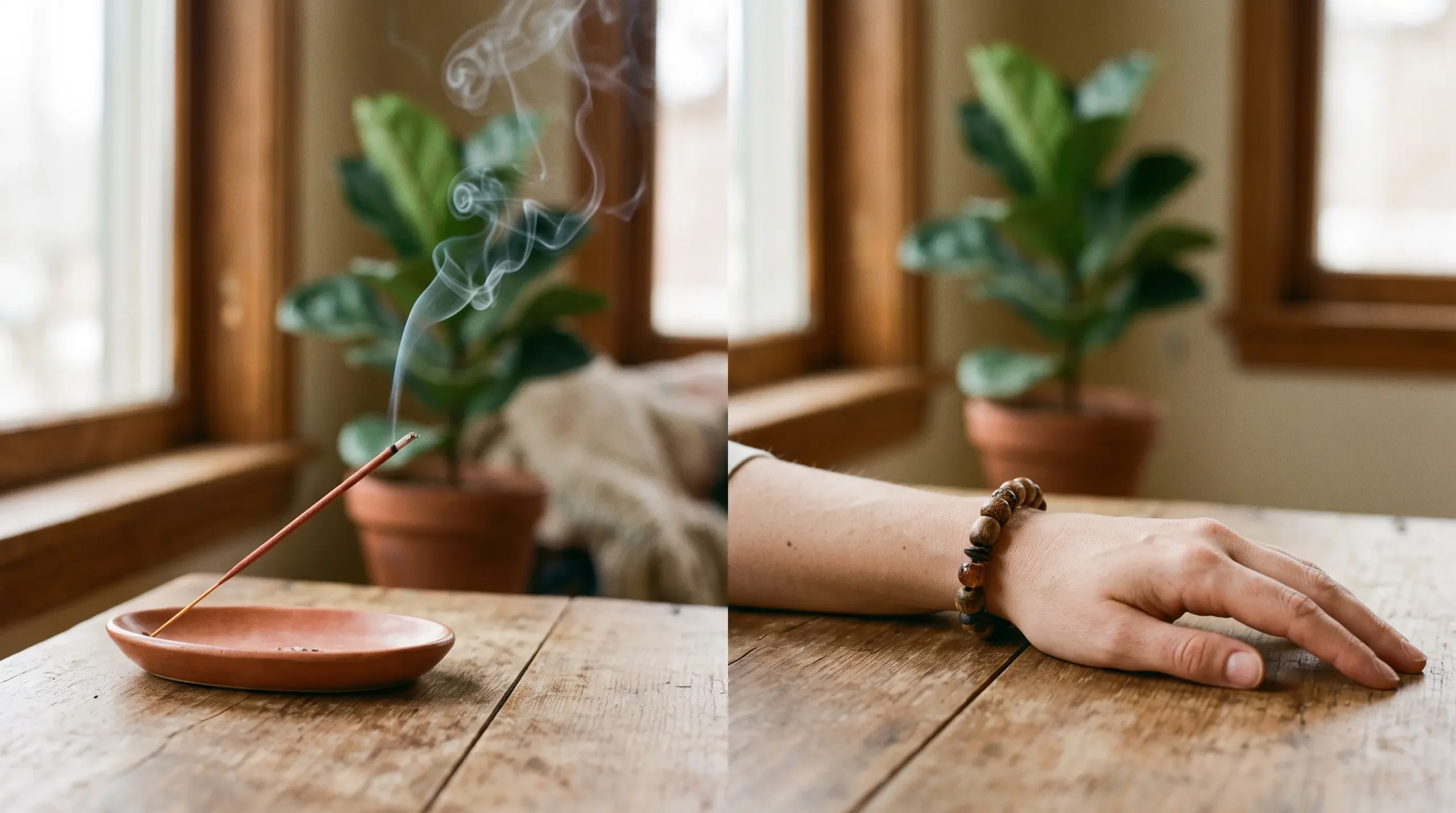
Yes for smoke, but that’s all we can say. Worn beads are never lit, so they produce zero combustion smoke, no PAHs from burning and no particle plume. That is a real, physical difference from burning sticks or cones.
However, we found no clinical safety studies on wearing herbal incense beads long term. Botanical ingredients such as clove, cinnamon-family spices or resins may irritate skin or trigger allergies in some people. Before regular wear, try a patch test: wear the bracelet for an hour or two and watch for redness or itching. If you are pregnant, have sensitive skin or have allergies, ask your doctor first.
To put it simply, beads remove the smoke problem, but they are not proven “safe” in a medical sense.
What Are He Xiang Beads Made Of?
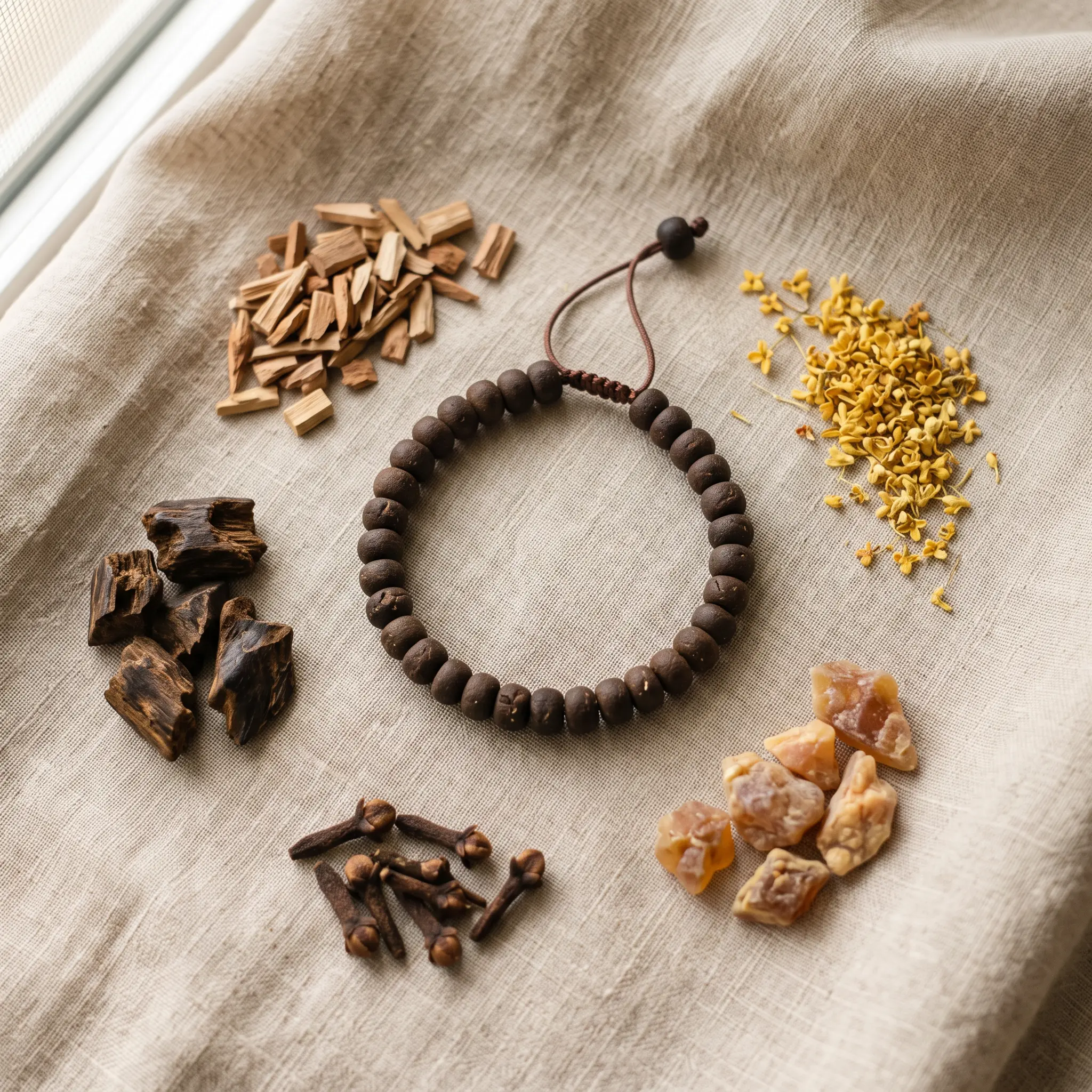
A classic he xiang bead blend combines 4 core aromatics: agarwood, sandalwood, benzoin and clove. Floral and herbal variants add osmanthus, jasmine, tangerine peel or mugwort for a lighter, fresher scent.
Makers balance these using Jun–Chen–Zuo–Shi (君臣佐使, “monarch-minister-assistant-envoy”). This borrowed herbal-formula logic gives each ingredient a role. The monarch sets the main scent, the minister supports it, the assistant rounds off rough edges, and the envoy ties everything together.
The handmade process usually follows 8 steps:
- Select and prepare raw materials.
- Grind them to fine powder (one heritage description cites 120 mesh or finer).
- Blend according to the formula.
- Knead and pound with a natural binder.
- Hand-shape each bead.
- Air-dry and cellar in shade.
- Polish the surface.
- String into a bracelet.
Drying times vary by maker. A 2026 Sina Finance report cites a traditional shade-drying period of 15-25 days, with no contact with water. Some makers also claim longer cellaring of roughly 6 months to 2 years; treat that as one maker’s account, not an industry standard.
Sandalwood vs Agarwood: Which Is Better for a He Xiang Bracelet?
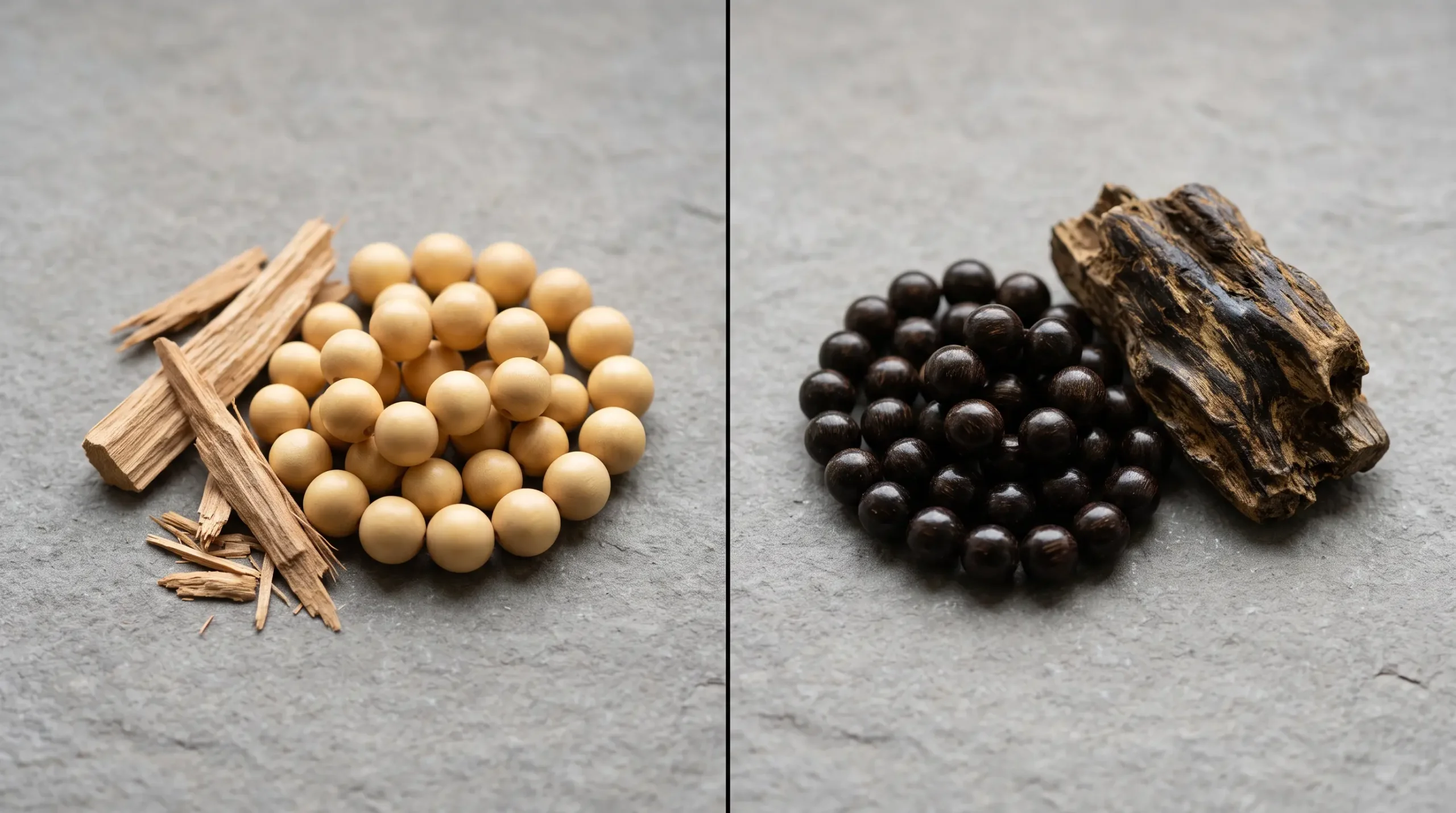
Neither is better overall: sandalwood suits daily wear and beginners, while agarwood suits strong-scent lovers and collectors. The table compares the two side by side.
| Attribute | Sandalwood | Agarwood (oud) |
|---|---|---|
| Botanical source | Santalum album, family Santalaceae | Aquilaria species, family Thymelaeaceae |
| Scent | Warm, sweet, creamy, woody | Deep, complex, resinous |
| Intensity | Gentle, easy to live with | Strong; can linger for hours |
| Rarity | Valuable but more available | Wild supply depleted; trade regulated by CITES |
| Price | Moderate | High; top grades extremely high |
| Best for | Beginners, daily wear, gifts | Collectors, lovers of bold scents |
How Do Sandalwood and Agarwood Smell Different?
Sandalwood smells warm, sweet and creamy; agarwood smells deep, complex and resinous. Sandalwood stays soft and close to the skin, which suits offices and shared spaces. Agarwood can linger for hours and shift as it warms. Some people love that depth, while others find it too intense for all-day wear.
Why Is Agarwood Rarer and Costlier?
Agarwood is rare because a tree only makes it after injury or infection. Healthy Aquilaria wood is pale and nearly scentless. When the tree is wounded and infected by fungi, it produces a dark, fragrant resin as a defense, according to a 2022 review in Molecules hosted by the U.S. National Library of Medicine.
The genus Aquilaria (family Thymelaeaceae) has about 20 species by most counts, while the CITES standard nomenclature lists 25 accepted species, of which 13 are reported to produce agarwood resin; they grow mainly in Southeast Asia. By contrast, Britannica describes sandalwood (Santalum, family Santalaceae) as a genus of about 25 species, with Santalum album the most important.
Overharvesting has stripped wild agarwood trees. In 2004, CITES added the entire Aquilaria and Gyrinops genera to Appendix II (in force from January 2005), which regulates international trade. Plantations now induce resin artificially, but plantation agarwood is generally considered inferior to natural material.
At the very top sits Kyara, Japan’s name for the finest agarwood grade. As of late 2012, lower-grade Kyara cost about 20,000 yen per gram, and top quality over 40,000 yen per gram. And yes, agarwood and oud are the same material.
Which Should You Choose?
Choose by budget, scent strength and where you’ll wear it. Use this quick decision table.
| Your priority | Best pick | Why |
|---|---|---|
| Tight budget | Sandalwood-led blend | Lower material cost; easier to find genuine |
| Soft, all-day scent | Sandalwood-led blend | Gentle and creamy; office-friendly |
| Bold, evolving scent | Agarwood-led blend | Deep, resinous and long-lasting |
| First He Xiang bracelet | Sandalwood-led blend | Easy to enjoy; low risk of scent fatigue |
| Collecting | Agarwood-led blend | Rarity and depth reward collectors |
In summary, start with sandalwood unless you already know you love oud.
How Can You Tell a Genuine Herbal Incense Bracelet from a Fake?
Check weight, surface and scent, and buy from sellers who list ingredients. Agarwood beads are the hardest agarwood product to verify and the easiest to fake, according to the agarwood expert behind KyaraZen.
That same source gives rough reference weights for solid agarwood bead bracelets: about 4-5 g for small bracelets and 25-30 g for large “sinking” bead bracelets. Treat these as a rough guide only. Compound He Xiang beads use mixed powders, so their weight depends on the recipe.
Use this checklist before you buy:
- Size: small bead-to-bead differences are normal for handmade beads; perfectly identical beads may be machine-pressed.
- Surface: firm, smooth and even, with no cracks and no powdery residue on your fingers.
- Scent: natural beads smell soft and grow stronger when warmed or rubbed; a blast of perfume suggests added fragrance oil.
- Labeling: beware synthetic “agarwood” made from sawdust and oil; ask for an ingredient list.
- Fit: for a 16 cm wrist, string to fit and ask for 2 spare beads in case one chips.
- Safety: never ingest beads, and keep them away from small children.
How Do You Wear and Care for He Xiang Beads?
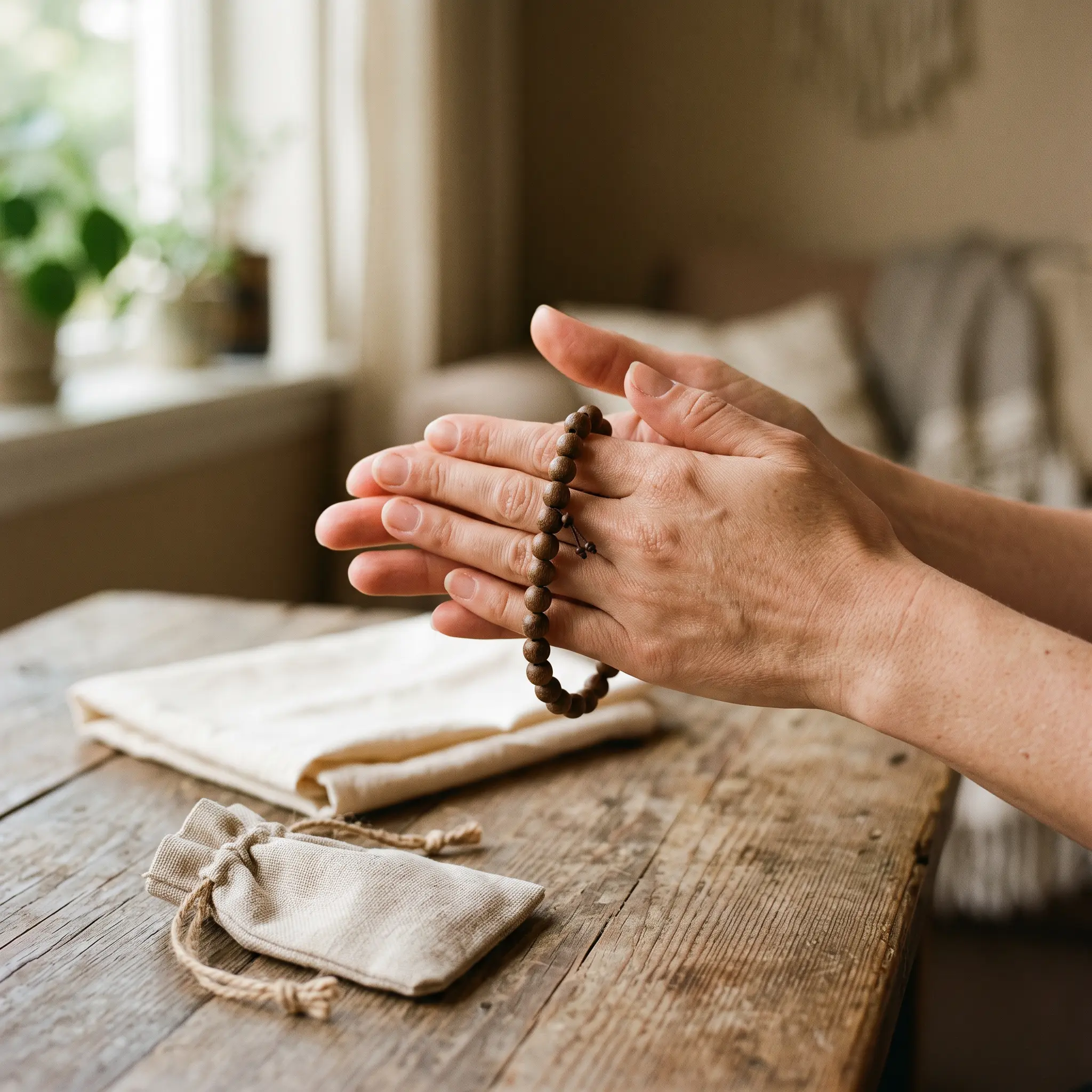
Keep He Xiang beads dry and handle them gently; water, sweat and oil are their main enemies. The beads are pressed powder, so soaking can soften or crack them. Follow these steps:
- Remove the bracelet before washing hands, showering, swimming or applying lotion.
- Avoid soap and water entirely; if beads get wet, let them air-dry naturally before wearing.
- Wear gently at first; a soft patina (a smooth, glossy surface layer) forms over a few months of handling.
- In humid or sweaty weather, wear the bracelet over a sleeve or carry it in a pocket instead.
- Refresh the scent by rubbing the beads between your palms for 10-20 seconds.
- Rest them in a dry, sealed pouch when you are not wearing them.
Which wrist? Some traditions favor the left wrist, but there is no strict rule. Wear it wherever feels natural.
Do He Xiang Beads Have Health Benefits?
He Xiang beads are scent and ritual objects, not medicine. They are about nurturing a calm moment, not healing a disease. No incense product should replace medical care.
Any calming effect is sensory and psychological. A familiar smell can work as a ritual anchor, a cue that tells your mind “now I pause.” Rubbing beads for 10-20 seconds before reading, praying or meditating can become that cue.
Some online sellers claim beads boost immunity, cure insomnia or treat breathing problems. Chinese media have questioned such claims too. We don’t repeat them, because no good evidence supports them.
The most important thing to remember is to enjoy the scent and the habit, and see a doctor for health concerns.
Which He Xiang Bracelet Fits Your Situation?
The best He Xiang bracelet depends on how and where you’ll use it. Match your situation in the table below.
| Situation | Recommended blend | Why it fits |
|---|---|---|
| Beginner / daily wear | Mild, sandalwood-led blend | Gentle scent, forgiving price, easy to wear at work |
| Meditation / focus ritual | Calm woody or herbal blend | Works as a ritual cue before quiet time |
| Collector | Agarwood-led blend | Depth, rarity and evolving scent |
| Gift | Mild scent, 2 spare beads, care card | Safe choice for unknown scent preferences |
If you’d like a place to start, ShaoLinStore offers handmade He Xiang bead bracelets in gentle and deeper blends; check each product page for the exact ingredients and bead size.
He Xiang beads give you blended incense without the smoke: rolled woods, resins and herbs you wear, rub and enjoy. Pick sandalwood for everyday comfort or agarwood for depth, keep the beads dry, and skip any medical promises. When you’re ready to find your first herbal incense bracelet, browse the collection at ShaoLinStore and choose the scent that feels like you.
❓ Frequently Asked Questions
Not quite. Aromatherapy bracelets usually hold added essential oil, while He Xiang beads are made from the aromatic materials themselves. Neither is a medical treatment.
Yes, agarwood and oud are the same resin-rich wood from Aquilaria trees. The difference is mostly semantic: “oud” is common in perfumery, while “agarwood” is common in incense and bead markets.
Don’t shower with them, because water and soap can soften or crack pressed beads. Sleeping in them is possible, but taking them off protects the beads from sweat and pressure.
Burned incense should be avoided during pregnancy and around pets. For worn beads, we found no safety studies, so ask your doctor if you are pregnant. Keep beads out of reach of pets, who might chew them.
Agarwood forms only when Aquilaria trees react to injury or infection, and wild trees have been heavily overharvested. Trade is regulated under CITES, and top Kyara grades have sold for over 40,000 yen per gram.
📚 References
- Incense and respiratory cancer: The Singapore Chinese Health Study cohort of 61,320 adults linking long-term incense use with squamous cell carcinomas. PubMed – Friborg et al., Cancer (2008)
- Incense particulate risk: 2025 laboratory study of four incense types, deposition in children vs adults, and cone dhoop cancer risk. PubMed – Arch Environ Contam Toxicol (2025)
- Indoor air and incense safety: Public-health guidance on incense smoke, high-risk groups, ventilation and HEPA filters. American Lung Association
- How agarwood forms: Scientific review of wounding, fungal infection, resin formation and overharvesting in Aquilaria. NIH PMC – Agarwood: The Fragrant Molecules of a Wounded Tree
- Sandalwood botany: Encyclopedia entry on the genus Santalum and true sandalwood, Santalum album. Encyclopaedia Britannica – Sandalwood