
Yes, you can learn kung fu at home, but only the basics, and only if you train with care. At ShaoLinStore, we wrote this guide for beginners with no school nearby who also want to pick the right staff on the first try.
Here’s what you need to know. Stances, kicks, flexibility and basic forms work well at home. Partner drills and technique correction need a real teacher. For the staff, choose a length about your height, up to 10 cm (4 in) taller for northern wushu. Then confirm it with your instructor.
The short answer: learn the basics at home, add a teacher as soon as you can, and size your staff to your height before you buy.
Below you’ll find a staff size table, a material guide, space rules, and ways to get feedback when no class is nearby.
Can I Learn Kung Fu at Home?
Yes, you can learn the basics of kung fu at home. Solo practice builds a real foundation in stances, kicks, balance and flexibility. It does not replace a teacher for refinement.
A quick definition first. Kung fu (功夫, gōngfu) is the common English name for Chinese martial arts. In Chinese, the word simply means any skill built through practice.
Chinese martial arts training has four parts: basics, forms, applications and weapons. Home practice covers the first two well. The last two usually need a partner or a coach.
The main risk is not laziness. It’s wrong habits. Without supervision, you can drift into poor posture or sloppy technique and never notice. That slows your progress and can lead to injury.
You’ll see conflicting advice online. Some people say videos are enough. Others say you can’t learn kung fu without a teacher in the room. Both camps have a point: video can teach you what a move looks like, but only a person can tell you whether yours looks right.
So start small. Train 10 minutes a day, at least 5 days a week. That beats one long session a week, because steady effort builds momentum.
In summary, home learning works for basics and conditioning. Mastery needs live feedback.
What Can I Learn at Home, and What Needs a Teacher?
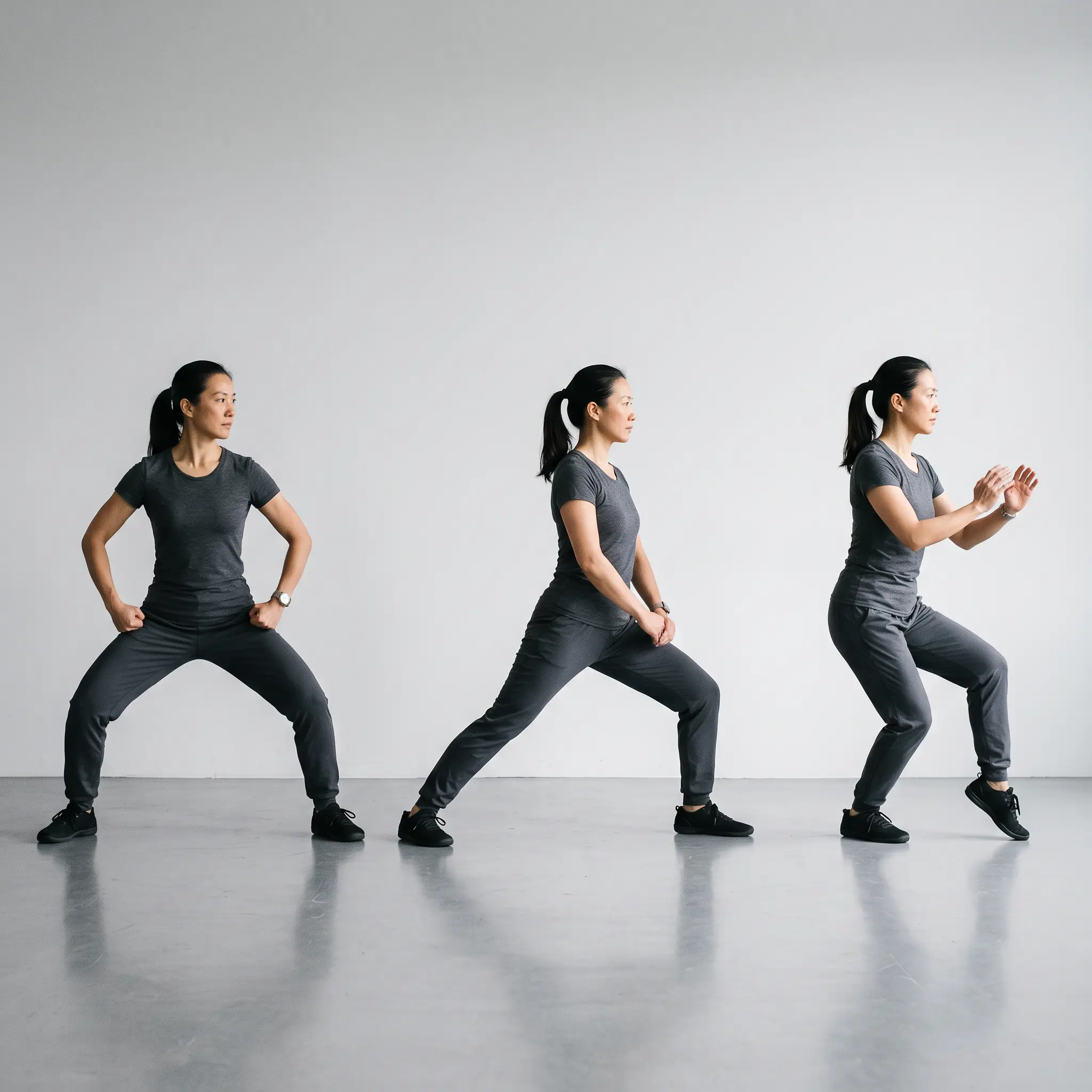
You can train stances, kicks, balance and flexibility at home. Partner drills and technique correction need another person.
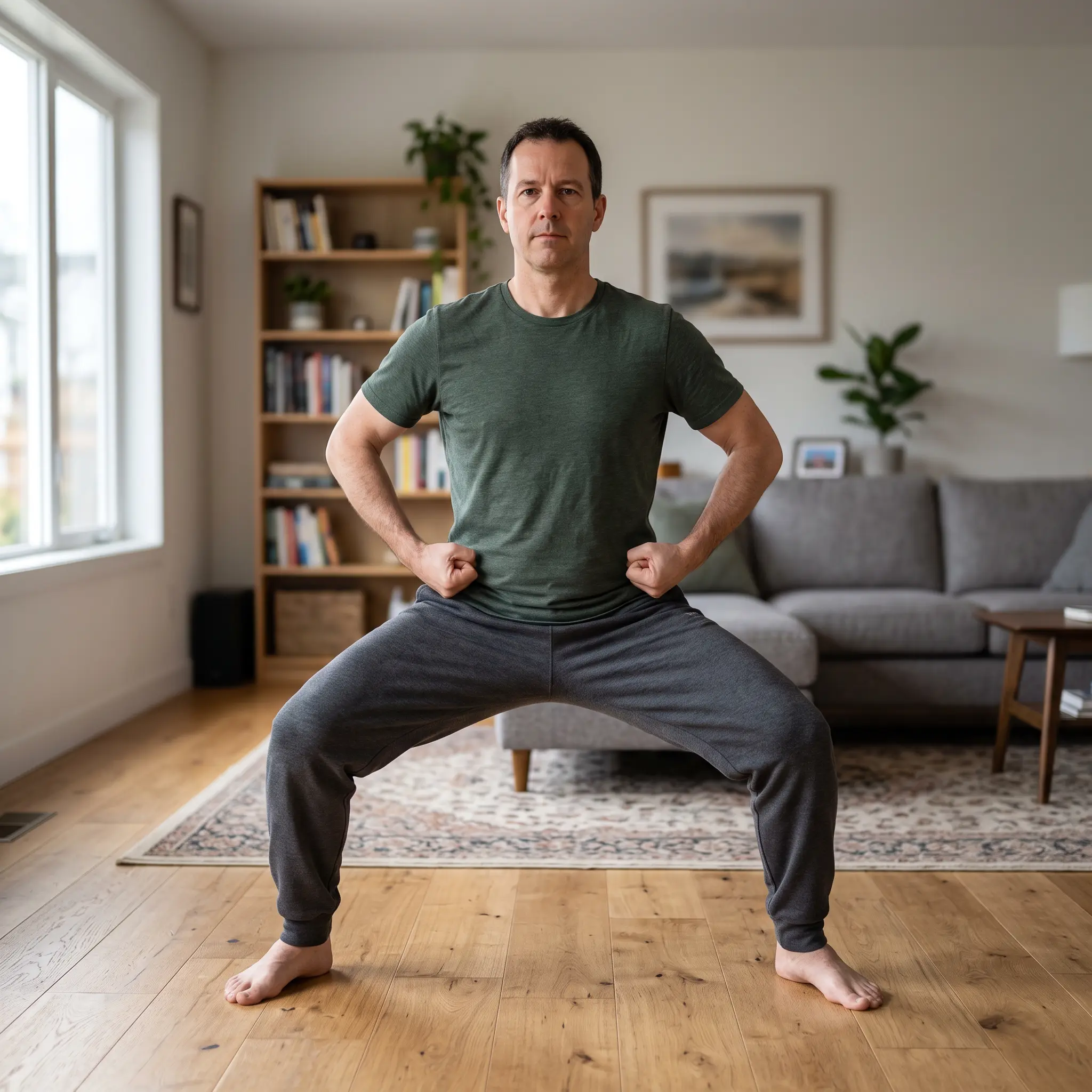
A stance is a fixed foot-and-leg posture that forms the base of every technique. The horse stance (mǎ bù) and the bow stance (gōng bù) appear in many styles. Chinese teachers call this base work basics (jī běn gōng), and they say you can’t progress without it.
| Skill | Home-friendly? | Why |
|---|---|---|
| Stances (horse, bow, cat) | Yes | You can check depth and balance in a mirror |
| Kicks, balance, flexibility | Yes | Needs no partner or equipment |
| Basic punches, blocks, strikes | Yes, slowly | Easy to repeat; harder to judge power and angle yourself |
| Solo forms | Partly | You can memorize them, but errors hide without feedback |
| Partner drills and sparring | No | Needs a live partner and supervision |
| Weapon forms | Later | Most teachers want basics solid first |
Forms (taolu, 套路) are preset movement sequences practiced as one continuous flow. You can learn the order from video. Learning them correctly takes someone who can see your mistakes.
The key takeaway: hand anything you can’t judge yourself to a teacher. That includes stance depth, hip turn and weapon grip.
What Do I Need to Start Kung Fu Training at Home?
You need about 3×3 feet (0.9×0.9 m) of clear floor, 10–30 minutes a day, and no special gear for the first stage.
These numbers come from a Wing Chun school. Other styles may need more room.
| Need | Starter amount | Notes |
|---|---|---|
| Floor space | 3×3 ft (0.9×0.9 m) | Grows to about 7×3 ft (2.1×0.9 m) once you add footwork and longer forms |
| Daily time | 10 minutes | Build to 15, then 20, then about 30 if your life allows |
| Training days | 5 or more per week | Up to 2 rest days a week is fine |
| Gear | None to start | Comfortable clothes and a flat, non-slip floor |
If your room is too small, train at a park. Most techniques can be adapted to the space you have.
Focus beats length. Ten focused minutes are worth more than an hour of going through the motions.
How Do I Start Learning Kung Fu at Home, Step by Step?
To start learning kung fu at home, choose one style, one teacher and one daily routine.
- Pick one style. Read about it first. Shaolin, Wing Chun and Hung Gar all train differently.
- Choose one reputable Sifu. A Sifu (师傅) is a kung fu teacher or master. Stick with one source. Mixing bits from many videos makes it hard to tell good advice from bad.
- Clear your space. Use the 3×3 ft starter area from the table above.
- Train 10 minutes a day. Add 5 minutes once the habit holds.
- Drill stances first. Work on the horse, bow and cat stances for your first 8–12 weeks. That’s our suggestion, not a fixed rule.
- Add kicks, then one short form from your chosen teacher’s material.
- Record yourself weekly. Compare your video with the teacher’s demonstration.
Here’s the bottom line: a clear routine matters more than a perfect plan.
Is a Staff a Good First Kung Fu Weapon to Learn at Home?
A staff is the usual first weapon in Chinese martial arts, but most teachers want your basics solid first.
The staff is called gun (棍, gùn) in Chinese. Staff training builds the fundamentals for every other long weapon, such as the spear. It is traditionally the first long weapon students learn.
Timing still matters. Weapons training generally starts after you’re proficient with basic forms. Some traditions had Shaolin monks study basics for about 1 year before staff fighting. One Wing Chun school holds weapons back until you finish all open-hand forms and the wooden dummy. It says that can take many years.
Our rule of thumb: practice steady stances for 8–12 weeks, then add a staff if your teacher agrees.
When you do start, begin with a short, basic form. In one well-known Shaolin staff program, the first sequence is Qi Mei Gun (齊眉棍), often translated as “eyebrow-level staff.” Learn only 2–3 moves at a time, and repeat them until they feel automatic.
A staff also trains your whole body. It asks for the same footwork and coordination as your empty-hand basics, so the weapon becomes an extension of your body. That is why steady basics make every staff drill easier.
What Length Staff Do I Need for Kung Fu?
Choose a kung fu staff about as tall as you are, up to 10 cm (4 in) taller for northern wushu. Then confirm the length with your teacher.
There is no single answer, because styles differ. Some use staffs near eyebrow height, and others use much longer ones. Your teacher knows the right size for your lineage. The seller doesn’t.
Competition adds another rule. The International Wushu Federation (IWUF) sets size standards for competition weapons. Home learners have more freedom, but the same height-based logic applies.
| Staff type | Typical length | Notes |
|---|---|---|
| Northern wushu staff | Your height, up to about 10 cm (4 in) taller | Common in competition-style forms |
| Southern staff (nangun) | Same range as northern | Usually thicker |
| Eyebrow-height staff | About eyebrow height | Used in some traditional systems; ask your teacher |
| Bo staff (Okinawan/Japanese term) | About 6 ft (1.8 m) as a shop standard | Some coaches prefer 2–3 in (5–8 cm) below your height |
Not sure which row applies to you? Use this quick guide:
- You have a teacher: use the length they give you.
- You’re learning Chinese staff forms alone: start with your height plus a fist (about 10 cm).
- You’re learning a bo kata: start near 6 ft, or 2–3 in below your height.
- You’re buying for a competition: check the current rules for your event first.
How Do I Measure the Right Staff Length?
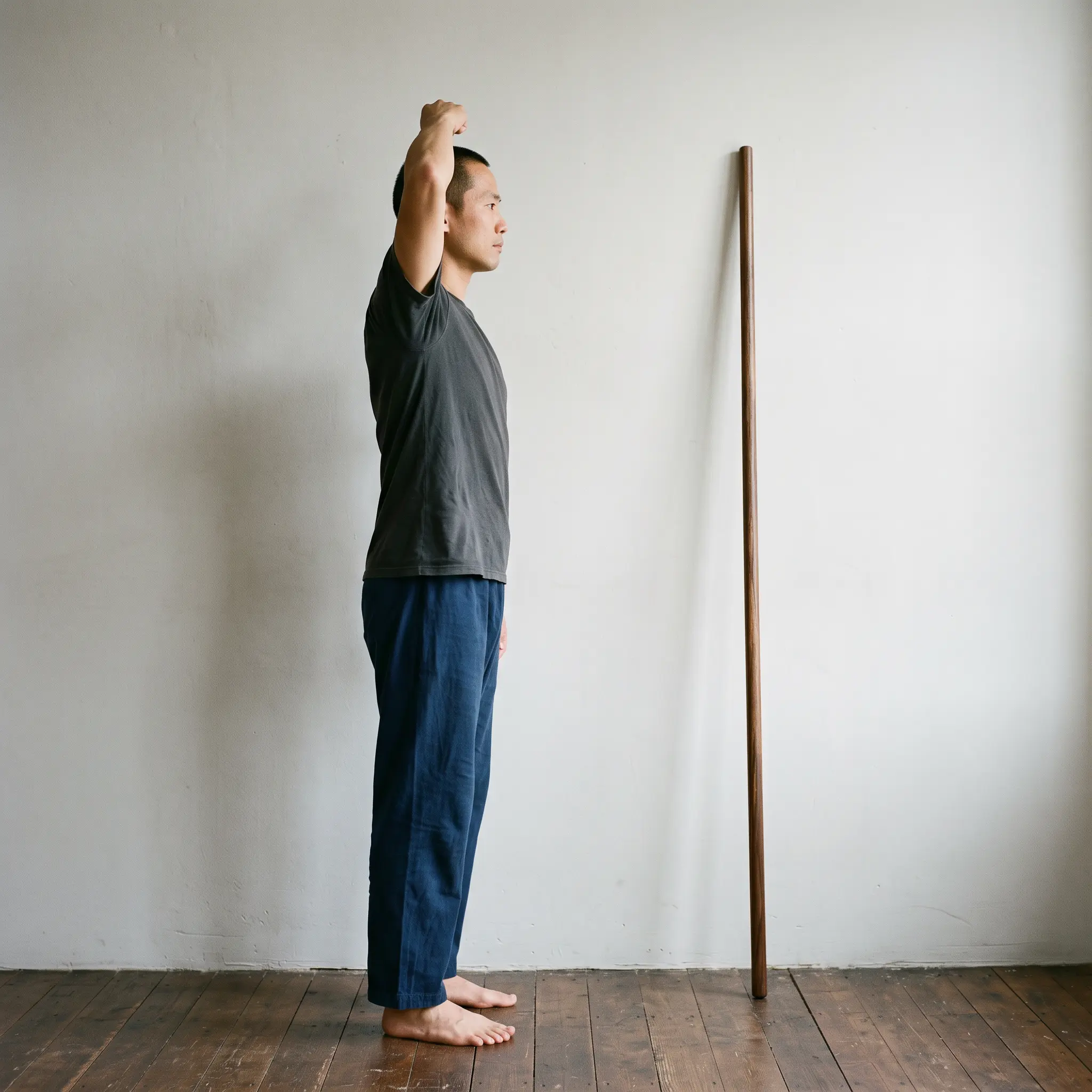
Measure your height, then add the height of your fist. That gives you the northern staff length, about 10 cm (4 in) above your head.
- Stand straight, barefoot, against a wall.
- Place a closed fist on top of your head.
- Measure from the floor to the top of your fist.
Carbon-fiber staffs come in fixed sizes. Pick the size closest to your height, such as the 170 cm staff if you’re 172 cm tall. Wooden staffs are different: buy slightly long and trim to fit.
| Your height | Northern staff range | Bo range (2–3 in below height) |
|---|---|---|
| 160 cm (5′3″) | 160–170 cm (63–67 in) | 60–61 in |
| 170 cm (5′7″) | 170–180 cm (67–71 in) | 64–65 in |
| 180 cm (5′11″) | 180–190 cm (71–75 in) | 68–69 in |
| 190 cm (6′3″) | 190–200 cm (75–79 in) | 72–73 in |
Ranges are calculated from the height-plus-10 cm rule above and one common bo coaching tip. Treat them as starting points.
Does Staff Length Change by Style?
Yes. Northern and southern styles often use different staffs. Chinese martial arts are split into northern and southern groups by the Yangtze River. Changquan is a northern example, and Wing Chun is a southern one.
Southern staffs are usually thicker than northern ones. Check thickness before you order. A thicker staff weighs more, which changes how it feels in your hands.
The word bo is a Japanese-style term. A gun is the Chinese version. They are related weapons, but sizes and materials often differ. The shorter jo (about 4 ft) and hanbo (about 3 ft) are different weapons altogether.
The key takeaway: ask which style you’re learning before you pick a length.
Should a Beginner Buy a Longer or Shorter Staff?
Buy slightly longer if you’re unsure. You can trim a wooden staff, but you can’t add length back.
| Choice | Upside | Downside |
|---|---|---|
| A bit longer than your height | You can cut it to fit | May hit the floor in spins and strikes |
| Equal to your height | Matches the standard guideline | Little room to adjust |
| Shorter than your height | Often easier to control and more forgiving | May not suit your style’s forms |
If you trim, mark the cut line first. Remove 1–2 cm (about ½ in) at a time, then test it. Ask your teacher before cutting.
What Length Staff for a Growing Child?
For a growing child, size the staff slightly above their height so it lasts longer. One bo coach orders about 2 inches (5 cm) taller than a child’s height for this reason.
Check with the child’s coach first, especially for competition. A weapon that’s too short may be rejected by judges, so a small amount of extra length is safer. Always supervise young learners.
What Material Should a Home-Practice Staff Be Made Of?
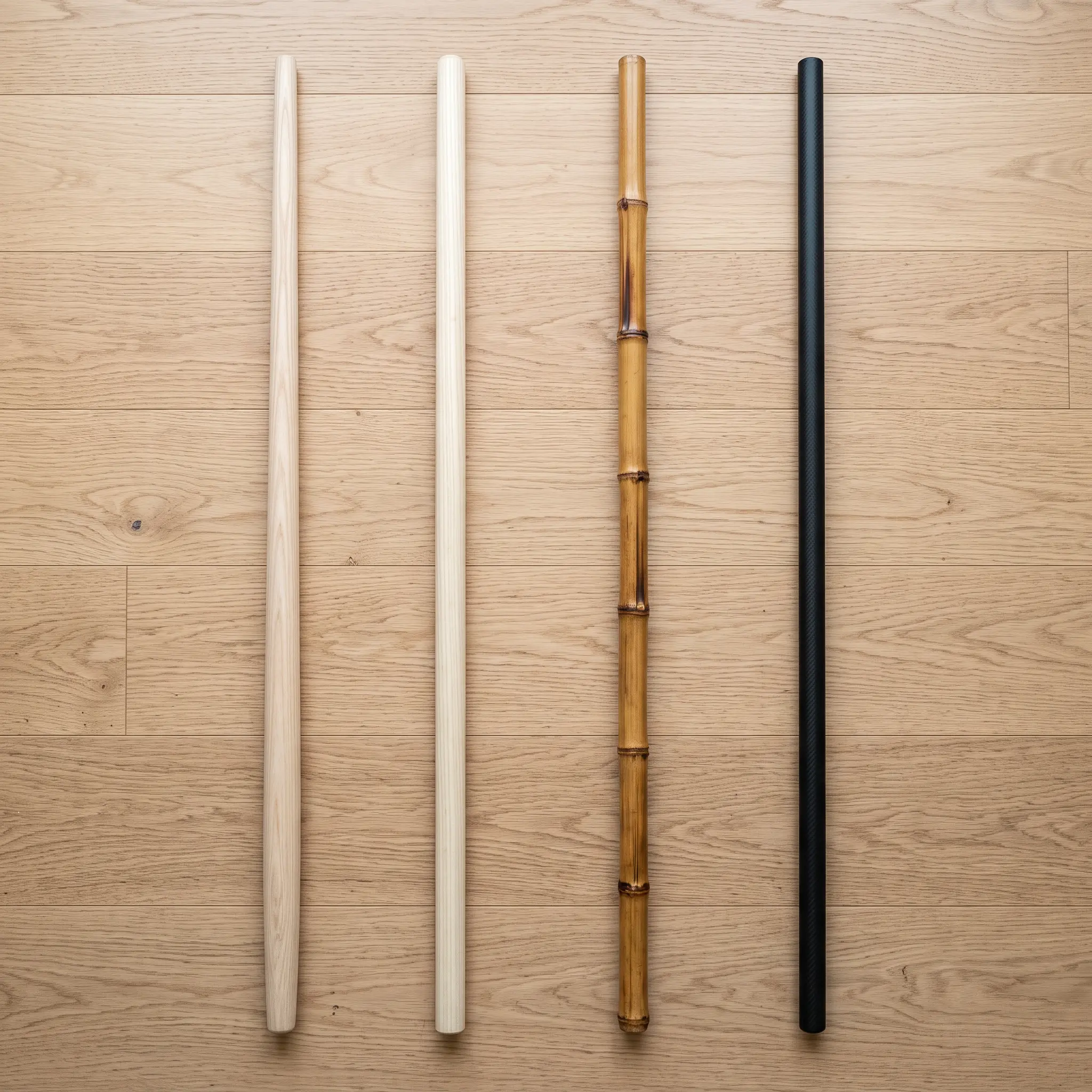
For most beginners, a tapered ashwood or white wax wood staff is the cheap, traditional choice. Rattan is another classic option.
| Material | Best for | Trade-off |
|---|---|---|
| Ashwood (tapered) | Beginners and heavy practice | Cheap, but it breaks with frequent training. Buy a spare. |
| White wax wood | Traditional Chinese practice | Classic feel; check thickness for your style |
| Rattan | Flexible, lighter forms | Less weight, different feel from hardwood |
| Carbon fiber | High-volume training and competition | Very hard to break, but expensive |
| Hardwood bo | Okinawan-style practice | Heavier; some practitioners find it awkward for flowing Chinese moves |
Weight matters as much as wood type. A heavier staff builds strength but is harder to control. A lighter one is easier to spin but gives less feedback when you strike. For a first staff, choose moderate weight and a thickness that your hand wraps around comfortably.
If you expect to train often, plan for wear. Wooden staffs can crack under heavy use, so some practitioners buy two or three at the start. Replacing a cheap ashwood staff costs far less than replacing a carbon-fiber one.
Store your staff lying flat on a shelf or the floor. Leaning it upright for long stretches can warp the wood. Check for tiny holes too, since they can signal woodworm.
Once you know your length and style, browse practice staffs at ShaoLinStore and compare them against the table above.
How Much Space Do I Need to Practice a Staff at Home Safely?
A staff needs far more room than empty-hand drills, so practice outdoors or in a large, clear space.
For scale, a Wing Chun school says its knife forms need at least 18×6 feet (5.5×1.8 m) outside. It says the long pole needs even more space, including overhead. A staff behaves like a long pole, so expect similar demands.
Here’s a conservative rule of thumb of our own: clear a circle whose radius equals your staff’s length. For a 6 ft staff, that’s a 6 ft radius.
- Look up. Lights, fans and low ceilings are common hazards.
- Clear people, pets and furniture from the circle.
- Start with slow drills before you add speed.
- Don’t spar with a partner unless a teacher is present.
In summary, space equals safety. If you can’t clear enough room, train empty-hand and save the staff for a park or yard.
How Do I Get Feedback if I Can’t Attend a Class?
Use structured courses plus periodic live feedback, because video alone can’t show you what you’re doing wrong.
| Option | Best for | Limit |
|---|---|---|
| Self-recorded video | Weekly self-checks | You only see what you already know to look for |
| Structured video course | Learning a staff routine step by step | The instructor can’t see you |
| Online private lesson | Live corrections from a Sifu | Costs more per session |
| Group seminar | Hands-on correction a few times a year | You need a local host or group |
Good courses exist. One staff fundamentals program runs 180 minutes and covers sliding, striking, blocking and partner practice. Pick a course from one lineage and stay with it.
Before you pay for any course or lesson, check three things:
- Lineage: does the teacher name their own teacher and style?
- Structure: does the course move from basics to forms in a clear order?
- Feedback: is there any way to send a video and get a correction?
Here’s a simple method: record each practice, then watch it next to your teacher’s demo. Check your stance depth, grip and footwork. Note one fix per week.
If you live far from a school, a small group can share the cost of bringing in a local teacher for a seminar or private lesson. A few correction sessions a year can protect you from years of bad habits.
The Bottom Line: Start Small, Start Safe
Learning kung fu at home works best as a bridge. Train stances, kicks and flexibility for 10 minutes a day. Add a staff once your base feels steady, sized to your height and confirmed by your teacher.
The most important thing to remember is feedback. Seek a real Sifu as soon as you can. When you’re ready to size and choose your first staff, ShaoLinStore is here to help you start with the right length.
❓ Frequently Asked Questions
Most traditional styles take years to learn well, and a figure of 3–5 years is often quoted. You can learn basic stances and kicks within weeks to months. Home training prepares you for a teacher but doesn’t replace one.
You can learn the shapes of moves and build conditioning. Without a teacher’s feedback, you mostly copy what you see. Treat video as a supplement, and add live correction when you can.
No. Stances, kicks, balance and flexibility need no equipment. Add a staff after your basics are steady, usually after about 8–12 weeks of practice.
They’re related but not identical. Gun is the Chinese word for staff, while bo is a Japanese-style term. Sizes, thickness and materials can differ, so check which one your style uses.
Yes. You can shorten a wooden staff, but you can’t make it longer. Mark the line, cut 1–2 cm at a time, and ask your teacher before you trim.
📚 References
- Chinese martial arts overview: Explains kung fu vs. wushu, the four training components, stances, forms, and when weapons training begins. Wikipedia: Chinese martial arts
- Learning kung fu from videos: A Shaolin academy’s view on what home practice can and can’t do, with a list of solo basics. Maling Shaolin Kung Fu Academy
- Choosing weapon length: Practical staff and spear sizing advice, including height-based rules and carbon fiber size grades. Académie Wukong Wushu
- Staff fundamentals course: Describes staff training as the traditional first long weapon and lists core techniques. YMAA: Staff Fundamentals Training
- Training at home: Covers daily schedule, space requirements, and weapon timing for home practice. West Coast Wing Chun