
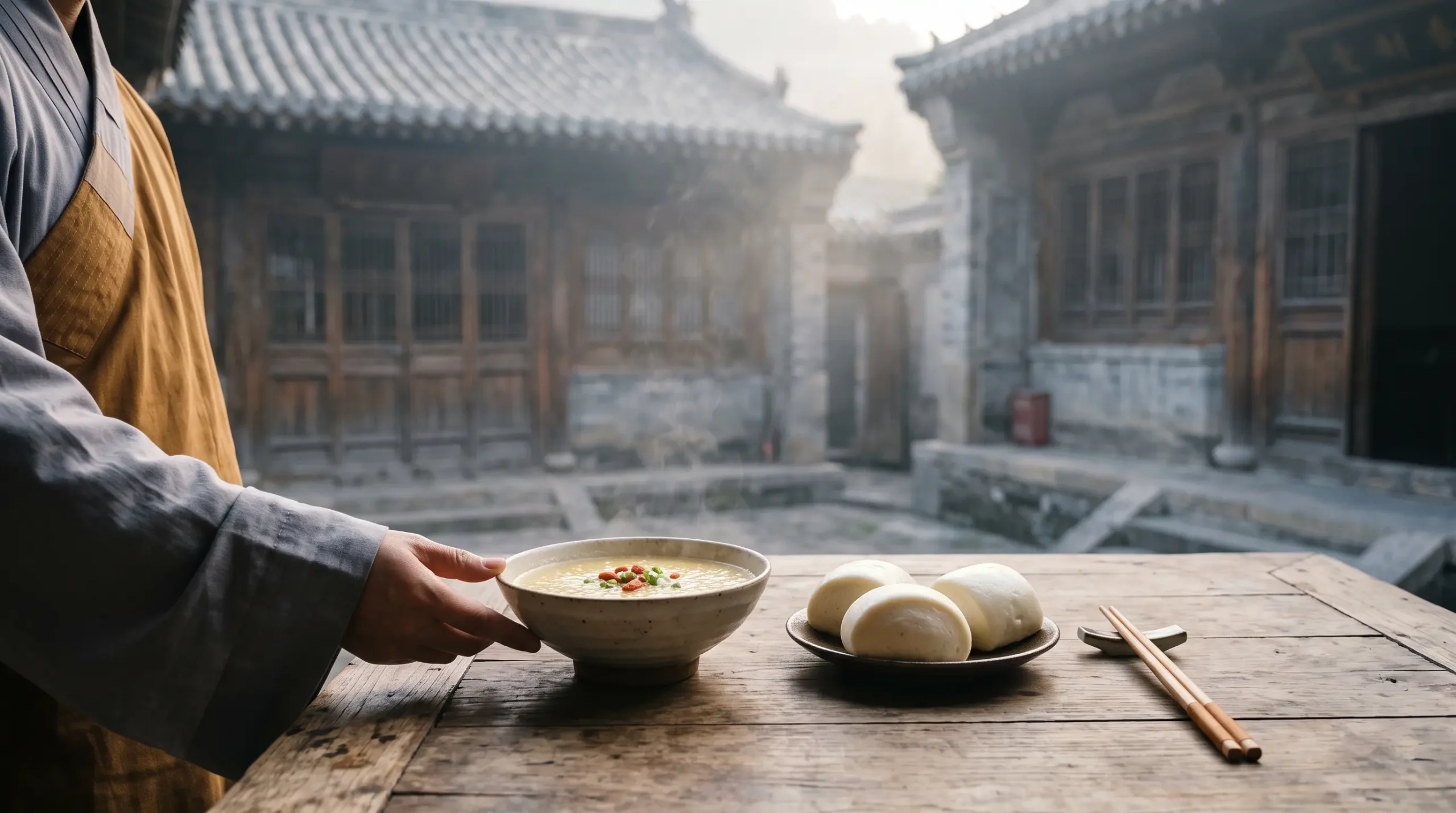
Ordained Shaolin monks traditionally eat a plant-based Buddhist diet. They start with millet or rice congee at dawn, eat a main meal of buns, noodles, tofu and vegetables near 11:30 am, and finish with a plain dinner. Meat, fish, alcohol and the five pungent spices, such as garlic and onion, stay off the menu.
Kung fu films make Shaolin monks look like warriors powered by secret foods. The reality is quieter. The Shaolin Monastery is a Chan (Zen) Buddhist temple founded in 495 CE on Mount Song in Henan, China. Its Buddhist vegetarian food follows monastic rules built around meditation and non-harming.
At ShaoLin Store, we write about Shaolin culture from published sources: interviews with Shaolin monks, university press books and peer-reviewed journals. Online guides often contradict each other on eggs, ginger and evening meals, so we flag every point where sources disagree.
What Do Shaolin Monks Eat in a Typical Day?
Shaolin monks eat three meatless Chan Buddhist meals a day: congee after dawn prayers, a main meal near 11:30 am, and a simple dinner around 5:30 pm, all built on wheat, rice, tofu and vegetables with no meat, fish or alcohol.
| Meal | Usual time | Typical foods | Source note |
|---|---|---|---|
| Morning congee | About 6:30 am, after dawn prayers | Rice or millet porridge, sometimes a soup called Eight Treasures | Time from Shi Yan Ming; soup from Sifu Wang Bo |
| Main meal | About 11:30 am | Rice, noodles or mantou, tofu, 5 to 6 vegetables | Both monks agree |
| Dinner | About 5:30 to 6:00 pm | Noodles, rice or bread, and soup | Some sites call it an optional “medicine” meal |
Morning Congee After the Dawn Service
Congee is a thin rice or millet porridge, and it opens the day after morning prayers. Shi Yan Ming is a Shaolin-trained master who now teaches in the United States. He recalls waking at 4:30 am and training for two hours before breakfast at 6:30 am. Sifu Wang Bo, a Shaolin monk interviewed by HuffPost, described a soup called Eight Treasures as the daily breakfast.
The Main Meal Around 11:30 am
The main meal starts at 11:30 am in the accounts of both monks. Shi Yan Ming lists noodles, rice or mantou, while Wang Bo describes tofu and rice with five to six vegetables. Shi Yan Ming adds that most Buddhist monks stop eating at noon, but Shaolin monks do not follow that rule strictly. They eat at 11:30 am partly so visiting monks from other temples can share the meal.
The Evening Meal: Some Call It “Medicine”
Dinner is plain: noodles, rice or bread, and soup around 5:30 pm. Wang Bo says the bread is made from black or yellow wheat flour. In many Chinese monasteries, the evening meal is called yaoshi, “medicine stone,” a name that frames food as nourishment rather than pleasure. Some retailer blogs describe a light, optional evening bowl in that spirit.
We expected one tidy schedule. We found that the accounts agree on the main meal and differ on dinner.
Staple Foods in a Chan Monastery Kitchen
Shaolin kitchens run on the wheat, millet and rice of north China: steamed mantou, noodles and congee fill the bowl, while tofu, wheat gluten and mushrooms supply protein without meat.
- Grains: mantou, noodles, congee and rice.
- Plant proteins: tofu, wheat gluten, beans and mushrooms.
- Vegetables: seasonal greens such as bok choy and cabbage.
Wheat, Millet and Rice: The Grain Staples
Mantou are plain steamed wheat buns, and they sit beside noodles and rice at Shaolin meals. Wheat dominates because Henan is one of China’s largest wheat-growing provinces. Monastic farming shaped the menu too. The Tang dynasty Chan master Baizhang Huaihai is credited with the rule that a day without work is a day without food.
Tofu, Wheat Gluten and Mushrooms for Protein
Tofu is the main protein at lunch, served with five to six vegetables, according to Wang Bo. Wheat gluten, also called seitan, is a chewy protein made by rinsing the starch out of wheat dough. Chinese temple kitchens commonly use it as a meat substitute, and mushrooms and beans add more plant protein.
Seasonal Vegetables and Light Seasoning
Vegetables change with the season. One popular overview of the Shaolin diet lists rice, bok choy and seitan as everyday foods. Without garlic and onion, temple cooks typically rely on the vegetables themselves plus simple seasonings such as salt, vinegar and sesame oil. We could not find a published menu from the temple kitchen, so treat exact recipes as unconfirmed.
Which Foods Are Off-Limits for Ordained Monks?
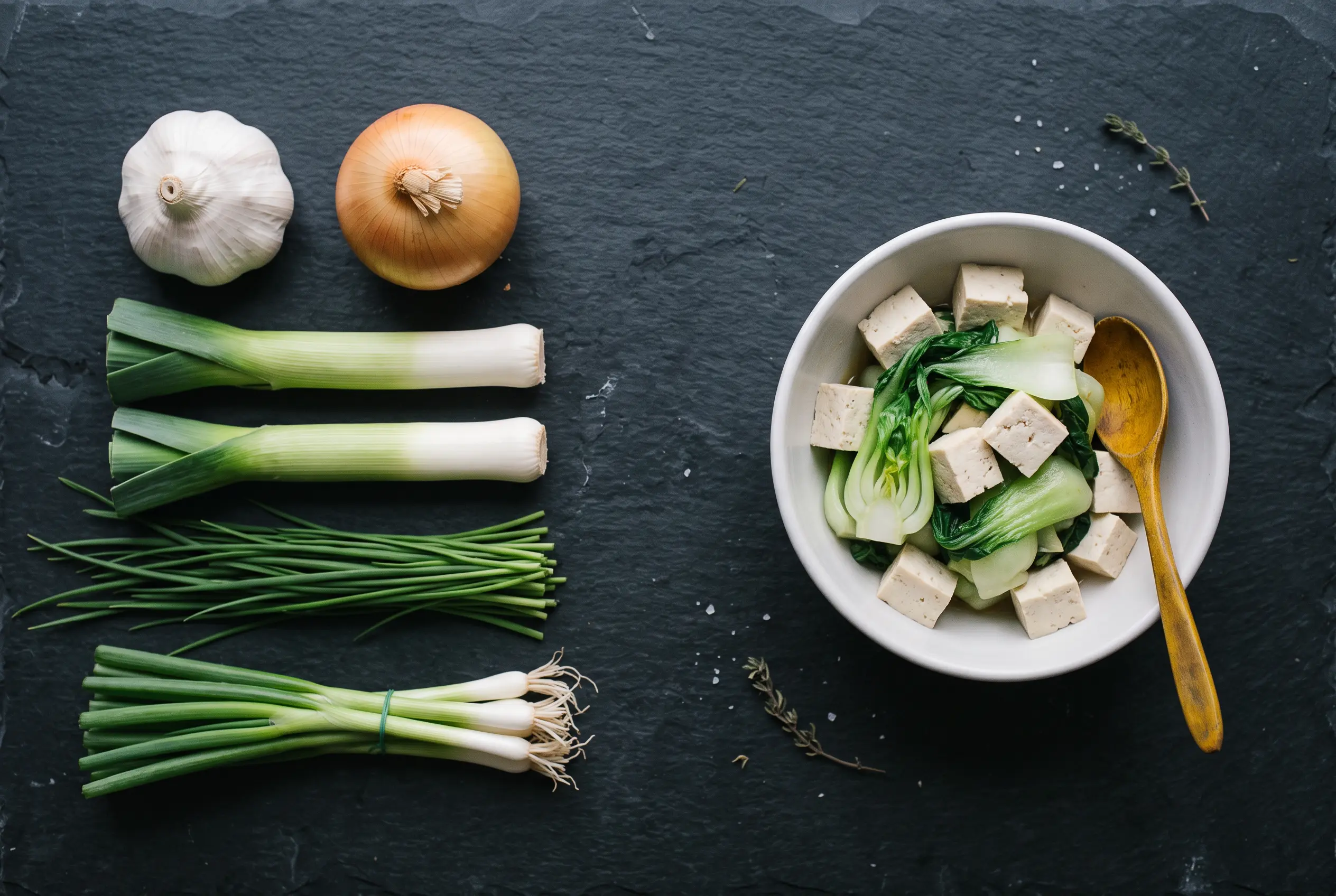
Ordained monks at Shaolin avoid five kinds of food:
- Meat and poultry: excluded under the Buddhist precept against killing.
- Fish and seafood: excluded for the same reason.
- Alcohol: forbidden for ordained monks.
- Five pungent spices: garlic, onion, leek, chives and scallion, plus asafoetida on some lists.
- Eggs: excluded in most sources, though a few disagree.
Meat, Fish and Alcohol
Meat, fish and alcohol are excluded because Buddhist precepts forbid taking life and using intoxicants. The Brahmajala Sutra, a key source of bodhisattva precepts in Chinese Buddhism, includes a rule against eating meat. Wang Bo says alcohol is strictly forbidden for the monks.
The Five Pungent Spices (Wuxin)
The five pungent spices (wuxin) are strong-smelling plants such as garlic, onion, leek, chives and scallion. Lists vary slightly by sutra, and some add asafoetida. The Śūraṅgama Sutra traditionally teaches that eating them raw stirs anger and eating them cooked stirs desire, which disturbs meditation. The reason is spiritual, not medical.
Eggs, Ginger and Evening Meals: Where Sources Disagree
Sources disagree on three details. Most conflicts trace to one habit: pages blend ordained monks with martial arts students.
| Question | What most sources say | Where they disagree |
|---|---|---|
| Eggs | Temple monks avoid them | A few martial arts and lifestyle pages mention eggs without separating monks from lay students |
| Ginger | Often grouped with strong flavors to avoid | Some Shaolin-themed pages describe ginger and pepper as seasoning |
| Food after noon | Most Buddhist monks stop eating at noon | Shi Yan Ming says Shaolin monks eat dinner near 5:30 pm |
Until the temple publishes an official menu, treat these three details as open questions.
Why Is Chinese Buddhist Food Vegetarian?
Chinese Buddhist monasteries became vegetarian through the Mahayana ideal of compassion and the early sixth-century edict of Emperor Wu of Liang, which barred monks from eating meat and drinking wine.
Compassion and the First Precept
Mahayana Buddhism asks monastics to extend compassion to every living being, so avoiding meat follows the first precept against killing. Guanyin, the bodhisattva of compassion, is the figure many Chinese Buddhists associate with that ideal. ShaoLin Store offers a Royal Ease Guanyin statue, a symbol of compassion, a solid copper piece about 8.9 inches (22.6 cm) tall. It gives your table a quiet reminder to eat with care.
Emperor Wu of Liang and the Meat Ban
Emperor Wu of Liang, who ruled southern China from 502 to 549 CE, is credited with the first formal ban on meat for Chinese monastics. His essay on abstaining from wine and meat is often dated to 511 CE. A 2025 paper in the journal Religions describes his edict as the first formal ban on monastic meat eating in East Asian Buddhism. He also took bodhisattva precepts in 519 CE and kept a vegetarian diet himself.
Before his ban, Indian monastic rules let monks accept meat under certain conditions.
Not All Buddhists Are Vegetarian: Theravada vs. Mahayana
Chinese Mahayana monks forbid meat, while Theravada monks may accept it. That difference explains why a monk in Thailand and a monk at Shaolin can follow different food rules and both be faithful to Buddhism.
| Tradition | How monks get food | Meat policy |
|---|---|---|
| Theravada (Sri Lanka, Thailand) | Alms rounds; monks accept what is offered | Allowed if the monk did not see, hear or suspect an animal was killed for him |
| Chinese Mahayana (including Shaolin) | Monastery kitchen run by the community | Forbidden for ordained monks |
Do Shaolin Monks Ever Eat Meat? Monks vs. Martial Myths
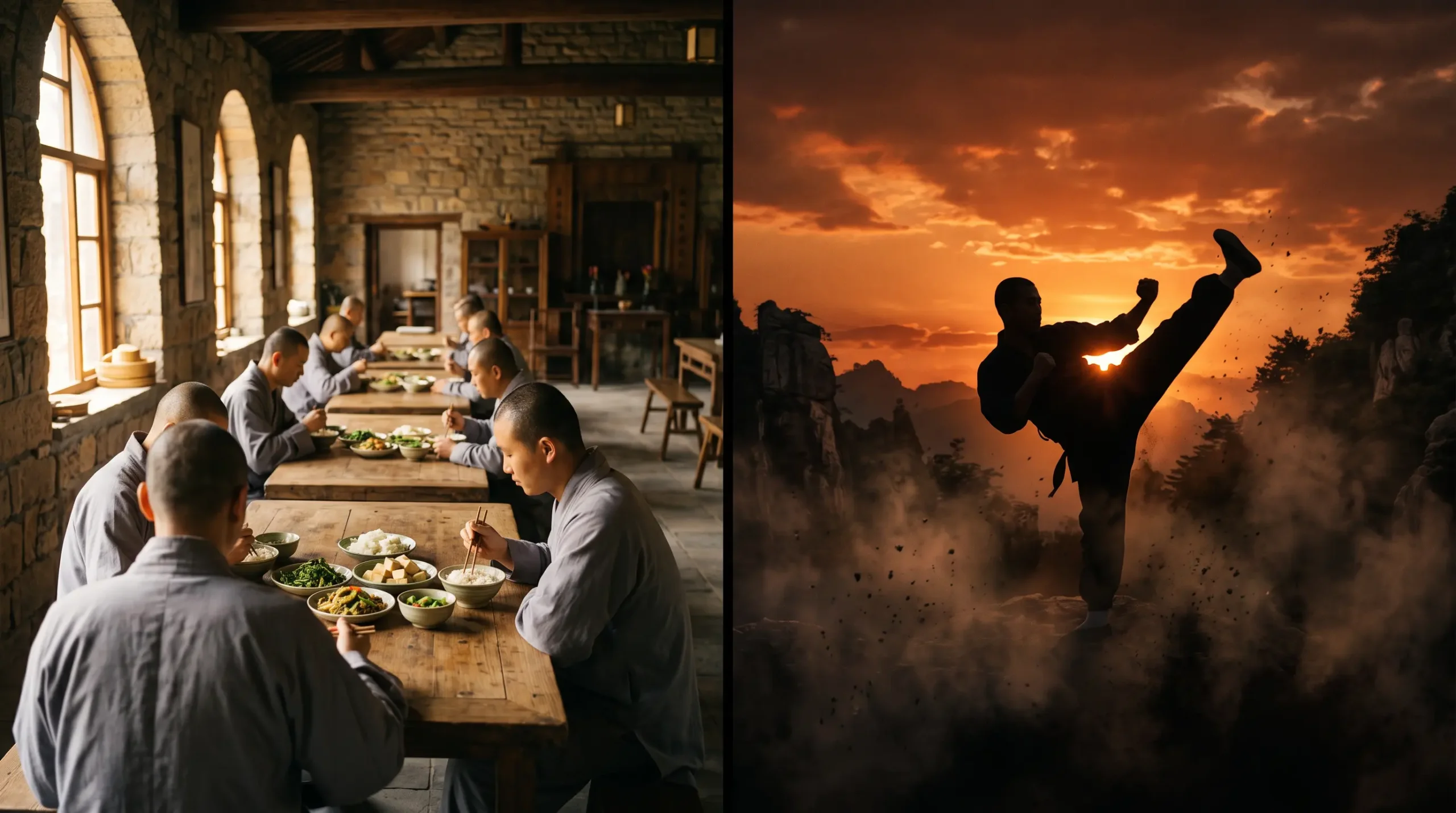
Inside the temple, ordained Shaolin monks do not eat meat, according to historian Meir Shahar, but some martial artists who trained at Shaolin and later opened schools do. The “meat-eating warrior monk” image comes from mixing these two groups.
Ordained Monks Inside the Temple
Shahar, author of The Shaolin Monastery: History, Religion, and the Chinese Martial Arts, reports that meat is not served in today’s temple. The monks who live inside the monastery follow a vegetarian diet. This matches what Shi Yan Ming and Wang Bo describe from their own years there.
Martial Artists and Schools Outside the Walls
Many fighting monks who left Shaolin to open private schools eat meat, though not all do. Shi Yan Ming also notes that some of his teachers were Shaolin disciples, not monks, who lived outside the temple. That distinction between ordained monks and martial schools outside the temple explains much of the confusion online.
What Historians Say About the Evidence
Shahar also discusses reports that Ming-era monks ate meat and drank wine. A scholarly review on Project MUSE argues this rests on a thin base: apart from one sixteenth-century source, no other evidence supports it. That source is the Ming official Wang Shixing (1547 to 1598), who accused the monks of eating meat and drinking wine.
The bottom line is that past centuries remain debated. For today’s ordained monks inside the temple, the sources agree on a vegetarian diet.
How to Bring Monastery-Style Mindful Eating Home
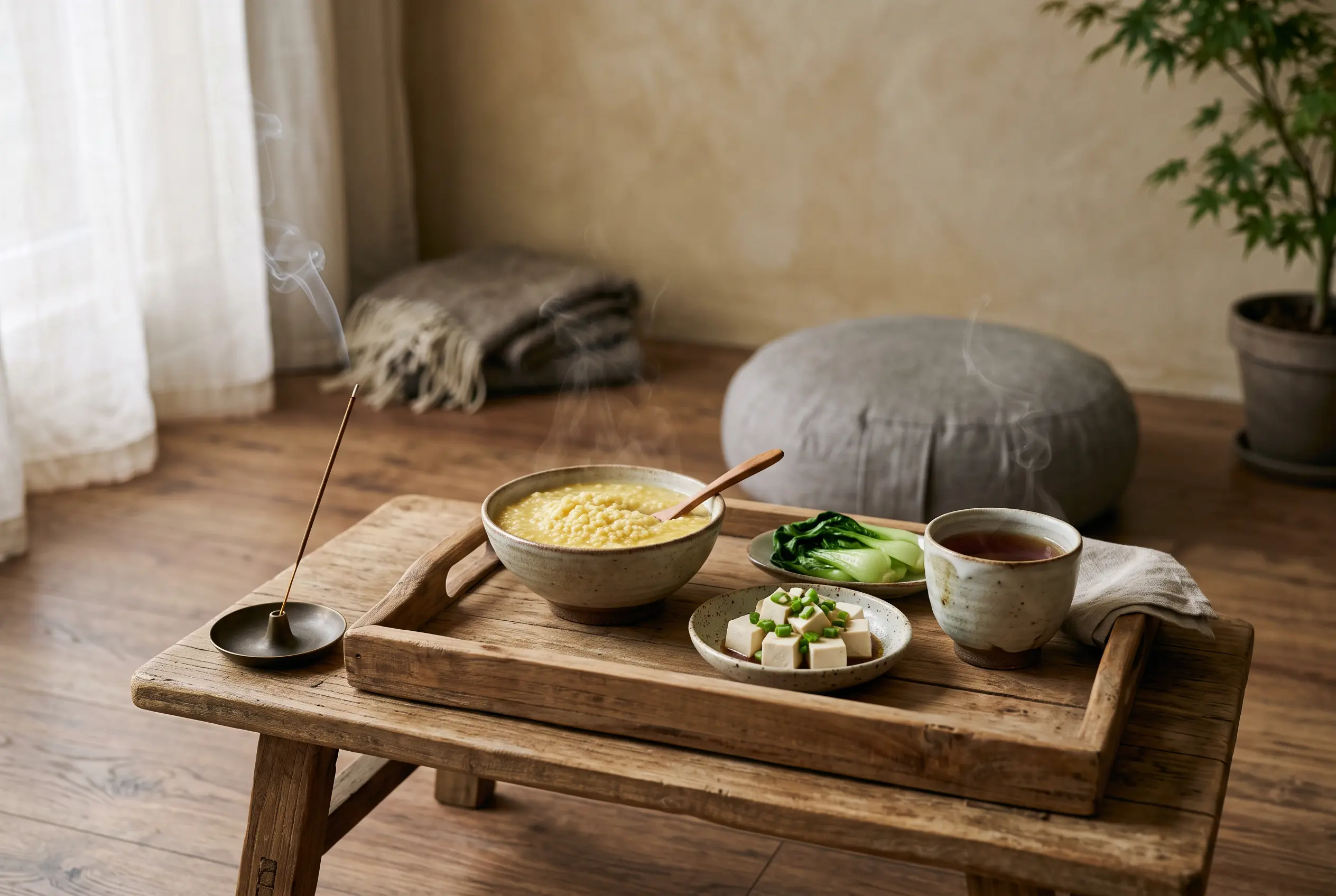
You don’t need a monastery to borrow the spirit of a Shaolin meal: pause before eating, keep the plate simple and plant-based, put away screens, and finish what you take. The goal is attention, not imitation.
The Five Contemplations Before a Meal
The Five Contemplations are short reflections that many Chan and Zen monasteries recite before eating. In plain English, they ask you to:
- Consider the work and care that brought the food to you.
- Reflect on your conduct and whether you have earned the meal.
- Guard your mind against greed, anger and distraction.
- Regard the food as medicine that sustains the body.
- Accept the meal so you can continue your practice.
Many American families do something similar at Thanksgiving, when they name what they are thankful for. The contemplations ask for that pause at every meal. Some people use handmade incense to mark a pause before eating. That is a modern habit, not a Shaolin rule.
A Simple Shaolin-Inspired Plate
Start with a bowl of millet congee, a few cubes of tofu and steamed bok choy, with no garlic or onion. It works well on a Meatless Monday and takes about as long to cook as a pot of oatmeal.
The Academy of Nutrition and Dietetics says appropriately planned vegetarian and vegan diets can be nutritionally adequate for adults, and it points to nutrients such as vitamin B12 as ones to plan for. The temple diet is a religious practice, not a medical plan. If you are pregnant, managing a health condition or have a food allergy, ask your doctor or a registered dietitian first.
Setting a Calm Table: Tea, Incense and a Quiet Corner
A calm table needs three things: a small cup, a few quiet minutes and one place you return to. A small cup slows each sip, so tea becomes a pause instead of a habit. Our handmade ceramic cups for a slow after-meal tea suit that routine.
If you want a place to sit afterward, add a meditation cushion and a singing bowl for a quiet practice corner. Five minutes of sitting after a meal is easier to keep when the spot is already set up.
Frequently Asked Questions
Ordained monks living in the temple follow a vegetarian diet with no meat, fish or alcohol. Most sources also exclude eggs, while the role of dairy is less clear, so “vegan” is not a precise label.
It depends on the account. Shi Yan Ming says Shaolin monks eat dinner around 5:30 pm even though most Buddhist monks skip food after noon. Some retailer sites describe only a light evening bowl called “medicine.”
Alcohol is forbidden for ordained monks. Sifu Wang Bo said the monks skip tea and other liquids with meals to aid digestion, though tea has long belonged to Chan monastic life. For a calm tea moment at home, start with a small cup and a few quiet minutes.
A simple plant-based pattern can be part of a balanced diet, but the temple diet is a religious practice, not a medical plan. Talk to your doctor or a registered dietitian before major changes, especially if you are pregnant or managing a health condition.
The key takeaway: Ordained Shaolin monks eat vegetarian meals built on grains, tofu and vegetables, and they avoid meat, fish, alcohol and the five pungent spices. Sources disagree on eggs, ginger and dinner, and most “meat-eating monk” stories come from martial artists outside the temple.
In summary, the easiest part of Shaolin Buddhist vegetarian food to borrow is not the menu. It is the habit of eating slowly and with thanks.
Build a quiet corner for mindful meals
Find cushions, singing bowls and tea-time companions for a slower table at ShaoLin Store.Shop meditation cushions and singing bowls for a quiet practice corner
⚠️ Important Note: This article is for cultural and educational purposes and is not medical or nutritional advice. Descriptions of what food means in Buddhist tradition reflect religious belief, not scientific findings. If you have a health condition, food allergy or are pregnant, consult a doctor or registered dietitian before changing your diet.
How we sourced this guide: We compiled it from accounts by Shaolin monks, an academic book, a scholarly review and peer-reviewed research. We have not observed the temple kitchen ourselves, and where sources disagree, we say so. We update this page as better sources appear.
📚 References
- The Shaolin Monastery: History, Religion, and the Chinese Martial Arts: Meir Shahar’s 2008 study of the temple’s history, including its diet and its martial tradition. University of Hawai’i Press via Oxford Academic
- Emperor Wu of Liang’s Reinterpretation and Elevation of the Precepts as the Bodhisattva Ideal: Peer-reviewed paper on the emperor’s role in Chinese monastic vegetarianism, Religions 2025, 16(2), 164. MDPI Religions
- Review of The Shaolin Monastery: Scholarly review that questions the evidence for meat eating inside the monastery. Project MUSE
- Vegetarian Dietary Patterns for Adults: Raj S, et al. Position paper of the Academy of Nutrition and Dietetics, Journal of the Academy of Nutrition and Dietetics 2025;125(6):831-846. PubMed