
A Buddha statue is a sentence written in posture and hands. Read it correctly, and you know whether it shows enlightenment, a first sermon or a promise of protection. At ShaoLinStore, we help buyers match the right Buddha statue to their space and intention. This guide gives you a mudra chart, the history behind the earth-touching Buddha, and a size rule for desks, altars and gardens.
Here’s what you need to know: posture sets the category, the hand gesture sets the meaning, and height should fit your surface, not the product photo.
What are the main types of Buddha statues?
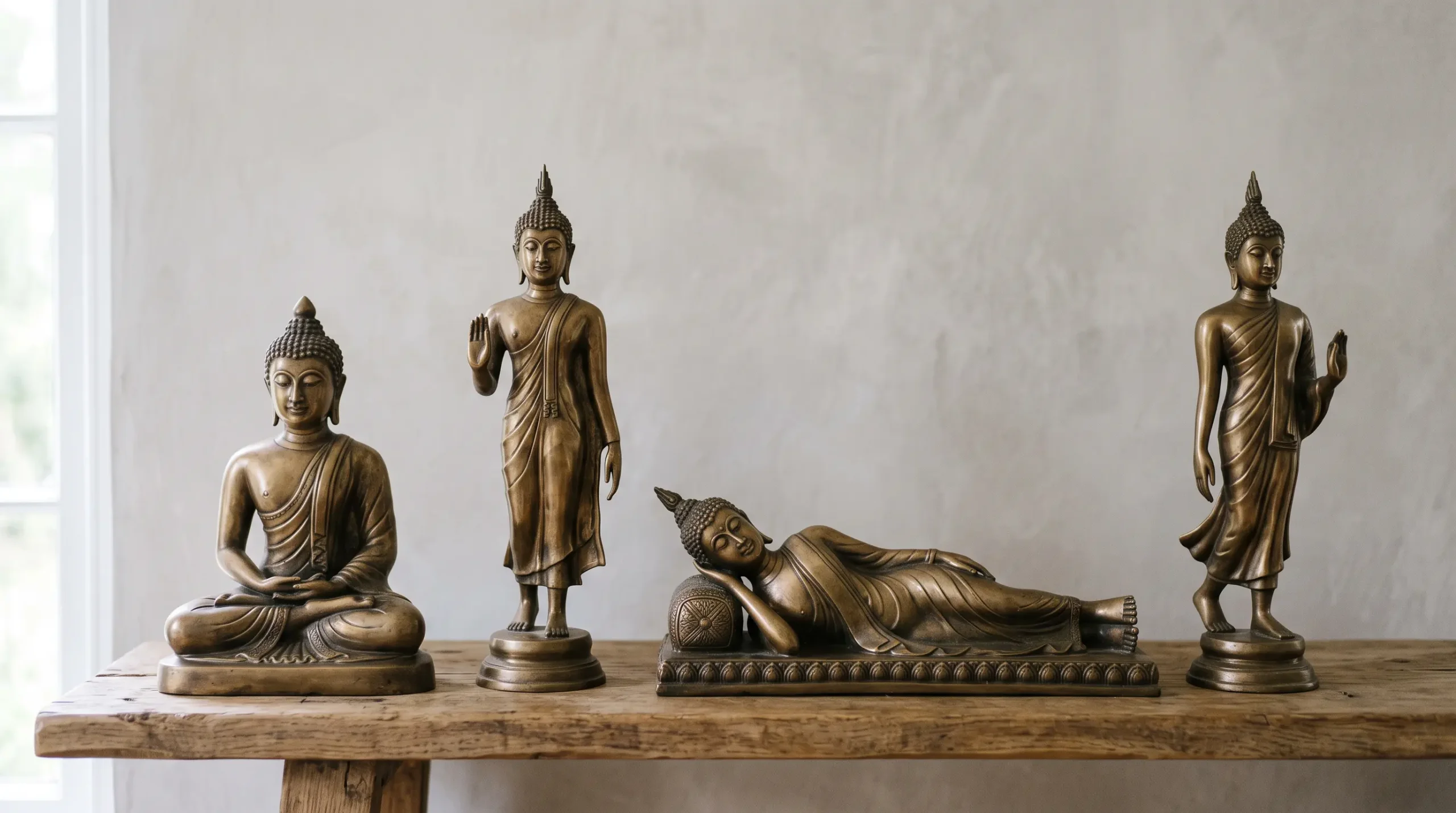
Buddha statues fall into four posture types: seated, standing, reclining and walking. The posture sets the category. The hand gesture, called a mudra (Sanskrit for “seal”), sets the specific meaning. Keep the two apart, and every statue becomes easier to read.
| Posture | What it shows | Typical hands | Best for |
|---|---|---|---|
| Seated | Meditation, awakening or teaching | Both in lap, or one reaching to the earth | Altar, desk, meditation corner |
| Standing | Blessing, protection, giving | Right palm raised, left hand open | Entryway, hallway |
| Reclining | The Buddha’s final passing (parinirvana) | Head rests on right hand | Wide shelf, shrine, garden |
| Walking | Active teaching; a classic Thai (Sukhothai) form | One arm swings forward | Feature piece, collectors |
What does a seated Buddha statue mean?
A seated Buddha with both hands resting palm-up in the lap shows deep meditation. This dhyana pose is the classic home-altar choice. The crossed legs form the lotus posture, the traditional cross-legged yoga seat.
What does a reclining Buddha statue mean?
A reclining Buddha lies on his right side, head on his right hand. It shows his final passing into parinirvana (release from the cycle of rebirth), not sleep. Reclining statues are long and low, so measure your shelf width first.
What does a standing Buddha statue mean?
A standing Buddha usually raises the right palm for fearlessness and lowers the left hand to give. It reads as protection and generosity. Many owners place one near an entrance.
Which Buddha is your statue actually showing?
Identify a Buddha statue with three clues: the mudra, any object it holds or sits beside, and its body shape. The same pose can represent different Buddhas, so objects matter.
- Medicine Buddha: holds a medicine bowl in the lap and is often painted blue.
- Akshobhya: touches the earth, with a vajra (a thunderbolt scepter) on the pedestal.
- Amitabha: usually shown in the meditation mudra.
Check the body, too. Three marks identify a Buddha: the ushnisha (the bump on the crown, a sign of wisdom), the urna (the dot between the brows) and long earlobes. They come from the traditional list of 32 signs of a great being.
Is the Laughing Buddha the same as Gautama Buddha?
No. The Laughing Buddha is Budai (Hotei in Japan), a Chinese monk linked to Maitreya, the future Buddha. He is not Siddhartha Gautama, the historical Buddha.
| Feature | Budai (Laughing Buddha) | Gautama Buddha (Shakyamuni) |
|---|---|---|
| Who | Chinese monk, linked to Maitreya | Historical founder of Buddhism |
| Look | Big belly, wide smile, cloth sack | Calm face, monastic robe, ushnisha |
| Typical use | Joy and abundance décor | Meditation, devotion, study |
The key takeaway is simple: if you want a meditation focus, choose a Buddha with a calm face and a monastic robe, not Budai.
What do Buddha hand gestures mean? (Mudra chart)
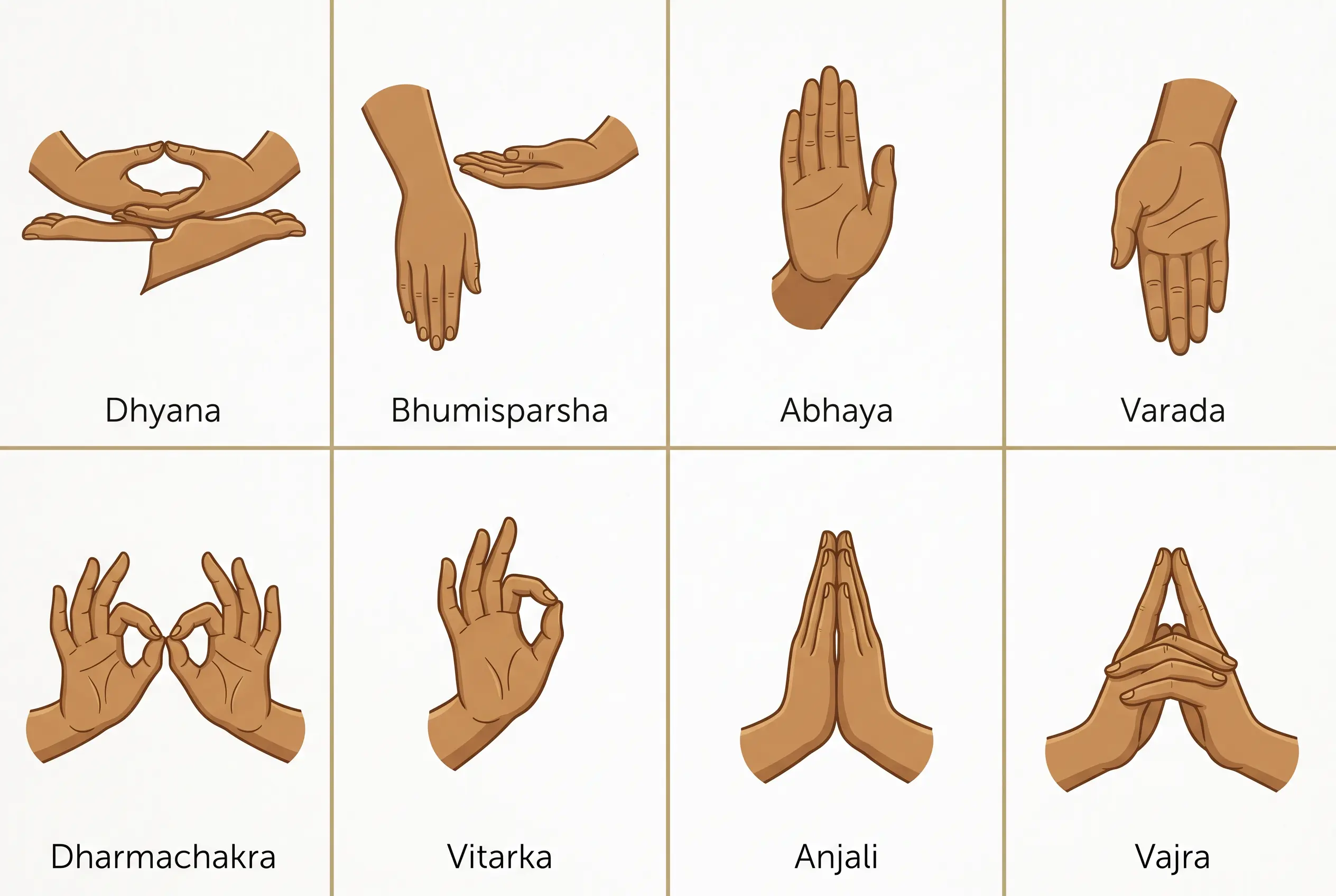
Five main mudras cover nearly every Buddha statue: abhaya, dharmachakra, bhumisparsha, varada and dhyana. A few close variations add three more. The chart below covers all eight.
| Mudra | Hand position | Meaning | Best for |
|---|---|---|---|
| Dhyana | Both hands in lap, palms up | Meditation, concentration | Meditation corner |
| Bhumisparsha | Right hand reaches to the earth; left in lap | Resolve; earth as witness | Study, desk, altar |
| Abhaya | Right palm raised, facing out | Fearlessness, protection | Entryway |
| Varada | Open hand lowered, palm out | Giving, compassion | Often paired with abhaya |
| Dharmachakra | Both hands at chest, thumb and index finger touch | Turning the Wheel of Dharma (first sermon) | Study space |
| Vitarka | One hand at chest, thumb and index finger form a circle | Teaching, discussion | Home office |
| Anjali | Palms pressed together at chest | Greeting, reverence | Devotional space |
| Vajra | Right fist grips raised left index finger | Unity of wisdom and method | Collectors (esoteric) |
How do you identify a mudra in 10 seconds?
Check three things in order: where the right hand is, which way the palm faces, and whether the fingers form a circle.
- Right hand reaches the ground? It is bhumisparsha.
- Both hands rest in the lap? It is dhyana.
- Palm faces out and is raised? It is abhaya. Lowered? It is varada.
- Thumb and finger circle at the chest? One hand is vitarka; two hands are dharmachakra.
- Palms joined? It is anjali.
Standing statues often combine two mudras: abhaya in the right hand and varada in the left.
What is the difference between bhumisparsha and dhyana mudra?
In dhyana, both hands rest in the lap. In bhumisparsha, only the left hand stays there, while the right reaches down to touch the earth. One shows absorption; the other shows victory over doubt.
Which mudra belongs to each of the Five Dhyani Buddhas?
In Vajrayana Buddhism, each of the five Dhyani Buddhas (the “wisdom Buddhas”) is identified by one mudra. The hand gesture alone can tell you which one a Tibetan or Nepalese statue shows. Colors and directions vary slightly between lineages.
| Dhyani Buddha | Mudra | Direction | Color |
|---|---|---|---|
| Vairocana | Dharmachakra | Center | White |
| Akshobhya | Bhumisparsha | East | Blue |
| Ratnasambhava | Varada | South | Yellow |
| Amitabha | Dhyana | West | Red |
| Amoghasiddhi | Abhaya | North | Green |
What does the earth-touching Buddha statue mean?
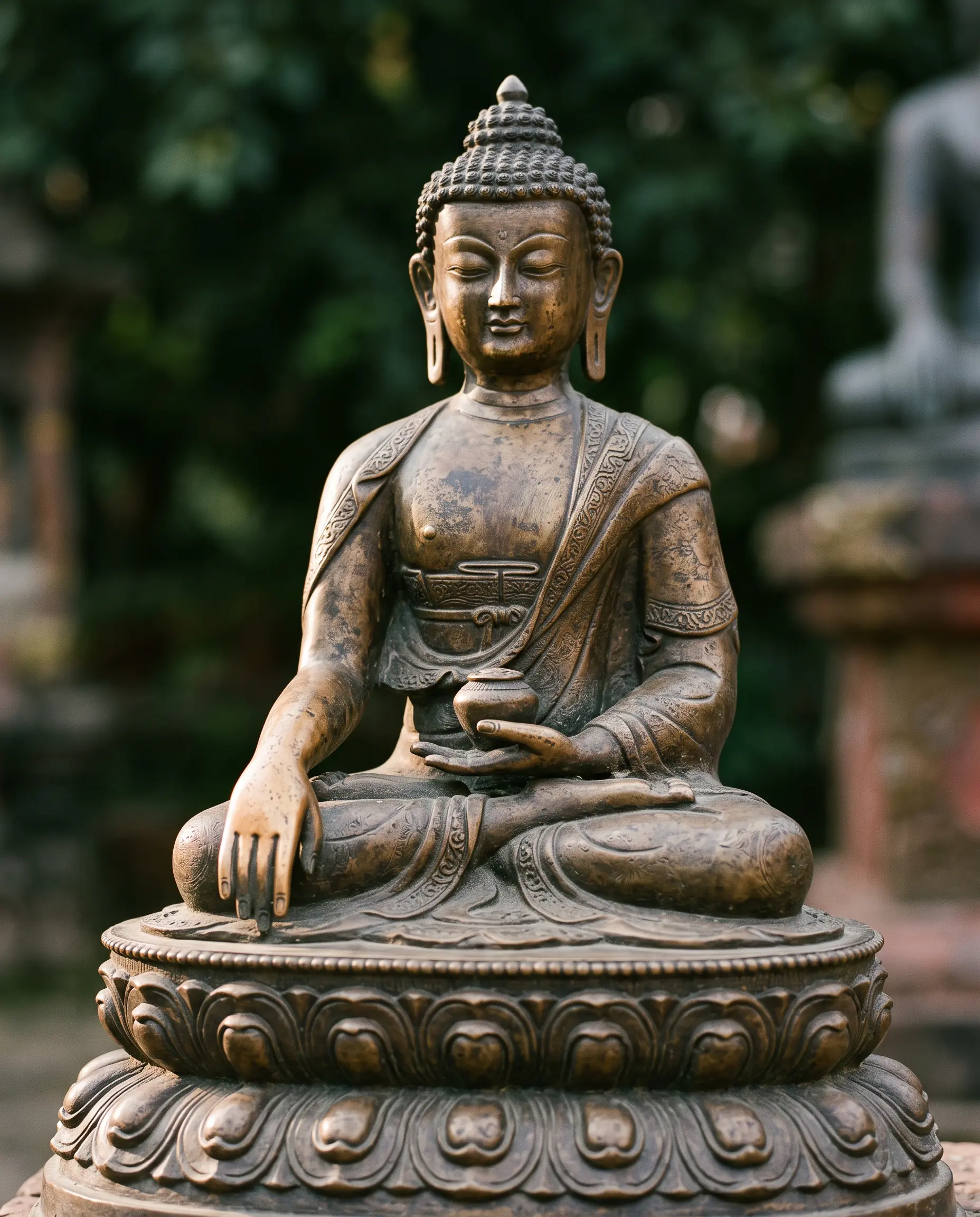
The earth-touching Buddha shows Siddhartha seated under the Bodhi tree, his right hand reaching down to call the earth as witness to his right to awaken. The gesture is called bhumisparsha, from bhumi (earth) and sparsha (touch). The Metropolitan Museum of Art describes it as the response to the demon Mara, which called the earth goddess to witness his right to enlightenment.
| Attribute | Value |
|---|---|
| Hand position | Right hand over right knee, fingers toward the ground |
| Moment shown | Just before enlightenment at Bodh Gaya |
| Symbolism | Unshakable resolve; victory over Mara |
| Also called | Earth-witness mudra; Maravijaya (Thai) |
What is the story behind the earth-touching gesture?
When Mara challenged Siddhartha’s right to the seat of enlightenment, Siddhartha touched the ground, and the earth itself answered. Mara’s armies then dispersed. Southeast Asian art adds a detail: the earth goddess Phra Mae Thorani wrings water from her hair, and the flood washes Mara’s army away. Treat the episode as sacred legend, not recorded history.
Where does the earth-touching story come from?
The earth-witness episode is missing from the earliest Buddhist texts. It appears in written accounts in the early centuries CE, around the same time sculptors in Gandhara carved the gesture in stone.
| Source | Approximate date | Earth-witness scene? |
|---|---|---|
| Earliest Pali suttas | Earliest layer | Absent |
| Xiu xing benqi jing (Chinese translation) | 197 CE | Present |
| Lalitavistara | About 3rd century CE | Present |
| Jataka-nidana (Pali) | About 5th century CE | Present, most dramatic form |
Scholar Douglass Smith traces the gesture through eight early textual accounts in a 2023 study. He also weighs the argument that it grew from Greek oath-making gestures carried into India through Gandhara, and he points to older Indian roots as well. In summary, the gesture is far younger than the Buddha himself, yet it became the best-known symbol of his awakening.
How do you tell an earth-touching Shakyamuni from Akshobhya?
Both make the identical gesture. A vajra on the pedestal, or blue coloring in paintings, marks Akshobhya; a plain base marks Shakyamuni. The Walters Art Museum notes that without the vajra, its Tibetan bronze of Akshobhya would be easy to mistake for the historical Buddha. Akshobhya’s name means “Unshakable.”
What is a Maravijaya Buddha in Thailand?
Maravijaya (“victory over Mara”) is the Thai name for the seated earth-touching Buddha. The Walters holds a 14th-century Sukhothai example. Thai versions often rest the hand loosely on the knee, with eyes cast down.
Is an earth-touching Buddha statue good for your home?
Yes. This statue suits an altar, study or desk because it stands for steadiness, not a request for luck. When you shop at ShaoLinStore, check that the right hand clearly reaches the ground and stays visible from your main viewing angle.
What do the Thai day-of-the-week Buddha postures mean?
In Thailand, each weekday has its own Buddha posture, and your image follows the day of the week you were born, not your birth date. This makes a thoughtful, culturally grounded gift.
| Birth day | Thai name | Posture |
|---|---|---|
| Sunday | Pang Thawai Net | Standing, hands crossed at the waist |
| Monday | Pang Ham Yati | Standing, right palm raised |
| Tuesday | Pang Sai Yat | Reclining |
| Wednesday (day) | Pang Umbat | Standing with alms bowl |
| Wednesday (night) | Pang Pa Lelai | Seated with elephant and monkey |
| Thursday | Pang Samathi | Seated meditation |
| Friday | Pang Ram Phueng | Standing, arms crossed on chest |
| Saturday | Pang Nak Prok | Seated under a Naga (serpent) hood |
Sources split Wednesday at noon or at dusk, so confirm with the seller. The earth-touching Maravijaya is not part of this weekday set.
What size Buddha statue should you choose?
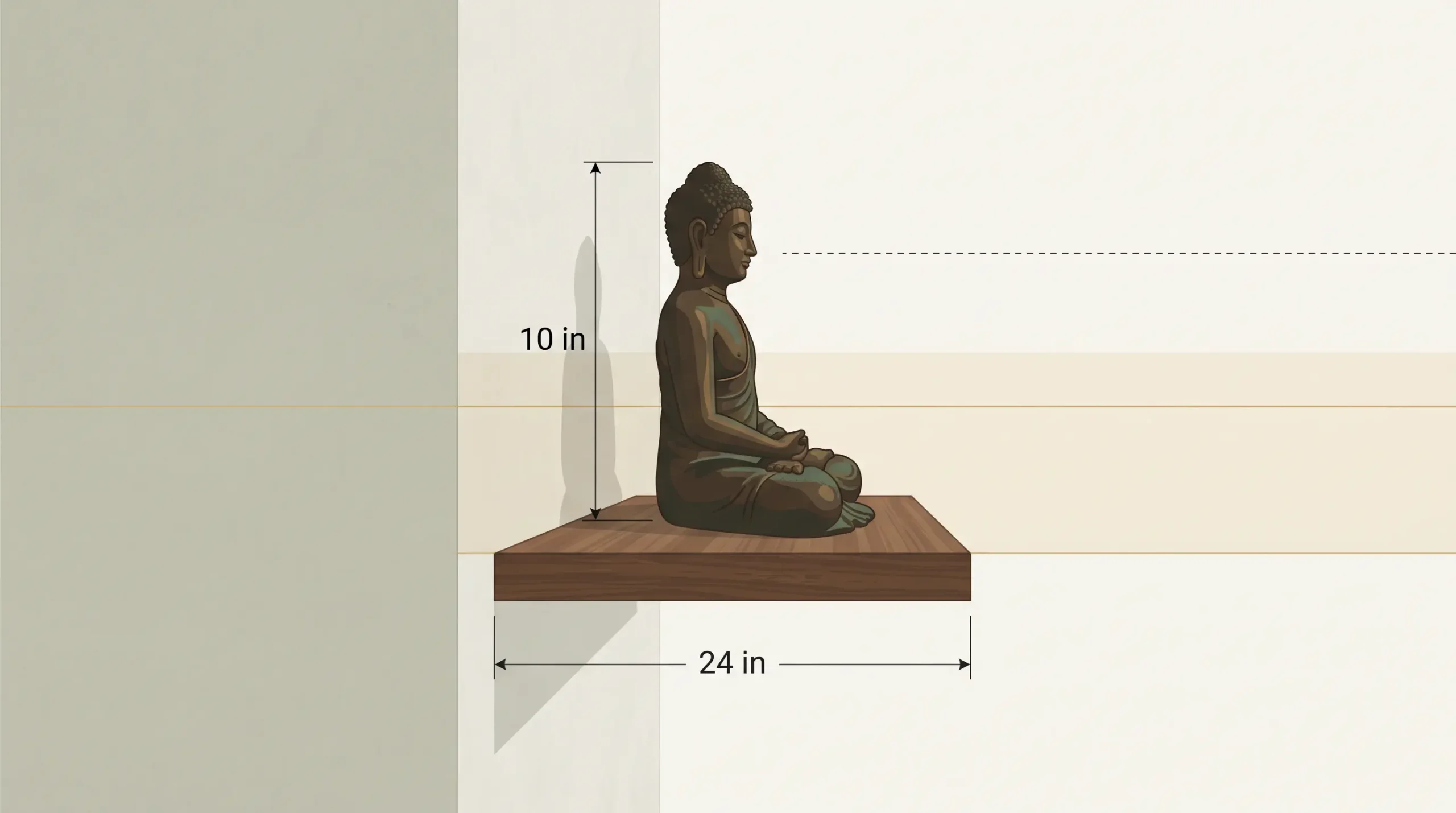
Choose a Buddha statue by placement: 8–14 inches (20–36 cm) fits most home altars. Guides disagree on size because they measure different surfaces. A proportion rule settles it.
Our rule of thumb: statue height should equal one-third to one-half of the surface depth. A 60 cm deep shelf takes a 20–30 cm statue.
| Placement | Recommended height | Key rule |
|---|---|---|
| Desk or bedside table | 3–5 in (7–13 cm) | Face and hands must read clearly up close |
| Bookshelf or windowsill | 5–8 in (13–20 cm) | Leave 2–3 in above the head |
| Home altar or shelf | 8–14 in (20–36 cm) | Face at or above seated eye level |
| Butsudan (Japanese altar cabinet) | 6–14 in (15–35 cm) | Measure interior height, depth, door clearance |
| Entryway | 10–18 in (25–46 cm) | Visible as you enter |
| Floor focal point, on a stand | 20–30 in (51–76 cm) | Eyes at standing eye level |
| Garden | 24 in (60 cm) and up | Stone or weatherproof, on a plinth |
Elevation matters more than size. A small statue raised high reads larger than a big one on the floor. Leave 2–4 inches (5–10 cm) of clear space on each side of the base. A bigger statue is not more powerful or more correct. The figure and mudra carry the meaning.
What size Buddha statue is best for a small apartment?
A statue of 4–10 inches (about 12–25 cm) fits shelves, desks and windowsills without crowding a small room. Under 4 inches, it tends to vanish among books. Pick a wide, flat base if you have pets.
What size Buddha statue makes a good gift?
Choose a 5–8 inch seated Buddha in meditation mudra as a gift. It fits any shelf and needs no altar. Skip detached Buddha heads, which some Buddhists find disrespectful.
How big are the world’s largest Buddha statues?
The tallest is the Spring Temple Buddha in Henan, China, at 128 meters (420 ft) including its lotus throne. That is roughly 400 times taller than a 12-inch altar statue.
Which material should your Buddha statue be made of?
Material changes durability, weight and feel, not meaning. The figure and mudra carry the symbolism, so choose material by where the statue will live.
| Material | Durability | Weight | Best setting |
|---|---|---|---|
| Bronze | Very high; develops patina | Heavy | Altar, heirloom |
| Brass | High | Heavy | Indoor altar, entryway |
| Wood | Moderate; can crack in dry heat | Light | Meditation room |
| Stone | Very high; weatherproof | Very heavy | Garden, courtyard |
| Resin | Moderate; fades in strong sun | Light | Budget décor, small spaces |
The short answer: stone for outdoors, bronze for a lasting altar, resin or wood for a small rental.
Where should you place a Buddha statue, and is it disrespectful to own one?
Place a Buddha statue on a clean, raised surface with its face at or above eye level, never on the floor or in a bathroom. This rule recurs across traditions.
- Height: raised, with the face at or above seated eye level.
- Avoid: floors, bathrooms, cluttered shelves, spots beside ashtrays or alcohol.
- Direction: east or northeast is a Vastu (Indian architecture) tradition. Vastu and feng shui sources contradict each other, so treat direction as optional.
Owning a statue as a non-Buddhist is widely considered fine when you treat it as a sacred image, not a novelty.
Which Buddha statue should you choose for your purpose?
Start with your purpose, then match the mudra, then the size. The table below turns that into a quick decision.
| Purpose | Statue | Size | Material |
|---|---|---|---|
| Daily meditation | Seated, dhyana mudra | 6–14 in | Bronze or wood |
| Resolve, study, new beginnings | Earth-touching Shakyamuni | 6–12 in | Bronze or brass |
| Protection at an entryway | Standing, abhaya mudra | 10–18 in | Brass or stone |
| Joy and abundance décor | Budai (Laughing Buddha) | 6–10 in | Resin or brass |
| Garden focal point | Seated meditation | 24 in and up | Stone |
| Birth-day gift (Thai custom) | Weekday posture | 5–8 in | Brass |
Bottom line: the right Buddha statue is the one whose gesture matches your intention and whose size lets its face meet your eyes. Measure your surface, read the mudra, then browse ShaoLinStore with both in hand.
❓ Frequently Asked Questions
Smarthistory lists abhaya (fearlessness) as the most common of five main mudras. The others are dharmachakra, bhumisparsha, varada and dhyana. Dhyana and bhumisparsha suit home altars well.
The right hand reaches over the right knee toward the earth, while the left rests palm-up in the lap. If both hands are in the lap, it is the meditation (dhyana) mudra instead.
Yes. Bhumisparsha means “touching the earth,” and “earth witness” describes what the gesture does in the story. Museums use both names for the same pose.
Generally no, if you treat it as a sacred image. Keep it clean and raised, and keep it out of bathrooms. Be careful with Buddha-head décor, which some Buddhists find disrespectful.
No. Choose a size that fits your space and keeps the face at or above eye level. The mudra and the figure carry the meaning, not the height or price.
📚 References
- Earth-touching meaning: The Met’s catalog entry explains how the gesture called the earth goddess to witness the Buddha’s right to enlightenment. The Metropolitan Museum of Art – Plaque with Scenes from the Life of the Buddha
- Shakyamuni vs. Akshobhya: The Walters explains how a vajra on the pedestal identifies Akshobhya in the earth-touching gesture. The Walters Art Museum – Buddha Akshobhya
- Maravijaya posture: A 14th-century Sukhothai image shows the Thai earth-touching pose and its meaning. The Walters Art Museum – Seated Buddha in “Maravijaya”
- Origins of the gesture: Douglass Smith’s 2023 study examines the early textual and artistic roots of the earth-touching gesture. The Indian International Journal of Buddhist Studies, Vol. 22 (Linfield University)
- Mudra basics: A concise guide to what common Buddhist mudras mean. Tricycle: The Buddhist Review – What Is a Mudra in Buddhism?
Royal Ease Guanyin Statue: Meaning, History & How to Choose - ShaoLin Store
[…] size-to-surface rules that apply to every statue, see our guide to types of Buddha statues and the right size. For room-by-room layout, our feng shui for beginners guide for Western homes covers entryways, […]