
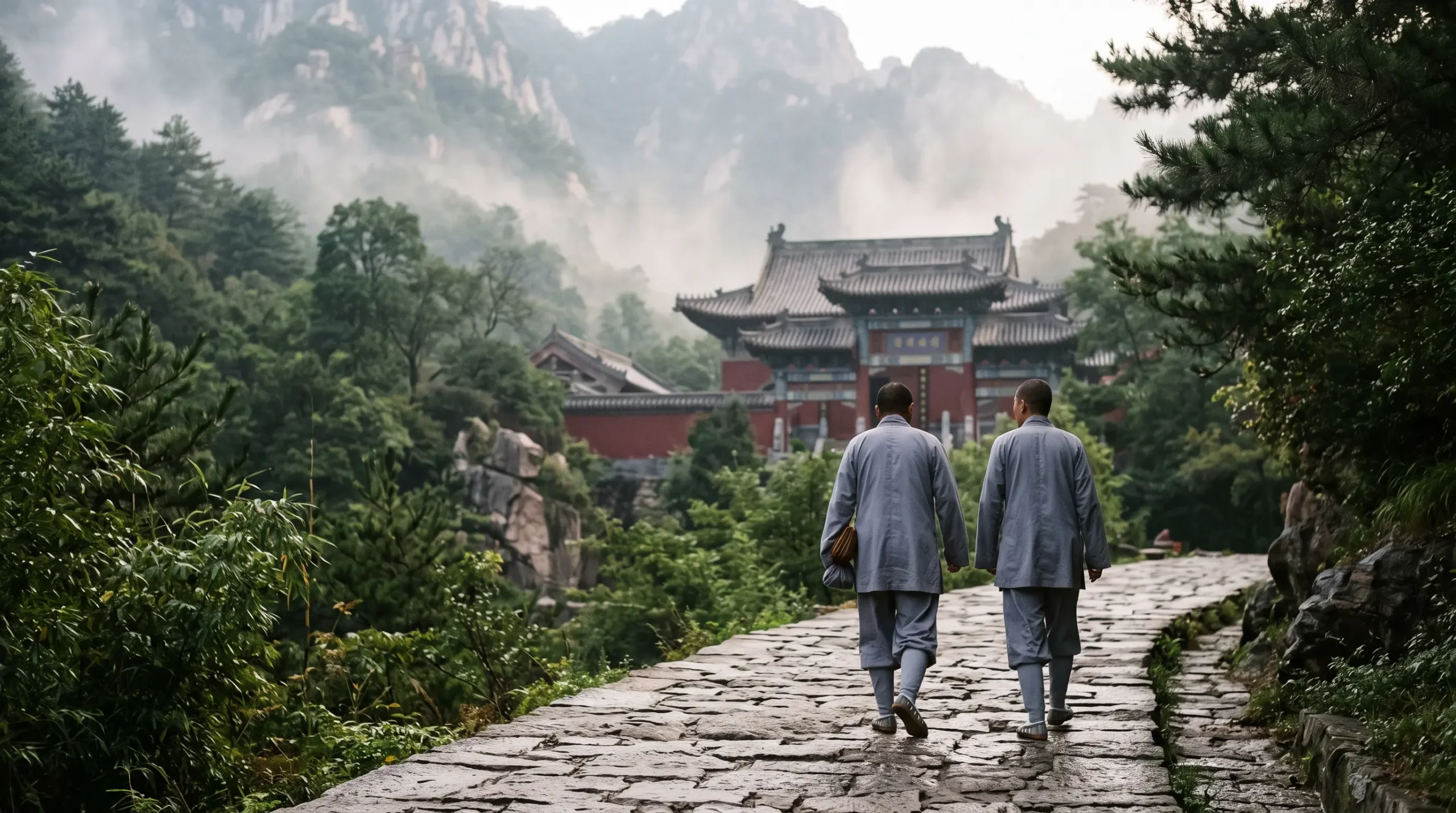
Shaolin monks are real. Chinese media reports put the community at the Shaolin Temple at roughly 200-300 people, and the temple is still an active Chan Buddhist monastery in Henan, China. It was founded in 495 CE.
But the bright orange robe you may picture? That is usually not Shaolin. Real Shaolin monks mostly wear grey. Orange belongs to Theravada monks in Thailand and Sri Lanka, and to stage performers. At ShaoLinStore, we love real Shaolin culture, so let’s sort fact from costume.
The short answer is: Shaolin monks exist, many “Shaolin monks” you see on stage are not ordained, and monks wear orange because of ancient Buddhist dye rules. Shaolin monks themselves wear mostly grey.
Are Shaolin Monks Real?
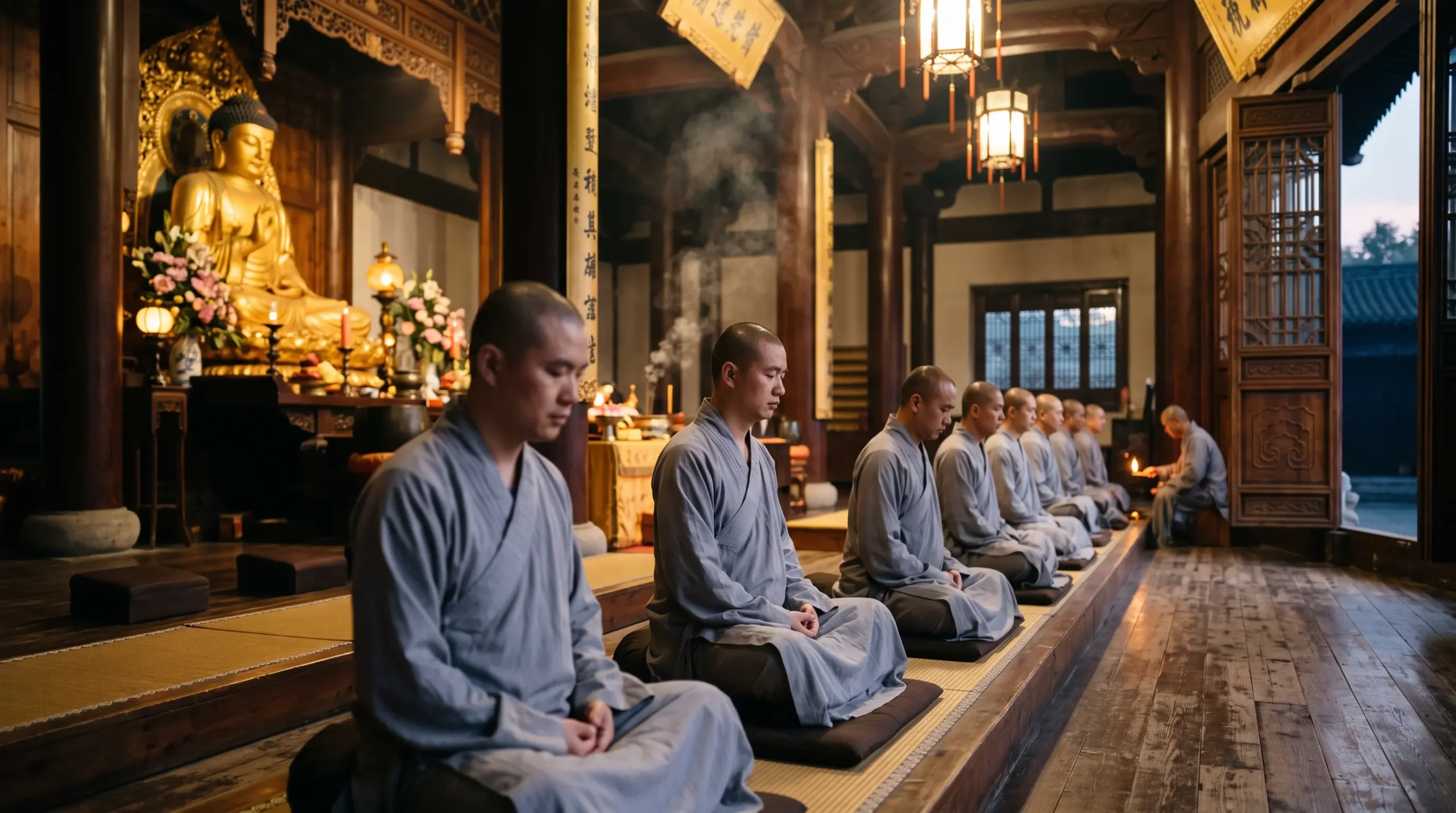
Yes, Shaolin monks are real: an active community of roughly 200 to 300 Chan Buddhist monks and trainees lives at the Shaolin Temple on Mount Song. Chan is the Chinese name for Zen.
Not everyone in that group is the same, though. It helps to think of three groups:
- Ordained monks. A bhikkhu is a fully ordained Buddhist monk. These men follow the monastic precepts, meditate, and study scripture.
- Warrior-monk troupe members. These are young men who train and perform kung fu. Many are novices, not fully ordained monks.
- Lay students. These people train kung fu near the temple but are not monks at all.
| Entity | Attribute | Value |
|---|---|---|
| Shaolin Temple | Status | Active Chan Buddhist monastery |
| Resident community | Size (Chinese media reports) | About 200-300 people |
| Warrior-monk corps | Size (Chinese media reports) | About 100 people |
Treat these numbers as estimates. Counts change over time, and no official headcount is published. The most important thing to remember is that the monks are real, but the label “Shaolin monk” covers very different people.
What does daily life look like? Monastic life centres on chanting, meditation, study and work. Kung fu is a practice that supports Chan, not the whole day. So if you picture monks fighting all hours, the reality is much quieter.
Maybe you just watched a kung fu film or a touring show and wondered if it was all staged. Part of it is. The costumes, the lighting and the flying kicks are made for the stage. The temple, the vows and the monastic routine are not.
How Old Is the Shaolin Temple, and Where Is It?
The Shaolin Temple is about 1,500 years old. According to Britannica, construction began in 495 CE on the orders of Emperor Xiaowendi of the Northern Wei dynasty.
The temple sits on the slopes of Mount Song, one of China’s five sacred mountains, near the city of Dengfeng in Henan province. Many of today’s buildings date from the Ming and Qing dynasties. The nearby Pagoda Forest holds burial towers for eminent monks.
Why does this temple matter so much? Britannica calls it the birthplace of Zen Buddhism, and notes that Indian scriptures were translated into Chinese there. In other words, Shaolin was a centre of learning long before it was a kung fu brand.
UNESCO lists the Shaolin complex, including its main compound, the Chuzu Temple and the Pagoda Forest, as part of the Dengfeng World Heritage property. That recognition came in 2010, under the 34th session of the World Heritage Committee.
| Entity | Attribute | Value |
|---|---|---|
| Shaolin Temple | Founded | 495 CE |
| Location | Region | Mount Song, near Dengfeng, Henan |
| UNESCO listing | Year | 2010 (as part of Historic Monuments of Dengfeng) |
Did Bodhidharma Really Invent Shaolin Kung Fu?
Probably not. The story says the Indian monk Bodhidharma (also called Damo) arrived around 527 CE, meditated in a cave for nine years, and taught the monks martial arts. Historians treat that last part as a late legend.
The Bodhidharma-taught-boxing tale became popular much later than the monk’s lifetime. It is a great story. It is not good evidence.
Did Shaolin Monks Really Fight in Battles?
Yes. A stone tablet at Shaolin, the Shaolin Monastery Stele of 728 CE, records that monks helped the future Tang emperor Li Shimin in a campaign around 621 CE.
The tablet names about 13 monks and says they captured a rival warlord’s nephew. That is real history. But the tablet does not describe a Shaolin fighting style. The famous “Shaolin boxing” systems appear in records much later.
| Claim | What the evidence shows |
|---|---|
| Monks fought for the Tang | Supported by the 728 CE stele |
| Bodhidharma taught kung fu | Late legend, not early evidence |
| A named Shaolin fighting style in 621 CE | Not described on the stele |
To put it simply, Shaolin monks did fight at least once. The detailed kung fu system grew over the following centuries.
This matters for the “real or fake” question. The warrior-monk reputation has a real root, but it was polished by later stories, novels and films. When someone tells you Shaolin fighting methods are 1,500 years old and unchanged, ask for the source.
Why Do People Think Shaolin Monks Are Fake?
People doubt Shaolin monks because the temple’s story was broken and rebuilt. It was burned in 1928, emptied during the Cultural Revolution, and revived as a tourist and kung fu brand from the 1980s on.
- 1928 fire. The warlord Shi Yousan set fire to the temple, and fire burned for about 40 days. Most buildings were badly damaged, and scriptures were lost.
- Cultural Revolution. Only a small number of elderly monks remained. Sources give very different counts, so be careful with claims like “only three monks survived.”
- The 1982 film. The Shaolin Temple, starring Jet Li, sparked a kung fu craze. Schools and shows multiplied around Dengfeng.
- Touring troupes. Performers in monk-style costumes tour the world. Many are athletes, not ordained monks.
Commercial growth added to the confusion. Reports from the early 2000s counted thousands of students at kung fu schools around Dengfeng. Some schools use the Shaolin name freely, even though they have no link to the temple’s monastic community.
| Entity | Attribute | Value |
|---|---|---|
| Temple fire | Year | 1928 |
| Film The Shaolin Temple | Release year | 1982 |
| World Heritage inscription | Year | 2010 |
What Happened to Shaolin Abbot Shi Yongxin?
Shi Yongxin, abbot of the Shaolin Temple since 1999, was sentenced to 24 years in prison on 29 May 2026. China Daily reports that a court found he embezzled more than 131 million yuan between 2003 and 2025.
The Buddhist Association of China revoked his ordination certificate in July 2025. The temple had also said he broke Buddhist precepts through improper relationships. He was fined 3.5 million yuan.
Does this prove the monks are fake? No. It shows the opposite: the institution is real, and it can be investigated and held accountable. It does show how commercial the Shaolin brand became.
What Is the Difference Between a Shaolin Warrior Monk and an Ordained Shaolin Monk?
An ordained Shaolin monk lives by full Buddhist precepts, while a warrior monk (wuseng) is mainly a kung fu trainee or performer. Many warrior monks are novices or lay disciples, not fully ordained monks.
| Type | Main focus | Ordination | Diet |
|---|---|---|---|
| Ordained monk | Meditation, scripture, ritual | Full precepts | Vegetarian |
| Warrior-troupe member | Kung fu training and shows | Often novice or lay | Varies |
| Outside school instructor | Teaching kung fu | Varies | Varies |
This explains the “meat-eating Shaolin monk” stories. Those people are usually warrior trainees or former students, not ordained temple monks.
Choosing a teacher? A real Shaolin-trained teacher should be able to name their master, their training years, and their ordination status. Vague answers are a warning sign.
Why Do Monks Wear Orange?
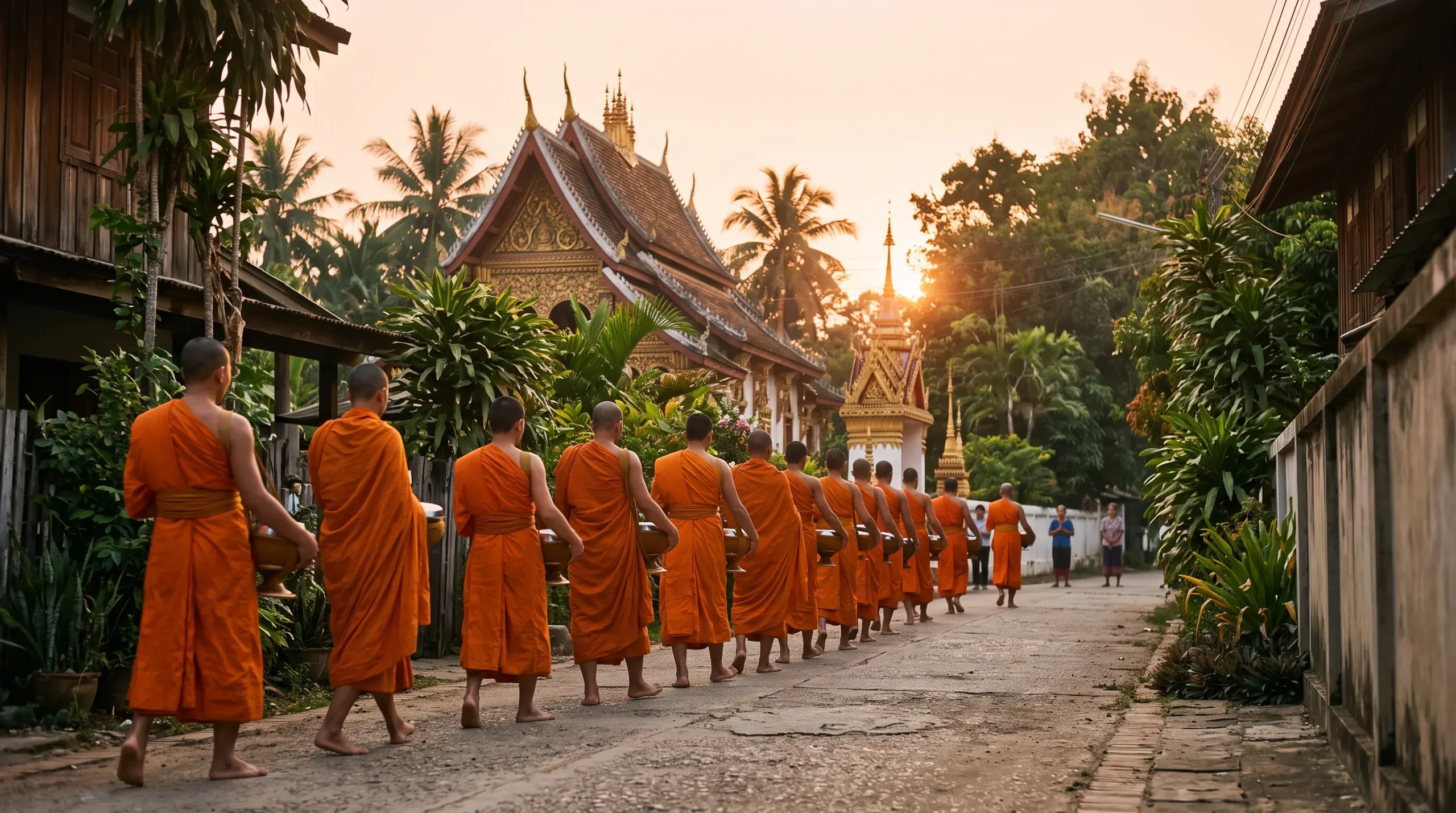
Monks wear orange because early Buddhist rules told them to make robes from discarded cloth and dye it with plain plant-based dyes. That dyeing gave a yellow-orange saffron colour that Theravada monks still wear today.
The Sanskrit word kasaya (Chinese jiasha) means the robe of a Buddhist monk. According to Wikipedia, the word comes from a brown or saffron dye. The colour was practical first: cheap local dyes, and a shade that hid stains.
The story goes back to the Buddha’s time. Early monks wore rag robes sewn from cloth that others threw away. Later, the Buddha is said to have asked for a robe pattern that looked like rows of rice paddy fields. That pattern became the triple robe, the three-piece set Theravada monks still wear.
Why do some monks wear red or maroon instead? Dyes differ by region. Burmese monks often wear deep red-brown, and Tibetan monks wear maroon. Wikipedia even notes that Chinese monks in the earlier Han-Wei period typically wore red. Colour changed with place and time.
| Entity | Attribute | Value |
|---|---|---|
| Kasaya | Name origin | A brown or saffron dye |
| Early robe cloth | Source | Discarded rags |
| Common dye sources | Examples | Bark, roots, flowers, turmeric |
| Theravada robes | Typical colour | Saffron or ochre |
What Does the Orange Robe Symbolize?
The orange robe symbolizes renunciation, which means giving up worldly status and wealth. ReligionFacts notes that Theravada monks wear these simple robes to follow the Buddha’s humble style and show detachment from the physical world.
Hindu holy men also wear saffron. That is a separate tradition, linked to fire and sacrifice. Don’t mix the two up.
Do Shaolin Monks Wear Orange?
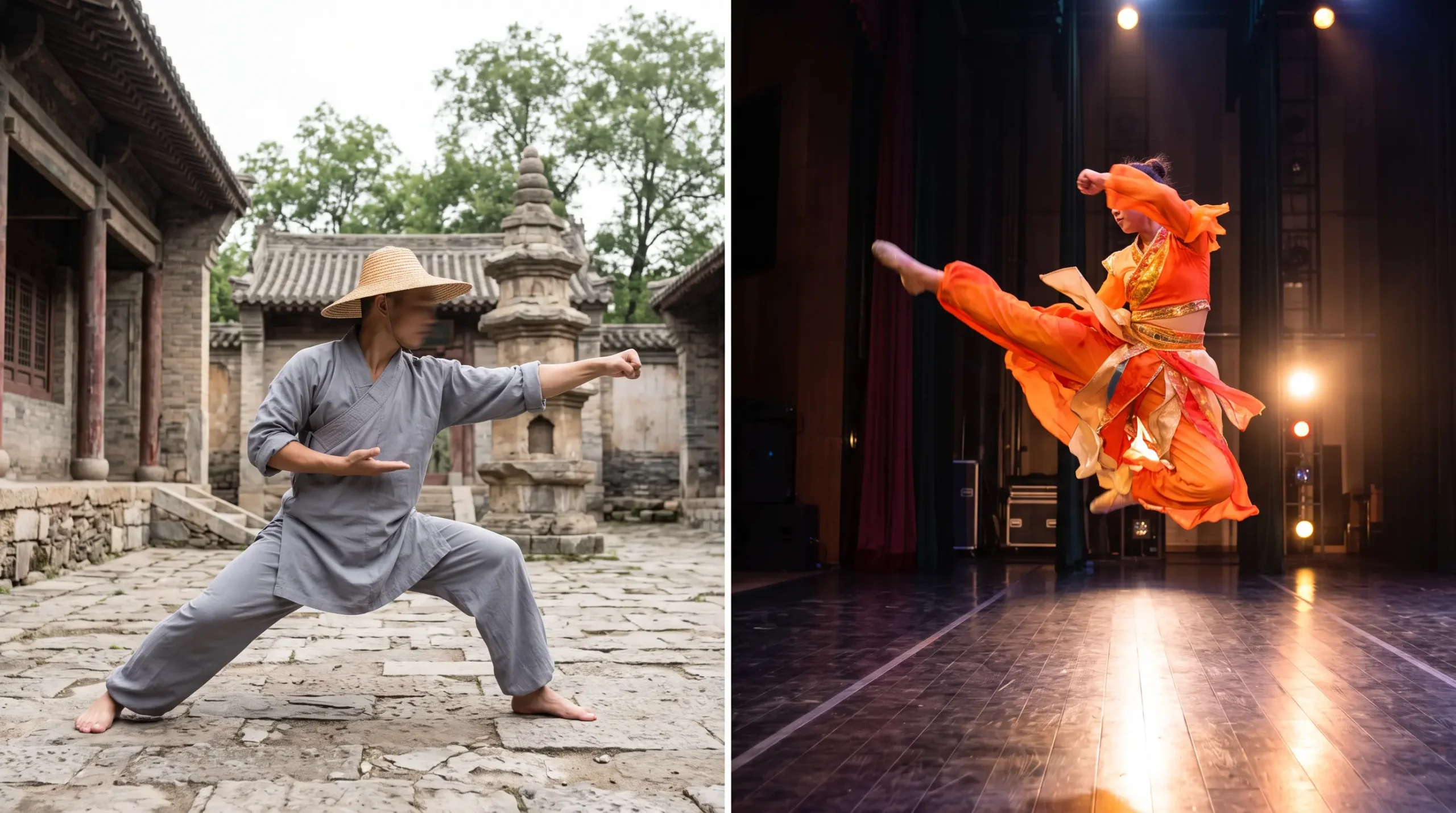
Mostly no. Shaolin monks wear grey for daily training and work, and dark or yellow Chinese Buddhist robes for ceremonies. Bright orange is mainly a performance colour.
Shaolin follows Chinese Mahayana dress, not Theravada dress. Mahayana is the Buddhist branch common in China, Korea and Japan. Wikipedia notes that Tang-dynasty Chinese monks wore grayish-black robes and were nicknamed Ziyi, “those of the black robes.”
| Item | Typical colour | When worn |
|---|---|---|
| Training suit | Grey | Daily life and kung fu practice |
| Formal robe | Black, dark, or yellow | Ceremonies and services |
| Kasaya over the shoulder | Varies | Ordained monks, rituals |
| Bright orange robe | Orange | Stage shows |
One caution. Some online shops and schools list a strict “rank colour” system for Shaolin robes. Those lists contradict each other. Treat them as one source’s opinion, not settled fact.
Why the confusion? According to Wikipedia, the colours of Chinese monastic robes often matched the region, not a specific school. So no single “official Shaolin colour” ever applied across all of China. Grey became the practical, everyday choice.
Want the everyday Shaolin look? A plain grey training uniform is the closest match to what monks wear in practice. You can browse Shaolin-style training wear at ShaoLinStore.
What Should You Wear for Shaolin-Style Training?
For training, choose a loose, breathable cotton uniform in grey or a similar muted colour. It lets you stretch, kick and move freely. Orange looks striking, but it is a stage colour, not a training standard.
Here is a simple way to decide:
- Training at home or in class: grey or dark, loose-fitting cotton.
- Performing or costume use: orange or bright colours are fine. Just know they are theatrical.
- Gift for a martial arts student: pick a classic grey set in their size, with room to move.
Why Do Shaolin Monks Look Orange in Movies and Shows?
Shaolin performers wear orange because it reads as “monk” to Western audiences and stands out under stage lights. It is not what the temple’s monks wear day to day.
Ticket pages for touring shows often describe performers in flowing orange robes. That image then spreads, and many people assume it is standard Shaolin dress.
Which Monks Wear Which Robe Colors?
Robe colour usually tells you a monk’s tradition: saffron points to Theravada, maroon to Tibetan Buddhism, and grey or black to East Asian Mahayana, the family Shaolin belongs to.
This helps if you travel. Seeing orange robes in Bangkok or Luang Prabang? You are almost certainly looking at Theravada monks. Seeing grey robes in a Chinese temple? That fits the Chinese tradition.
| Tradition | Main robe colour | Where you’ll see it |
|---|---|---|
| Theravada | Saffron, orange, ochre | Thailand, Laos, Cambodia, Sri Lanka |
| Tibetan Vajrayana | Maroon and yellow | Tibet, Bhutan, Nepal |
| Chinese Mahayana (incl. Shaolin) | Grey, brown, black, yellow | China, Taiwan |
| Korean Seon | Grey | Korea |
| Japanese Zen | Black or grey | Japan |
Colours vary by temple, climate and ceremony. Use this table as a guide, not a rulebook.
How Can You See Real Shaolin Monks (and Avoid Fakes)?
The surest way to meet real Shaolin monks is to visit the temple in Dengfeng, Henan. Expect crowds, since the site is also a major tourist destination.
Plan for a ticketed scenic area, not a silent retreat. Travel guides describe Shaolin as heavily commercialized, with kung fu demonstrations scheduled through the day. The quieter Pagoda Forest nearby is a good place to slow down. If you want deeper contact with monastic life, look for official programmes, not street offers.
Be careful with “monks” in orange robes who approach you in Western cities. People pretending to be monks, selling amulets or pushing for cash, have been documented in several countries. This is often called the monk scam.
Use this quick checklist:
- Check the setting. Real monks live in temples. They do not usually stop strangers on the street.
- Watch for money pressure. Real monks do not sell blessings or demand cash.
- Ask about lineage. A genuine teacher can name their master and training.
- Compare the robe. Orange robes on a “Shaolin” claim are a red flag.
| Entity | Attribute | Value |
|---|---|---|
| Shaolin Temple visit | Where | Dengfeng, Henan |
| Street “monk” scam | Typical sign | Pressure for cash or amulet sales |
| Genuine teacher | Can provide | Master’s name and ordination status |
Conclusion: What to Remember About Shaolin Monks and Orange Robes
In summary, Shaolin monks are real, documented since 495 CE, and still living on Mount Song. Not every performer in a monk costume is ordained, and the orange robe belongs mainly to Southeast Asian Theravada monks and the stage.
Here are the key points to keep:
- Real: an active Shaolin monastic community of roughly 200-300 people lives on Mount Song.
- Mixed: ordained monks, warrior-troupe members and lay students are three different groups.
- Orange: saffron robes come from early Buddhist dye rules and mark Theravada monks.
- Grey: everyday Shaolin dress is grey, with dark or yellow robes for ceremonies.
- Caution: be wary of street “monks” asking for money, and of rigid “rank colour” charts.
If you want the real thing, look for grey. And if you want to bring some authentic Shaolin style home, ShaoLinStore is a good place to start.
❓ Frequently Asked Questions
Ordained monks living inside the Shaolin Temple follow a vegetarian diet. Some troupe members and former students who run outside schools do eat meat, because they are not fully ordained.
Yes. Fully ordained Shaolin monks take a vow of celibacy and do not marry. Lay disciples and many troupe members are not ordained, so that vow does not apply to them.
Yes, but it is rare. Many schools near the temple train foreign students, yet full ordination is selective. Italian-born Shi Yan Fan is often cited as the first Westerner ordained as a Shaolin monk.
No. Orange or saffron is typical of Theravada monks in Southeast Asia and Sri Lanka. Tibetan monks wear maroon, Japanese Zen monks wear black or grey, and Chinese monks, including Shaolin monks, mostly wear grey, brown, black or yellow.
Yes. The Shaolin Temple is a Chan (Zen) Buddhist monastery, and its monks follow Buddhist precepts.
📚 References
- Temple history and founding date: Britannica’s overview of the Shaolin Temple, including its 495 CE founding, Mount Song setting and Ming-Qing buildings. Britannica – Shaolin Temple
- World Heritage status: Official UNESCO page for the Historic Monuments of Dengfeng, which includes the Shaolin Temple complex. UNESCO World Heritage Centre
- Origin and meaning of the kasaya robe: Overview of Buddhist robes, their dye origins and Chinese robe colours. Wikipedia – Kasaya (clothing)
- Robe colours by tradition: Guide to Theravada, Mahayana and Vajrayana monastic robes. ReligionFacts – Monastic Robes
- Abbot Shi Yongxin’s sentencing: Court findings and timeline reported by China Daily. China Daily via Henan Government – Shaolin ex-abbot gets 24 years