
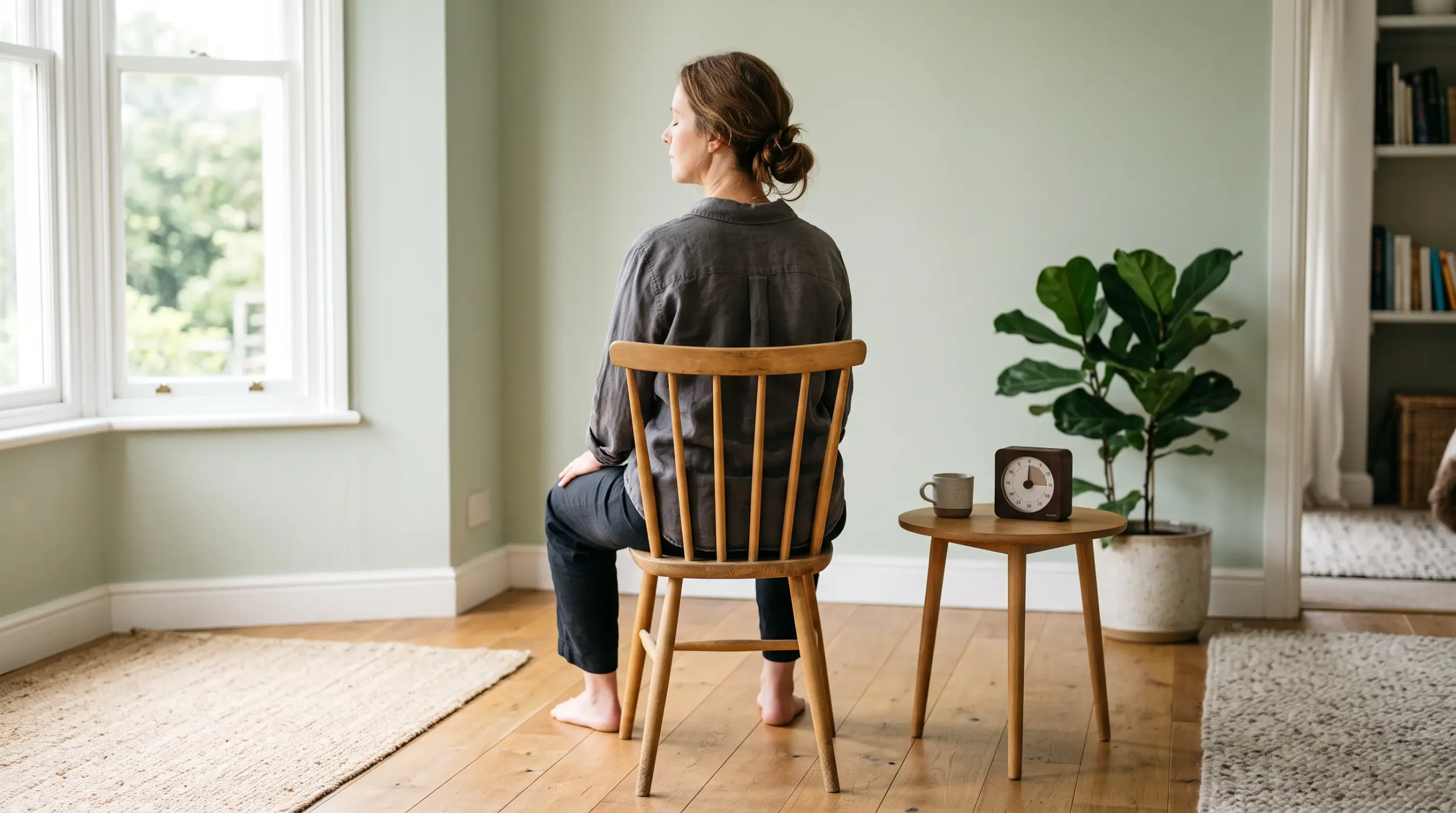
To meditate at home as a beginner, you need a chair, a timer, and your breath. Sit upright, set the timer for 10 minutes, follow your breathing, and gently return whenever your mind drifts.
Your mind will drift often. A Harvard study of 2,250 adults found that people’s minds wander 46.9% of their waking hours. Noticing the drift is the exercise, not a sign you are failing.
At ShaoLinStore, we believe the best home meditation setup is the one you will actually use. This guide covers your space, your posture, and a minute-by-minute script for your first session.
What Do You Need to Meditate at Home?
Home meditation needs three things: a timer, a stable seat, and one point of focus, usually your breath.
Mindfulness meditation is the practice of paying attention to the present moment without judging it. Mayo Clinic says most forms share four features: a quiet setting, a comfortable position, focused attention, and an open attitude.
Skip the incense, special clothes, and perfect silence. You can add them later if you enjoy them. The NHS agrees that you need no specialist equipment, only somewhere comfortable and warm to sit.
| Item | Role | Essential? |
|---|---|---|
| Timer | Ends the session so you stop checking the clock | Yes |
| Chair or floor seat | Keeps your spine upright | Yes |
| Breath as focus point | Gives your attention a home base | Yes |
| Cushion or folded blanket | Lifts your hips for floor sitting | Optional |
| Guided audio | Adds a voice to follow | Optional |
The short answer: practice for two weeks with what you already own. Then upgrade only the part that felt uncomfortable, which is usually the seat.
Where Should You Set Up a Meditation Space at Home?
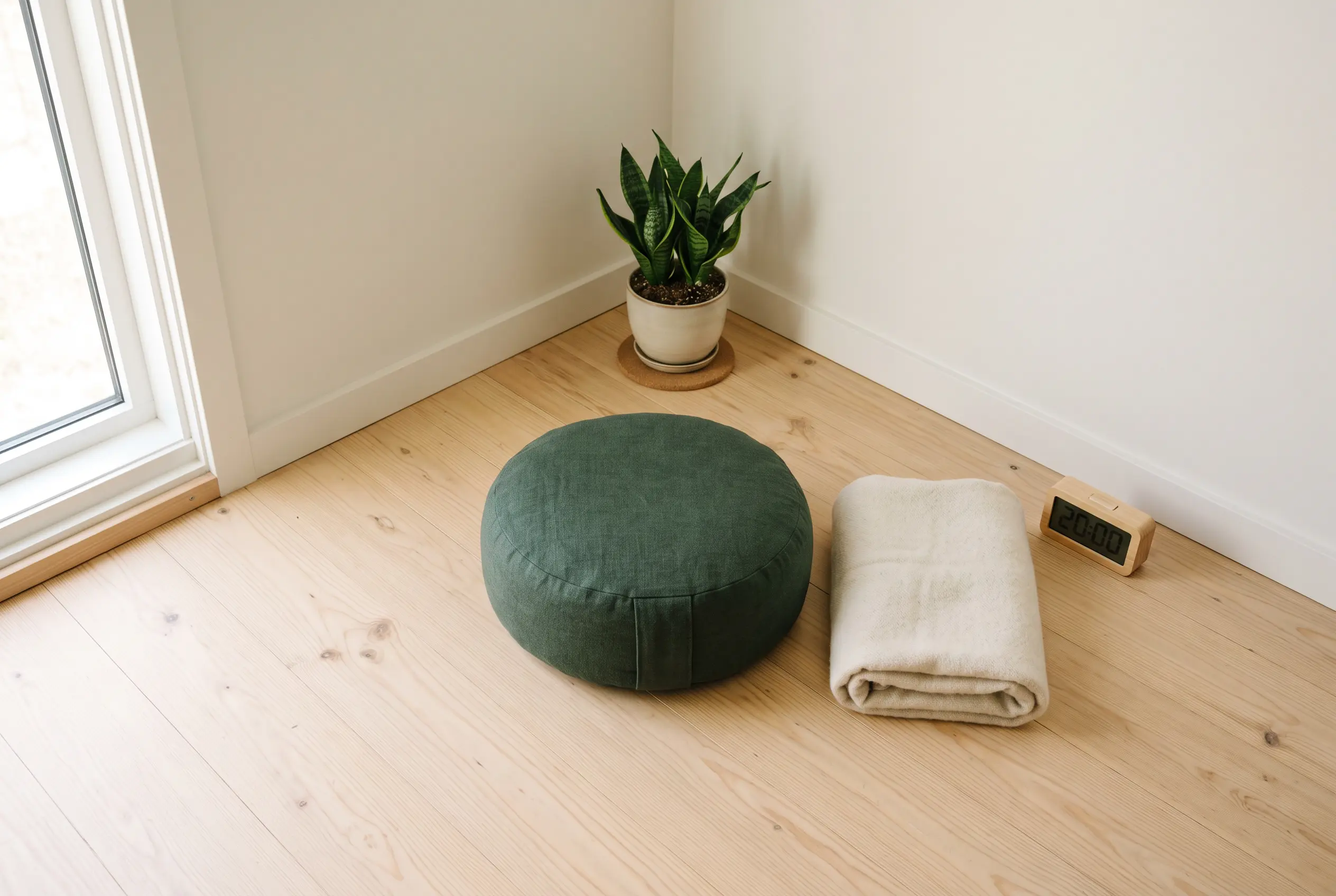
Choose the quietest corner you can return to daily; a patch of floor about 4 by 4 feet is enough.
Pick a low-traffic spot away from the kitchen and television. Move your phone to another room, or switch it to airplane mode. Sitting in the same place each day can become a cue that tells your mind it is time to settle.
Short on space? Try one of these spots:
- The floor beside your bed
- A corner of the living room
- A cleared corner of a bedroom
Do You Need a Meditation Cushion, Bench, or Chair?
Start with a chair, and buy a cushion only if you want to sit on the floor.
A zafu is a round meditation cushion that lifts your hips above your knees. A meditation bench is a low seat for kneeling. Each one suits a different body.
| Seat | Best for | Key detail |
|---|---|---|
| Chair | Tight hips, knee pain, back pain | Feet flat, sit near the front edge |
| Zafu | Cross-legged sitters | Hips higher than knees |
| Meditation bench | Kneeling sitters | Keeps your weight off your heels |
| Folded blanket | Budget setups | Firm and stable, not squishy |
If you want a cushion, ShaoLinStore’s meditation collection is a simple place to start. Pick one thick enough that both knees rest below your hips.
What Should You Do in the Two Minutes Before You Sit?
Spend 2 minutes on setup, and your session starts calmer and with fewer interruptions.
- Silence your phone and notifications.
- Set your timer for 10 minutes, then turn the clock face away.
- Loosen tight clothing or a belt.
- Use the bathroom, so your body is not asking for attention.
What Is the Best Meditation Posture for Beginners at Home?
The best meditation posture is upright, comfortable, and steady for 10 minutes. For most beginners, that means a chair.
The NHS says two things matter most: you are comfortable, and you can sit upright. On a chair or bed, choose a surface with support so you do not sink into it.
“Upright” does not mean stiff. Think of a tall, relaxed spine with its natural curves intact. Run through this quick check before you start:
| Body part | Position | Quick cue |
|---|---|---|
| Feet | Flat on the floor, hip-width apart | Both soles touch down |
| Knees | Level with or below your hips | Raise your seat if they float up |
| Spine | Tall, with natural curves | Imagine a string lifting the crown of your head |
| Shoulders | Relaxed, back and down | Let them drop on an exhale |
| Chin | Slightly tucked | The back of your neck feels long |
| Hands | Resting on thighs or in your lap | Palms up or down, as you prefer |
This check takes about 30 seconds. Repeat it any time you notice slumping. In summary, sit tall, stay comfortable, and keep your knees at or below hip level.
How Should You Sit in a Chair to Meditate?
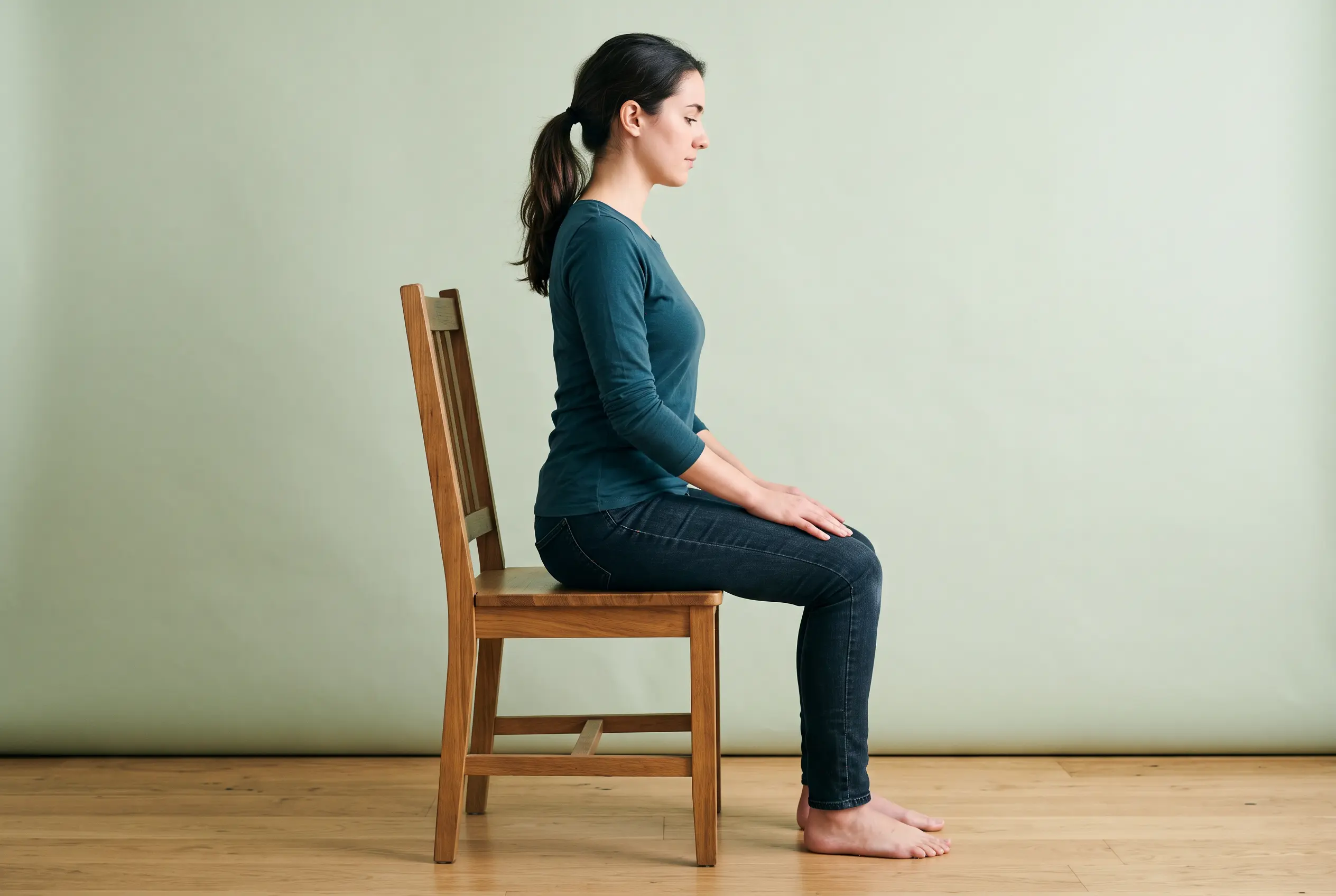
Sit near the front edge of a firm chair, feet flat, and let your spine rise without leaning back.
Avoid soft sofas, because they pull you into a slump. If your knees sit higher than your hips, slide a folded towel under your sit bones. If your lower back aches, tuck a small pillow behind it.
How Do You Sit on the Floor Without Knee or Back Pain?
Raise your hips on a cushion until both knees rest below your hips, then choose a leg position your knees tolerate.
The Burmese position is a cross-legged seat with both feet resting flat on the floor, one in front of the other. It is gentler on the knees than lotus poses.
| Position | Difficulty | Pain tip |
|---|---|---|
| Easy cross-legged | Low | Add a cushion under your hips |
| Burmese | Low to medium | Keep both feet on the floor |
| Kneeling (seiza) | Medium | Use a bench or cushion to take weight off your heels |
| Full lotus | High | Skip it as a beginner |
Sharp knee pain means stop. Switch to a chair instead. Mild tingling in your feet is a sign to shift or raise your seat.
What Should You Do With Your Hands and Eyes While Meditating?
Rest your hands where they stay relaxed, and either close your eyes or soften your gaze a few feet ahead.
Two easy hand positions work well. Rest your palms on your thighs, or cup one hand inside the other in your lap. No hand position is “correct.” Mayo Clinic suggests closing or partly closing your eyes. If you feel sleepy, keep them half open.
Can You Meditate Lying Down in Bed?
Yes, you can meditate lying down, but save it for body scans or bedtime, because lying flat invites sleep.
For daytime practice, sit up against the headboard with pillows behind your back. If pain or injury keeps you from sitting, lie on a mat with your knees bent and feet flat. Expect to feel drowsy, and try again upright another day.
How Do You Do Your First 10 Minutes of Home Meditation? (Step-by-Step Script)
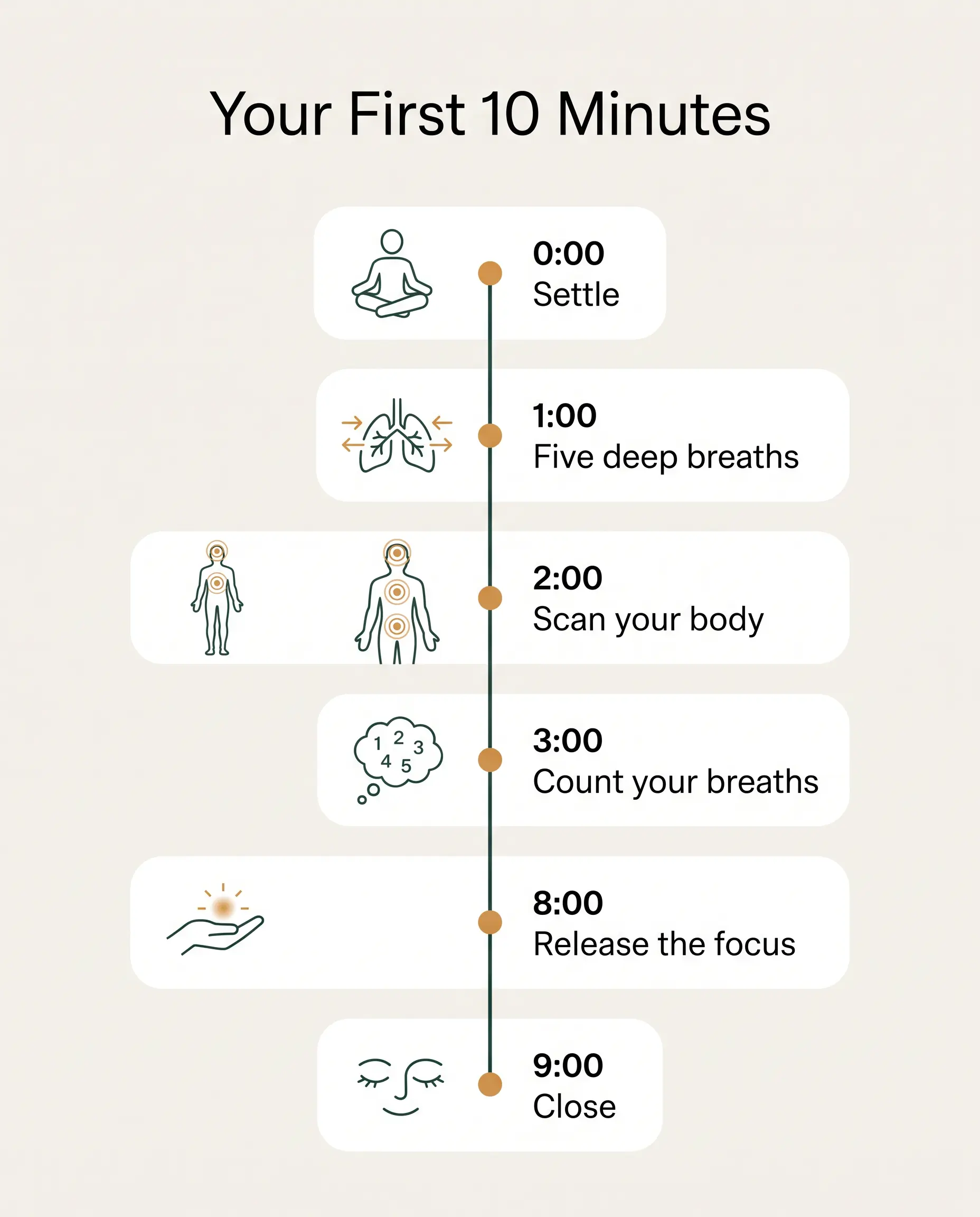
Your first 10-minute home meditation has six stages: settle, breathe, scan, count, release, and close.
The breath anchor is the breath itself, the spot your attention keeps returning to. Breathe as you normally do, and do not force it. Here is the full script:
- 0:00–1:00, Settle. Set a timer for 10 minutes. Check your posture. Feel where your body touches the seat, floor, and hands.
- 1:00–2:00, Five deep breaths. Inhale through your nose and exhale through your mouth. Close your eyes, or lower your gaze, on the last exhale.
- 2:00–3:00, Scan your body. Move your attention from head to toes. Soften your jaw, shoulders, and hands as you go.
- 3:00–8:00, Count your breaths. Count one full breath in and out as “1.” Continue to 10, then restart. If you lose count, begin again at 1.
- 8:00–9:00, Release the focus. Stop counting. Let your attention rest on sounds and sensations without chasing them.
- 9:00–10:00, Close. Stop focusing on the breath and sit still with your eyes closed. When the timer sounds, open your eyes slowly.
Prefer words to numbers? Silently say “breathe in” and “breathe out,” as both Mayo Clinic and the NHS suggest. Mayo Clinic also advises staying seated for a minute or two after you stop focusing on the breath.
Too long? Start with 5 minutes and add a minute every few days. If watching your breath makes you tense, switch to sounds in the room or your feet on the floor. The NHS also suggests tuning in to your senses.
To put it simply, a good first session is not a quiet one. It is one where you sat down, followed the script, and came back to your breath when you drifted. Mayo Clinic says you might feel calmer after each session, and less stressed over time.
Should You Follow a Guided Meditation or Meditate in Silence?
Beginners can use either, but guided audio is easier in week one because a voice tells you what to do.
A guided meditation is a recording or video where a teacher talks you through each step. Mayo Clinic says classes with a trained teacher, online videos, and meditation apps can all help. The NHS publishes audio-only guided body scan and breath meditations.
| Format | Best for | Watch out for |
|---|---|---|
| Guided audio | Week one, restless minds | Needing a voice every time |
| Silent with a timer | Building independence | Feeling lost without a script |
| Live class | Questions and feedback | A fixed schedule |
A simple plan: use guided audio for week one, then switch to the silent script above.
What Should You Do When Your Mind Wanders During Meditation?
When your mind wanders, notice where it went, silently label it “thinking,” and return to your breath; that return is the meditation.
Mind wandering is when attention drifts from what you are doing to something else. It is the human default, not a flaw. Harvard researchers Matthew Killingsworth and Daniel Gilbert tracked 2,250 volunteers aged 18 to 88. They found mind wandering in nearly every activity.
Mayo Clinic describes meditation as training your mind to return to its focus. The NHS offers a clear rule: if your mind wanders off 10 times, bring it back 10 times.
Use this three-step return each time you drift:
- Notice that your attention has left the breath.
- Label the thought silently: “thinking.”
- Return to the next breath, without scolding yourself.
A wandering mind is not a failed session. Each return to the breath is one repetition.
| Entity | Attribute | Value |
|---|---|---|
| Mind wandering | Share of waking hours | 46.9% (Harvard study) |
| Noting label | Word to use | “Thinking” |
| Returns to the breath | How to score progress | Count returns, not quiet minutes |
The key takeaway: score yourself by returns, not by silence. A session with 20 returns is a session with 20 repetitions. When you catch a drift, the NHS suggests congratulating yourself for noticing.
How Long and When Should Beginners Meditate at Home?
Beginners should meditate 5 to 10 minutes a day, ideally in the morning.
Sources vary a little. Mayo Clinic suggests trying 10 to 15 minutes at first. The NHS calls 20 minutes a good guide. Starting shorter makes the habit easier to keep, and you can build up. Use this first-week ramp:
| Days | Session length | Goal |
|---|---|---|
| Days 1–2 | 5 minutes | Show up and count breaths |
| Days 3–4 | 7 minutes | Add the body scan |
| Days 5–7 | 10 minutes | Run the full script |
| Week 2 onward | 10–15 minutes | Match Mayo Clinic’s starting range |
Morning has a small edge in the research. A JMIR study analyzed 14,879 meditation app users over 180 days. For morning sessions, the daily chance of meditating fell 63.4%. At other times it fell 67.8% to 74.5%.
That data is observational, so it shows a link, not a cause. It also hints at flexibility. People with less rigid timing kept using the app longer. The NHS adds that an evening session can help you let go of tension before bed.
Bottom line: aim for mornings, but do not quit if one day shifts.
Why Do Beginners Get Sleepy, Restless, or Uncomfortable, and What Should You Do?
Sleepiness and restlessness are common in early home meditation, and most can be fixed with one small change.
| Problem | Likely cause | Fix |
|---|---|---|
| Sleepiness | Tired body or a too-relaxed pose | Sit upright, half-open your eyes, practice when alert |
| Restlessness | Stillness feels unfamiliar | Shorten to 3 minutes or try slow walking meditation |
| Tension while watching the breath | Too much effort on breathing | Switch to sounds or touch points |
| Aching legs or back | Seat is too low or unsupported | Raise your seat or move to a chair |
Is meditation safe? The National Center for Complementary and Integrative Health (NCCIH) says meditation is usually low risk, but some people have negative experiences.
In an analysis of more than 6,000 participants, about 8% reported negative effects, most often anxiety or depression. That rate is similar to what people report for psychological therapies.
Mayo Clinic also notes that meditation might cause anxiety or depression for some people. If a session stirs up distress, stop, open your eyes, and feel your feet on the floor. If the feelings stay, talk with a doctor or mental health professional. Meditation does not replace medical care.
Here’s what you need to know: mild drowsiness is normal, but ongoing distress means pause and seek support.
How Do You Turn Home Meditation Into a Daily Habit?
The fastest way to make home meditation stick is to attach a short session to something you already do every day.
Habit stacking means pairing a new habit with an existing one. For example: “After I brush my teeth, I sit for five minutes.” The JMIR authors point to earlier research where people who linked meditation to existing habits kept practicing longer.
Start small and stay moderate. The same JMIR analysis found that an intense start was hard to sustain, while steady, moderate practice fared better. The NHS also advises building regular meditation into your daily routine. Try one of these anchors:
| Habit anchor | Example plan | Starting length |
|---|---|---|
| After brushing teeth | Sit before leaving the bathroom | 5 minutes |
| Before morning coffee | Chair by the kitchen window | 5 minutes |
| After closing your laptop | Cushion in your meditation corner | 10 minutes |
Missed a day? Do not make it up. Sit at your next planned time. Keep a simple log with four items: the date, your minutes, your number of returns, and one word for your mood.
Missed a whole week? Restart at 5 minutes. A short restart is easier to repeat than a long catch-up session.
Ready to Start Your Home Meditation Practice?
Meditating at home comes down to three moves: claim a quiet corner, sit comfortably, and give your breath 10 honest minutes.
The most important thing to remember is that returning counts more than focusing. Tonight, set your chair and timer where you will see them in the morning. Tomorrow, sit down before your first coffee.
When you are ready to make your corner feel like your own, explore the meditation essentials at ShaoLinStore.
❓ Frequently Asked Questions
Start with 5 to 10 minutes a day. Mayo Clinic suggests 10 to 15 minutes at first, but shorter sessions are easier to repeat. Consistency matters more than length.
No. A firm chair with your feet flat and your spine upright works well. Sit cross-legged only if a cushion keeps your knees below your hips without pain.
Either works. Mayo Clinic suggests closing or partly closing your eyes. A half-open, soft gaze can help if you feel sleepy.
Yes. People’s minds wander about 46.9% of their waking hours, according to a Harvard study. Each time you notice and return to your breath, you are doing the exercise correctly.
Yes. Breath-focused meditation needs no teacher or equipment. Mayo Clinic notes that classes, videos, and apps can help if you want guidance. Consider a trained teacher if meditation brings up persistent distress.
📚 References
- Meditation basics and steps: Mayo Clinic’s overview lists the four shared features of meditation, a beginner step list, and the “10 to 15 minutes” starting timer. Mayo Clinic, “Meditation”
- Seating, posture, and ending a session: The NHS 7-step guide covers comfort, upright posture, the “breathe in, breathe out” method, and wandering thoughts. NHS Every Mind Matters, “How to meditate for beginners”
- Safety and negative experiences: This U.S. National Institutes of Health tip sheet summarizes what research says about benefits and risks, including the roughly 8% rate of negative effects. NCCIH, “8 Things to Know About Meditation and Mindfulness”
- Mind wandering: Harvard’s news office reports the 46.9% finding from a study of 2,250 volunteers. Harvard Gazette, “Wandering mind not a happy mind”
- Time of day and habit formation: This peer-reviewed study of 14,879 app users examines morning meditation and timing flexibility. Berardi et al., Journal of Medical Internet Research, 2023