
Buddhist symbols are visual shortcuts for core teachings, such as the path to awakening, purity, and compassion. You see them on temple roofs, thangka paintings, mala bracelets, and tattoos. At ShaoLinStore, we believe every symbol should come with its story.
This glossary explains 40 terms in 8 groups. Each entry gives the meaning, the tradition it comes from, and where you will likely spot it. Start with the eight auspicious symbols, because they unlock a large share of Tibetan art.
What Are Buddhist Symbols and Why Do They Matter?
Buddhist symbols are signs that stand for parts of the Dharma, the Buddha’s teaching on ending suffering. Many are older than Buddhism itself. Early Buddhists adopted ancient Indian signs of good fortune, called mangala, because ordinary people already knew them.
The earliest Buddhist art dates to the Mauryan era, 322–184 BCE. Symbols then spread across Asia and picked up local styles. In summary, a Buddhist symbol works like a visual reminder of a teaching, not a magic charm.
Why Did Early Buddhists Use Symbols Instead of Buddha Statues?
Early Buddhist art showed the Buddha only through symbols, such as an empty throne, a tree, or footprints. This phase is called aniconism, meaning art without human images of the Buddha. It ran from about the 2nd century BCE to the 1st–2nd century CE.
Human-form Buddha images became popular around the 1st century CE, in Mathura and Gandhara. Scholars still debate why the aniconic phase happened, so treat any single explanation with care.
How Are These 40 Buddhist Symbols Organized?
This glossary sorts 40 terms into 8 groups, so you can find any symbol in seconds. Each group has one table with the meaning and a quick way to recognize the symbol.
| Group | Terms | Count |
|---|---|---|
| Eight auspicious symbols | 1–8 | 8 |
| Symbols of the Buddha | 9–14 | 6 |
| Hand gestures (mudras) | 15–20 | 6 |
| Ritual objects | 21–25 | 5 |
| Animals | 26–30 | 5 |
| Colors | 31–33 | 3 |
| Mandalas, mantras, and diagrams | 34–37 | 4 |
| Regional symbols | 38–40 | 3 |
What Are the Eight Auspicious Symbols of Buddhism? (Terms 1–8)
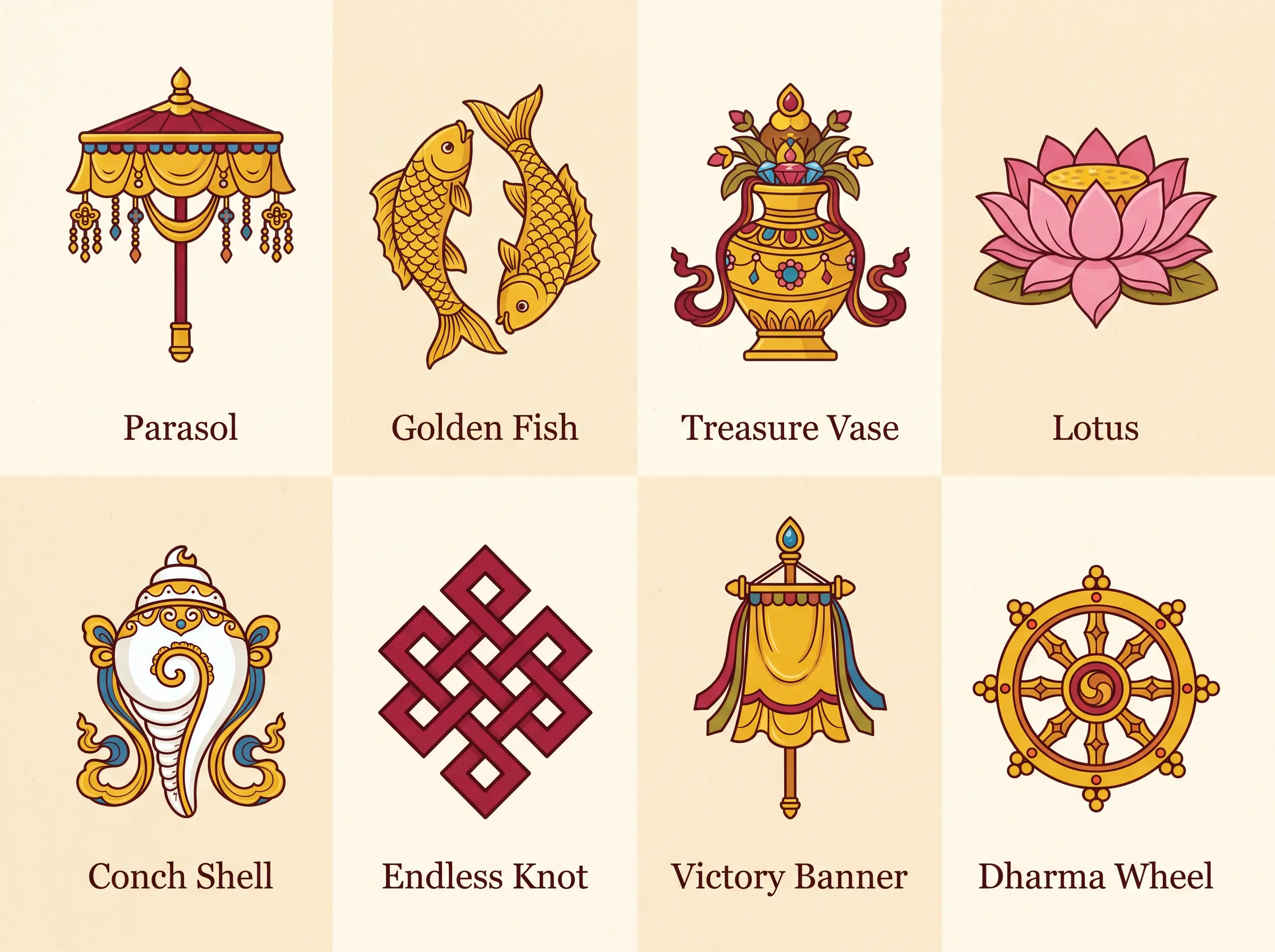
The eight auspicious symbols are called Ashtamangala. They are the parasol, golden fish, treasure vase, lotus, conch shell, endless knot, victory banner, and Dharma wheel. Each one points to a quality of the awakened mind. They are most popular in Tibet and Nepal.
| # | Symbol (Sanskrit) | Core meaning |
|---|---|---|
| 1 | Parasol (chattra) | Protection from harm and illness; royal dignity |
| 2 | Golden fish (matsyayugma) | Fearlessness, freedom, happiness, and abundance |
| 3 | Treasure vase (kalasha) | Inexhaustible spiritual and material wealth |
| 4 | Lotus (padma) | Purity and awakening rising from muddy water |
| 5 | White conch (shankha) | The Dharma spreading far and wide |
| 6 | Endless knot (shrivatsa) | Interdependence; wisdom and compassion joined |
| 7 | Victory banner (dhvaja) | The Buddha’s victory over Mara, the tempter, and over delusion |
| 8 | Dharma wheel (dharmachakra) | The Buddha’s teaching set in motion |
These signs began as pre-Buddhist Indian symbols of kingship. Buddhists later reread them as qualities of enlightenment. The order of the eight varies between traditions. Some lists swap in other items, such as a throne or a fly whisk. You will find the set on shrine-room ornaments and household décor. In the Tibetan tradition, people also draw the symbols on the ground to welcome an important guest to a monastery.
Which Is the Most Important Buddhist Symbol?
The Dharma wheel is the symbol most often named the most important, because it stands for the Buddha’s teaching itself. Its 8 spokes usually represent the Noble Eightfold Path, the Buddha’s eight-part guide to ethical living and meditation.
There is a twist. Scholar Klemens Karlsson notes that early wheels carried 8, 16, 20, 25, or 32 spokes. The link between eight spokes and the Eightfold Path is a later reading. The short answer is that no official ranking exists.
Which Symbols Represent the Buddha Himself? (Terms 9–14)
Six symbols stand in for the Buddha: the Bodhi tree, footprint, empty throne, stupa, triratna, and wisdom eyes. Karlsson found that the Bodhi tree, Dharma wheel, and stupa appear at all major early Buddhist sites.
| # | Term | Meaning | Where you will see it |
|---|---|---|---|
| 9 | Bodhi tree (Ficus religiosa) | The place of awakening; liberation | Temple grounds; heart-shaped leaf jewelry |
| 10 | Buddha footprint (buddhapada) | The Buddha’s presence; often marked with a wheel or triratna | Thai temples such as Wat Phra That Doi Suthep |
| 11 | Empty throne (vajra seat) | The seat at Bodh Gaya where he awakened | Early Indian reliefs |
| 12 | Stupa | A dome for relics; the Buddha’s final nirvana | Nepal, Sri Lanka, Tibet (called a chörten) |
| 13 | Triratna (Three Jewels) | Buddha, Dharma, and Sangha (the community) | Sanchi gateways; footprints |
| 14 | Eyes of Buddha (wisdom eyes) | All-seeing wisdom | Nepalese stupas such as Boudhanath |
The earliest stupas date to about the 3rd century BCE. A Tibetan chörten has 5 parts, one for each element: earth, water, fire, air, and space. Visiting one? Walk clockwise around it.
What Will You See When You Visit a Stupa or Temple?
At a Tibetan or Nepalese stupa, you will usually see wisdom eyes, prayer flags, and prayer wheels in one place. At a Thai temple, look for Buddha footprints and Bodhi trees. At a Japanese temple, watch for the manji on signs and maps.
Use the glossary like a field guide. Spot the symbol, find its group, and read the one-line meaning. Here’s what you need to know: two or three symbols per visit are enough to start.
What Do Buddhist Hand Gestures (Mudras) Mean? (Terms 15–20)
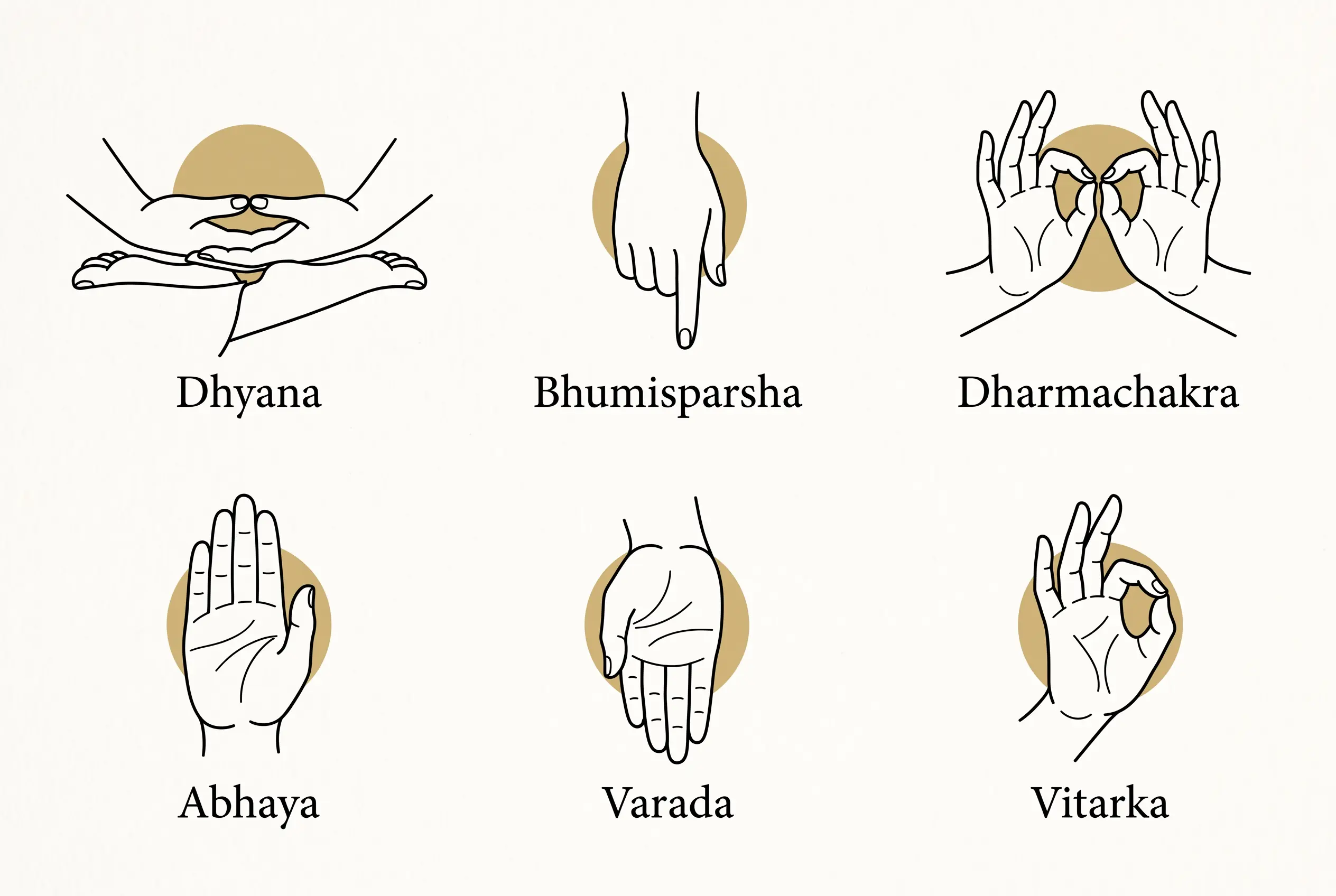
A mudra is a symbolic hand gesture, from a Sanskrit word for “seal.” It shows what a Buddha figure is doing: meditating, teaching, protecting, or giving. In practice, mudras also evoke a particular state of mind. Six cover most statues you will meet.
| # | Mudra | Meaning | How to spot it |
|---|---|---|---|
| 15 | Dhyana | Meditation | Both hands in the lap, right over left, thumbs touching |
| 16 | Bhumisparsha | Earth-witness; awakening | Right hand on the knee, fingers pointing to the ground |
| 17 | Dharmachakra | Turning the wheel of teaching | Thumb and finger circles from both hands touch |
| 18 | Abhaya | Fearlessness, protection | Right hand at shoulder height, palm out, fingers up |
| 19 | Varada | Giving, generosity | Palm out, fingers pointing down |
| 20 | Vitarka | Teaching, discussion | Right hand at chest height, thumb and finger form a circle |
How Can You Tell Abhaya From Varada at a Glance?
Check the fingers: pointing up means Abhaya (fearlessness), and pointing down means Varada (generosity). Both show an open palm. Choosing a statue for your space? Match the gesture to the feeling you want, such as Dhyana for calm or Abhaya for reassurance.
Which Ritual Objects Appear in Buddhist Practice? (Terms 21–25)
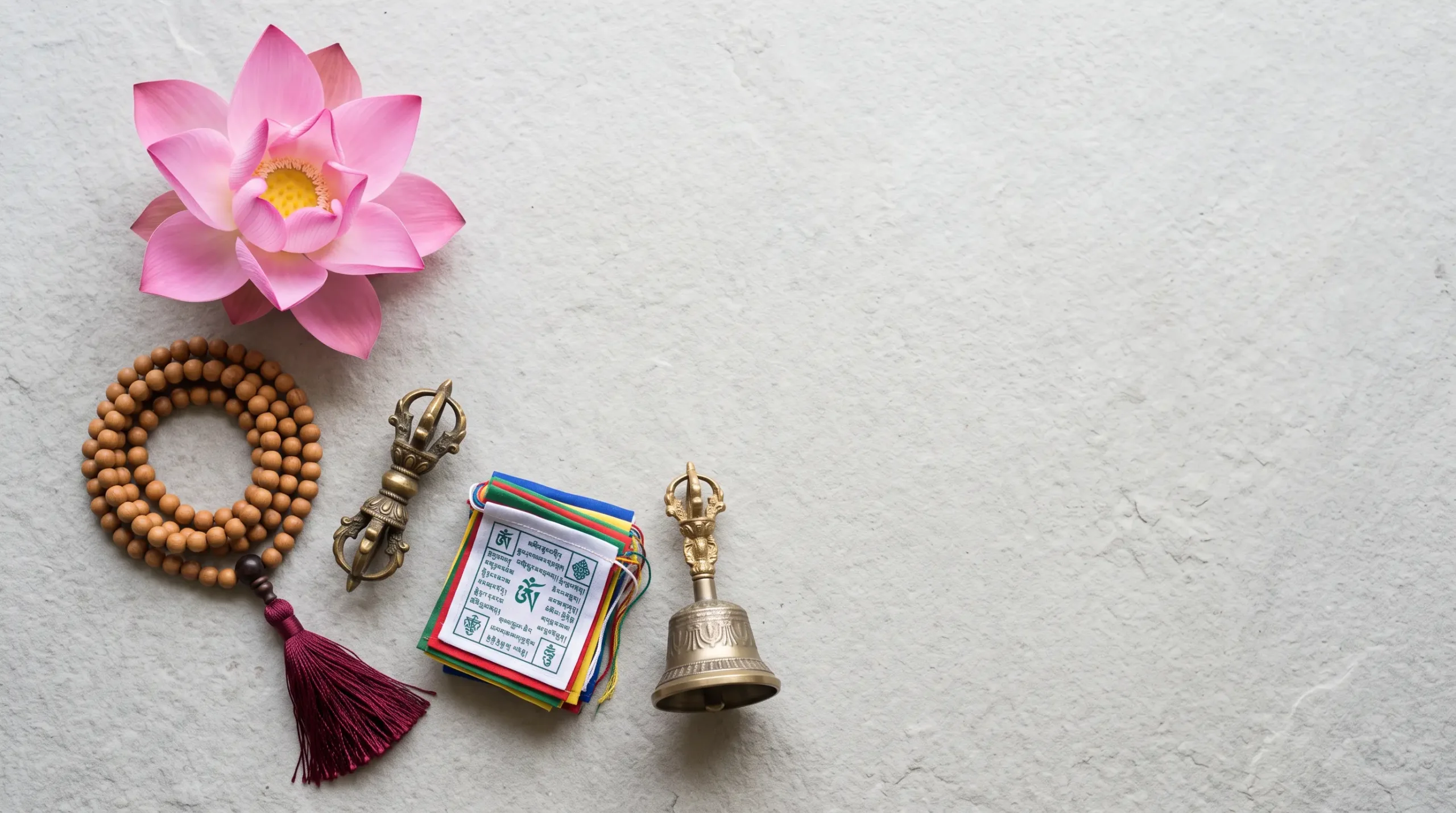
Five ritual objects appear again and again: the vajra, bell, mala, prayer wheel, and prayer flags. Most are tied to Tibetan (Vajrayana) practice, except the mala, which is used across traditions.
| # | Object | Meaning | Key data |
|---|---|---|---|
| 21 | Vajra (dorje) | Indestructible truth; skillful means | Most common form has 5 prongs |
| 22 | Bell (ghanta) | Wisdom and emptiness | Always paired with the vajra |
| 23 | Mala | Counting mantras and prayers | Commonly 108 beads |
| 24 | Prayer wheel | Spinning mantras into the world | Holds Om Mani Padme Hum scrolls; turned clockwise |
| 25 | Prayer flags (lungta) | Blessings carried by wind | Sets of 5 colors |
A vajra is a ritual scepter that combines a diamond’s indestructibility with a thunderbolt’s force. Held with the bell, it shows the union of method (vajra) and wisdom (bell).
A mala is a string of prayer beads, much like a rosary. The number 108 is usually linked to the 108 kleshas, the mental afflictions Buddhists work to overcome. Japanese temples ring a bell 108 times on New Year’s Eve for the same reason.
Prayer flags are strips of colored cloth hung outdoors so the wind can carry their blessings. A standard set has 5 colors. Hang them in the order blue, white, red, green, yellow, from left to right.
What Do Animals Symbolize in Buddhism? (Terms 26–30)
In Buddhism, animals stand for qualities of mind and scenes from the Buddha’s life. Early art shows lions, elephants, horses, and deer, often as stand-ins for the Buddha himself.
| # | Animal | Meaning | Story or detail |
|---|---|---|---|
| 26 | Lion | Royalty, protection, fearless teaching | The Buddha is “lion of the Shakyas”; his teaching is the “lion’s roar” |
| 27 | White elephant | Strength; a tamed mind | Appears in Queen Maya’s dream of the Buddha’s conception |
| 28 | Deer | Disciples; peaceful listening | Flank the Dharma wheel, recalling the first sermon at Deer Park |
| 29 | Riderless horse | Renunciation | Stands for Kanthaka, the horse the Buddha rode when leaving home |
| 30 | Garuda | Energy that destroys jealousy and hatred | A mythical bird that devours snakes; popular in Vajrayana art |
What Do Colors Mean in Buddhist Symbolism? (Terms 31–33)
Buddhist colors are coded. The Buddhist flag shows the Buddha’s aura, prayer flags use five element colors, and lotus colors signal different qualities. Exact mappings vary by tradition, so treat these as the most common readings.
| # | Term | Colors and meanings |
|---|---|---|
| 31 | Buddhist flag | Six bands for the aura at enlightenment: blue (compassion), yellow (the Middle Way), red (blessings of practice), white (purity), orange (wisdom), and a sixth blend of all five |
| 32 | Prayer-flag colors | Blue (space), white (air), red (fire), green (water), yellow (earth), hung in that order |
| 33 | Lotus colors | White (purity), pink (the Buddha), red (compassion), blue (wisdom) |
The lotus earns its place everywhere because it rises from mud and blooms clean. The Buddha compared himself to a lotus in the early scriptures. Some guides add purple or gold lotuses, but the four colors above are the safest readings for beginners.
The Buddhist flag is modern. It was designed in Sri Lanka in the 1880s with help from the American Henry Steel Olcott. The World Fellowship of Buddhists adopted the five-color flag and the eight-spoked wheel as its two symbols in 1952.
What Are Mandalas, Mantras, and the Wheel of Life? (Terms 34–37)
These four terms are Buddhism’s big-picture symbols. They map the awakened mind, encode the path in sound, and show how suffering keeps cycling. All four are most common in Tibetan Buddhism.
| # | Term | Meaning | Key data |
|---|---|---|---|
| 34 | Mandala | A sacred circle map of the awakened mind | Central to tantric ritual |
| 35 | Om Mani Padme Hum | Mantra of compassion | 6 syllables; carved on rocks, prayer wheels, and stupas |
| 36 | Om | Often explained as the Buddha’s body, speech, and mind | Opens most mantras |
| 37 | Wheel of Life (bhavacakra) | The cycle of rebirth and suffering | Hub shows a pig, rooster, and snake: ignorance, attachment, and aversion |
The three hub animals are called the three poisons, the roots of suffering in Buddhist teaching. The wheel also shows 6 realms of rebirth and 12 links of cause and effect. In summary, the Wheel of Life is a teaching diagram. You will often see it painted near Tibetan monastery entrances.
Which Buddhist Symbols Are Most Often Misunderstood? (Terms 38–40)
Three symbols are often misread in the West: the unalome, the ensō, and the manji. Each has a specific meaning tied to its own tradition.
| # | Term | Meaning | Key data |
|---|---|---|---|
| 38 | Unalome | The winding path from confusion to clarity | A spiral ending in a straight line and a dot; popular in Thai-style tattoos |
| 39 | Ensō | Enlightenment, strength, and emptiness | Zen circle drawn in 1–2 brushstrokes; never retouched |
| 40 | Manji (卍) | Good fortune and auspiciousness | Marks Buddhist temples on Japanese maps |
The manji is an ancient Indian sign of good fortune. Left-facing versions often appear on the chest, feet, or palms of Buddha images. It is not the Nazi symbol. The key takeaway is that context and history separate the two.
Details on the unalome vary by source, so check the tradition before you commit to a design.
Which Tradition Uses Which Buddhist Symbols?
Most Buddhist symbols are shared, but a few belong to one tradition. Theravada art kept the classic Indian signs, such as the Dharma wheel. Mahayana and Vajrayana art often use the eight auspicious symbols.
| Tradition | Signature symbols | Less central |
|---|---|---|
| Shared by all | Dharma wheel, lotus, Bodhi tree, stupa, Buddha image | — |
| Theravada (Sri Lanka, Thailand, Myanmar) | Footprint, Bodhi tree, white elephant | Vajra, mandala |
| Mahayana and Zen (China, Japan, Korea) | Manji, ensō, lotus | Prayer flags, vajra |
| Vajrayana (Tibet, Nepal) | Eight auspicious symbols, vajra and bell, prayer flags, mandala, Wheel of Life | Ensō, unalome |
Know the tradition before you buy, hang, or wear a symbol. It keeps your choice accurate and respectful.
How Can Beginners Use Buddhist Symbols Respectfully?
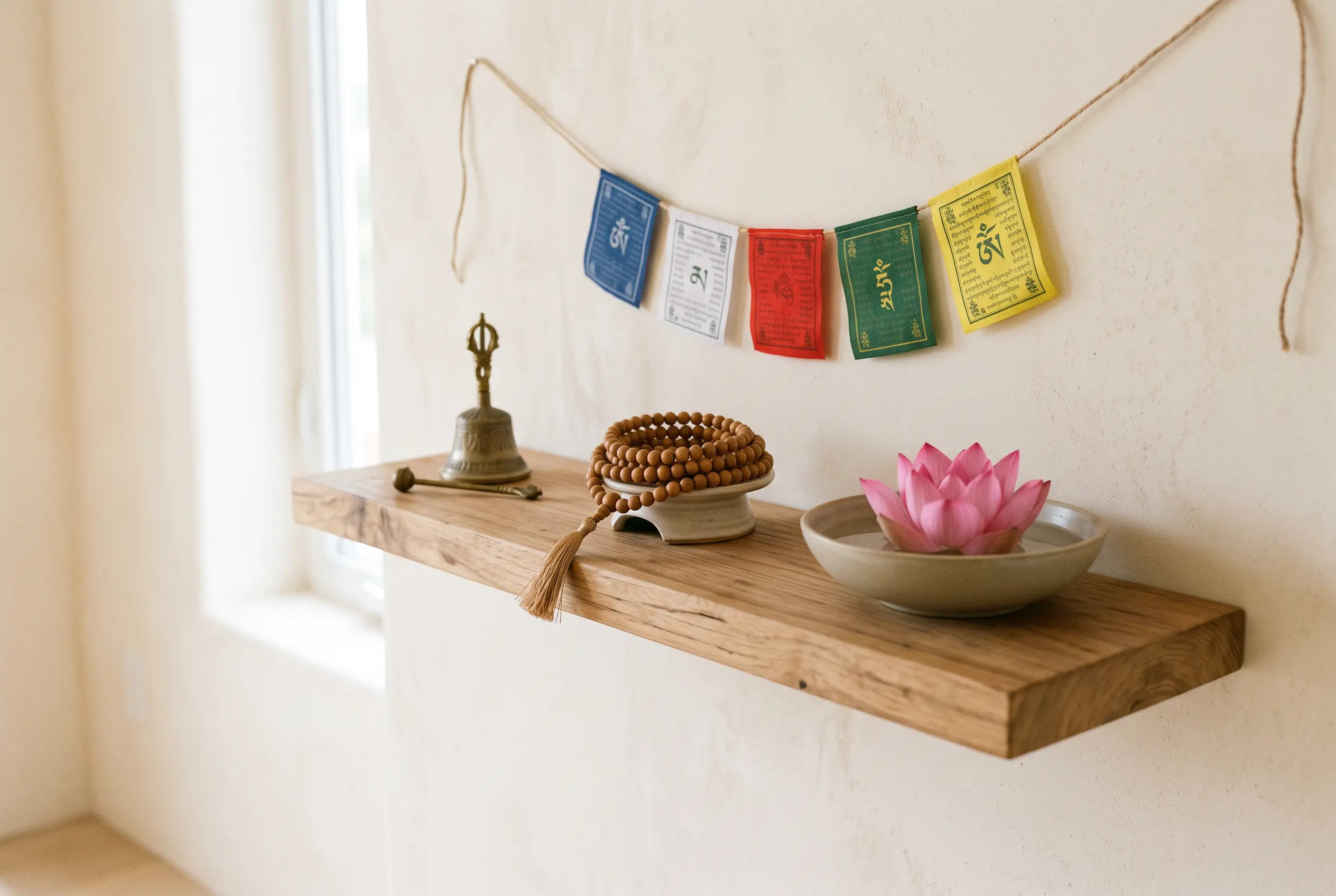
Wear or display Buddhist symbols respectfully by learning their meaning, keeping sacred images high and clean, and avoiding pure decoration. Intention and placement matter more than the object itself.
| Use | Lower-risk choices | Take extra care | Simple rule |
|---|---|---|---|
| Jewelry | Lotus, endless knot, Dharma wheel, mala | Buddha-head pendants | Wear above the waist |
| Tattoo | Lotus, ensō | Full Buddha images; sacred scripts | Avoid feet and legs |
| Home décor | Prayer flags, wheel art | Statues | Place high; never on the floor or in a bathroom |
Hang prayer flags high. When they fade, retire them respectfully rather than tossing them in the trash. At ShaoLinStore, we suggest starting with one symbol you can explain in a single sentence.
How Should Beginners Start Learning These Buddhist Symbols?
Start with the 8 auspicious symbols, then 4 shared icons, then 6 mudras. Those 18 terms decode most Buddhist art you will meet. Follow this order:
- Learn the 8 auspicious symbols (terms 1–8). They unlock most Tibetan art.
- Add 4 shared icons: Bodhi tree, stupa, triratna, and footprint.
- Study the 6 mudras so you can read any statue’s hands.
- Cover 8 more terms: ritual objects and colors, for temples and travel.
- Finish the last 14: animals, mandalas, mantras, and regional symbols.
Final Thoughts: What to Remember About Buddhist Symbols
Buddhist symbols work like a visual language. Once you know these 40 terms, a temple roof or a mala reads like a sentence, not decoration.
A symbol is a reminder of a teaching. Learn the teaching first, and the symbol follows.
Bookmark this glossary and pick one group to learn this week. When you are ready to bring a meaningful symbol home, explore ShaoLinStore.
❓ Frequently Asked Questions
The eight auspicious symbols (Ashtamangala) are the parasol, golden fish, treasure vase, lotus, conch shell, endless knot, victory banner, and Dharma wheel. Each points to a quality of the awakened mind.
The Dharma wheel is the symbol most often named the most important, because it stands for the Buddha’s teaching. Its 8 spokes usually represent the Noble Eightfold Path. No official ranking exists.
In Buddhism, 108 is most often linked to the 108 kleshas, the mental afflictions that block awakening. Japanese temples ring a bell 108 times at year-end for the same reason.
No. The Buddhist manji is an ancient sign of good fortune that marks temples on Japanese maps. It was used in India long before its 20th-century misuse.
Not automatically. Learn what the symbol means first. Keep sacred images above the waist and off the floor, and avoid using them as pure decoration.
📚 References
- Overview of Buddhist symbolism: A broad, well-sourced survey of early symbols, the Dharma wheel, animals, the vajra, and the Buddhist flag. Wikipedia: Buddhist symbolism
- Eight auspicious symbols: Names, Sanskrit terms, and meanings of the Ashtamangala from a Buddhist reference encyclopedia. Encyclopedia of Buddhism
- Buddhist mudras: Clear descriptions of hand positions and their meanings from a respected Buddhist magazine. Tricycle: Mudra
- Aniconism in early Buddhist art: An academic article by John C. Huntington (Art Journal, 1990) on why early art avoided Buddha images. National Taiwan University Buddhism Library
- Symbols across Buddhist schools: A government education resource comparing Theravada, Mahayana, and Vajrayana symbolism. Manitoba Education: Buddhism Supplemental Resource (PDF)
Royal Ease Guanyin Statue: Meaning, History & How to Choose - ShaoLin Store
[…] For more on the lotus and similar motifs, see our lotus, wheel and other Buddhist symbols explained. […]