
You can start meditating at home today with a chair, a timer, and 5 minutes. At ShaoLinStore, we hear the same worry again and again: “Do I need to buy a meditation cushion first?” The short answer is no.
This guide shows you how to start meditating at home, how long to sit, and which signs tell you a cushion is worth buying. It starts with some good news. In a 2019 randomized trial, 42 adults who had never meditated sat for just 13 minutes a day. After 8 weeks, they had a lower negative mood and sharper attention than a group that listened to podcasts instead.
Quick answer: Start with a chair, 5 minutes a day, and your breath. Buy a cushion only when you sit on the floor for 10+ minutes and your knees, hips, or back start to complain.
What Do You Need to Start Meditating at Home?
To start meditating at home, you need three things: a timer, a stable place to sit, and one thing to focus on. Most people choose their breath.
Meditation is the practice of resting your attention on one thing, noticing when it drifts, and gently bringing it back. That is the whole skill.
You do not need special gear. The NHS says you need no specialist equipment, just somewhere comfortable and warm to sit. A towel or rug works fine on the floor. A chair or a bed also works, as long as it supports you and you don’t sink into it.
| Item | Needed to start? | Typical cost |
|---|---|---|
| Timer | Yes | $0 (your phone) |
| Place to sit | Yes | $0 (chair, sofa edge, folded towel) |
| Attention anchor | Yes | $0 (your breath) |
| Quiet room | No, but it helps | $0 |
| Meditation cushion | No | Optional purchase |
Two things matter most: be comfortable and sit upright. The NHS gives the same advice. Bottom line: gear is optional, but consistency is not.
How Do You Start Meditating at Home? A 5-Step Beginner Routine
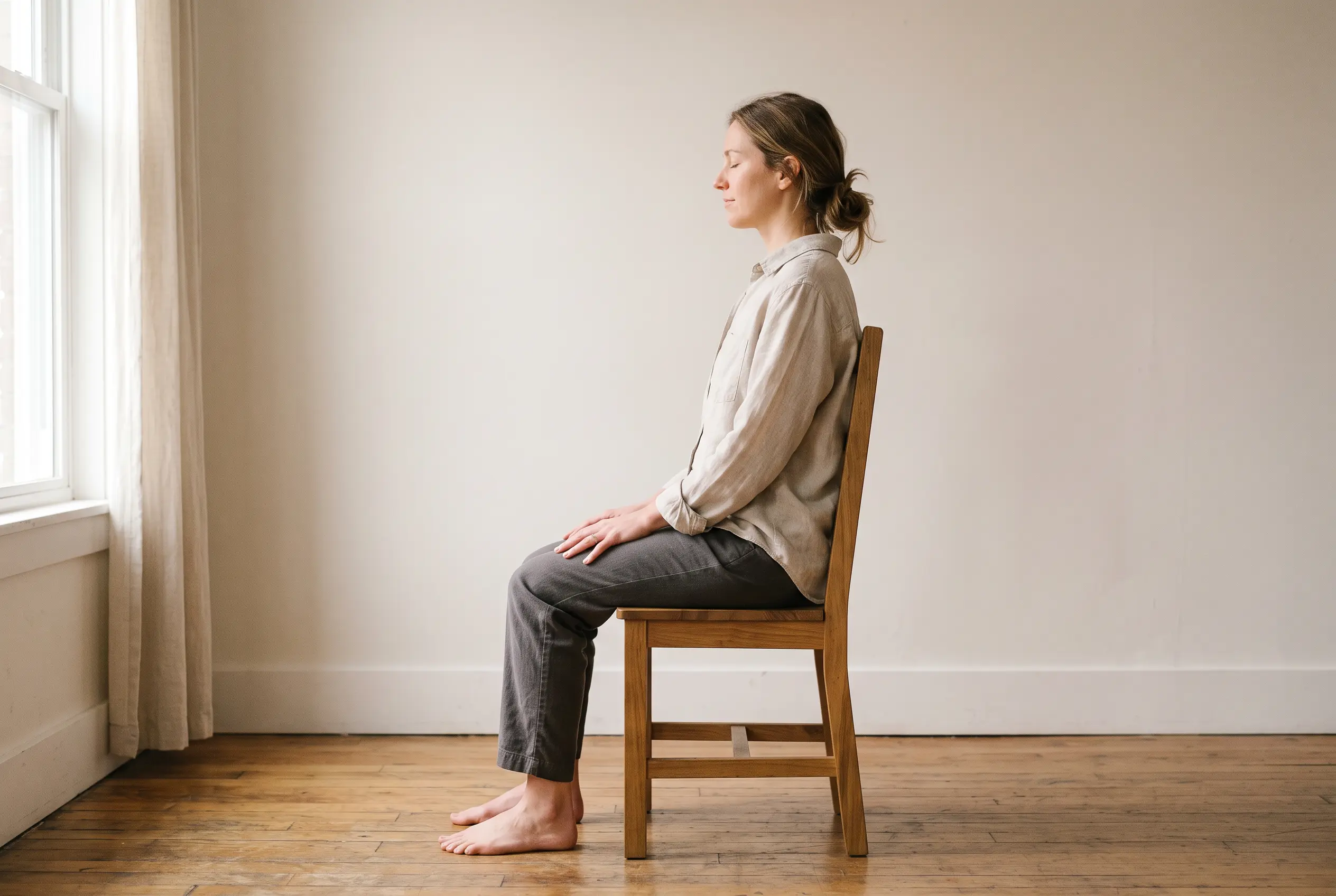
Start meditating at home by sitting upright, setting a 5-minute timer, and returning your attention to your breath each time your mind wanders. Here is the full routine.
- Pick a time you already have. Attach your session to an existing habit, such as brushing your teeth or making coffee. This is called habit stacking: pairing a new habit with one you already do.
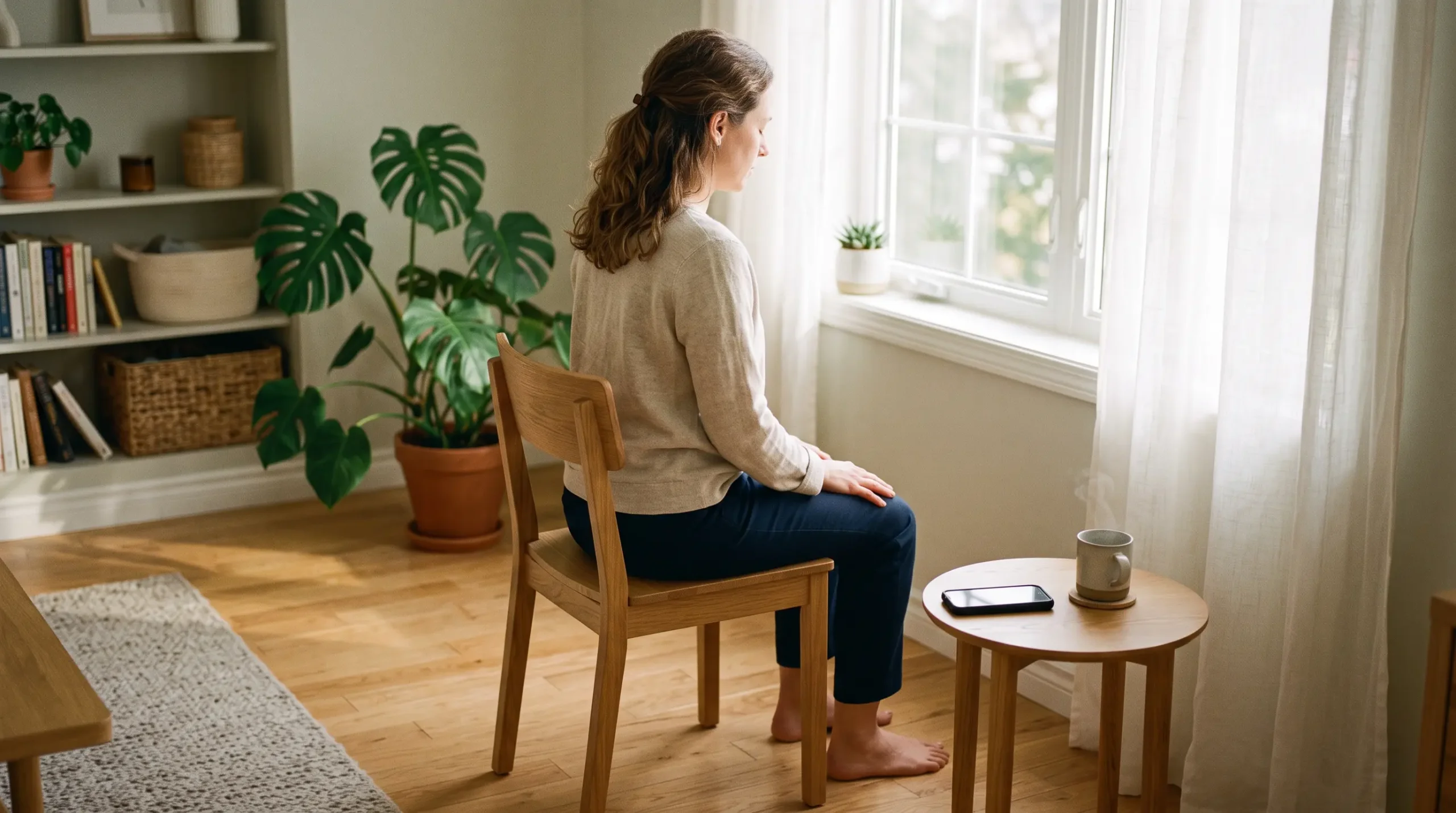
- Choose a seat you can sit on upright. A sturdy chair works well. Keep your feet flat and your spine tall, but not stiff.
- Set a timer for 3–5 minutes. The timer stops you from checking the clock.
- Rest your attention on your breath. Notice the air at your nose or your belly rising and falling. Don’t force the breath.
- Notice, then return. When your mind wanders, silently say “thinking” and come back to the breath.
That return is the practice. The NHS puts it simply: if your mind wanders 10 times, bring it back 10 times. A wandering mind is not a failure. Even experienced meditators have it.
Close gently. Stay still for a minute with your eyes closed, then open them slowly. A complete first session is 3–5 minutes long, with one anchor and as many returns as you need.
What should you do with your hands and eyes?
Rest your hands on your thighs and keep your eyes closed or softly open. Palms up or down are both fine. Choose whatever feels relaxed.
Closed eyes cut distraction. A soft gaze at the floor, about an arm’s length ahead, helps if you feel sleepy. Keep your shoulders loose and your jaw relaxed. You should feel upright but not rigid. If you notice tension, take one slow breath and let your shoulders drop.
How Long Should a Beginner Meditate at Home Each Day?
Most beginners should meditate for 5–10 minutes a day. Short daily sessions build the habit faster than rare long ones, and Mindful.org also suggests five or ten minutes for new meditators.
| Stage | Daily time | Your goal |
|---|---|---|
| Week 1 | 3–5 min | Show up every day |
| Weeks 2–4 | 5–10 min | Stick with one technique |
| Month 2 | 10–15 min | Add 1–2 minutes only if it feels easy |
Research backs the “short and steady” approach. In the 2019 trial, 13 minutes a day for 8 weeks lowered negative mood and improved attention and memory. At the 4-week mark, there was no significant difference from the control group. So expect results in about two months, not two weeks.
Some guides differ. The NHS calls 20 minutes a good guide. Treat 20 minutes as a goal, not a starting line. If you miss a day, just sit tomorrow. Don’t try to make up the minutes.
What if 5 minutes still feels too long?
If 5 minutes feels too long, start with 2 minutes. A short session you finish builds more confidence than a long one you abandon. Add 1 minute each week until the time feels natural. Starting small is not cheating. It is how the habit sticks.
The most important thing to remember is this: a short session you repeat beats a long one you skip.
What Is the Best Time to Start Meditating at Home?
The best time to start meditating at home is whenever you can sit consistently. Morning and evening are the two most popular choices. The NHS suggests the start of the day to set you up well, and the evening to let go of tension before bed.
| Time of day | Why it works | Tip |
|---|---|---|
| Morning | Fewer interruptions and a calm start | Sit before you check your phone |
| Midday break | Resets a busy day | Use 3–5 minutes between tasks |
| Evening | Releases tension before bed | Sit upright, not in bed, so you don’t doze off |
Pick one slot for your first two weeks. Changing the time often makes a new habit harder to build.
Which Meditation Technique Should You Try First at Home?
Breath meditation is the easiest technique to try first because your breath is always with you and needs no setup. The breath is your attention anchor, the one thing you return to when your mind drifts.
| Technique | Best for | Typical time |
|---|---|---|
| Breath meditation | Focus and a simple daily routine | 3–10 min |
| Body scan | Releasing tension, winding down at night | 5–15 min |
| Guided meditation | Not sure what to do | 5–10 min |
| Walking meditation | Restless bodies and small spaces | 3–10 min |
Pick the one that fits your day. If watching your breath makes you tense, switch your anchor to sounds or the feel of your feet. If you feel sleepy, try walking. If you have no idea what to do, use a free guided recording. The NHS offers free audio for both a body scan and a breath meditation.
Stay with one technique for the first two weeks. Switching too often makes it harder to tell what works.
Do You Need a Meditation Cushion to Meditate at Home?
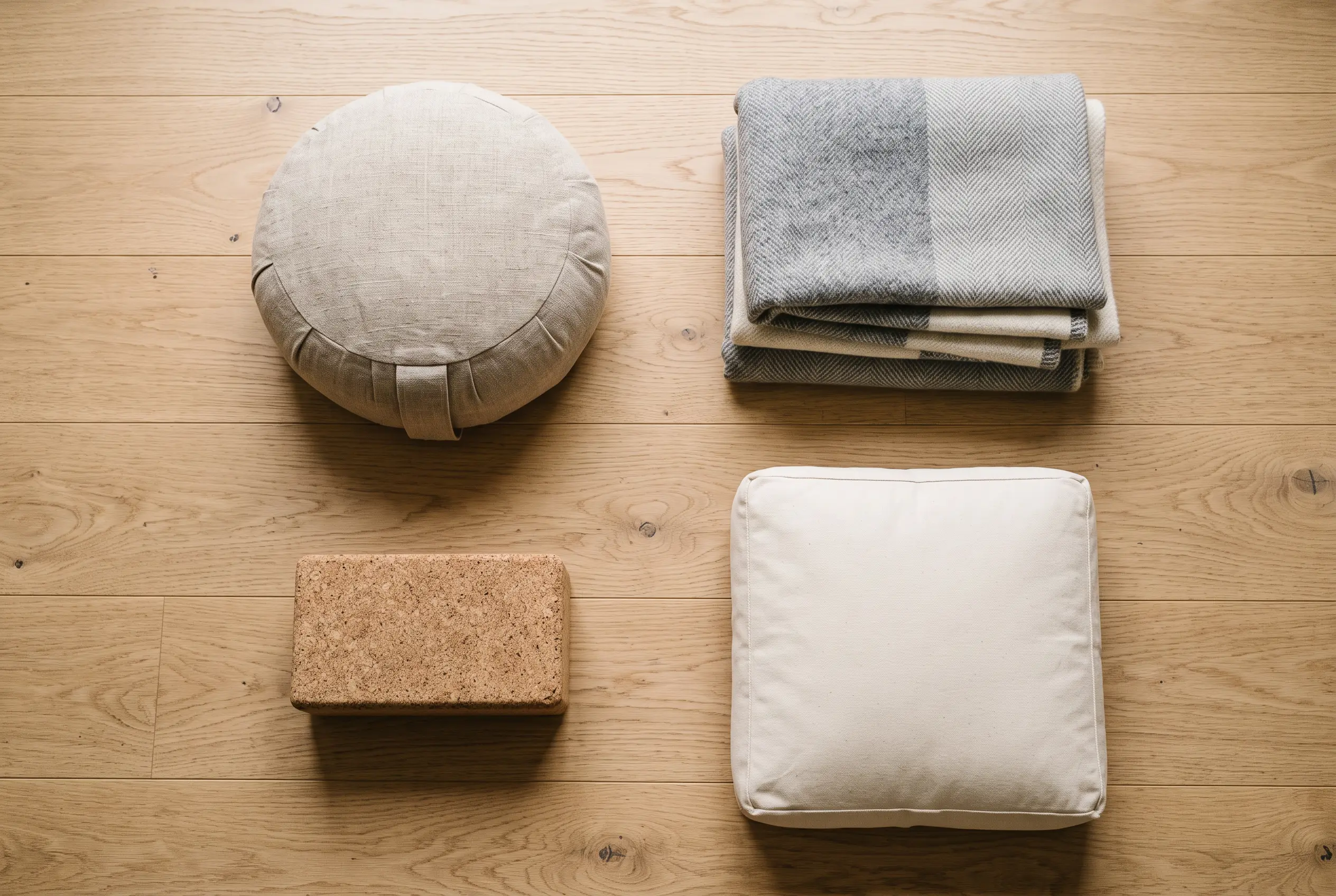
No, you don’t need a meditation cushion to start meditating at home. A chair or a folded blanket works for short sessions.
A meditation cushion, often called a zafu (ZAH-foo), is a round or crescent-shaped cushion that lifts your hips above your knees when you sit on the floor.
Here is what the evidence says. A 2018 pilot study with 31 volunteers tested three seats: a chair, a zafu, and a meditation bench. The researchers concluded that all three suit short sitting sessions. The zafu allowed fewer postural changes, so people shifted less. It was a small study, so treat it as a hint, not a verdict. The NHS agrees that a cushion is optional, noting that some people find one helps them sit upright.
What does a meditation cushion actually do?
A meditation cushion tilts your pelvis forward and lifts your hips above your knees. This makes an upright spine easier to hold. It can also reduce leg numbness and back rounding on the floor. Many people find that seeing the cushion works as a daily reminder to sit.
When is a meditation cushion worth buying?
A meditation cushion is worth buying when you sit on the floor for more than about 10 minutes and feel discomfort. Look for these five signs:
- You prefer to sit on the floor.
- Your sessions often run longer than 10 minutes.
- Your knees float above your hips when you sit cross-legged.
- Your lower back rounds or aches.
- Your legs go numb.
If none of these fit, keep using your chair.
Is a meditation cushion worth the money?
A meditation cushion is worth the money only if it solves a problem you actually have. Many quality zafus cost roughly $70–$80 at specialist retailers, while a folded blanket costs nothing.
Spend the money after you have sat daily for two weeks and know the floor is where you want to be. At that point, the price buys comfort for longer sessions, not better meditation.
What can you use instead of a meditation cushion?
You can use a folded blanket, a firm pillow, a yoga block, or a sofa cushion instead of a meditation cushion. Each lifts your hips for free.
- Folded blanket: easy to adjust, so add or remove folds until your spine feels tall.
- Firm pillow or sofa cushion: works well for sessions under 10 minutes.
- Yoga block: stable and fixed in height.
- Yoga mat or rug: stands in for a zabuton, the flat mat that cushions your knees and ankles.
In summary, start with what you own. Upgrade only when a specific discomfort tells you to.
Cushion, Chair, Bench, or Bed: Which Meditation Seat Is Best for Beginners?
For most beginners, a sturdy chair is the best first meditation seat because it keeps your spine upright without needing flexible hips.
| Seat | Best for | Watch out for |
|---|---|---|
| Chair | Beginners, back or knee pain | Leaning back and slouching |
| Zafu cushion | Cross-legged floor sitting | Needs some hip flexibility |
| Meditation bench (seat about 6–8 in high) | Tight hips, kneeling | Ankle pressure on hard floors |
| Bed or lying down | Pain, body scans | Falling asleep |
Is it OK to meditate sitting in a chair?
Yes, it is fine to meditate in a chair. Put both feet flat on the floor and sit slightly forward from the backrest. Choose a chair that supports you so you don’t sink into it.
Can you meditate lying down or in bed?
Yes, you can meditate lying down, especially for body scans or when sitting hurts. The trade-off is that you will fall asleep more easily. When you want to stay alert, sit up against the headboard instead.
How Do You Choose the Right Meditation Cushion?
Choose a meditation cushion by height first: it should lift your hips so your knees rest lower than your hips. For most adults, that means roughly 4–9 inches, depending on body height.
| Your height | Suggested cushion height |
|---|---|
| 5’0″–5’6″ | 4–5 in |
| 5’6″–6’0″ | 6–7 in |
| Over 6’0″ | 8–9 in |
These ranges come from cushion retailers, so use them as starting points. Test the height first with folded blankets. Stack them until your spine feels tall and your knees feel light, then measure the stack.
Zafu or zabuton: do you need both?
You need only a zafu to start. A zafu supports your hips. A zabuton is a flat mat, about 30 by 28 inches, that cushions your knees and ankles. Buy the one that solves the first discomfort you notice.
Buckwheat or kapok: which fill is better?
Buckwheat hulls are a good first choice because they are firm and adjustable. You can remove some hulls to lower the height. Kapok, a soft plant fiber, is lighter and gentler but tends to flatten sooner. Foam is the budget option.
If you reach that point, the meditation collection at ShaoLinStore is a good place to compare options. Start with one zafu. Add a zabuton only if your knees complain.
How Do You Set Up a Meditation Space at Home (Even in a Small Apartment)?
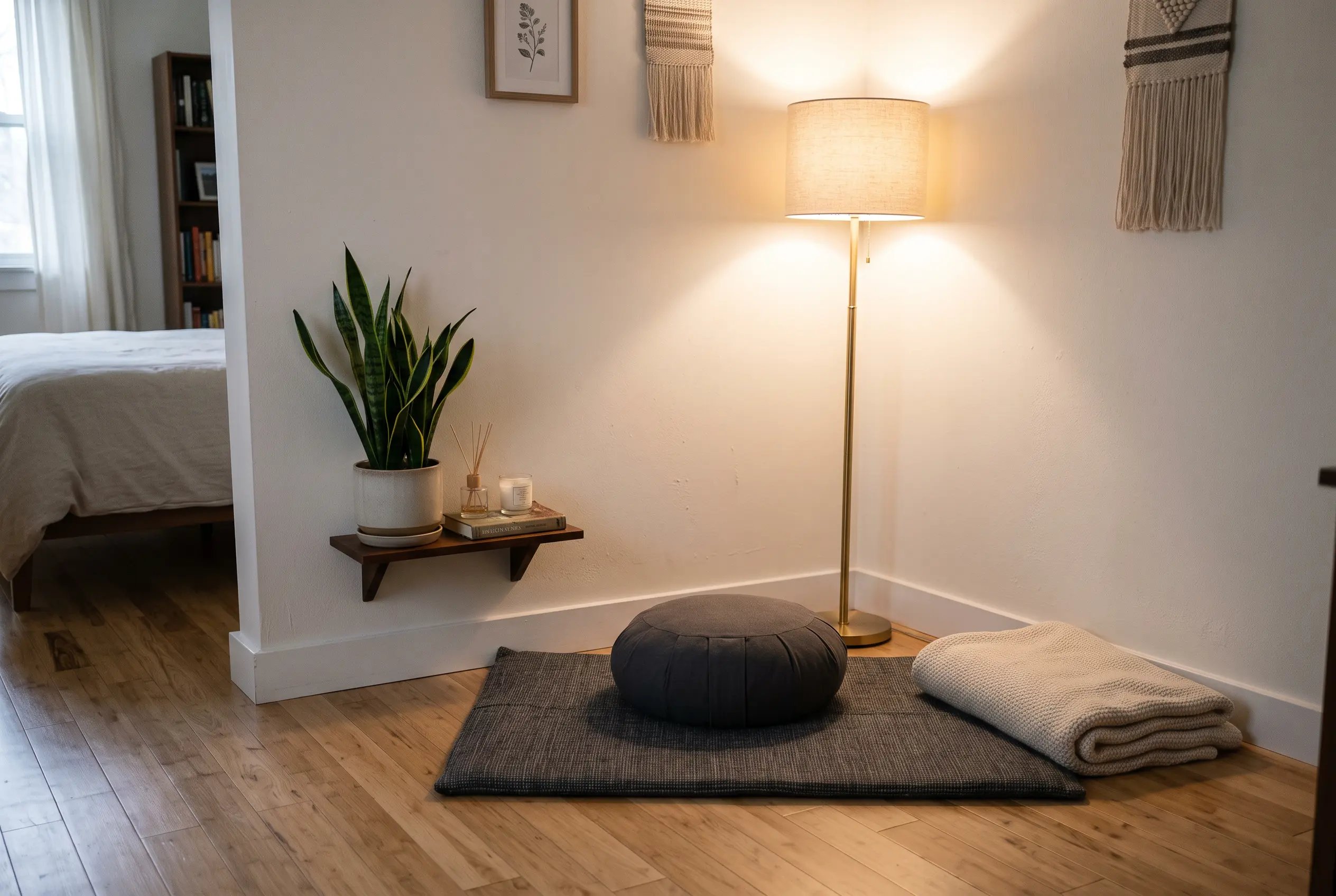
The best meditation space at home is the quietest spot you can return to every day. One corner and one chair are enough.
- Use the same spot each day. Your brain learns that this place means “sit.”
- Silence your phone. Use silent or airplane mode before the timer starts.
- Keep it simple. A cleared corner beats a perfect shrine.
- Small apartment? Use a bedroom corner, or store a folded blanket under the bed.
- Noisy home? Make the sounds your anchor, or practice before others wake up.
Do you need incense, music, or candles?
No, you don’t need incense, music, or candles to meditate at home. They are optional extras, and strong scents or busy playlists can pull your attention away from the breath. If you like a little atmosphere, choose one simple cue, such as soft light or quiet nature sounds, and keep it the same every day.
You don’t need perfect silence. Total quiet can even feel overwhelming at first. Setup should take under one minute, or you won’t keep doing it.
What Mistakes Do Beginners Make When They Start Meditating at Home?
The most common beginner mistake is thinking a wandering mind means failure. Noticing and returning is the skill you are training.
| Mistake | Why it hurts | Quick fix |
|---|---|---|
| Trying to empty your mind | You feel like you’re failing | Count each return as one rep |
| Starting with 20–30 minutes | You burn out and quit | Start at 3–10 minutes |
| Forcing a full lotus pose | It can strain your knees | Use a chair or a raised seat |
| Buying gear first | You delay starting | Use household items for 2 weeks |
| Meditating while lying down and tired | You fall asleep | Sit upright or move to an earlier time |
What should you do if you feel sleepy or restless?
If you feel sleepy, sit up straighter, open your eyes softly, or move your session to the morning. If you feel restless, try walking meditation for a few minutes, then sit again. Both reactions are normal. They tell you what your body needs, not that you are doing it wrong.
One safety note. Meditation is usually considered low-risk, but the U.S. National Center for Complementary and Integrative Health notes that some people have negative experiences. If a session leaves you distressed, or you have pain that doesn’t ease, stop and talk to a health professional.
❓ Frequently Asked Questions
Yes. A chair, a firm pillow, a folded blanket, or a yoga block all work for short sessions. A 2018 pilot study found that chairs, benches, and zafus all suit short sitting meditations.
Start with 5–10 minutes a day and add a minute or two each week. In a 2019 trial, 13 minutes a day improved mood and attention after 8 weeks, but not after 4.
Yes, especially for body scans or when sitting hurts. You may fall asleep more easily, so sit up against the headboard when you want to stay alert.
Either works. Closed eyes cut visual distraction. A soft, half-open gaze toward the floor helps if you feel sleepy.
Pick a height that keeps your knees below your hips. Retailer guides suggest about 4–5 inches if you are 5’0″–5’6″, 6–7 inches for 5’6″–6’0″, and 8–9 inches above 6’0″.
Your Home Meditation Practice Starts Today
Your home meditation practice starts with the next 5 minutes, not the next purchase. Sit in a chair, set a timer, and follow your breath. Do that daily for two weeks.
If you then find yourself sitting on the floor for 10+ minutes while your knees or back complain, that is the moment a meditation cushion earns its place. ShaoLinStore will be here when you are ready.
📚 References
- Beginner meditation steps and equipment: The NHS guide covers session length, seating, and handling a wandering mind. NHS Every Mind Matters, “How to meditate for beginners”
- 13-minute daily trial: A randomized study of 42 new meditators showing benefits at 8 weeks but not 4. PubMed, Basso et al. (2019), Behavioural Brain Research
- Chair, zafu, and bench comparison: A 31-person pilot study of seats for short sitting meditation. PubMed Central, Rodriguez et al. (2018), Journal of Healthcare Engineering
- Starting length and seat basics: A beginner guide recommending five or ten minutes and a stable seat. Mindful.org, “Mindfulness Meditation: How to Do It”
- Safety and evidence overview: A U.S. government summary of what science says about meditation, including low risks. NCCIH, “8 Things to Know About Meditation and Mindfulness”