
Torn between a $60 hand-hammered bronze bowl and a $300 quartz bowl? This guide compares Tibetan and crystal singing bowls on sound, price, durability and meditation fit, so you buy once and keep playing it.
At ShaoLin Store, we sell handcrafted metal singing bowls and we do not sell crystal ones. That means we have no reason to push crystal, and we will say plainly when it is the better buy.
Tibetan singing bowls are hand-hammered bronze bowls with warm, layered overtones. Crystal singing bowls are fused 99.9% pure quartz with a clean, long-sustaining tone. Metal bowls usually cost $50-$500+ and survive drops. Crystal bowls run $100-$1,000+ and suit exact-note work and large sound baths, but they crack more easily.
| Feature | Tibetan (metal) bowl | Crystal (quartz) bowl |
|---|---|---|
| Material | Hand-hammered bronze (copper and tin) | 99.9% pure fused quartz |
| Sound | Warm, layered overtones with a slow “wobble” | Clean, pure tone with few overtones |
| Sustain | Shorter, rich in overtones | Long, fills the room |
| Tuning | Often within about ±8 Hz of the target note | Made to exact notes, such as C at 256 or 261 Hz |
| Price (USD) | $50-$500+ | $100-$1,000+ |
| Durability | Dents or scuffs, survives drops | Can crack or shatter if struck hard or dropped |
| Weight | Sellers disagree, so check each listed weight | Sellers disagree, and the bowl is bulky and needs a case |
| Learning curve | Forgiving for beginners | Needs a lighter, more careful touch |
| Best for | First bowl, home practice, travel | Group sound baths, exact notes, large rooms |
| Care | Keep dry, store on cloth or foam | Padded case and O-ring, keep off hard floors |
Please note: Singing bowls are a relaxation and meditation aid, not a medical treatment. Talk to your doctor about any health condition.
Bronze vs Quartz: What Really Separates These Two Instruments?
Metal and quartz vibrate differently, and that single fact explains almost every difference you will hear, feel and pay for.
What is the main difference between a crystal and a Tibetan singing bowl?
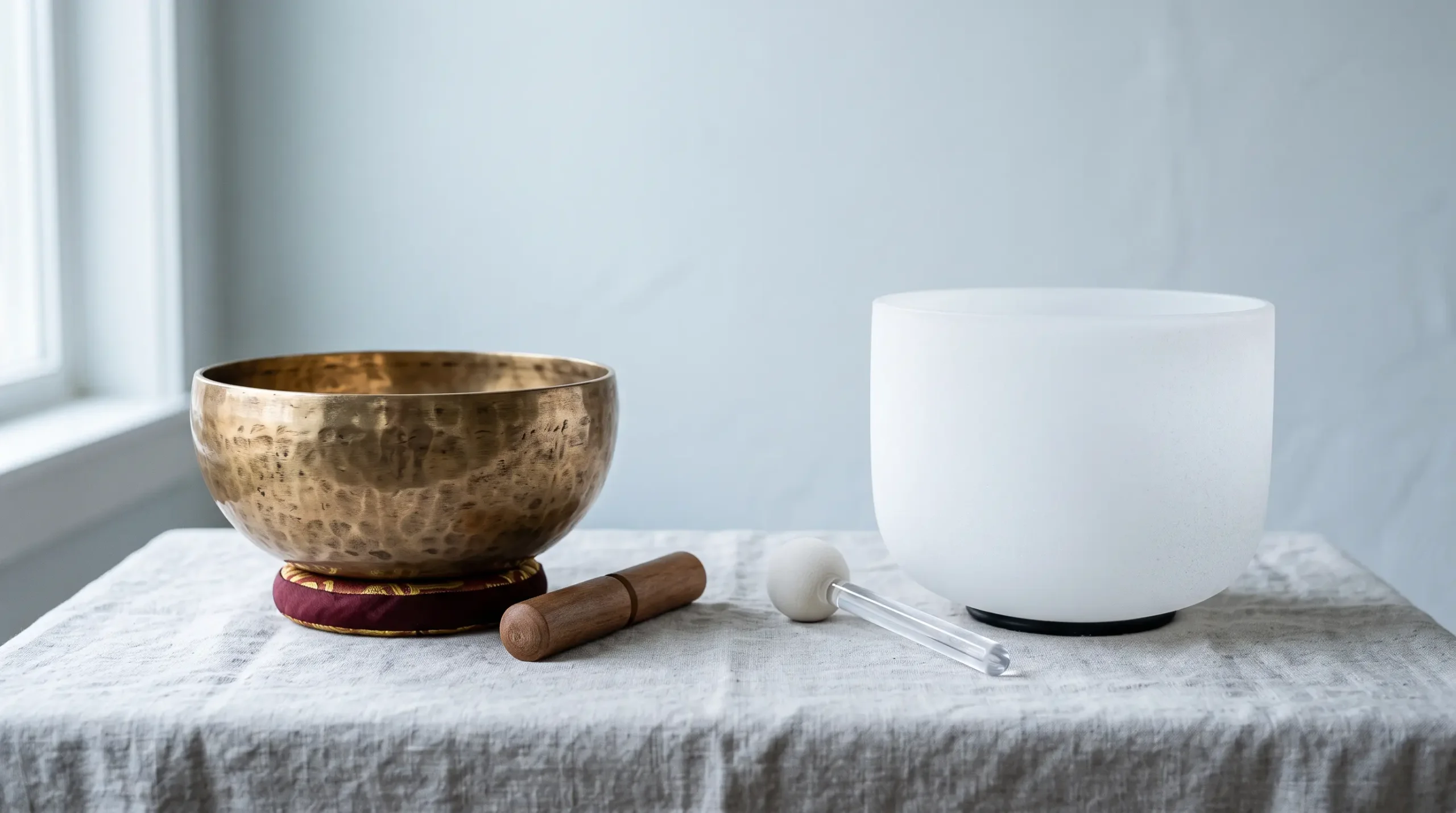
A Tibetan bowl is hand-hammered from bronze, traditionally copper and tin, while a crystal bowl is quartz sand fused into shape. Metal bowls come from Himalayan metalworking traditions. Crystal bowls are a modern instrument that spread widely in the 1990s.
Bronze (also called bell metal) is a copper and tin alloy. Some sellers describe a seven-metal recipe for Tibetan bowls. Treat that as tradition, not a verified formula. Quartz bowls come in two finishes: frosted (matte and sandblasted) and clear (glossy and transparent).
Layered Overtones vs a Pure, Long Sustain
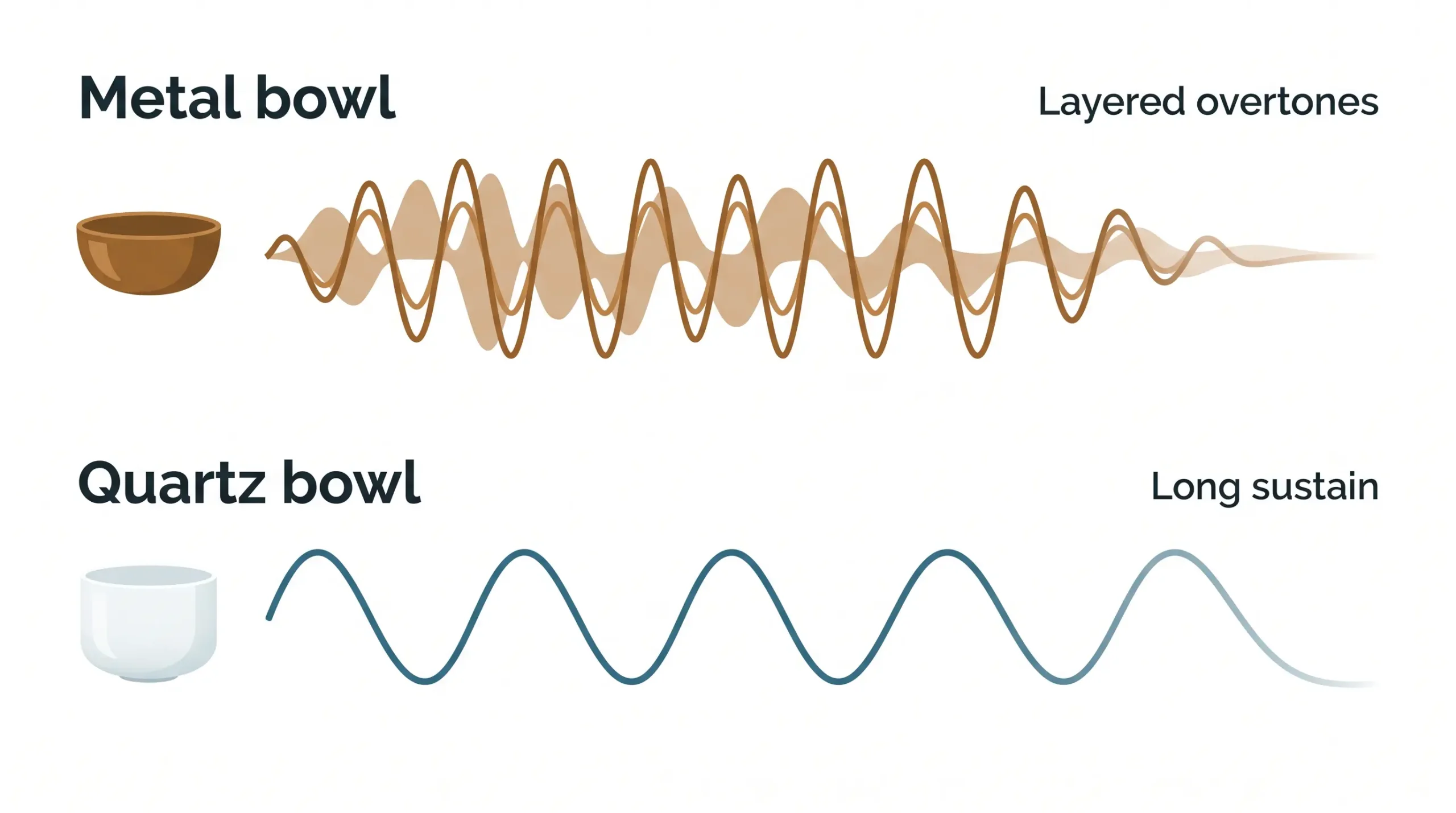
Metal bowls stack overtones, the extra tones above the main note, while quartz bowls favor a long sustain, the time a tone keeps ringing. Strike a metal bowl and you hear several tones at once, pulsing against each other in a slow wobble. Rim a quartz bowl and one clean tone swells until it fills the room.
Metal tends to sound close and physical. Quartz tends to sound spread around you. One 14-bowl spectral analysis from Alchemy Sound Studio counted 2-3 frequency partials in a frosted quartz bowl and 10-12 in an alchemy bowl.
Want to start with the metal side? Browse our handcrafted metal singing bowls.
Tuning Precision: ±8 Hz vs Note-Specific Bowls
Handmade metal bowls often land within about ±8 Hz of a target note, while crystal bowls are made to specific notes. A quartz C bowl sits at 256 or 261 Hz. A G bowl sits at 384 or 392 Hz.
For solo meditation, a few hertz rarely matters. It matters when you build a matched set or play alongside other instruments. In that case, exact tuning is worth paying for.
Why Are Crystal Singing Bowls So Expensive? Real USD Price Ranges
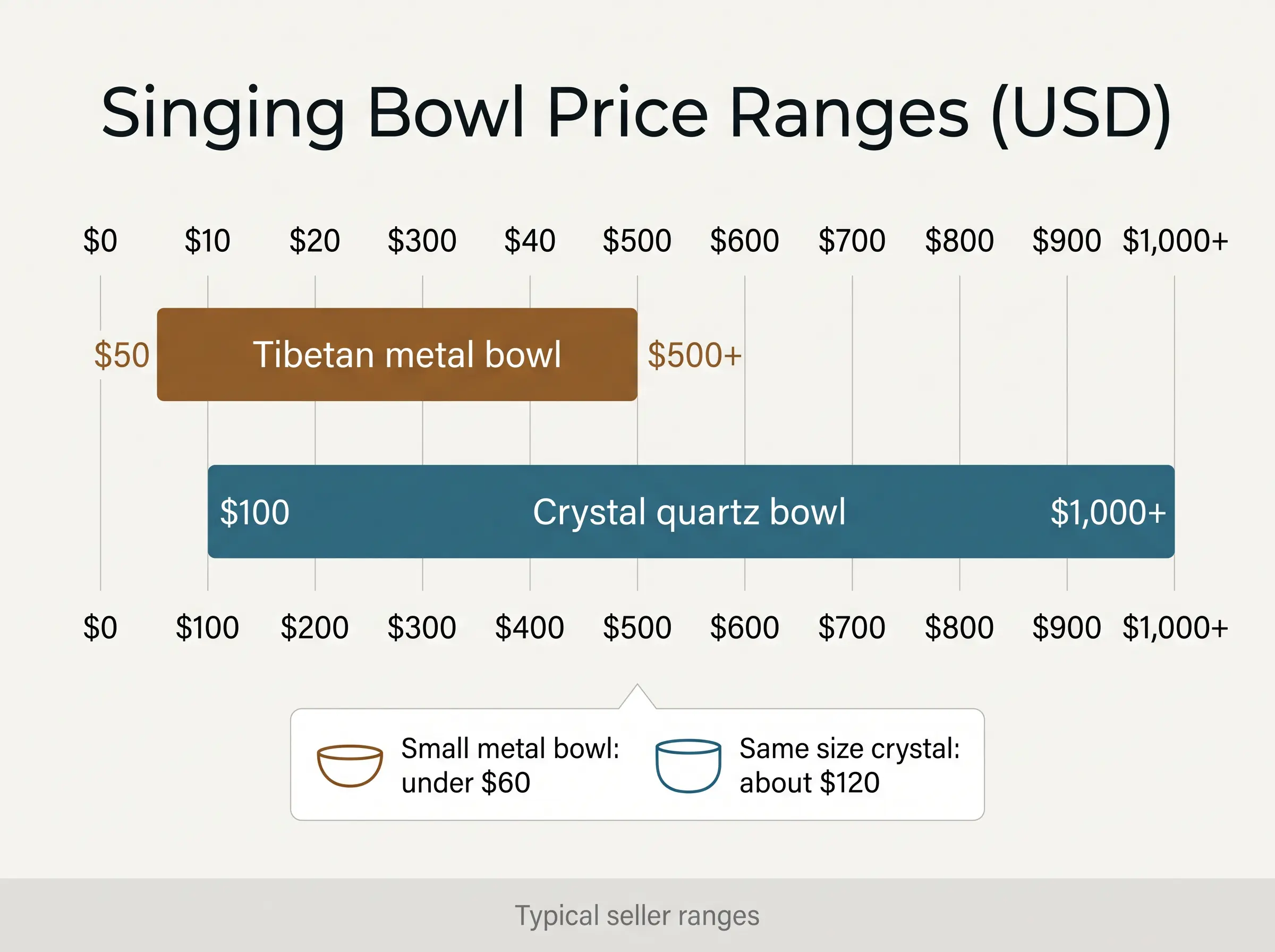
Crystal bowls cost more mainly because of high-purity quartz and precision manufacturing. Seller price guides list most metal bowls at about $50-$500+, while crystal bowls typically start near $100 and climb past $1,000.
What a First Metal Bowl Costs
A small hand-hammered metal bowl often costs under $60. One seller guide puts a crystal bowl of the same diameter at roughly $120.
Hand-hammered bowls cost more than cast or machine-pressed ones, because each takes more labor. Check the listed price on each product page before you compare.
A low entry price lowers your risk. You can find out whether you enjoy bowl meditation before you spend $300 on quartz.
Frosted, Clear and Alchemy: How Quartz Pricing Climbs
Frosted quartz is the entry point, clear quartz costs more, and alchemy bowls sit at the top. An alchemy bowl is quartz fused with metals or gemstones.
Frosted bowls are usually easier to afford and a little more forgiving. Clear bowls look striking but are more fragile. A higher price does not guarantee a tone you will like, so listen first.
Hidden Costs: Cases, Mallets and Cushions
The sticker price is not the full bill. Quartz is fragile, so a padded carrying case is not optional. Crystal bowls also need an O-ring and often a rubber-ball mallet.
Metal bowls usually ship with a wooden mallet and a ring cushion. Either type sounds better on a stable base and with a comfortable seat. If you need a seat for long sessions, browse meditation cushions for seated sound practice.
Durability, Weight and Care: What Owning Each One Is Really Like
If your bowl will live near kids, pets, hardwood floors or a gym bag, durability should drive your decision more than tone.
Are crystal singing bowls more fragile than Tibetan bowls?
Yes. Quartz is rigid, so a hard strike or a drop onto a hard floor can crack or shatter a crystal bowl, while a bronze bowl usually just dents or scuffs. Crystal bowls need a soft mallet and a light touch.
Frosted quartz is generally more durable than clear. Metal bowls handle travel, small rooms and busy households with far less worry.
Weight and Portability: Where Sources Disagree
Sellers disagree on weight. One guide calls crystal bowls lighter. Another measures them at two to three times the weight of a metal bowl of the same diameter. A third calls them lighter but bulky and fragile.
We have not weighed bowls side by side, so we will not pick a winner. Either way, a quartz bowl is bulky and needs a case. That keeps portability in metal’s favor.
Cleaning and Storage Basics
- Metal bowls: Wipe dry after handling to slow oxidation, and rest the bowl on cloth or foam.
- Crystal bowls: Store in the padded case, with the O-ring in place, and keep the case off the floor.
- Both types: Keep the bowl where you will actually play it, such as a meditation corner beside a solid copper Guanyin statue for your meditation altar.
Which One Fits Your Practice? A Buyer-Profile Verdict
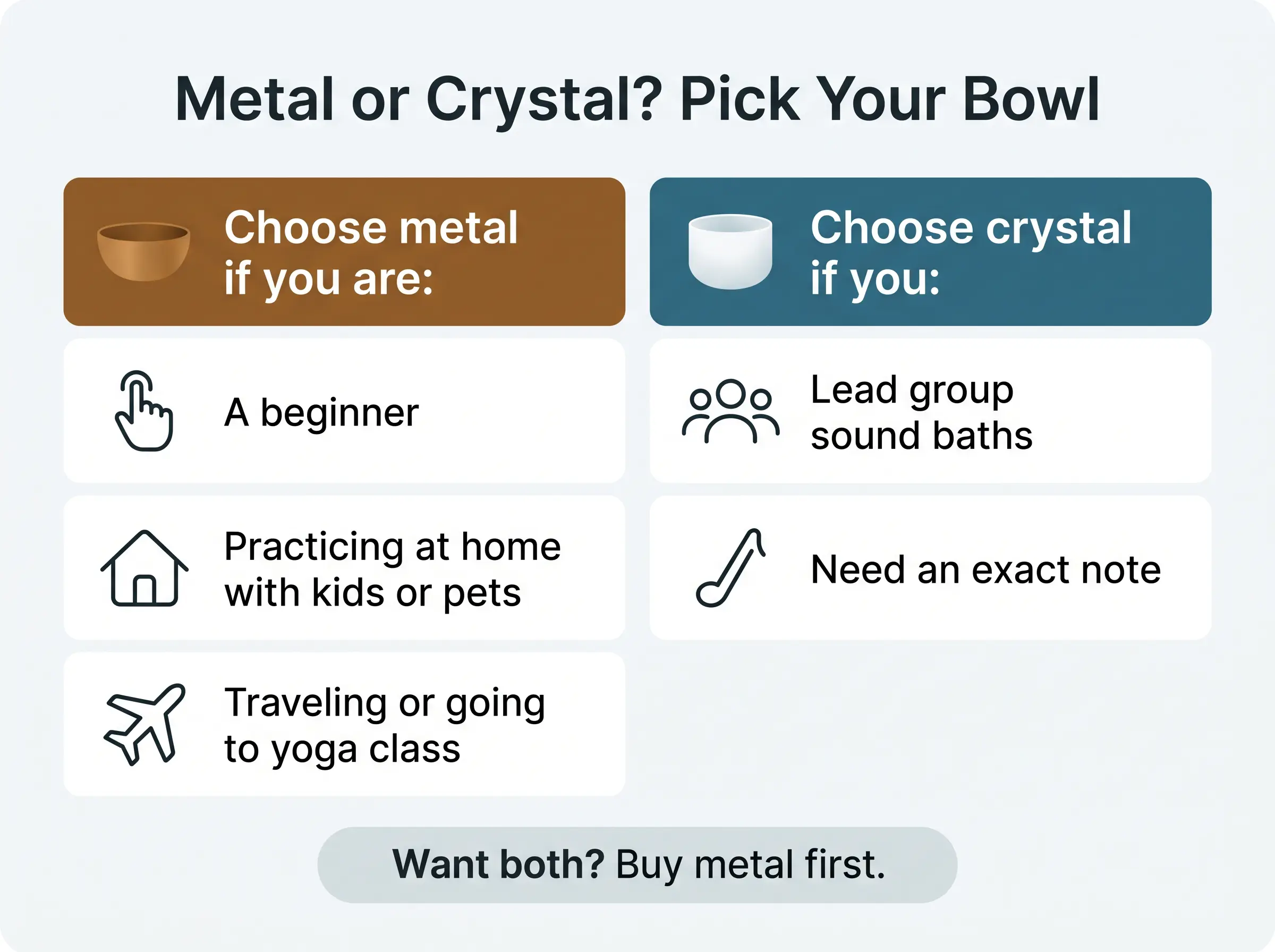
For most first-time buyers, start with a hand-hammered metal bowl. Choose crystal if you lead group sound baths or need one exact note.
- First bowl or tight budget: metal.
- Home practice with kids or pets: metal.
- Travel or yoga class: metal.
- Group sound baths or large rooms: crystal.
- Exact note or matched set: crystal.
- Both sounds: buy metal first, then add crystal.
Which type of singing bowl is better for beginners?
Metal bowls win for most beginners, because they are forgiving of rough technique. They cost less, survive mistakes and still sound good while you learn to strike and rim.
Feeling unsure about your first bowl is normal. One seller estimate puts metal at roughly one-fifth to one-tenth the price of quartz, so a wrong guess costs far less.
If you still want crystal first, a frosted bowl is the safer starting point.
Starting out? Pair your first bowl with a supportive meditation cushion so practice feels comfortable from day one.
Body-Focused Meditation vs Open-Awareness Practice
If your practice centers on breath and body sensation, metal’s layered tone may feel grounding. If you rest in open, spacious awareness, quartz’s long sustain may suit you better. Many practitioners report this split, though it is a matter of taste, not a rule.
Listening preference matters more than any spec on the page. Browse handcrafted meditation tools for a daily practice, and pick the sound you enjoy hearing. The tool you enjoy is the one you will use.
Group Sound Baths and Large Rooms
For a room of 20 people, crystal’s far-reaching sustain does more work per strike. For one-on-one sessions or close-to-body listening, metal’s vibration is easier to feel.
That split, near-field for metal and far-field for quartz, is the reason many sound bath leaders own both.
Can I use a crystal and a Tibetan singing bowl in the same session?
Yes. Many practitioners open with a metal bowl to ground the room, move to crystal for long sustained tones, and close with metal again. The contrast keeps the session varied.
On a limited budget, buy the metal bowl first. You can add quartz later, once you know which tones you reach for.
How to Test a Bowl Before You Buy
Your ears are the best spec sheet: strike the bowl, rim it, and time the sustain before you pay.
The 60-Second Listening Test
- Strike once with a padded mallet and start a timer.
- Count the seconds until the tone fades. Longer sustain means a more open, ringing bowl.
- Rim the bowl slowly for 10-15 seconds and listen for a steady tone, not a rattle.
- Listen up close for buzzing or an uneven pulse that sounds like a flaw.
- Online? Ask the seller for a recording of the exact bowl you will receive.
Signs of a Genuinely Hand-Hammered Metal Bowl
Look for visible, irregular hammer marks, slight asymmetry and a rich mix of overtones. Machine-made bowls tend to look uniform and sound simpler.
Marks alone do not prove a bowl is handmade, so combine the look with the sound test. For quartz, ask the seller to confirm the 99.9% purity claim and the exact note.
What to Ask a Seller
Before you buy online, ask three questions. Can I hear this exact bowl? What is included, such as a mallet, cushion or case? What is the return window?
This is a real purchase, so ask before you commit. At ShaoLin Store, every order ships free, U.S. delivery takes 5-10 business days, and you can return an item within 60 days of purchase. If the tone is not right for you, you can send it back.
Do Singing Bowls Actually Help? What the Research Says
Early research is encouraging but limited: in a 2017 observational study of 62 adults, one hour of singing bowl meditation was followed by lower tension, anger, fatigue and depressed mood.
The Goldsby Study: 62 Adults, One Hour
Researchers at UC San Diego measured mood before and after a 60-minute sound meditation. Tension, anger, fatigue and depressed mood all dropped (P<.001). People new to this kind of meditation showed a significantly larger drop in tension (P<.001).
The session used several bowls and other instruments, so the effect cannot be pinned on one bowl type.
What the Evidence Can’t Tell You Yet
The study had no control group, so it cannot prove the bowls caused the change. A 2020 systematic review by Stanhope and Weinstein found only four peer-reviewed studies and judged the evidence too thin to recommend singing bowl therapies. A 2025 review of 14 quantitative studies noted small samples and method limits.
A registered trial from the University of Waikato compares quartz bowl music with guided relaxation. It is listed as completed, but we found no published results, so we do not cite any. The studies we reviewed do not compare metal and crystal bowls directly, so research cannot tell you which type to buy.
Important note: Singing bowls are a relaxation and meditation aid, not a medical treatment. Claims about chakras or energy are traditional beliefs, not tested outcomes. Talk to your doctor about any health condition.
The bottom line is simple. Choose a hand-hammered metal bowl if you are a beginner, on a budget, or practicing at home. Choose crystal if you lead group sound baths or need exact notes. Want both? Buy metal first and add crystal later.
When you are ready, ShaoLin Store ships every order free, and you have 60 days to return it if the tone is not right for you.
Ready to choose your first bowl?
Browse handcrafted singing bowls for daily meditation, with free shipping on every order and 60 days to return.Shop handcrafted singing bowls
Singing Bowl FAQ
Many sellers advise against it. Water can change the tone and make a quartz bowl slippery, which raises the risk of a crack. If you want to experiment with water, use a sturdy metal bowl instead.
A 5-6 in (13-15 cm) hand-hammered metal bowl is a comfortable start. It is large enough for good sustain and small enough to hold in your palm. If you go crystal, an 8 in (20 cm) frosted bowl is a common first pick.
They can be, if you love their pure, room-filling tone and have a safe place to store them. If you are not sure yet, start with a metal bowl and add crystal later.
Yes. A ring cushion keeps the bowl stable so it rings freely, and the right mallet makes a clean tone easier. Browse ShaoLin Store’s meditation cushions to set up a comfortable seat for your first session.
📚 References
- Singing bowl sound meditation and mood: Goldsby TL, Goldsby ME, McWalters M, Mills PJ. “Effects of Singing Bowl Sound Meditation on Mood, Tension, and Well-being: An Observational Study.” Journal of Evidence-Based Complementary & Alternative Medicine, 2017;22(3):401-406. PubMed (PMID 27694559)
- Tibetan singing bowl systematic review: Lin F-W, Yang Y-H, Wang J-Y. “Effects of Tibetan Singing Bowl Intervention on Psychological and Physiological Health in Adults: A Systematic Review.” Healthcare, 2025;13(16):2002. PubMed Central (PMC12385955)
- Registered quartz bowl trial: University of Waikato, “The Effects of Quartz Crystal Singing Bowl Music and Guided Relaxation on Mood and Sleep in Rangatahi (Young Adults),” listed as completed, no results cited. ClinicalTrials.gov (NCT07267520)
- Earlier systematic review of singing bowl therapies: Stanhope J, Weinstein P. Complementary Therapies in Medicine, 2020;51:102412. Found only four peer-reviewed studies. Source: Complementary Therapies in Medicine (Readers may search the journal’s website or PubMed for this article.)